History as Literature, Literature as History

Lost Names: Scenes From A Korean Boyhood

History as Literature, Literature as History: An Interview with Lost Names Author, Richard E. Kim

Lost Names is a useful, rare, and wonderful book for several reasons. The book’s title reflects the Japanese Pacific War policy of forcing Koreans to replace their own names with Japanese ones. Lost Names is the story, as recounted by a young boy, of one Korean family’s experience during the war years. Although Lost Names is technically a novel, according to author Richard Kim, ” . . . all the characters and events described in the book are real, but everything else is fiction.” Never in my time in Asian Studies has one work been so applicable to such a wide range of students as is the case with Lost Names.

In the pages that follow, we feature an interview by EAA editorial board member Kathy Masalski with Richard E. Kim and essays by a junior high, senior high school, and university instructor on how they have used Lost Names as a highly effective teaching tool. We sincerely hope this special feature encourages teachers at all levels to read Lost Names and consider using it with students.

Lucien Ellington

Lost Names

Kathleen Woods Masalski
Kathleen Woods Masalski — I first met Richard Kim in 1994 when I asked him to speak at a National Endowment for the Humanities summer institute on the War in the Pacific. The audience responded so well that I invited him to speak at several other summer institutes sponsored by the Five College Center for East Asian Studies. After reading Peter Wright’s, Susan Mastro’s, and Dick Minear’s essays about their teaching of Lost Names, I asked Lucien if he would be interested in an interview with Kim. Lucien had read the book and read the essays (Kim did not ask to see them before publication), and urged me to proceed. Kim agreed to get together with me on May 18 in Amherst, Massachusetts.

I presented him with a list of questions that I had prepared. The interview lasted three hours; I took copious notes and wrote them up immediately afterward. Although I suggested that he edit the final interview, Kim declined. What follows are selected passages from our discussion that afternoon.

I should note that I approach Lost Names as history, and my questions reflect my background as a history teacher. An English teacher would have asked different questions. Lost Names is first and foremost creative writing. Social studies teachers may well wish to introduce the book to their colleagues in the English or Language Arts departments.

Masalski: One question the audience always has about Lost Names is whether it is fiction or nonfiction. Do you really intend to tell readers that nothing in Lost Names is “factual” or “historical”? How much of what is in it actually happened? How much actually happened to you?

Kim: Everything in the book actually happened. It happened to me. So why am I always insisting it’s not autobiographical? I think because of the way I used the things that actually happened. You have to arrange them, mix them up. Above all, it’s interpretation of facts, of actual events—some thirty or forty years later. For example, when “the boy” gets beaten, what went through his mind? We don’t know. . . . even I don’t know. I like to separate the actual events from the emotional, the psychological. One shouldn’t confuse the actual events with the inner events. That’s where a lot of beginning writers make a big mistake. A lot think everything is exactly as it happened; but we put our own interpretation on events. I didn’t invent any actual events. . . . but everything else is fiction. That is very important to me.
Richard Kim

Masalski: When you wrote the book in 1970, how did you go about gathering evidence? Or didn’t you?

Kim: I didn’t have to gather much. I made a chronology of actual political events and a chronology of events in my life. Then I rearranged . . . I had to rearrange the events in my life. I think that the private events happened at the time [I described them] . . . but maybe not. The big world events happened . . . [the question was] how to bring them together . . . .
The original plan for this book was different from what it turned out to be. Praeger planned a series of books on different countries, Japan, China, India, Korea, etc. to introduce these countries to American children. I decided to introduce Korea through family life. As soon as I started writing, the book took on a different life. I called my editor and said, “I can’t do it the way it was planned.” She said, “What is your idea for the book?” and I said I didn’t know. She said, “Let it loose, let it go.” I had already listed many details, for example, what we typically ate for breakfast, because I was using that information to introduce what Koreans eat. When I finished writing (it took me only three months), we took a look at the manuscript. It was not what the editors had in mind, but they liked it. They took the work out of the country series and decided to publish it separately. But, they wondered, how should they treat it? They sent the manuscript to Pearl Buck, and she praised it as a novel. But Praeger didn’t want a novel. So they convinced her to call it something else. [She called it “the best piece of creative writing I have read about Korea.”] So Praeger decided to just get it out . . . to let others decide. And the reviews were good. [Edward] Seidensticker reviewed it for the New York Times and Praeger breathed a sigh of relief.

Masalski: You were a boy of thirteen or fourteen when the book—and the war—ended. What do you remember of your feelings then? Now, fifty-plus years later, how have your feelings changed?

Kim: I don’t feel differently about things today. I feel the same as when they happened. My father was in a detention camp, so I didn’t jump up and down for joy. Rather, I felt that finally it’s happened. Something that should have happened happened.
I didn’t have feelings of hatred for the Japanese. My feelings were more of contempt. I despised, had contempt for [them]. . . . In a perverse sort of way, I had a feeling of superiority. It was a defense mechanism to think, “Forgive them, Lord, for they know not what they do.” This may be a cultural, a class thing. I felt the Japanese were not to be trusted or respected. It might have been different in Seoul, but not in my small town. The Japanese we dealt with were not very good. After all, who would go to a dinky town, a dinky province, if they had a choice?
I [didn’t] think of the Korean characters as saintly, but as ordinary. In those days there was no room for cynicism. Everything seemed clear cut. We knew where we were and where we stood. Today is different; I don’t know where I stand. I don’t know what to think. . . . in those days I knew. Them and us. Cynicism comes from self-doubt. There was no room for that sort of thing.
When the Japanese priest and his wife [who lived nearby] came [when the end of the war was announced] and begged that we protect them, my grandfather didn’t know what to do. . . . I didn’t know what to do. . . . We went back to the source of authority. . . . do what your father would have done. The tenant farmer, too, kept telling me that my father would have protected them. . . .
Actually, my father was a saint. I wrote an inscription on his gravestone, “He was a good man and just.” He was like that—truly. I never heard him say anything bad about anyone. I never saw him enraged. I’m not like him. . . . He had a great capacity for suppressing his feelings; he was patient.
If I had been exposed to constant hatred at home, maybe I would have felt differently about Japan and the Japanese. But I wasn’t. Grandfather never said much. And I never heard my father say nasty things verbally. We thought, they’re bad ones. . . . so why should we waste our time talking about them. . . .

If the Japanese had been victorious, if the war had lasted another four or five years, maybe most Koreans would have become “Japanized.”

Masalski: What difference to Lost Names does it make that you and your family were well-to-do and Christian?

Kim: This is a very important question. We were upper-middle class, the town’s elite. The Japanese who were there were not. We saw them as men who couldn’t get jobs in Tokyo. “Why are they here?” we asked ourselves. As colonizers, they were supposed to be better than the colonized, but a lot of Japanese were simply not that great. It’s a cultural, a class thing. I didn’t hate them. They were like dangerous dogs to be avoided.
Although we were not that wealthy, we were reasonably well-to-do. In those days we were made to look upper class because we went to college. The Christian thing is tricky. I’ve been thinking about it. Some really well-to-do Koreans, especially in the South—even among my generation—sometimes the Japanese treated them like upper class, with kid gloves. Made them feel better, like the aristocracy, the ruling class, the landlord class. Made them feel as if they were treated with respect. To this day I know people with backgrounds like this who are without anti-Japanese feelings.
The lower classes—what did they care if they were governed by the Japanese or a Korean dynasty? They were treated the same. My grandfather told me that one time, when he witnessed royalty passing by, he saw someone miserably beaten because he didn’t bow low enough. And he (my grandfather) felt that when the dynasty perished, well, it served the royalty right.
I don’t know how much of a sense of nationalism existed at the time of Japanese annexation. As long as the upper classes kept their money and status, and as long as the Japanese left them alone, what difference did it make? And what difference did it make to the peasants—both Korean royalty and the Japanese took eighty percent of their crops, regardless. If the Japanese had been victorious, if the war had lasted another four or five years, maybe most Koreans would have become “Japanized.”
I think it was the middle class, the upper-middle class who were affected most by the war. That group produced more educated people, those with expanded consciousness.
To the Japanese, the Christians were the ones with the most connections with the West—simply because they were Christians. They were therefore characterized as outsiders, as dangerous. They were an important minority because they were upper-middle class. They sent their sons to schools and colleges. So as a group they were more conscious of national identity. I don’t think the upper or lower classes thought about nationalism or independence, but I really don’t know. The early uprisings were not organized by the upper classes. In those days [during the war], memories were fresh. Twenty–thirty years later, I don’t know. . . .
Belonging to that class and being Christian made all the difference. We were more aware of where we belonged. I grew up thinking we were a little different. Lost Names would be a different book if it were written by someone else at the same time but in a different class and in a different place.
The book is not representative of “the Korean experience.” I was a marked boy. Somehow the village had voted me most likely to succeed, because I was my father’s son. My grandfather, the minister, was one of the best-known leaders of the Christian community. Most Christians knew my grandfather’s name. The first day back in a Korean school, things were very tense for me. My parents wondered, how would he (I) be received—both by the Japanese and the town’s kids. I always had to be conscious of what I was. The key was “do not disgrace the family.”

One exception I take is to anyone who says it’s (Lost Names) anti-Japanese. It’s not; there are some bad Japanese characters in the book, but it is not anti-Japanese.

Masalski: In your opinion, has the Japanese government apologized to the Korean people for its treatment of them during the occupation period?

Kim: I’m not so sure they’ve apologized. Regret, maybe. But that’s beside the point. I don’t really care if any government apologizes. It’s probably a political thing, anyway. It seems to me that Asians are less capable than Europeans of accepting collective responsibility for their actions. Maybe the Judeo-Christian culture has more possibilities for atonement and redemption. Not so true for Asians. Why is it so difficult for Asians or Koreans to say we are all guilty? We tend to say, “I didn’t do it.”

Masalski: The title of the book is problematic—in all three languages. Why did you choose it? What was your intent?

Kim: I loved the word “lost” and all the things that it conjures up, especially in English. Paradise Lost. Lost is almost damned. . . . almost sinful. Lost Souls (which was at one point my working title). I like “lost” because it has a lot to do with my sense of my generation. Kind of like I am now. I don’t belong. Born in Korea. Moved to Manchuria. Back to the north [Korea]. Then to South Korea. Didn’t belong either place. Then to the military, where I didn’t belong. To here. For awhile I thought about it, then I gave up thinking about it, for it’s not important. Especially my generation of Koreans happened to be between periods. . . . Japanese occupation . . . a little of that . . . then the country was divided. . . . then exodus . . . lost again. Led a refugee’s life . . . lost again . . . then ended up here in god-forsaken Shutesbury with a name like Richard. . . .
My college dean in this country thought that other students would have difficulty pronouncing my Korean name, so we looked at names in a telephone book. I chose Richard because I knew of Richard the Lion-Hearted. I finally had it legalized. I like to think it fits with my character . . . it’s how I think of myself. I’m lost, lost between two cultures, two worlds, neither North or South Korea, not Korean or American. I felt that way always, even as a little kid. I couldn’t even sing Korean songs. . . .
This has been one of my missions in life, to teach Koreans to accept responsibility for their lives, to stop blaming others, the Japanese, the Chinese. We lost it. . . . but many Koreans would like to think someone grabbed it. . . . thinking this justifies hatred. I’ve often said that Koreans need a national psychotherapy session, a large couch. Why are we as we are, why is self-examination such a rare commodity in Korean life? Koreans are so good about blaming others . . . they know so little about what they have done. They lack a collective sense of guilt or action.
Koreans can’t say we were careless, we dropped our names, and someone else picked them up and took them away. What the Japanese did was terrible—perhaps more stupid than terrible. How can such smart people do such dumb things? Didn’t they see that what they did would cause more resentment?

Masalski: One of the most important scenes in the book takes place in a graveyard, where all your known ancestors are buried. You, your grandfather, and your father visit that burial ground after the Japanese have given you new names, Japanese names. Your grandfather says, “We are a disgrace to our family. We bring disgrace and humiliation to your name. How can you forgive us?” He and your father bow, their tears flowing (p. 111). . . . Will you explain that scene?

Kim: My father felt that his generation had failed. (Maybe that’s why there isn’t naked hatred of the Japanese.) The kind of man he was resulted in his asking, “What have we done? How could we have allowed this to happen?” I don’t think he blamed grandfather’s generation. My father had a perfect right to fly into a rage, but there was none of that. “The important thing,” my father said, “is now how can we deal with this? Someday your generation will forgive us.” Why otherwise would he have taken me to the graveyard where he and my grandfather asked their ancestors to forgive them? He was almost telling me that one day we would have to forgive his generation.

Masalski: Were you surprised by the book’s reception? By the way readers (then and now) interpret it? Is there a difference?

Kim: It has been a surprise. It’s especially a great honor to find it’s read in so many schools. I really feel good about that. I have no way of influencing how readers take it, however. One exception I take is to anyone who says it’s anti-Japanese. It’s not; there are some bad Japanese characters in the book, but it is not anti-Japanese.
I wrote it quickly—between books. I had some legal problems with my second book and decided to do something with the Praeger series. It started out as one thing and ended up another. So I was very surprised.

Masalski: When they finish reading Lost Names, how do you want readers to feel toward the characters and the countries represented?

Kim: When I wrote the book, I didn’t feel that I wanted the reader to feel this way or that. I really didn’t think about writing for a foreign audience. I never thought about any audience, in fact.

Masalski: What led to the rebirth of Lost Names? How much did the 50th anniversary of World War II have to do with it?

Kim: I was willing to let it go, but the time came when Asian studies programs here and there realized that there’s not enough material around. The talk was taken up on the Internet, and there you are. I don’t think it had anything to do with the anniversary of the war.

Masalski: What do you think the book has become?

Kim: I don’t know. A textbook. I’ll tell you . . . when The Martyred came out, the New York Times reviewer said it would last. . . . When I finished Lost Names, I didn’t think it was in the same class as The Martyred, but I said to my wife, Penny, this is an exquisite piece, a small jewel. Because that was how I felt. It was hard to find fault with the book. The technique, the language: granted that the author was biased, prejudiced . . . I felt it was nice, not grand, not big (The Martyred was), but nice. I felt good, really good about it.
I don’t know. . . . maybe it [the book] will last. If it does, it’s only because people will look at it [in a larger context?] . . . if it were only a picture of a family. . . . I don’t know, maybe there’s something more to it than a family and a family’s survival.

Masalski: If you were teaching in a college, high school, or junior high/middle school classroom today, how would you “teach” the book?

Kim: I would stress that they shouldn’t read this book as issue-oriented, as anti-Japanese or anti-colonial. I would ask that they [teachers and students] observe and understand how a family, both in private and in times of war, copes with war and with one another. I know you think the characters are almost too good to be true, but we really were good. We never fought. My parents never exchanged harsh words.
My grandparents were patient souls. It may have to do with the culture thing. . . . They had humble beginnings. . . . didn’t have the “more sinned against than sinning” attitude . . . they didn’t feel wronged; they were always grateful for what they had. I think I have that. I’m so grateful every time I go into a grocery store that I am able to pick from the shelves that which I want. . . .
My grandmother was tough. . . . grandfather was saintly. They didn’t talk that much. I’m different. I’m told that on the second day of Kindergarten I didn’t like school so I stopped going. I left the house every morning and hid. No one knew until the school came looking. I never went back. . . . I’m different. . . .

Masalski: At every one of our summer institutes, teachers have brought up the incident in Lost Names that involves rubber balls. The chapter, “An Empire for Rubber Balls,” presents such an engaging, dramatic scene. When the Japanese Empire was at its height, the Japanese distributed rubber balls to all children. But after the tide turned for Japan, they wanted them back. As class leader, the boy was responsible for collecting the balls. He pricked them in order to fit them into a container, and the teacher beat him severely. What is the message here, the lesson?

Kim: The Japanese really wanted the balls back. And here is the irony of the situation. My grandmother, in her peasant wisdom, came up with the idea of pricking holes in them. I think the Japanese assumed that the boy’s father had influenced him. It was not so . . . the incident happened. . . . I was beaten pretty badly. . . . I don’t remember all the details . . . for example, there was a Korean policeman, but I don’t think he intervened. . . . this is where the fiction comes in. . . . I brought him into the story.
That’s the fun part of a book like this. . . . taking fact and fiction and mixing them together. I don’t know what my mother said in certain situations, but I’d make what she said sound good in certain situations. The momentum creates the situation. . . . dialogue comes out . . . you can’t plan every dialogue. I would call my mother up (when I was writing the book) and say guess what you said today, and she would ask, “did I really say that?”
“There is no nobility in pain; there is only degradation” (p. 134). This was an unusual thing for me to say. It’s not Christian, but . . . the truth is, for most people a beating is a beating. I remember my father was held upside down from the ceiling, not by the Japanese, but by a Korean who was working for American intelligence. (This took place in South Korea after the family moved from the north to the south.) He was picked up in 1946, ‘47, ‘48. . . . a Korean detective working for the Americans brought him in, saying he was a communist spy sent by the north Koreans. They held him upside down and pulled all his hair out. (In the Japanese prison earlier, the Japanese shaved his head every day. . . . he said that was so painful. . . .) The Americans held him until something happened that proved he was not a spy. When I arrived in the south, I found him and spoke with a Korean American in intelligence. When my father was released, I shouted, “Someday I’ll kill all you Americans.” This was so difficult for me. . . . the Americans had come as our liberators. . . .

Masalski: Which incident/passage in the book lends itself to teaching, or presents an “ideal” teaching situation?

Kim: I don’t know about teaching it, but my favorite scene in the book is in “Once upon a Time, on a Sunday.” . . . They come home, finally, and the boy is outside the cottage with paper screen (shoji) for windows; the light inside glows, and the boy is looking up. . . . and this is fact and fiction . . . being so afraid of the dark, but suddenly with a sense of the insignificance of things . . . of his minute existence . . . and yet we were killing each other. . . . the sudden ludicrousness of being in a vast universe. That day we had studied with the map in the classroom. . . . and the day ended with the entire universe in the dark. . . . I felt some kind of fear, a primordial fear drove me into the cottage. Mom, Dad, and light were there in the face of this primordial fear of the vast unknown. And what was there to protect me was the family.
I like that one-page scene because it suggests the possibility for the mind and the view of this boy. . . . the scene is so commonplace, the beautiful stars, a conventional thing . . . why be terrified of that when everyone else sees something beautiful, awesome. . . . What is there to terrify him . . . something scary out there? Something terrifying out there—all this is going on out there—war, nationalism, colonialism—it’s all so insignificant.
Maybe in a sense that’s what I think today, having gone through colonial life, war which consumed my youthful existence . . . and defined everything for me . . . now is so insignificant . . . in the twilight of my life. Really, what we think is so earth-shaking turns out in the end to be so insignificant. . . .

Richard E. Kim was born in Korea and has lived in the U.S. much of his adult life. He was educated at Middlebury College, Johns Hopkins University, the State University of Iowa, and Harvard. Richard Kim has taught at several universities in the U.S. and, as a Fulbright Scholar, at Seoul National University in Korea. In addition to Lost Names, he is the author of several books including The Innocent (Boston: Houghton Mifflin, 1968) and The Martyred (New York: George Brassiller, 1964). He has also scripted and narrated several documentaries for KBS-TV in Seoul.

Kathleen Woods Masalski is Program Coordinator for the Five College Center for East Asian Studies located at Smith College in Massachusetts. She directs projects on China, Japan, and Korea that serve New England teachers. She serves as chair of the AAS Committee on Teaching About Asia (CTA) and is a member of the editorial board of EAA.

Utilizing “Lost Names” in the Junior High Classroom
I first was introduced to the novel Lost Names during a recent postgraduate fellowship I participated in entitled Imperial Japan—Expansion and War, 1892 to 1945. Sponsored by the Five College Center for East Asian Studies, the seminar was conducted at Mount Holyoke College. Our preconference assignment included reading this novel, and we actually had the opportunity to meet its author, Richard E. Kim, during the conference. He helped us analyze our feelings and reactions to his powerful story. In announcing its reprinting, scheduled for 1998, he previewed our group with his own Author’s Note for this new edition in which he states that he is proud of the fact that his work is often taken as a factual memoir, not fiction. wright.jpg (5097 bytes)

Fast-forward one year, and I am now teaching Seventh Grade Social Studies at the Brimmer and May School in Chestnut Hill, Massachusetts. Brimmer is a small, coed private school and a member of the Coalition of Essential Schools. The philosophy of this coalition promotes a collaborative education encompassing the values of independent thinking with group oriented problem solving and analytical skills, community, individual responsibility, citizenship, and respect.

In this collaborative setting, I found myself team teaching these students with Joseph Iuliano, who taught English in addition to being Head of the Middle School. Interestingly enough, when we met over the summer, we were both new teachers to the Brimmer community. Our initial course curriculum goal was to meld writing skills with the study of geography and culture of the Middle East, Africa, and Latin America. We also planned to incorporate a student project entitled “Family History—A Short Story.” Questions to be addressed included: what resources can students use to learn about their ancestors and other cultures; and how can factual events be used to enhance a fictional work? For this project, we required both accurate historical and cultural information, along with a solid narrative model, which the students could relate to and emulate. We also wanted to ensure that this experience would be academically enriching for them as well as being personally satisfying.

In August, I had given Joe my copy of Lost Names as potential curriculum material for his English class. He rediscovered the book while cleaning out his office prior to this term and began reading it. Simultaneously, I realized that we were doing the students a disservice in not studying the cultures of Asia. In discussing this lapse with him, we realized that this novel would be a perfect fit for our project. When both Joe and myself had initially read Lost Names, we did so without realizing that it was a work of fiction because of its personal intensity. We hoped that our students would assume the same until they read the Author’s Note at the end, thus subliminally impressing upon them the literary style we were looking for.

In addition to reading the book to appreciate its composition, we also wanted our students to glean the significance of the actual history. Lost Names contains pronounced anti-Japanese sentiment expressed from the black vs. white/good vs. bad viewpoint of a young boy. In order to counterbalance this one-sided view, I also chose to incorporate excerpts from other works such as Saburo Ienaga’s The Pacific War: 1931–1945, Norma Field’s In the Realm of a Dying Emperor, and films like Isao Takahata’s Grave of the Fireflies, which all added critical insight into this study. My fear was that if I presented Lost Names on its own, my students would walk away with a biased opinion of Japan instead of a variety of perspectives from which they could judge Japanese culture and political actions themselves. We did not believe our seventh grade students had been exposed to a strong enough background in World War II history to prevent a bias if the book was taken on its own.

Some initial student comments regarding Lost Names follow:

We learned a lot about war and life in it. After we read the book we watched a video about life in Japan during the war. I found out that life was no picnic there either.

Lost Names was a really moving story. I think Lost Names was the perfect book to read before we did the Family History Short Story Project.

. . . it was a great example of an autobiography and dealing with hardships. Lost Names is a lot easier to understand than many other World War II references. It is also rare to find a book with a Korean point of view.

I am the same age as the narrator, but we have some huge differences in our lifestyles. I can play football and use computers and do a lot of different things. He was forced to work on building an airfield.

Before reading Lost Names, I always had thought of books based on history as being boring, but after finishing it and writing the short story on my family history, I realized what I had thought wasn’t necessarily true.

My great grandfather, the person I am writing about, also suffered through a lot of persecution because he was Jewish. Reading about this boy’s experiences helped me to understand what might have happened to my great grandfather.

The real events in Lost Names make it a great research tool as well as a great book that teaches different writing styles.

Many of the students’ projects on family history coincidentally involve that same period of time illustrated in Lost Names. I think this novel gave them an added perspective on the political changes erupting at this time. The novel also illustrated to them that persecution and political unrest exists across all cultures and age groups. They not only learned what factors affected their recent ancestors’ choices in life, but that these factors are in a way universal.

Lost Names is a multidisciplinary novel; it goes beyond the confines of social studies or a history course; I plan to incorporate it into my United States History courses in the future. I hope my seventh graders will have the opportunity to study Lost Names at some other time in their educational career with an insight gained from their Family History Short Story Projects.

PETER R. WRIGHT holds a Master’s degree in History and a Master’s in Teaching from Simmons College and teaches United States History and Seventh Grade Humanities at the Brimmer and May School in Chestnut Hill, Massachusetts. He has participated in summer programs and fellowships at Deerfield Academy, the University of Virginia, and at the Five College Center for East Asian Studies at Smith College.

kim3.gif (2338 bytes)

mastro.jpg (5333 bytes)

In a currently popular world literature text of 1,442 pages, there are a total of four pages on Korean literature. An entire country’s literary heritage is condensed into two poems. Until I read Lost Names by Richard Kim, my only contact with Korea had been to watch my mother cry as my older brother set off for the Korean War. Then later I encountered some opinions and allusions to the country through study of Japanese language and culture. None of these led me any closer to what might be the heart and soul of the Korean people—the essential quality to which I wanted to expose my students in world literature. Then I read Lost Names. I knew immediately that this text would help my students discover that a small country across the world from America, with customs and traditions very different from theirs, is a place with warm, friendly people who share the same hopes and dreams as they do.

The student body at W. G. Enloe High School is very diverse. There might be a dozen different national backgrounds in any given classroom. A student sitting side-by-side with a friend who speaks English fluently may have no idea that his classmate’s home life is based on assumptions and ideas quite different from his own. Until they are introduced to world cultures and world literature in tenth grade, our students often have little idea of the value and richness of other cultural heritages.

It is the personal lives of others that draw students into literature, that make them want to know and understand more about another culture. Literature is the perfect key to open the curious minds of adolescents and help them to understand that for all of our differences, human beings share the same basic needs and desires and values. Lost Names is one of those rare texts that appeal to all ages. Seeing World War II through the eyes of a boy growing up in the midst of the chaos puts the war in a completely different perspective for our students who have no understanding of genuine hardship or sacrifice.

I knew immediately that this text would help my students discover that a small country across the world from America, with customs and traditions very different from theirs, is a place with warm, friendly people who share the same hopes and dreams as they do

Before my students begin to read Lost Names, they have studied the cultures, religions, and literatures of India, China, and Japan. They have looked at World War II through the eyes of Japanese survivors of the bomb dropped on Hiroshima. They are empathetic and sympathetic to the suffering of the Japanese people. Then they look at another non-American side of the war—not just what Japan suffered, but also the suffering Japan caused. They triumph with the small victories of a young boy and his proud father trying to retain their self respect amid the indignities of occupation and war. The story that Richard Kim weaves encircles them and draws them into the pain and daily victories of survival, into the courage and determination to persevere in the face of great danger. They see the Confucian values of family hierarchy and duty, not as abstract characteristics to memorize, but as a way of life that, when they are practiced well, supports every member of a society. They see filial piety and duty as two parts of a whole. They see the boy practicing these values as a son and then as a leader of his group at school.

Until American students see how these values work in everyday life, it is hard for them to understand how anything but being a “rugged individualist” can be a good way of life. When, in chapter three, the boy challenges a classmate to a race, knowing the classmate will win, students can see that losing can be a different kind of victory. From reading this novel students can begin to develop an understanding of the tragedy of war in general and civil war in particular. In addition, they can vicariously experience the triumph of the human spirit, something common to all mankind.

At the end of last school year, when I asked which works in the curriculum should be taught again and which replaced, there was a great outcry for the continued inclusion of Lost Names. For further information, see Teaching More about Korea: Lessons for Students in Grades K-12. The lesson plans are published by The Korea Society as an outcome of the Tenth Annual Summer Fellowship in Korean Studies Program. The booklet includes “A Study Guide for Lost Names and Discussion Questions for Various Short Stories,” all by Korean authors. For more information about the publication, contact Yong Jin Choi, Director, Korean Studies Program, The Korea Society, 950 Third Avenue, 8th Floor, New York, NY 10022; Phone: (212) 759-7525, ext. 25.

SUSAN MASTRO is currently the Coordinator of the International Baccalaureate Programme at W. G. Enloe Magnet High School in Raleigh, North Carolina. Formerly a teacher of world literature and Japanese language, she has written curricula for both subjects and an article on Japanese literature for AGORA magazine (1992). She is an adjunct to the North Carolina Japan Center and has traveled extensively in Japan.

kim4.gif (2410 bytes)
“Problematize the master narrative!” These were the words some years ago at an NEH summer institute for teachers. The speaker’s language wasn’t mine then (it is now), but I realized that that’s what I’d been doing in my teaching for years: making an issue of the dominant interpretation (usually that of a textbook). It is what more of us need to focus on, at all levels and in all subjects. Textbooks are always wrong. History is never simple.

As a professor of Japanese history at a major state university, I have the luxury of teaching a full-semester survey course on Japan (History of Japanese Civilization). It is in this course that for many years now I have used Richard Kim’s Lost Names. (Just before the first edition went out of print, I was able to buy forty copies, so that Lost Names lived on in my course even though it was out of print.) So let me describe the course.
Richard Minear

There are forty-five students of various rank, freshman through senior; and the class meets three times per week. Two meetings per week are lectures, films, or other activities; one meeting per week is a discussion. I lead all the discussions. One of the concerns throughout the course is the relation between author and material (study the historian), and the syllabus carries biographical data on all authors we encounter, including both me and Richard Kim. I have as well the advantage of having been present twice in the last five years when Kim discussed Lost Names with groups of teachers.

The latter half of my course, roughly, is Japan since 1800. Because I dislike textbooks, I assign a non-textbook, Ienaga Saburo’s The Pacific War, and then spend much of my time disagreeing with it. My lecture presentations take issue with Ienaga, and for the final paper the students have to compare and contrast Ienaga and Minear. The next-to-last paper concerns Lost Names.

The Lost Names paper focuses on ethnocentrism in the Japanese treatment of their Korean subjects (Lost Names is the students’ only source) and on how to evaluate the evidence Kim presents. Lost Names is not a history book; but how do we process the information Kim offers? Students find the first part of the paper—how ethnocentrism affects the narrator and his family and the Japanese officials—very easy and the second part very difficult. The sheer power of Kim’s prose makes it difficult for them to step back and criticize—even though this is late in the course and we have been criticizing sources all semester.

But close reading and criticism are what the course is about, and despite the fact that many students complain that Lost Names is all they know about the subject, I insist that they can and must criticize. It is not a matter of liking the book or not liking the book; with rare exceptions, students are bowled over by it. It is a matter of processing the material.

So where to begin? As always, with the author’s biography. Clearly, the narrator’s life and Kim’s overlap. But how do we deal with autobiography? What are the advantages and disadvantages of hearing things “straight from the horse’s mouth”? Some students find it impossible to believe that the narrator was so utterly invincible, so right in all the major choices he makes. The “Author’s Note” at the end of the new edition states artfully (too artfully?), “Perhaps I should have included a disclaimer [in the first edition]: all the characters and events described in this book are real, but everything else is fiction. . . . It is for me a happy predicament. On the one hand, a book I created as fiction is not accepted as such. . . .” In sessions with teachers, Kim has come close to stating that things happened essentially as he recounts them in the book, except that he combined events from separate days into one day or changed a daytime event to nighttime.

At war’s end, Kim the author is thirteen years old, the age of the narrator. But Kim wrote Lost Names twenty-five years later, in 1970, when Kim the author was thirty-eight. Between 1945 and 1970 Kim had continued his education in Korea, fought in the Korean War (on the side of South Korea), attended Middlebury College, and written several novels about the Korean War; in 1970 he was teaching in the English Department at the University of Massachusetts (he wrote Lost Names in English). What is the relation between Kim in 1970 and the narrator in 1933 or 1940 or 1945? That is a real question.

Most if not all students note that Kim the author cannot have remembered the scenes from 1933, at the beginning of Lost Names. After all, he is a baby in his mother’s arms. Fewer raise questions about the scenes of 1940 (the loss of names, when author Kim was eight years old) or 1945 (the liberation, when author Kim was thirteen). Lost Names is seductive in part because it purports to be a child’s recollection, but are we reading the thoughts of an eight-year-old Korean schoolkid (1940) or the thoughts of a war-hardened and cross-culturally sophisticated 38-year-old (1970)? At the end of the “Lost Names” chapter, the narrator speaks: “Their pitifulness, their weakness, their self-lacerating lamentation for their ruin and their misfortune repulse me and infuriate me. What are we doing anyway—kneeling down and bowing our heads in front of all those graves? I am gripped by the same outrage and revolt I felt at the Japanese shrine, where, whipped by the biting snow and mocked by the howling wind, I stood, like an idiot, bowing my head to the gods and the spirit of the Japanese Emperor.” Are these the words of an eight-year-old? Fortunately, some students have a family member or know a neighbor of that age.

If the thoughts are, in part at least, the thoughts of a 38-year-old, what were the influences on him? When teachers asked author Kim about favorite reading when he was young, he mentioned the great Russian novelists (in Japanese translation). Is Kim’s narrator perhaps part Tolstoyan hero?

Is the narrator’s experience representative of the Korean experience? Lost Names is useful in my course in part because much of what the students hear from me (especially in contrast with Ienaga’s book) is sympathetic to the Japanese—not in their treatment of Koreans but in relation to their struggle with American power. To hear a Korean viewpoint is enormously useful. But is Kim’s viewpoint the Korean viewpoint or a Korean viewpoint? This is a tougher issue for students, but some acknowledge that the narrator and his family are exceptional in terms of wealth, prestige, nationalistic activity and religion, that one of the narrator’s classmates—Pumpkin, for example—might have written a very different book. On occasion I have given them a quotation from an essay by Bruce Cumings to underline the point that not all Koreans think alike. Speaking in 1950, a Korean industrialist commented that the return to Korea after the war of “numerous revolutionists and nationalists” had stirred up anti-Japanese feeling, but today “there is hardly any trace of it.” Korea and Japan “are destined to go hand-in-hand, to live and let live,” so bad feelings should be “cast overboard.” Today “an economic unity is lacking whereas in prewar days Japan, Manchuria, Korea and Taiwan economically combined to make an organic whole.”

Almost to a person, the students are appalled at the Japanese treatment of the Koreans that Lost Names describes. It reinforces what they read in Ienaga, and I offer them no contrary evidence. (A former colleague of mine, growing up on Taiwan at the same time, was sure at the end of the war that he was Japanese, not Chinese. Was Japanese colonialism the same everywhere and for every person subject to it? That is material for an entire course.) Could Lost Names happen only in Korea, or are there echoes in the histories of other countries, perhaps even our own? This is a tough one. A number of students come up with Ellis Island and the changing of names; but that was by and large voluntary—a simplification, not the forced purging of a past. A very few mention the Bureau of Indian Affairs and the schools it ran, which outlawed the use of native languages and insisted on “Christian” names. These events do not excuse the Japanese acts we read about in Lost Names, but they provide a context that the book does not.

We do not discuss Lost Names in class; the students read it on their own. Here are excerpts from two papers from Fall 1998 (I have made no changes):

Lost Names is a work of fiction, and it can not be construed otherwise. . . . [t]he narrator’s family counters each insult from the Japanese in a glorious manner, which gives the story an element of unrealistic magnificence often found in fiction. . . . Events described in the book may have happened to Koreans, but it is implausible to have one family continually shake the foundations of Japanese occupation in one town without being ousted or “disappeared”—especially when the Thought Police knew the narrator’s father organized a resistance in the past. The story is perfect. It was obvious that the narrator would save the Japanese Shinto priest—everything falls into place, and the family reclaims their dignity at every step. But these elements exist only in fiction.

—a junior majoring in History

Kim did not write Lost Names as a journal, as events happened. Instead he wrote the story when he was in his late 30’s as a subjective reflection on what happened. The story was subjected to his experience and his views of the occupation and later events that shaped his life.

—a sophomore majoring in Political Science

It was clear from both their papers that Lost Names had moved these students, but they had been able to keep their critical faculties intact. And that, I suggest, should be one major goal of our teaching.

Lost Names is a work of high art. It deserves the most serious consideration. In my course, we use it in significant measure to problematize the Japanese master narrative. But just as there are American and Japanese master narratives, so there is a Korean master narrative. We need to be as leery of the Korean master narrative as of the other two. We may not know much about Korea, but there, too, we need to problematize the master narrative.

RICHARD H. MINEAR is Professor of History at the University of Massachusetts at Amherst. He has translated the writings and poetry of atomic bomb survivors of Hiroshima, Hiroshima:Three Witnesses, 1990; Black Eggs, 1994; When We Say ‘Hiroshima,’ 1999. His most recent book is Dr. Seuss Goes to War: The World War II Editorial Cartoons of Theodor Seuss Geisel (1999).
The myth of Park Chung-hee and Korea’s economic development

http://english.hani.co.kr/arti/english_edition/e_national/924092.html

Seo Jung-seok

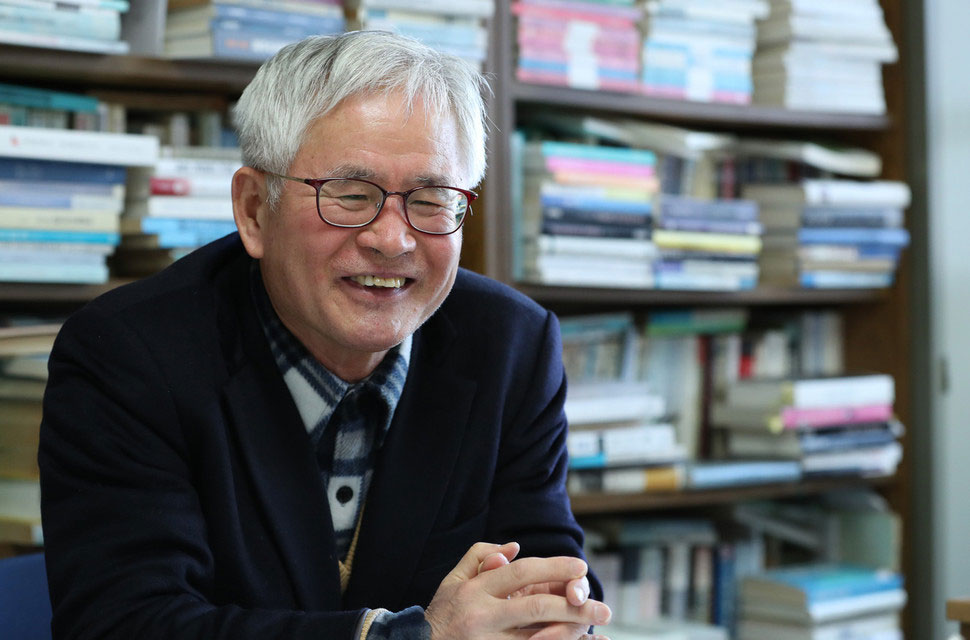
Seo Jung-seok, professor emeritus at Sungkyunkwan University, during his interview with the Hankyoreh in Seoul on Dec. 31, 2019. (Kim Jung-hyo, staff photographer)

The eighth volume in the 20-volume “Seo Jung-seok’s Contemporary Korean History,” which has now been published in its entirety, has a rather pugnacious subtitle: “Crediting Economic Growth to Park Chung-hee is a Dangerous Misunderstanding.” Considering that even critics of Park’s long dictatorship and his suppression of democracy tend to give him credit for economic growth, what grounds could there be for such remarks by Seo Jung-seok, professor emeritus at Sungkyunkwan University and a leading authority on Korea’s modern and contemporary history? Seo waxes eloquent on this topic for nearly 20 minutes, explaining that people need to take into account all the domestic factors and international conditions that made Korea’s explosive growth possible.

“Germany and Japan enjoyed incredible economic growth, beginning in Germany in 1945 and in Japan shortly after the Korean War and lasting until the early 1970s. Taiwan underwent rapid growth from the early 1960s until the 1980s, and the economies of Western Europe, including France, and even Spain under the Franco dictatorship, began growing in the 1960s. This was a good time for the global economy. Oil prices were extremely low, under US$2 a barrel.”

The boom in the global economy lasted until oil prices spiked in 1973, effectively proving the point about positive conditions overseas. Next, Seo turns to domestic factors. “The motto of the administration led by Prime Minister Chang Myon [after the April 1960 revolution] was ‘the economy first.’ The economy was the first, second, and third priority. The five-year economic development plan drafted by the Chang administration was adopted without revision by Park Chung-hee. Koreans had an incredible desire for economic development at the time, and the educational fervor was intense as well. During the presidency of Syngman Rhee, the percentage of Koreans entering elementary school had already exceeded 90%, which was even higher than in Taiwan. That’s the foundation of economic development. But the Rhee administration’s obsession with winning elections prevented it from achieving economic development.”

Middle Eastern construction projects allowed chaebols to invest in heavy industry

According to Seo, therefore, the domestic factors were already mature enough. Another important factor for economic success was that Korea had implemented land reform (unlike countries in Central and South America), and removed the restrictions on mobility, which is a prerequisite for an industrial workforce. When advanced economies were rocked by the oil embargo, Koreans viewed it as an opportunity. Enriched by soaring oil prices, OPEC oil producers in the Middle East launched construction projects that were a perfect fit for Koreans’ temperament. Competitors couldn’t keep up with Koreans, given their knack for “building things in a flash to meet construction deadlines.”

“The Minister of Construction at the time was Kim Jae-gyu [who later assassinated Park Chung-hee], and we owe a lot to him. But Kim used to downplay his role and give credit to businesspeople. In reality, it was people like [Hyundai Group founder] Chung Ju-yung who made a huge impact. That had little to do with Park Chung-hee.”

Korea’s investment in heavy industry was also made possible by money flowing in from Middle East construction projects, Seo contends. Prior to that, no companies were willing to step up to the plate, despite benefits promised by the government. But once the chaebols, or family-run conglomerates, were flush with cash from the Middle East construction contracts, they eagerly jumped into heavy industry. Seo argues that the story of Park Chung-hee spearheading the country’s economic growth is no more than a myth. He marshaled numerous facts attesting to the economic mismanagement of the Park regime, including opposition parties’ victory in parliamentary elections on Dec. 12, 1978, despite the oppressive atmosphere created by Emergency Order No. 9, and the surge of popular opposition represented by democratic protests in Busan and Masan, which ultimately led to the downfall of Park’s Yushin regime.

“While Ludwig Erhard [who served as Germany’s Minister of Economic Affairs and Chancellor] played a big role in the ‘Miracle on the Rhine,’ people don’t say that the miracle was his doing. Nor do people say that Taiwan owes [its economic growth] to Chiang Kai-shek or his son Chiang Ching-guo. If anything, [the Chiangs] are criticized for being dictators. In Spain, there’s a stigma about Franco. I’m not saying that Park Chung-hee didn’t work hard. What I’m saying is that, if you take a close look at the domestic and international conditions, he didn’t accomplish everything on his own.”

That’s why it’s important to look back at the comparatively recent past through the study of contemporary history. There are still many “facts” once taken for granted that should be reexamined, to see if they’re historically accurate. The reason the Korean public is largely uninformed about the democratic protests in Busan and Masan, which were designated a national memorial day this year, is because of the rigid control of the press during the Yushin regime. The protests were only covered by newspapers after martial law was declared.

Park admitted to exaggerating N. Korean threat to tighten political control

Another good example is the Park regime’s anti-Communist campaign and all-out national security campaign, which it waged simultaneously, emphasizing North Korea’s ambition of invading the South. But during a meeting with foreign correspondents, Park reportedly expressed skepticism about whether the North would actually attack. Seo stumbled upon that remark in a collection of Park’s speeches. Park exaggerated the North Korean threat for the purposes of domestic control even while knowing full well there was little chance of war. In South Korea, Park played up tunnels that the North Koreans had dug under the DMZ as evidence of preparations for an invasion, but then told Japanese reporters that, practically speaking, the tunnels couldn’t be used for a full-scale war.

The series took nearly five years to be published, following the release of the first volume, titled “Liberation, Division, and Collaborators: The Joy and Junctures of Contemporary History,” in March 2015. It the series were to have a main character, it would obviously be Park Chung-hee. A full 16 of its 20 volumes deal with the Park era, from Volume 5 (“The 2nd Republic and the May 16 Coup d’?at: Why Did the US Stand By?”) to Volume 15 (“Collapse of the Yushin Regime: Was Kim Jae-gyu a Traitor?”). Since Park held power for 18 of the 42 years covered in the series, from Korea’s liberation on Aug. 15, 1945, to 1987, so much attention might seem inevitable. Another factor is that Seo has already published a lot of books about post-liberation Korea and about the presidency of Syngman Rhee, including “Research on the Nationalist Movement in Contemporary Korea,” “Cho Bong-am and the 1950s,” and “The Political Ideology of Syngman Rhee.” Debunking the lies about the Park Chung-hee has always been on Seo’s to-do list, and this series makes the relevant records easily accessible to the general public.

Unraveling the liars of South Korea’s democratization

The final three books in the series, now released, deal with the mass protests in June 1987 that led to Korea’s democratization: Volume 18 (“Background to the June Democracy Movement: Push for Constitutional Reform and Chun Doo-hwan’s Counterattack”), Volume 19 (“The June Democracy Movement Unfolds: Contemporary History Changed by Huge Simultaneous Demonstrations”), and Volume 20 (“The Wave of Democratization Runs High: Chun Doo-hwan and Roh Tae-woo Surrender, and the Aftermath”). One of the strengths of the series is its eminent readability, organized in Q&A format. A generous assortment of photographs and newspaper articles keep the reader grounded, they don’t go adrift in a sea of facts.

“There’s been a marked decrease in our society’s interest in and excitement about our modern and contemporary history. It was just then that the New Right emerged and began working to distort history, taking the perspective of the collaborators. I don’t like the ‘history wars,’ but at the same time, I see it as my fate. There’s nothing that can teach us the value of democracy quite like contemporary Korean history. In that sense, I see this book as a textbook in democracy.”

By Lee Jae-sung, staff reporter

Please direct comments or questions to [english@hani.co.kr]

https://www.facebook.com/groups/criticalkoreanstudies/permalink/3804038979610159/


Kim Jong-un’s Image Shift: From Nuclear Madman to Skillful Leader

https://www.nytimes.com/2018/06/06/world/asia/kim-korea-image.html

SEOUL, South Korea — He ordered his uncle executed and half brother assassinated. He spent millions developing and testing a hydrogen bomb and intercontinental ballistic missiles as his people suffered severe food shortages. He exchanged threats of nuclear annihilation with President Trump, calling the American leader a “mentally deranged U.S. dotard.”

That was last year’s image.

In more recent months, North Korea’s leader, Kim Jong-un, has achieved one of the most striking transformations in modern diplomacy.

The man described by critics as a murderous dictator and nuclear lunatic has held hands and had heart-to-heart talks with South Korea’s president, Moon Jae-in, who has encouraged and abetted Mr. Kim’s makeover.

Mr. Kim has enticed South Korea and the United States into negotiations by dangling the possibility of denuclearizing his country. His popularity has surged in polls in South Korea as he prepares to become the first North Korean leader to meet a sitting American president.

With a dazzle of diplomatic initiatives in the run-up to his historic June 12 summit meeting with Mr. Trump in Singapore, Mr. Kim has effectively redefined himself. Some South Koreans now see him as more reliable than Mr. Trump despite the decades-long alliance between their country and the United States.

Mr. Kim’s enhanced standing among South Koreans was crystallized by recent images of him walking in the woods with Mr. Moon, and on a beach with President Xi Jinping of China discussing North Korea’s nuclear program.

The optics contrasted with what many South Koreans view as Mr. Trump’s scattershot diplomacy, in which he abruptly canceled the Singapore summit meeting, then reversed himself after Mr. Kim authorized a calm statement offering Mr. Trump “time and opportunity” to change his mind. (On Wednesday, one of the president’s lawyers, Rudolph W. Giuliani, said that Mr. Kim “got back on his hands and knees and begged” for the meeting to be rescheduled.)

Mr. Kim and President Moon Jae-in of South Korea walking at the border village of Panmunjom in the Demilitarized Zone in April

Mr. Kim and President Moon Jae-in of South Korea walking at the border village of Panmunjom in the Demilitarized Zone in April. Mr. Moon has eagerly promoted Mr. Kim’s new image.

Despite the image change, Mr. Kim is unlikely to surrender his nuclear weapons anytime soon, or ease the grip of his repressive regime. But he has proved to be a skilled — some might say beguiling — strategist, driving events on the Korean Peninsula and showing a willingness to recalibrate.

“Once Kim Jong-un decided to improve ties with South Korea and the United States, he knew he could not do so with his image as a repressive tyrant,” said Kang Dong-wan, an expert on North Korea’s “image politics” at Dong-A University in Busan, South Korea. “He is creating a new portrait of him abroad as the leader of a normal country.”

In the West, Mr. Kim, 34, has often been caricatured as a chubby child toying with nuclear missiles. Mr. Trump, more than twice his age, has called Mr. Kim “short and fat,” a “sick puppy” and a “little rocket man.”

But when Mr. Trump meets Mr. Kim, the American leader will be dealing with the ruler of a totalitarian regime adept at political theatrics to bolster Mr. Kim’s charisma at home and advance his agenda abroad.

“The reason the world pays attention to him is not just because he has a few nuclear weapons, but more because of his image as a leader with mystical power, his absolute control over a highly consolidated, regimented and disciplined country,” said Chung Byung-ho, an anthropologist at Hanyang University in South Korea, who examined the role of theatrics in North Korean politics in a book he wrote with another scholar.

Whatever his true personality, Mr. Kim has found an avid partner in advancing his new image: Mr. Moon.

Since taking office a year ago, Mr. Moon has exhorted Mr. Trump to test the idea that Mr. Kim was a reasonable leader ready to bargain away his nuclear weapons for the right incentives, such as normalized ties and security assurances from the United States. It seems to have worked: Mr. Trump has recently changed his public appraisals of the North Korean leader, calling him “smart and gracious” and “very honorable.”

Mr. Kim and President Xi Jinping

Mr. Kim and President Xi Jinping of China in Dalian, China, last month. It was Mr. Kim’s second meeting with Mr. Xi in two months. Credit: Korean Central News Agency/EPA, via Shutterstock

Mr. Kim started his image makeover this year by reaching out to South Korea, which was eager to play intermediary between North Korea and the United States after a year in which the countries appeared to verge on war. In a New Year’s Day speech, Mr. Kim offered to send athletes, cheerleaders and political emissaries to South Korea during its Winter Olympics.

Then, he whetted Washington’s appetite for negotiations by announcing a moratorium on nuclear and missile tests, closing North Korea’s only known nuclear test site and releasing three American prisoners. He also appeared to have hedged his bets by meeting twice with Mr. Xi, mending frayed ties with an old ally whose protection he needed as he entered delicate negotiations with Washington.

The diplomatic outreach was a sharp departure from North Korea’s history of rhetorical bombast, chest-thumping theatrics, military parades and mass rallies, which have fed the country’s image as an international pariah.

Mr. Kim’s image reinvention was skillfully staged with the help of Mr. Moon’s government, which made sure every detail of the leaders’ April 27 summit meeting was steeped in potent symbols dear to both Koreas: respect, ethnic unity and eventual Korean reunification.

For the meeting held at the “truce village” of Panmunjom on the inter-Korean border, Mr. Moon’s government redecorated a conference building, installing paintings of famous mountains and waterfalls that reminded people in both Koreas of their shared heritage before their peninsula was divided by foreign powers at the end of World War II.

“We packed each piece of furniture and each painting with a story,” said Koh Min-jeong, a spokeswoman for Mr. Moon.

During a break from their talks, Mr. Kim and Mr. Moon ambled off for a walk through the woods of Panmunjom, with cameras broadcasting their outing live around the world.

A caricature of Mr. Kim in Seoul

A caricature of Mr. Kim in Seoul, South Korea, last month. Recent surveys show increasing numbers of South Koreans see Mr. Kim as trustworthy. Credit: Ahn Young-Joon/Associated Press

But nothing softened Mr. Kim’s image like the moment when he arrived at the border to meet with Mr. Moon. At Mr. Kim’s suggestion, Mr. Moon stepped across the border into the North for 10 seconds. Then Mr. Kim and Mr. Moon walked back across to the South for their meeting, holding hands, an encounter that transfixed television viewers in South Korea.

“That single gesture went beyond political language,” said Mr. Chung, the anthropologist. “The theatrics conveyed messages of trust that language alone could not.”

The summit meeting mainly rehashed old inter-Korean agreements that had never been kept, producing only a vaguely worded commitment to denuclearization and peace. But the images made the event a success, providing momentum for warmed ties between the two countries and redefining Mr. Kim in the eyes of many South Koreans.

The next morning, a South Korean newspaper filled its front and back pages with a photograph showing Mr. Moon and Mr. Kim crossing the border hand in hand. Mr. Kim, formerly vilified as the region’s most dangerous leader, was considered “trustworthy” by 77 percent of South Koreans following the meeting, according to a survey by the Korea Research Center.

“Chairman Kim’s popularity has risen rapidly among South Koreans, and so have the expectations,” Mr. Moon told Mr. Kim last month when they met for the second time at Panmunjom. He said the summit meeting especially strengthened Mr. Kim’s image among younger South Koreans, who have shaped their views of North Korea through the past decade of inter-Korean tensions and have become increasingly skeptical of reconciliation, much less reunification, with the North.

“That’s great to hear,” Mr. Kim responded, according to South Korean officials.

Critics warn of dashed expectations, reiterating their view that Mr. Kim will never completely abandon the nuclear weapons considered so dear to his regime’s survival and his legitimacy as leader of North Korea.

“It’s right to be skeptical,” said Ra Jong-yil, a political scientist and former deputy director of the South’s National Intelligence Service. “How can the leader of a nation change so quickly? We tend to see what we want to see in North Korea.”

Some expect that in his meeting with Mr. Trump, Mr. Kim will most likely commit to denuclearizing his country completely in order to weaken the rationale for sanctions, but insist on a “phased” denuclearization. They say Mr. Kim probably fears that whatever agreement he strikes with Mr. Trump may not survive, given Washington’s unpredictable politics.

“The whole world is being duped” by Mr. Kim, said Shim Jin-sup, a retired psychological warfare officer of the South Korean military and expert on North Korean propaganda.

Locked and Loaded for the Lord

After the Rev. Moon died in 2012, his church split apart. Two of his sons established a new congregation. Their followers are eagerly awaiting the end times. And they are armed.

https://www.washingtonpost.com/news/style/wp/2018/05/21/feature/two-sons-of-rev-moon-have-split-from-his-church-and-their-followers-are-armed/

Story by Tom Dunkel Photos by Bryan Anselm

Hyung Jin “Sean” Moon, leader of Sanctuary Church

Hyung Jin “Sean” Moon, leader of Sanctuary Church, wears a crown of rifle shells and holds a gold-plated AR-15.

Sanctuary Church — whose proper name is World Peace and Unification Sanctuary, but which also goes by the more muscular-sounding Rod of Iron Ministries — stands inconspicuously on a country road that winds through the village of Newfoundland, Pa., 25 miles southeast of Scranton. The one-story, low-slung building used to be St. Anthony’s Catholic Church. Before that, it was a community theater, which is why there are no pews, only a semicircle of tiered seats facing the old stage, now an altar.

On a Sunday morning in late February, 38-year-old Pastor Hyung Jin “Sean” Moon, son of the late Rev. Sun Myung Moon, entered stage right wearing a white hoodie and cargo pants. He strapped on a leather headband and picked up a microphone. “Okay, take it away,” he said to the electric pianist and two female vocalists who function as the choir. They launched into the first of four songs: “O, light of grace, shining above / lighting my dim shadowed way …”

The 200-plus congregants packed into the room sang along with gusto. Pastor Sean stood by his front-row seat with his wife at his side, wringing his hands like an orchestra conductor. The song cycle ended and, after a brief prayer, he took center stage. “Look at all these crowns of sovereignty!” he exclaimed, gazing upon his audience. One tenet of the Sanctuary Church is that all people are independent kings and queens in God’s Kingdom — a kind of don’t-tread-on-me notion of personal sovereignty. Hence, symbolic gold and silver crowns bobbed on row after row of heads.

TOP: Attendants hold assault rifles during a sermon at Sanctuary Church in Pennsylvania. LEFT: Members during a blessing ceremony in February. RIGHT: The congregation during a sermon.

This crowd was about twice the usual size because this service was the warm-up for a renewal-of-marriage-vows ceremony scheduled for Wednesday morning. Scores of couples already had arrived from Japan and Korea. That ceremony — officially, the “Cosmic True Parents of Heaven, Earth and Humanity Cheon Il Guk Book of Life Registration Blessing” — would cap a week of activities that thus far had included an arts festival, a survival skills contest and a goat-butchering demonstration.

The wedding-blessing event was generating nationwide attention — something new for Sanctuary Church, which, until now, hadn’t even registered on the radar of the Pocono Record, the local daily newspaper. A key pillar of Sanctuary dogma is the importance of owning a gun, particularly the lethal, lightweight AR-15 semiautomatic, which the National Rifle Association has proclaimed “the most popular rifle in America.” Last fall, Pastor Sean had studied the Book of Revelation. It makes multiple references to how Christ one day will rule his earthly kingdom “with a rod of iron.” Although Revelation was written long before the advent of firearms, Pastor Sean concluded that “rod of iron” was Bible-speak for the AR-15 and that Christ, not being a “tyrant,” will need armed sovereigns to help him keep the peace in his kingdom.

As a result, a recent Sanctuary Church news release had noted that “blessed couples are requested” to bring with them to the upcoming Book of Life ceremony an AR-15 semiautomatic rifle “or equivalents.” This was unfortunate timing for the Church: The next day a young man walked into Marjory Stoneman Douglas High School in Parkland, Fla., and killed 17 people with an AR-15. Shooters had used that same model rifle to carry out mass murders in Las Vegas; Orlando; San Bernardino, Calif.; and other cities.

That latest tragedy was freshly imprinted on millions of minds, among them Pastor Sean’s. He eased into his hour-long Sunday morning sermon by reminding everyone of what President Trump had pointed out after the Parkland shooting: “He said if the teachers were armed, they would have shot the hell out of that guy. This is the first time we’ve heard a president talk like that. This is God’s grace, folks.”

Virtually the entire congregation was coming back on Wednesday for the big blessing ceremony, so he reviewed some safety precautions, like securing rifle triggers with a zip tie: “Remember, folks, you can never take back a bullet.” That was not to say worshipers couldn’t pack heat. Anyone with a concealed-carry permit was welcome to bring their loaded pistol Wednesday (their “mini rod of iron”) in addition to their AR-15. You never know, “there may be a wolf in sheep’s clothing who tries to make trouble,” said Pastor Sean.

After delivering a few social announcements (parents seeking marriage partners for their adult children were meeting at 3 p.m.; tomorrow at 5 p.m. there would be an AR-15 “breakdown” tutorial on how to properly disassemble the rifle), Pastor Sean delivered the meat of his sermon. He plowed familiar ground at first, citing Bible passages where the “rod of iron” was used to smite evildoers. Pacing the altar, he then segued into a freewheeling, gunfire-and-brimstone diatribe.

“You must shed the slave mentality and adopt the royal mentality. … The Democratic Party has become the Communist Party funded by Nazi collaborator George Soros. … The fake ministers and fake priests are pushing a dictator-Christ.” He took potshots at some favorite targets: Hillary Clinton (“she was paying for the Russian dossier”), Pope Francis (“a socialist, communist devil”) and government that gets too big for its britches. “Jesus never centralized power. Jesus never created government,” he said. “The worst killer in all of humanity the last one hundred years is centralized government.”

He showed a video clip of younger Church members undergoing quasi paramilitary training as Sanctuary’s standby Peace Police/Peace Militia. They shoot rifles on the run in the woods. They wear camo for the Lord. They learn Filipino knife fighting. “It’s not about being a badass. It’s about practicing to be deadly because you love people,” Pastor Sean told his flock. “The way of the rod of iron is the way of love.”

In a few days, reporters, photographers and TV camera crews would swarm upon sleepy Newfoundland for the wedding-blessing ceremony — professional gawkers lured by the incongruous coupling of semiautomatic rifles and a house of worship. But the media circus also would quickly move on, without fully answering questions left dangling. Who, exactly, are these Sanctuarians? And, with their injection of guns into the country’s already divisive mix of politics and religion, what do they want?

When the Rev. Sun Myung Moon died of complications from pneumonia in 2012 at age 92, it set off a power struggle within his family. Sean, with backing from older brother Kook Jin “Justin” Moon, contends he was selected from among his 10 adult siblings to inherit the Unification Church mantle and be crowned the next-generation “Second King” — not a full-fledged messiah like his father purported to be, but nonetheless responsible for finishing the work of building God’s Kingdom. Meanwhile, their mother, Hak Ja Han, claims the Rev. Moon, her husband of 52 years, passed the baton to her.

The church they were fighting over has roots in both Korea and America. The Rev. Moon — born in 1920 in what is now North Korea but was then part of Japan — said Jesus appeared to him when he was 15 and asked him to take on the “special mission” of completing God’s Kingdom on earth, Cheon Il Guk in his native Korean. First, however, he went off to study electrical engineering in Japan and got arrested (and tortured) twice for his activity in the Korean independence movement. He returned home, married and after World War II moved to Pyongyang, where the communist government threw him in a labor camp for preaching Christianity. When that camp was liberated near the end of the Korean War, Moon headed south.

He established a church in Seoul in 1954, dubbing it the Holy Spirit Association for the Unification of World Christianity. He codified his beliefs in a text titled “Divine Principle.” One core construct says Satan seduced Eve in the Garden of Eden. This caused “the fall” of humankind by contaminating the bloodlines she and Adam transmitted through Cain and Abel. God sent Jesus to serve as a Second Adam to find sin-free love and salvage the family of man. But Jesus didn’t live long enough to marry. It thus became Sun Myung Moon’s destiny to step in as a Third Adam and redeem the world.

His ministry put a premium on the sanctity of traditional marriage and condemned premarital sex, divorce and homosexuality. That conservative message found an audience in Seoul, though police arrested him twice — for suspicion of having religious sex orgies and ducking the draft. (Both charges ultimately were dropped.) By 1957, he’d built a network of 30 churches and was wired into the South Korean business community and government. The only glitch was that his own marriage proved imperfect, ending in divorce. However, Hak Ja Han soon entered his life. They married in 1960, and followers hailed them as God’s anointed “True Parents.”

A decade later the Rev. Moon came to the United States, a necessary foothold for uniting the planet under his Unification banner. Moon spun a web of foundations and interlocking companies, reportedly becoming South Korea’s first billionaire. His followers were untroubled by his wealth, but Congress investigated his empire, and then the Internal Revenue Service came after him. In the mid-1980s Moon served 13 months in prison for failure to declare $162,000 in taxable income. Ever the entrepreneur, he made arrangements in prison to start the conservative Washington Times, saying he did it “to fulfill God’s desperate desire to save this world.”

Unification Church membership figures have always been elastic, ranging from tens of thousands to several million. In 2009, the Washington Times cited 110,000 “adherents.” Whatever the correct number, it had peaked by the late 1990s. Yet the Rev. Moon pressed on. In 2003, a double-page ad in the Washington Times trumpeted this news: All 36 deceased American presidents acknowledged Sun Myung Moon’s greatness. What’s more, each one had written an endorsement letter from the Great Beyond. “People of America, rise again. Return to the nation’s founding spirit,” said Thomas Jefferson, once characterized as a “howling atheist” by political opponents. “Follow the teachings of Rev. Sun Myung Moon, the Messiah to all people.”

Jefferson was, of course, one of the architects of America’s system of government — which will become obsolete if the Rev. Moon’s vision of God’s Kingdom on earth comes to pass. Pastor Sean is convinced that will happen, and in preparation, he has taken it upon himself to write a Constitution of the United States of Cheon Il Guk, grounded in principles articulated by his father.

If all proceeds according to divine plan, the country will be ruled by monarchs drawn from his branch of the Moon family. If the Kingdom comes in Sean’s lifetime, he’ll take the reins as king of the United States. Brother Justin — who serves as Sanctuary Church’s de facto assistant pastor — is set to be inspector general, a super special prosecutor charged with rooting out government corruption. Don’t worry. It’s not a theocracy, Sean says: “We would refer to it as a libertarian Christian monarchy or maybe a libertarian republican democracy.”

LEFT: The Rev. Sun Myung Moon’s crown sits atop his robe. RIGHT: Moon’s son Sean Moon.

The Moons primarily raised their 13 children on an estate north of New York City owned by the Unification Church. The main house at East Garden had 12 bedrooms, seven bathrooms and Church minions catering to their every need. But life was far from idyllic. One son died in a car accident, another committed suicide and a third succumbed at a relatively young age to drinking and drugs.

Sean Moon wrote about the downside of their gilded childhoods in a 2005 memoir. “We grew up many times seeing Parents one or two weeks, combined over various visits, out of the year,” he recalled. “I many times felt scared, abandoned, and neglected. … We were surrounded, constantly, by [Church] members. … I sat and seethed in anger many nights, as I drifted off to sleep.”

Rev. Moon fancied himself an outdoorsman. There were guns around the mansion, and, at 14, Justin fired one. It was love at first recoil: By 18 he had a permit to carry. He went on to major in economics at Harvard and earn an MBA at the University of Miami, tinkering with gun designs in his spare time. After graduate school he opened Kahr Arms in office space across the Hudson River from East Garden, using a $5 million loan from his father. His immediate goal, he later told American Handgunner magazine, was to create “an ultracompact 9-millimeter pistol.” And he did.

Kahr introduced its palm-size K9 model in 1995; people and police departments gobbled it up. Justin’s success with the company caught his father’s eye. Kahr soon was absorbed into one of the Unification Church’s corporations. Justin moved to Korea to take on the added role of president of a sister subsidiary. By 1999, Kahr had enough cash to buy the company that produced the storied Thompson submachine gun once toted by gangsters such as Baby Face Nelson. The Bureau of Alcohol, Tobacco, Firearms and Explosives reports Kahr sold 40,274 pistols and 9,086 rifles in 2016.

Justin Moon is a hyper defender of the Second Amendment. Private citizens, he says, should have unfettered access to any handheld weapon the U.S. military uses. “Were every woman in America to exercise their right to bear arms, America would basically eliminate its crime rate,” he told me one morning at Kahr Arms. “Nobody would be able to rape them or rob them.”

While Justin was climbing the Unification Church’s corporate ladder, Sean followed in his footsteps only as far as Harvard. He got a bachelor’s degree in liberal arts and a master’s of theology, and spent eight years studying Buddhism in the United States, Korea and India.

He had a compelling reason to go off in search of himself. Sean was in college in October 1999 when his brother Young Jin “Phillip” Moon jumped out the 17th-floor window of a Las Vegas hotel. He was 21, a year older than Sean. They had been inseparable growing up. “For most of our lives we shared the same room, the same video games, and the same Doritos chips,” Sean wrote in his memoir.

In July 2007, the prodigal son returned to the fold of the Unification Church. Sean had telegraphed his intentions the previous fall by doing 12,000 prayer bows over six days; on one of those days he also made a poster-size calligraphy of the Korean character seong (“sincere”), using a paintbrush dipped in his blood, which had been extracted by a physician.

Sean’s initial job was pastor of a Unification Church in Seoul. Within 10 months, he was put in charge of international Church operations. On three ceremonial occasions, he says, his father named him “heir and successor.” However, he also sent conflicting signals to oldest brother Preston and to Hak Ja Han. A few days after her husband’s passing in 2012, Hak Ja Han summoned Sean to the magnificent Peace Palace the Moons had built in the mountains north of Seoul. According to Sean, she put him on notice that “I’m God. I’m Hananim.” To which he replied, “Mummy, please, you can’t say that. Father’s not going to be happy.”

He says she phased him out of Church activities and stopped taking his phone calls. In September 2013, on the first anniversary of his father’s death, Sean went to the palace in hopes of seeing his mother. In his version of events, she had security guards shoo him away.

Justin Moon sided with his younger brother. Coincidentally, around that time, the New York legislature passed several gun-control measures that irked him. He decided to extricate himself and Kahr Arms from the Unification Church and move Kahr headquarters elsewhere. Eastern Pennsylvania beckoned: reasonable cost of living, excellent schools for his seven children, and 900,000 NRA members within a 300-mile radius of the state capital, Harrisburg.

A member of the church holds her assault rifle during a blessing ceremony.

By spring 2013, both brothers’ families were ensconced in Pennsylvania. Sean began holding Sanctuary Church services in his living room (in a town appropriately named Lords Valley). When the congregation outgrew the space, he did his preaching in the banquet room at a Best Western. In May 2014 Sanctuary settled into the former Catholic church in Newfoundland. Members voluntarily have dug into their pockets, contributing $683,000 in 2015 and $491,000 for the first six months of 2016. A foundation Justin runs in brother Phillip’s name supports Sanctuary with grants (almost $380,000 combined in 2015 and 2016), plus it bought the church site. That revenue stream should keep the lights burning for the foreseeable future and Pastor Sean’s camouflage-colored Jeep Wrangler on the road.

In January 2015, Sean publicly renounced his mother for hijacking the Unification Church and rewriting and editing his father’s religious texts. He has since taken to calling her the “whore of Babylon.” Last September, Sanctuary Church shunted Hak Ja Han aside, and a posthumous wedding was thrown for the Rev. Moon. He (well, his spirit) married 90-year-old Hyun Shil Kang, supposedly the first person to join his ministry in the early 1950s. She moved to Pennsylvania to live with Sean and his family.

Hak Ja Han did not comment on specific allegations made by her son, but Ki Hoon Kim, continental chairman of the Family Federation for World Peace and Unification USA, responded in an email: “I know with certainty that Dr. Moon has reached out to her son, Hyung Jin, numerous times since February 2013 asking him to come back to Korea to meet with her, but he has refused each request. … We can’t know exactly what took place in private discussions between mother and son, but it’s clear that he holds an escalating resentment towards her. … Even if Dr. Moon had made such a statement [that she is God], it is in line with our theological beliefs that she and her husband are one with God, just as Jesus said, ‘I and the Father are One.’ ”

In Jin Moon, second oldest of the surviving children, took an active role in the Unification Church until about eight years ago. She currently lives in New Jersey and has never before spoken out publicly about Sean and Justin. However, she says, “the language that’s coming out of Sanctuary Church is quite alarming,” so she feels obliged to raise her voice. She loves her brothers “ferociously” but says that the possibility their commingling of God and guns could inadvertently incite violence “is the great concern for the family.” And, yet, she thinks healing and reconciliation is possible. “I still believe in the unity of my family,” she says.

There seemingly is not much interest in reconciliation on the part of her brothers, however. Indeed, kicking Mom out of the family tree was not enough to satisfy Justin Moon. At a question-and-answer session with Church members in 2016, he explained that if a queen tries to usurp a king’s throne, the ultimate price must be paid: “It’s the king’s responsibility to arrest her and execute her.”

Any second thoughts about Hak Ja Han having committed a capital offense? Sitting at his office desk one morning, sporting his ever-present Kahr Arms baseball hat, Justin told me he stands by his earlier remarks: “It’s a comment on the record. I’m not going to walk it back.” All he was willing to do was change the analogy: “I love my mother,” he said, but what if she attempted to overthrow the U.S. government? “She should probably be tried for treason.”

A year and a half ago, Sanctuary Church bought a larger house for Pastor Sean, his wife and their five children. Heaven’s Palace is perched on a hill overlooking Matamoras, the easternmost town in Pennsylvania, hard by the Delaware River. Sean has a brown belt in Brazilian jujitsu and several nights a week teaches a class inside his converted garage. The students are Church members, most in their 20s, and most of them active in the so-called Peace Police/Police Militia.

On a Wednesday in late March, eight women and five men paired up for a practice session, trading positions as Moon guided them through a series of jujitsu holds and mini bouts. Dressed in a salmon-colored kimono top and loosefitting black pants, he sat yoga-style on his knees facing the class. “Work it! There you go! That’s definitely burning it into your muscle memory, your hippocampus.”

CLOCKWISE FROM TOP: Church members do outdoor circuit training. Some members are part of the church’s Peace Police/Peace Militia. Members during a martial arts class taught by Moon in a converted garage at his home in Matamoras, Pa. Moon holds a brown belt in Brazilian jujitsu.

A burst of action. A pause for sips of water and a few push-ups. Repeat, repeat. More guidance. Using his son as a prop, Sean stopped at one point to demonstrate the kimura hold, a double-wrist lock you can put on an opponent’s shoulder and upper arm. “Once we have the kimura position, we’re going to capture the shoulder with chest pressure,” he said while tying his son in a knot. “Basically, you’re sitting on the head so it doesn’t move.”

“He explains things well,” said Doug Williams, a retired police officer and Sanctuarian who lives next door and studied judo in his younger days. “He’s strict, but he’s inspiring at the same time. The kids know that.”

They obediently ground each other’s faces into the mat for two hours. Everyone then knelt and recited the Lord’s Prayer in unison. Sean lifted his arms and murmured, “All glory to God.” Class dismissed.

Sean Moon never raises his voice teaching jujitsu in the garage. Inside the house, however, he regularly unleashes the higher-octane side of his personality. Monday, Tuesday, Thursday and Friday from 5 to 8 a.m., Pastor Sean records a live webcast, called “The King’s Report,” in a room next to the kitchen. He sits at a desk with an AR-15 rifle prominently displayed next to his microphone, always decked out in a shirt and tie, the camouflage suit jacket he bought on eBay, and a crown made of polished rifle shells. He’ll interview an occasional guest and show clips from the NRA’s digital TV channel. But mostly he discusses the latest stories being featured by his conservative-media holy trinity — the Drudge Report, Breitbart News and Alex Jones’s paranoia-pushing Infowars — and riffs at length about current events, from Oprah Winfrey’s potential presidential bid (“She worships Satan. She promotes the New Age Christian view of God, which is a relevant God, which is, of course, Satan”) to gun-control advocates (“They are complete demons. … They want to make you completely vulnerable to the predations of the wicked”).

While the Rev. Moon seldom indulged in personal attacks, Sean and Justin regularly toss verbal grenades. They’re also more enamored with guns than their father — and more overtly political. “No question about it,” Sean told me one afternoon as we chatted in the orchestra section of the theater-turned-sanctuary: God’s hand was at work in the 2016 presidential campaign. A week before Election Day, Justin spoke to a group of Japanese Sanctuarians who were visiting Pennsylvania and described in biblical terms what was at stake: Hillary Clinton, he said, was the “Fallen Eve” who would start a war (possibly nuclear) with Russia. Donald Trump was the “Adam-type figure” who wanted to attack and “bring judgment on the government, on the archangel.” Depending on the outcome, he added, “the nature of God’s judgment on this world will be dramatically different.”

Both Moons shoot straight on and off the firing range. Sean on Al Gore: “A fricking nutbag.” Sean on 9/11: “False flag.” Sean on Hollywood liberals: “The most despicable, thieving, conniving, manipulating, evil, wicked, iniquitous demons on the planet.” Justin on the United Nations: “Satanic.” Justin on welfare recipients: “Parasites.” Justin on Democrats: “There are a lot of pedophiles in the Democratic Party. They realize that Trump is coming to get them. Literally. Round them up and put them in prison and execute them.”

Their straight talk caught up with them three weeks before the blessing ceremony. The Southern Poverty Law Center, which monitors extremists, issued a “Hate Watch” on Sanctuary Church — ironically, further raising its profile. SPLC took issue with a “cult leader” urging followers to carry guns and with comments Sean made about public school children “getting indoctrinated into the homosexual political agenda” and “the transgender agenda.” Sean responded by posting an alert of his own on Facebook: “Southern Poverty Law Center is well known as an extreme left hate group.”

Moon records “The King’s Report,” his live webcast, in his home studio.

In December 2013, Justin Moon paid $2 million in cash for a 620-acre industrial site north of Newfoundland. On Aug. 30, 2016, he held the grand opening of Kahr Arms’ Tommy Gun Warehouse showroom-store, the place to go for rifles, pistols, knives and the Brooklyn Smasher steel baseball bat that in an emergency can be used to club an intruder or a deer to death. The grand-opening guest of honor was Eric Trump. “That came about because God made it happen,” Justin told me. Somebody from the Trump campaign had called him out of the blue and said, “Eric wants to come.”

So Eric came, and Sean introduced him by saying: “It’s my opinion that we must elect a president that will protect and expand the right to bear arms. … I hope we can all agree that Hillary Clinton should never be the president of the United States. … God bless the U.S.A., and please buy some guns and ammo!”

Eric, in an open-collar shirt and dark sports jacket, stood in front of a wall of rifles and next to a U.S. flag. “This election for every gun owner is a huge thing. It will be the difference between adding to our Second Amendment freedoms or not adding to our Second Amendment freedoms,” he said, then switched to the topic of America hemorrhaging jobs. “We don’t make anything here anymore. That’s why Justin deserves a tremendous, tremendous round of applause. … Our government does not make it easy on you, either from a shooting perspective or from a manufacturing perspective.”

A year and a half later — on a Saturday night before the renewal-of-vows ceremony — Rod of Iron Ministries and Kahr Arms hosted a “President Trump Thank You” dinner at the Best Western in Matamoras. This time the only Trump in attendance was a life-size cardboard cutout of the president.

The event doubled as a fundraiser for Gun Owners of America, an organization Executive Director Emeritus Larry Pratt said takes “a more robust position” on guns than the NRA. Pratt lives in Northern Virginia and served one term in the House of Delegates in the early 1980s. His dinner speech not only denounced any restrictions on gun sales and possession, it went a giant step further by asserting “the feds should have nothing to do with law enforcement anywhere.”

Sean Moon echoed that ultra-libertarian theme. “Government is becoming a totalitarian crime syndicate,” he warned, on its way to creating “a dystopian, Christ-hating hell on earth.” Justin alluded to his father, saying, “without our property and our guns, we’re nothing but laborers in a communist death camp.”

The dinner opened with a moment of silence for the Parkland shooting victims, followed by a prayer led by Sanctuarian Ted O’Grady, who gave thanks for Trump: “This room knows that this is only the beginning … that you will be the president that ushers in God’s Kingdom on earth.”

It ended with Hyun Shil Kang, Mrs. Moon No. 3, selecting the winning raffle ticket for the door prize: an AR-15 rifle donated by Kahr Arms. The winner was a middle-aged woman whose reaction was surprisingly muted; it turned out she already owns an AR-15.

A few days later, on Wednesday morning, about 20 demonstrators gathered outside Sanctuary Church armed with only signs. “Father Forgive Them.” “Pickles for Peace, No More Absurd than Guns for God.” As a precaution, all students at the elementary school a half-mile away had been bussed to other classrooms for the day. But no wolves in sheep’s clothing tried to make trouble.

Moon, left, and wife Yeon Ah Lee Moon, right, lead prayers at church. Moon holds a crown to be placed next to Hyun Shil Kang, seated, to whom his father was posthumously married.

John Hind, a lifelong Newfoundlander, soaked in the scene from his front porch across the street. “They’re good neighbors,” he said of the Sanctuarians. “They haven’t bothered nobody.”

“But they’re weird,” snorted his friend Carol Wood, puffing a cigarillo. “And blessing their guns? It’s confusing and it’s irritating.”

Inside the church, Timothy Elder, acting as master of ceremonies, informed the overflow congregation and some 50 reporters and cameramen lining the walls (plus about a hundred people watching a video feed in the adjacent community room) that “this is not a blessing of inanimate firearms.” It was strictly a recommitment of sacred wedding vows — for people bearing firearms.

Just before 10:30, Elder asked everyone to remove their AR-15s from their cases, “being careful to point the muzzle up and remove your finger from the trigger.” Camera shutters clicked crazily. Attendants in pink-and-white vestments led a procession into the sanctuary, followed by a three-man, armed color guard dressed in combat fatigues. Next came Pastor Sean, the “Second King,” and his wife, Yeon Ah Lee Moon, the “Queen,” both clad in white. Justin Moon was on their heels, his dark suit topped off by his baseball hat. Mother Kang took a seat in a white-and-gold chair on the altar. A crown was placed on the chair next to her, representing the absent Rev. Moon.

Pastor Sean carried a bound copy of the Constitution of the United States of Cheon Il Guk, which he carefully laid on a table on the altar. His wife cradled a gold-plated AR-15. “The King and Queen will now place the Rod of Iron on its ceremonial stand where it will guard the Constitution,” Elder explained.

The brides and grooms in attendance, some 500 total, jointly sipped from tiny cups of wine. They took their vows (“Do you promise an eternal bond as husband and wife?”). The King said an extended prayer, acknowledging their “right to sovereignty, the right to keep and bear arms, the right to inherit the earth and protect it from socialism, communism and political Satanism.” Husbands and wives then exchanged rings. The sanctuary filled with applause, then cheers.

A group of protesters outside Sanctuary Church.

Outside a polite battle of words raged. On the front lawn, a contingent of Korean Sanctuarians unfurled a 20-foot-long banner referencing their divided country: “Thank you USA. We will never forget America’s grace. Trump chosen by God, relocate the tactical nucleus to the 38th line.” A chest-high rail fence runs along the property line, hugging the road. The Sanctuarians occupied one side, the protesters commanded the other.

Two adversaries faced off in gentlemanly mouth-to-mouth combat. Gideon Raucci is a second-generation Unificationist in his late 20s who switched allegiance to Sanctuary Church. He’s active in Sean’s Peace Police. Teddy Hose, 39, is a writer-graphic artist who flew in from San Francisco. He was part of a film crew shooting a documentary on cults. He’s also a second-generation Unificationist who grew up near East Garden in close contact with the Moon family. Hose left the Church years ago.

“It can take just one bullet to change everything,” he told Raucci.

“I totally hear you about being responsible with guns,” Raucci replied.

“What I feel is not coming across to the rest of the community around you, this is scaring people …”

“This might open up something beautiful where people understand where we’re coming from,” Raucci said. “Your focus is on loving your neighbor, I’m totally down with that. … We’re taught to never be the initiators of violence.”

“David Koresh and Charles Manson both used the Book of Revelations,” Hose reminded him, “because it’s a very extreme part of the Bible.”

It went back and forth like that for about 10 minutes. Then they reached over the fence, and hugged.

LEFT: Kook Jin “Justin” Moon, Sean’s older brother and owner of Kahr Arms’ Tommy Gun Warehouse. Justin Moon is Sanctuary Church’s de facto assistant pastor. RIGHT: Taxidermied animals shot by Justin Moon on safari in Tanzania are on display at the warehouse.

The day after the blessing ceremony Regis Hanna, a Georgetown University graduate in his late 60s who recently moved to Pennsylvania to join the Sanctuary Church congregation, walked into Kahr Arms’ Tommy Gun Warehouse showroom with his wife, Nancy. Right inside the door stands a taxidermy triptych: a lion and a leopard attacking an antelope, all three animals shot by Justin Moon on safari in Tanzania. “Infowars” was playing on the big-screen TV. Posters of beautiful women in spiked heels, flashing slit skirts and Kahr pistols, adorn two walls. Hanna was thinking of buying a handgun. He moved here from Panama, where gun laws are strict and where he spent 21 years doing missionary work for the Unification Church. He and Nancy did a lot of family counseling with unwed couples. Theirs was one of the early American marriages arranged by the Rev. Moon. They’ve been together 43 years and have seven children.

After the Unification Church rupture, the Hannas chose to cast their lot with Pastor Sean. Regis, a round-faced man of mellow temperament, is now part of Sanctuary’s paid staff, and today it was his job to field any post-ceremony calls. The Church’s main number had been forwarded to his cellphone, which rang shortly after he entered the showroom. It was a New Jersey area code. He put the call on speaker phone.

“Are you f—ing insane! You don’t know the meaning of religion! You ought to be ashamed of yourselves!”

A minute later, another call came in. Oklahoma area code: “I was wondering if you’re accepting more people into your group.” Hanna told the man he could catch Sanctuary services on YouTube.

Another call. British Columbia. “I love what you guys are doing. I love Sean.”

“Thank you, brother,” said Hanna.

Hak Ja Han’s ascension to the head of the Unification Church had ripple effects, and many hundreds of people faced the same decision the Hannas did. Friendships got torn apart, marriages blew up and families were divided as Church members declared different loyalties. Most Unificationists stayed with the parent church; some went with Pastor Sean; a few followed oldest brother Preston Moon, who established a secular Global Peace Foundation in Seattle. Others quit the movement altogether.

Kyle Toffey, 65, was a longtime Unificationist who lived in Korea for 10 years. He admitted to me that “at first it did sound a little bit off the wall” when Pastor Sean added an AR-15 twist to the blessing ceremony, but he and his wife participated. He has learned to “reserve my skepticism” and trust Sean’s judgment. Plus, he has grown to appreciate the responsibility and self-confidence that comes with being armed: “In the morning when you strap on a pistol, you feel like the sheriff of the town.”

Dan Fefferman used to worship with Regis Hanna at a Unification Church in Washington. He and his wife were married in the same group ceremony as the Hannas. They live in Bowie, Md., now and stayed with the Unification Church, but Fefferman visited Sean Moon’s congregation several times.

“A lot of us went to check it out,” Fefferman said in a phone interview, “hoping we could talk sense into him.” In his opinion, the Moon brothers “attract the more unbalanced members” that can be found in any religious sect. He considered Rod of Iron a “far-right group with a paramilitary aspect to it.” Not a hate group per se, “but I certainly hope and expect the FBI is watching them closely.”

For second-generation Church members, these choices are more emotionally complex. The Unification Church is the only anchor they’ve known. Andrew Stewart’s parents raised him in the Church. He spent several college summers as an intern on a nondenominational farm near Newfoundland, where he got exposed to Sanctuary Church. He helped with some minor building renovations and attended Sunday services. The vibe grew progressively darker, he said. Although personally fond of many people he met, it struck him as odd that, theologically, “the Church thrives off the ability to make people angry.” He gradually drifted away from Sanctuary and this spring left the Unification Church, too.

Somiya Chapman Gabb — whose father was part of the Unification Church support staff at East Garden — was so offended by Hak Ja Han’s revising of Rev. Moon’s religious texts that she jumped to Sanctuary in early 2015. She and her husband were then living in Yonkers, N.Y., a three-hour round-trip drive. But she and her family felt increasingly out of tune with Sanctuary’s often “scathing” sermons. Also, a member of the congregation told her that another Sanctuarian had pulled a loaded gun on him. By the end of 2017, the Gabbs stopped making that long Sunday drive to Pennsylvania. They read the Bible and pray at home now. Gabb thinks “there’s still hope” that Sanctuary Church can right itself but said Sean Moon “is one word away from a violent situation and he may not even know it.”

Sharon Barnett of Florida holds an AR-15 and bows her head in prayer during a blessing ceremony at Sanctuary Church.

Individually, Sanctuary Church members come across as honest, reasonable, upright folk, the stuff of good neighbors. Collectively, the dynamic changes. So much of the Church discourse can’t abide contrasting opinions and worldviews. You don’t hear much talk about, or empathy for, the poor, the infirm, the weak. Most enervating, though, is the steady drumbeat of dystopia. To be a devout Sanctuarian requires almost superhuman faith in the cleansing waters of catastrophe. It’s like standing on the deck of the Titanic and rooting for the icebergs.

Justin Moon told me we’ve entered “that End of Times time frame” prophesied in the Book of Revelation, when God and “his champions” will “take the political power in the earth” away from Satan. Viewed through that lens, the 2016 election was “very different.” Actually, hugely different. “I believe God is using Donald Trump,” he said, a sentiment his brother shares. “He is an imperfect person, a sinner, but God has chosen to use him. Just like King David was an imperfect person.”

The apocalyptic events predicted in the Bible began unspooling, Justin explained, during his father’s lifetime: World War II, the Cold War, famines, disease epidemics and “the continuing confusion we see today.” Biblical timelines are unpredictable, but he is confident the End of Times and the corresponding advent of Cheon Il Guk will come in his son’s lifetime, if not his own. His father, the Rev. Moon, said so.

Sean Moon’s Constitution of the United States of Cheon Il Guk is a powerful document. It throws the country in reverse and then steps on the gas. Consider just these few provisions: The House of Representatives will elect the president. The king will pick Supreme Court justices. Congress cannot levy income taxes or property taxes; nor can it fund health care, education, Social Security or Medicare. The constitution specifically states there will be no Central Bank, Environmental Protection Agency or national police force.

Oh, and there will be no standing military of any kind. Justin Moon says the United States will follow the “Swiss model” of national defense. For example, he says, the Swiss Air Force has a small number of paid managers who schedule airplane maintenance and design training regimens, but citizen volunteers take care of all the planes and fly them, too. He says the Swiss defense system has kept Switzerland safe and secure for a long time. This is true, though being a neutral country may have a little something to do with that.

President Trump was doing a fine job implementing God’s plan, the way Pastor Sean saw it — that is, until he signed the omnibus spending bill that added another trillion dollars to the national debt. Then came the April airstrikes on Syria. A few days later Sean Moon addressed these developments in a “King’s Report” webcast: “This is very, very disturbing for the actual Trump supporters who got him elected. We don’t want war. We’re sick of foreign entanglements. … He’s completely doing a 180. He’s becoming frickin’ Hillary Clinton. … If he continues down this road, America is dead, folks. … He’s a man with many flaws, many sins, and now he’s capitulating to the most evil wickedness on the planet.”

That wickedness kept getting worse. The day he recorded this particular “King’s Report,” news broke that the judge overseeing the court case of the president’s personal attorney, Michael Cohen, had officiated at the 2013 wedding of George Soros (“the Antichrist; he has his Rothschild fingers in everything,” Pastor Sean moaned) and Nancy Pelosi was a guest. The fix is in, he said. One way or another, the “deep state” is going to take Trump down.

Then again, for Pastor Sean, the good news is that all this bad news is actually great news. He perceived a hidden hand at work, puzzling it out live on “The King’s Report.” The quicker the country goes down the toilet, the quicker Americans will come to their senses and embrace the Rod of Iron and Cheon Il Guk. It now appears to him that God is using Trump to run America into the ground, not make it great again. “We didn’t know exactly how it would unfold,” Pastor Sean told his fellow Sanctuarians, YouTube watchers and the world, “but we knew that in the end times, it gets worse before it gets better.”

The 1,500-Year-Old Love Story Between a Persian Prince and a Korean Princess that Could Rewrite History

http://www.ancient-origins.net/myths-legends-asia/1500-year-old-love-story-between-persian-prince-and-korean-princess-could-rewrite-021896

More than a thousand years before the first European explorer reached Korea’s shores, the Persian Empire was writing love stories about Korean princesses.

It’s a little-known story that could change the way we see our history. Recently, historians took a second look an old Persian epic written around 500 AD and realized that, at the center of the tale, was the unusual story of a Persian prince marrying a Korean princess.

It’s an incredible discovery. Up until recently, we weren’t sure that the Persians of that time even knew Korea existed. This new revelation shows Persia didn’t just make contact with Korea – these countries were intimately connected. And it might just call for a total rewrite of history.

The Kushnameh: A 1,500-Year-Old Persian Epic About Korea

The story is called the Kushnameh, and, in itself, it’s hardly a new discovery. It’s one of the most popular stories to come out of the Persian Empire, one that’s been told and retold countless times in the 1,500 years since it was written.

The Kushmaneh is a massive, epic poem about an evil creature with elephant tusks named Kus who terrorizes a Persian family throughout the generations. The whole story spans across hundreds of years and thousands of lines of poetry – but the really interesting part is somewhere around the middle. There, the author sat down and dedicated an incredible 1,000 lines of poetic verse to describing life in Korea during the Silla dynasty.

King and Queen of Silla. South Korea, Seoul National Folk Museum - Traditional Korean Costumes of Silla Kingdom (57 BC – 935 AD) (CC BY-SA 2.0)

King and Queen of Silla. South Korea, Seoul National Folk Museum – Traditional Korean Costumes of Silla Kingdom (57 BC – 935 AD) ( CC BY-SA 2.0 )

A Love Letter to Korea

Korea comes into play when the story starts to focus on a young, noble prince of Persia named Abtin. For his whole life, Abtin has been forced to live in the woods, hiding from the evil Kus the Tusked. He has only one thing to keep him safe: a magic book that tells him his future.

It’s almost like breaking the fourth wall – Abtin has a copy of the book we’re reading, and he’s not above flipping ahead a few pages to see how it all ends. In fact, that’s just what he does. He reads the next chapter and finds out that he’s supposed to go to the Silla kingdom of Korea, and – after briefly getting confused and going to China – he winds up being welcomed with open arms by the king of Silla.

From here, the story is just page after page of lavish descriptions of how beautiful Korea is. Admittedly, some of it seems a little over-the-top. It says, for example, that Korea is so overflowing with gold that even the dogs are kept on golden leashes. But on the whole, the description is so accurate that modern historians are sure the author must have visited it himself .

Abtin is mesmerized by the beauty of the country, and, soon after, by the beauty of its princess Frarang. He falls madly in love with Korean princess, begs the king for her hand in marriage, and she soon becomes his wife and the mother of his firstborn son.

Marriage of Abtin and Frarang. (Image: Daum)

Marriage of Abtin and Frarang. (Image: Daum)

The Story of a Korean Hero

It’s unlikely that any of this really happened, of course. For one thing, there’s limited evidence that Persia spent 1,500 years being terrorized by an immortal monster with elephant tusks, and even less that any early Persian princes had magic books that could tell them the future.

But the symbolism of having a Persian prince take refuge in Korea and fall in love with a Korean princess is undeniable. This is hard proof that Persians didn’t just know about Korea 1,500 years ago; they had a deep, profound admiration for their nation.

What happens next, though, is what makes it a really big deal. Frarang’s son isn’t just a minor character. His birth is a turning point in the whole story.

The fully Persian prince spends his whole life in hiding and, when he finally returns to his homeland, ends up getting killed by Kus’s men. But it’s his half-Korean son who turns things around.

Frarang and Abtin’s son ends up raising up an army and leading the revolt against Kus. For centuries, in this story, Persia gets tormented by an evil, tusked monster. It’s only under the command of a half-Korean boy and his mother that Persia finally wins its freedom.

This 14th-century Persian painting portrays a scene from the Kushnameh in what scholars believe could be the betrothal of prince Abtin (kneeling) and Silla princess Frarang (sitting). (Hanyang University Museum)

This 14th-century Persian painting portrays a scene from the Kushnameh in what scholars believe could be the betrothal of prince Abtin (kneeling) and Silla princess Frarang (sitting). (Hanyang University Museum)

A Secret Hidden in Plain Sight

For 1,500 years, people have been reading this story without any idea what they were looking at. For a long time, we assumed that the story was just about China.

In the story, the Korean Silla kingdom is referred to as “Chin”, a name that could refer to either China or Korea. It’s even a plot point in the story, in fact. At first, Abtin, like most historians, misreads the “Chin” in his magic future-telling book and thinks he’s supposed to go to China. And, just like modern historians, it takes him years before he realizes that it’s actually talking about China.

Recently, though, historians have taken a look at those descriptions again and realized just how perfectly they really do match up with Korea . The descriptions in this book don’t sound anything like China, but they’re a perfect, vivid description of 6 th-century Korea – a place where, believe it or not, they really did keep their dogs on leashes of pure gold.

A Total Rewrite of History

This really might completely change the way we see history. For a long time, Korea has seemed an isolated, distant place from the Western world; but this story suggests that the east and west may not have been so disconnected after all.

It took until 1653 before the first European explorer reached Korea. That’s more than 1,100 years after Kushnama was written.

We’ve always known that Persia had some kind of contact with Korea. They were both a part of the Silk Road, and we’ve known for some time that Persian goods somehow ended up in Korea. Generally, though, it was assumed that they were just part of a bigger trade network.

In this story, though, Korea isn’t a trade partner. They’re a trusted ally, and they’re so important to the Persians that they literally can’t overcome evil until they trust the leadership of a half-Korean, half-Persian prince. It’s an incredibly symbolic marriage of cultures.

It puts other relics under a new light, as well. In an ancient tomb in Gyeong-Ju, for example, there is an old monument to a Korean war hero who looks an awful lot more like a Persian soldier than a Korean one. Now, some people are starting to wonder if this might really be the monument to a forgotten Persian hero who fought for Korea.

There’s no telling how far this could go. It could change everything about how we see the history of these countries. After all, this is far more than a love story between two people. It’s a love story between two nations.

Top image: This 14th-century Persian painting portrays a scene from the Kushnameh in what scholars believe could be the betrothal of prince Abtin (kneeling) and Silla princess Frarang (sitting). (Hanyang University Museum)

By Mark Oliver

References:

Akbarzadeh, Daryoosh. “Alexander’s Tale or a Collection of Symbols According to the Kush-Nameh”. Research Institute of Ichto . October, 2015. Available at: https://scielo.conicyt.cl/scielo.php?script=sci_arttext&pid=S0718-84712015000100012

Hee Soo Lee. “1,500 Years of Contact Between Korea and the Middle East”. Middle East Institute. 7 June, 2014. Available at: http://www.mei.edu/content/1500-years-contact-between-korea-and-middle-east

Iglauer, Philip. “Scholars Reveal Ancient Korean-Iranian Diplomatic Ties”. The Korea Herald. 3 February, 2013. Available at: http://www.koreaherald.com/view.php?ud=20130203000203

Kim Young Deok. “Silla, Oasis of the East.” Korea.net. 25 September, 2017, Available at: http://www.korea.net/NewsFocus/People/view?articleId=150241

Encyclopedia Iranica . “Kus-Nama”. 15 December, 2008. Available at: http://www.iranicaonline.org/articles/kus-nama-part-of-a-mythical-history-of-iran

“Recent Acquisitions of the British Museum.” The Athenæum , 31 May 1884, Available at: https://books.google.com.ec/books?id=m-VCAQAAMAAJ&pg=PA695&lpg=PA695&dq=kushnameh+when+written&source=bl&ots=pTTbPrq_md&sig=395Zv-PqCUgG3mIwvPRR69K9qTI&hl=en&sa=X&redir_esc=y#v=onepage&q=kushnameh%20when%20written&f=false.

Zegeling, Mark. “Dutch Marco Polo ‘Discovered’ Korea.” Kingdom by the Sea . 2018, Available at: http://kingdombythesea.nl/site/en/blogs/dutch-marco-polo-discovered-korea/

Security Council Imposes Fresh Sanctions on Democratic People’s Republic of Korea, Including Bans on Natural Gas Sales, Work Authorization for Its Nationals

https://www.un.org/press/en/2017/sc12983.doc.htm

https://www.un.org/sc/suborg/en/sanctions/1718/resolutions

Resolution 2375 (2017)

Adopted by the Security Council at its 8042nd meeting, on 11 September 2017

The Security Council,

Recalling its previous relevant resolutions, including resolution 825 (1993), resolution 1695 (2006), resolution 1718 (2006), resolution 1874 (2009), resolution 1887 (2009), resolution 2087 (2013), resolution 2094 (2013), resolution 2270 (2016), resolution 2321 (2016), resolution 2356 (2017), resolution 2371 (2017) as well as the statements of its President of 6 October 2006 (S/PRST/2006/41), 13 April 2009 (S/PRST/2009/7), 16 April 2012 (S/PRST/2012/13), and 29 August 2017 (S/PRST/2017/16),

Reaffirming that proliferation of nuclear, chemical and biological weapons, as well as their means of delivery, constitutes a threat to international peace and security,

Expressing its gravest concern at the nuclear test by the Democratic People’s Republic of Korea (“the DPRK”) on September 2, 2017 in violation of resolutions 1718 (2006), 1874 (2009), 2087 (2013), 2094 (2013), 2270 (2016), 2321 (2016), 2356 (2017), and 2371 (2017) and at the challenge such a test constitutes to the Treaty on Non-Proliferation of Nuclear Weapons (“the NPT”) and to international efforts aimed at strengthening the global regime of non-proliferation of nuclear weapons, and the danger it poses to peace and stability in the region and beyond,

Underlining once again the importance that the DPRK respond to other security and humanitarian concerns of the international community and expressing great concern that the DPRK continues to develop nuclear weapons and ballistic missiles by diverting critically needed resources away from the people in the DPRK who have great unmet needs,

Expressing its gravest concern that the DPRK’s ongoing nuclear- and ballistic missile-related activities have destabilized the region and beyond, and determining that there continues to exist a clear threat to international peace and security,

Underscoring its concern that developments on the Korean Peninsula could have dangerous, large-scale regional security implications,

Underscoring its commitment to the sovereignty, territorial integrity, and political independence of all States in accordance with the Charter, and recalling the purposes and principles of the Charter of the United Nations,

Expressing also its desire for a peaceful and diplomatic solution to the situation, and reiterating its welcoming of efforts by Council members as well as other Member States to facilitate a peaceful and comprehensive solution through dialogue,

Underlining the need to ensure international peace and security, and ensure lasting stability in north-east Asia at large and to resolve the situation through peaceful, diplomatic and political means,

Acting under Chapter VII of the Charter of the United Nations, and taking measures under its Article 41,

  1. Condemns in the strongest terms the nuclear test conducted by the DPRK on September 2 of 2017 in violation and flagrant disregard of the Security Council’s resolutions;
  2. Reaffirms its decisions that the DPRK shall not conduct any further launches that use ballistic missile technology, nuclear tests, or any other provocation; shall immediately suspend all activities related to its ballistic missile program and in this context re-establish its pre-existing commitments to a moratorium on all missile launches; shall immediately abandon all nuclear weapons and existing nuclear programs in a complete, verifiable and irreversible manner, and immediately cease all related activities; and shall abandon any other existing weapons of mass destruction and ballistic missile programs in a complete, verifiable and irreversible manner;

Designations

  1. Decides that the measures specified in paragraph 8 (d) of resolution 1718 (2006) shall apply also to the individual and entities listed in Annex I and II of this resolution and to any individuals or entities acting on their behalf or at their direction, and to entities owned or controlled by them, including through illicit means, and decides further that the measures specified in paragraph 8 (e) of resolution 1718 (2006) shall also apply to the individual listed in Annex I of this resolution and to individuals acting on their behalf or at their direction;
  2. Decides to adjust the measures imposed by paragraph 8 of resolution 1718 (2006) through the designation of additional WMD-related dual-use items, materials, equipment, goods, and technology, directs the Committee to undertake its tasks to this effect and to report to the Security Council within fifteen days of adoption of this resolution, and further decides that, if the Committee has not acted, then the Security Council will complete action to adjust the measures within seven days of receiving that report, and directs the Committee to regularly update this list every twelve months;
  3. Decides to adjust the measures imposed by paragraph 8 (a), 8 (b) and 8 (c) of resolution 1718 (2006) through the designation of additional conventional arms-related items, materials, equipment, goods, and technology, directs the Committee to undertake its tasks to this effect and to report to the Security Council within fifteen days of adoption of this resolution, and further decides that, if the Committee has not acted, then the Security Council will complete action to adjust the measures within seven days of receiving that report, and directs the Committee to regularly update this list every twelve months;
  4. Decides to apply the measures imposed by paragraph 6 of resolution 2371 (2016) on vessels transporting prohibited items from the DPRK, directs the Committee to designate these vessels and to report to the Security Council within fifteen days of adoption of this resolution, further decides that, if the Committee has not acted, then the Security Council will complete action to adjust the measures within seven days of receiving that report, and directs the Committee to regularly update this list when it is informed of additional violations;

Maritime Interdiction of Cargo Vessels

  1. Calls upon all Member States to inspect vessels with the consent of the flag State, on the high seas, if they have information that provides reasonable grounds to believe that the cargo of such vessels contains items the supply, sale, transfer or export of which is prohibited by resolutions 1718 (2006), 1874 (2009), 2087 (2013), 2094 (2013), 2270 (2016), 2321 (2016), 2356 (2017), 2371 (2017) or this resolution, for the purpose of ensuring strict implementation of those provisions;
  2. Calls upon all States to cooperate with inspections pursuant to paragraph 7 above, and, if the flag State does not consent to inspection on the high seas, decides that the flag State shall direct the vessel to proceed to an appropriate and convenient port for the required inspection by the local authorities pursuant to paragraph 18 of resolution 2270 (2016), and decides further that, if a flag State neither consents to inspection on the high seas nor directs the vessel to proceed to an appropriate and convenient port for the required inspection, or if the vessel refuses to comply with flag State direction to permit inspection on the high seas or to proceed to such a port, then the Committee shall consider designating the vessel for the measures imposed in paragraph 8 (d) of resolution 1718 (2006) and paragraph 12 of resolution 2321 (2016) and the flag State shall immediately deregister that vessel provided that such designation has been made by the Committee;
  3. Requires any Member State, when it does not receive the cooperation of a flag State of a vessel pursuant to paragraph 8 above, to submit promptly to the Committee a report containing relevant details regarding the incident, the vessel and the flag State, and requests the Committee to release on a regular basis information regarding these vessels and flag States involved;
  4. Affirms that paragraph 7 contemplates only inspections carried out by warships and other ships or aircraft clearly marked and identifiable as being on government service and authorized to that effect, and underscores that it does not apply with respect to inspection of vessels entitled to sovereign immunity under international law;
  5. Decides that all Member States shall prohibit their nationals, persons subject to their jurisdiction, entities incorporated in their territory or subject to their jurisdiction, and vessels flying their flag, from facilitating or engaging in ship-to-ship transfers to or from DPRK-flagged vessels of any goods or items that are being supplied, sold, or transferred to or from the DPRK;
  6. Affirms that paragraphs 7, 8 and 9 apply only with respect to the situation in the DPRK and shall not affect the rights, obligations, or responsibilities of Member States under international law, including any rights or obligations under the United Nations Convention on the Law of the Sea of 10 December 1982, with respect to any other situation and underscores in particular that this resolution shall not be considered as establishing customary international law;

Sectoral

  1. Decides that all Member States shall prohibit the direct or indirect supply, sale or transfer to the DPRK, through their territories or by their nationals, or using their flag vessels or aircraft, and whether or not originating in their territories, of all condensates and natural gas liquids, and decides that the DPRK shall not procure such materials;
  2. Decides that all Member States shall prohibit the direct or indirect supply, sale or transfer to the DPRK, through their territories or by their nationals, or using their flag vessels or aircraft, and whether or not originating in their territories, of all refined petroleum products, decides that the DPRK shall not procure such products, decides that this provision shall not apply with respect to procurement by the DPRK or the direct or indirect supply, sale or transfer to the DPRK, through their territories or by their nationals, or using their flag vessels or aircraft, and whether or not originating in their territories, of refined petroleum products in the amount of up to 500,000 barrels during an initial period of three months beginning on 1 October 2017 and ending on 31 December 2017, and refined petroleum products in the amount of up to 2,000,000 barrels per year during a period of twelve months beginning on 1 January 2018 and annually thereafter, provided that (a) the Member State notifies the Committee every thirty days of the amount of such supply, sale, or transfer to the DPRK of refined petroleum products along with information about all the parties to the transaction, (b) the supply, sale, or transfer of refined petroleum products involve no individuals or entities that are associated with the DPRK’s nuclear or ballistic missile programmes or other activities prohibited by resolutions 1718 (2006), 1874 (2009), 2087 (2013), 2094 (2013), 2270 (2016), 2321 (2016), 2356 (2017), 2371 (2017) or this resolution, including designated individuals or entities, or individuals or entities acting on their behalf or at their direction, or entities owned or controlled by them, directly or indirectly, or individuals or entities assisting in the evasion of sanctions, and (c) the supply, sale, or transfer of refined petroleum products are exclusively for livelihood purposes of DPRK nationals and unrelated to generating revenue for the DPRK’s nuclear or ballistic missile programmes or other activities prohibited by resolutions 1718 (2006), 1874 (2009), 2087 (2013), 2094 (2013), 2270 (2016), 2321 (2016), 2356 (2017), 2371 (2017) or this resolution, directs the Committee Secretary to notify all Member States when an aggregate amount of refined petroleum products sold, supplied, or transferred to the DPRK of 75 per cent of the aggregate amount for the period between 1 October 2017 and 31 December 2017 has been reached, and again notify all Member States when 90 percent and 95 percent of such aggregate amount has been reached, directs the Committee Secretary beginning on 1 January 2018 to notify all Member States when an aggregate amount of refined petroleum products sold, supplied, or transferred to the DPRK of 75 per cent of the aggregate yearly amounts have been reached, also directs the Committee Secretary beginning on 1 January 2018 to notify all Member States when an aggregate amount of refined petroleum products sold, supplied, or transferred to the DPRK of 90 per cent of the aggregate yearly amounts have been reached, and further directs the Committee Secretary beginning on 1 January 2018 to notify all Member States when an aggregate amount of refined petroleum products sold, supplied, or transferred to the DPRK of 95 per cent of the aggregate yearly amounts have been reached and to inform them that they must immediately cease selling, supplying, or transferring refined petroleum products to the DPRK for the remainder of the year, directs the Committee to make publicly available on its website the total amount of refined petroleum products sold, supplied, or transferred to the DPRK by month and by source country, directs the Committee to update this information on a real-time basis as it receives notifications from Member States, calls upon all Member States to regularly review this website to comply with the annual limits for refined petroleum products established by this provision, directs the Panel of Experts to closely monitor the implementation efforts of all Member States to provide assistance and ensure full and global compliance, and requests the Secretary-General to make the necessary arrangements to this effect and provide additional resources in this regard;
  3. Decides that all Member States shall not supply, sell, or transfer to the DPRK in any period of twelve months after the date of adoption of this resolution an amount of crude oil that is in excess of the amount that the Member State supplied, sold or transferred in the period of twelve months prior to adoption of this resolution, unless the Committee approves in advance on a case-by-case basis a shipment of crude oil is exclusively for livelihood purposes of DPRK nationals and unrelated to the DPRK’s nuclear or ballistic missile programmes or other activities prohibited by resolutions 1718 (2006), 1874 (2009), 2087 (2013), 2094 (2013), 2270 (2016), 2321 (2016), 2356 (2017), 2371 (2017) or this resolution;
  4. Decides that the DPRK shall not supply, sell or transfer, directly or indirectly, from its territory or by its nationals or using its flag vessels or aircraft, textiles (including but not limited to fabrics and partially or fully completed apparel products), and that all States shall prohibit the procurement of such items from the DPRK by their nationals, or using their flag vessels or aircraft, whether or not originating in the territory of the DPRK, unless the Committee approves on a case-by-case basis in advance, and further decides that for such sales, supplies, and transfers of textiles (including but not limited to fabrics and partially or fully completed apparel products) for which written contracts have been finalized prior to the adoption of this resolution, all States may allow those shipments to be imported into their territories up to 90 days from the date of adoption of this resolution with notification provided to the Committee containing details on those imports by no later than 135 days after the date of adoption of this resolution;
  5. Decides that all Member States shall not provide work authorizations for DPRK nationals in their jurisdictions in connection with admission to their territories unless the Committee determines on a case-by-case basis in advance that employment of DPRK nationals in a member state’s jurisdiction is required for the delivery of humanitarian assistance, denuclearization or any other purpose consistent with the objectives of resolutions 1718 (2006), 1874 (2009), 2087 (2013), 2094 (2013), 2270 (2016), 2321 (2016), 2356 (2017), 2371 (2017), or this resolution, and decides that this provision shall not apply with respect to work authorizations for which written contracts have been finalized prior to the adoption of this resolution;

Joint Ventures

  1. Decides that States shall prohibit, by their nationals or in their territories, the opening, maintenance, and operation of all joint ventures or cooperative entities, new and existing, with DPRK entities or individuals, whether or not acting for or on behalf of the government of the DPRK, unless such joint ventures or cooperative entities, in particular those that are non-commercial, public utility infrastructure projects not generating profit, have been approved by the Committee in advance on a case-by-case basis, further decides that States shall close any such existing joint venture or cooperative entity within 120 days of the adoption of this resolution if such joint venture or cooperative entity has not been approved by the Committee on a case-by-case basis, and States shall close any such existing joint venture or cooperative entity within 120 days after the Committee has denied a request for approval, and decides that this provision shall not apply with respect to existing China-DPRK hydroelectric power infrastructure projects and the Russia-DPRK Rajin-Khasan port and rail project solely to export Russia-origin coal as permitted by paragraph 8 of resolution 2371 (2017);

Sanctions Implementation

  1. Decides that Member States shall report to the Security Council within ninety days of the adoption of this resolution, and thereafter upon request by the Committee, on concrete measures they have taken in order to implement effectively the provisions of this resolution, requests the Panel of Experts, in cooperation with other UN sanctions monitoring groups, to continue its efforts to assist Member States in preparing and submitting such reports in a timely manner;
  2. Calls upon all Member States to redouble efforts to implement in full the measures in resolutions 1718 (2006), 1874 (2009), 2087 (2013), 2094 (2013), 2270 (2016), 2321 (2016), 2356 (2017), 2371 (2017), and this resolution and to cooperate with each other in doing so, particularly with respect to inspecting, detecting and seizing items the transfer of which is prohibited by these resolutions;
  3. Decides that the mandate of the Committee, as set out in paragraph 12 of resolution 1718 (2006), shall apply with respect to the measures imposed in this resolution and further decides that the mandate of the Panel of Experts, as specified in paragraph 26 of resolution 1874 (2009) and modified in paragraph 1 of resolution 2345 (2017), shall also apply with respect to the measures imposed in this resolution;
  4. Decides to authorize all Member States to, and that all Member States shall, seize and dispose (such as through destruction, rendering inoperable or unusable, storage, or transferring to a State other than the originating or destination States for disposal) of items the supply, sale, transfer, or export of which is prohibited by resolutions 1718 (2006), 1874 (2009), 2087 (2013), 2094 (2013), 2270 (2016), 2321 (2016), 2356 (2017), 2371 (2017), or this resolution that are identified in inspections, in a manner that is not inconsistent with their obligations under applicable Security Council resolutions, including resolution 1540 (2004), as well as any obligations of parties to the NPT, the Convention on the Prohibition of the Development, Production, Stockpiling and Use of Chemical Weapons and on Their Development of 29 April 1997, and the Convention on the Prohibition of the Development, Production and Stockpiling of Bacteriological (Biological) and Toxin Weapons and on Their Destruction of 10 April 1972;
  5. Emphasizes the importance of all States, including the DPRK, taking the necessary measures to ensure that no claim shall lie at the instance of the DPRK, or of any person or entity in the DPRK, or of persons or entities designated for measures set forth in resolutions 1718 (2006), 1874 (2009), 2087 (2013), 2094 (2013), 2270 (2016), 2321 (2016), 2356 (2017), 2371 (2017), or this resolution, or any person claiming through or for the benefit of any such person or entity, in connection with any contract or other transaction where its performance was prevented by reason of the measures imposed by this resolution or previous resolutions;

Political

  1. Reiterates its deep concern at the grave hardship that the people in the DPRK are subjected to, condemns the DPRK for pursuing nuclear weapons and ballistic missiles instead of the welfare of its people while people in the DPRK have great unmet needs, and emphasizes the necessity of the DPRK respecting and ensuring the welfare and inherent dignity of people in the DPRK;
  2. Regrets the DPRK’s massive diversion of its scarce resources toward its development of nuclear weapons and a number of expensive ballistic missile programs, notes the findings of the United Nations Office for the Coordination of Humanitarian Assistance that well over half of the people in the DPRK suffer from major insecurities in food and medical care, including a very large number of pregnant and lactating women and under-five children who are at risk of malnutrition and nearly a quarter of its total population suffering from chronic malnutrition, and, in this context, expresses deep concern at the grave hardship to which the people in the DPRK are subjected;
  3. Reaffirms that the measures imposed by resolutions 1718 (2006), 1874 (2009), 2087 (2013), 2094 (2013), 2270 (2016), 2321 (2016), 2356 (2017), 2371 (2017) and this resolution are not intended to have adverse humanitarian consequences for the civilian population of the DPRK or to affect negatively or restrict those activities, including economic activities and cooperation, food aid and humanitarian assistance, that are not prohibited by resolutions 1718 (2006), 1874 (2009), 2087 (2013), 2094 (2013), 2270 (2016), 2321 (2016), 2356 (2017), 2371 (2017) and this resolution, and the work of international and non-governmental organizations carrying out assistance and relief activities in the DPRK for the benefit of the civilian population of the DPRK and decides that the Committee may, on a case-by-case basis, exempt any activity from the measures imposed by these resolutions if the committee determines that such an exemption is necessary to facilitate the work of such organizations in the DPRK or for any other purpose consistent with the objectives of these resolutions;
  4. Emphasizes that all Member States should comply with the provisions of paragraphs 8 (a) (iii) and 8 (d) of resolution 1718 (2006) without prejudice to the activities of the diplomatic missions in the DPRK pursuant to the Vienna Convention on Diplomatic Relations;
  5. Reaffirms its support for the Six Party Talks, calls for their resumption, and reiterates its support for the commitments set forth in the Joint Statement of 19 September 2005 issued by China, the DPRK, Japan, the Republic of Korea, the Russian Federation, and the United States, including that the goal of the Six-Party Talks is the verifiable denuclearization of the Korean Peninsula in a peaceful manner, that the United States and the DPRK undertook to respect each other’s sovereignty and exist peacefully together, that the Six Parties undertook to promote economic cooperation, and all other relevant commitments;
  6. Reiterates the importance of maintaining peace and stability on the Korean Peninsula and in north-east Asia at large, expresses its commitment to a peaceful, diplomatic, and political solution to the situation, and welcomes efforts by the Council members as well as other States to facilitate a peaceful and comprehensive solution through dialogue and stresses the importance of working to reduce tensions in the Korean Peninsula and beyond;
  7. Urges further work to reduce tensions so as to advance the prospects for a comprehensive settlement;
  8. Underscores the imperative of achieving the goal of complete, verifiable and irreversible denuclearization of the Korean Peninsula in a peaceful manner;
  9. Affirms that it shall keep the DPRK’s actions under continuous review and is prepared to strengthen, modify, suspend or lift the measures as may be needed in light of the DPRK’s compliance, and, in this regard, expresses its determination to take further significant measures in the event of a further DPRK nuclear test or launch;
  10. Decides to remain seized of the matter.

Annex I

Travel Ban/Asset Freeze (Individuals)

  1. PAK YONG SIK
    1. Description: Pak Yong Sik is a member of the Workers’ Party of Korea Central Military Commission, which is responsible for the development and implementation of the Workers’ Party of Korea military policies, commands and controls the DPRK’s military, and helps direct the country’s military defense industries.
    2. AKA: n/a
    3. Identifiers: YOB: 1950; Nationality: DPRK

Annex II

Asset Freeze (Entities)

  1. CENTRAL MILITARY COMMISSION OF THE WORKERS’ PARTY OF KOREA (CMC)
    1. Description: The Central Military Commission is responsible for the development and implementation of the Workers’ Party of Korea’s military policies, commands and controls the DPRK’s military, and directs the country’s military defense industries in coordination with the State Affairs Commission.
    2. AKA: n/a
    3. Location: Pyongyang, DPRK
  2. ORGANIZATION AND GUIDANCE DEPARTMENT (OGD)
    1. Description: The Organization and Guidance Department is a very powerful body of the Worker’s Party of Korea. It directs key personnel appointments for the Workers’ Party of Korea, the DPRK’s military, and the DPRK’s government administration. It also purports to control the political affairs of all of the DPRK and is instrumental in implementing the DPRK’s censorship policies.
    2. AKA: n/a
    3. Location: DPRK
  3. PROPAGANDA AND AGITATION DEPARTMENT (PAD)
    1. Description: The Propaganda and Agitation Department has full control over the media, which it uses as a tool to control the public on behalf of the DPRK leadership. The Propaganda and Agitation Department also engages in or is responsible for censorship by the Government of the DPRK, including newspaper and broadcast censorship.
    2. AKA: n/a
    3. Location: Pyongyang, DPRK

WSJ Trump Interview Excerpts: China, North Korea, Ex-Im Bank, Obamacare, Bannon, More

https://blogs.wsj.com/washwire/2017/04/12/wsj-trump-interview-excerpts-china-north-korea-ex-im-bank-obamacare-bannon/

The Wall Street Journal held a wide-ranging interview with President Donald Trump on Wednesday , in which he talked about tying a trade deal with China to Beijing’s North Korea policy, addressed where things stand on a health overhaul, said he supported the Export-Import Bank, and weighed in on the United Airlines controversy, among other topics. Here are some selected excerpts from the Oval Office interview:

* * *

Trump on China and North Korea

But we had a really good meeting [with Chinese President Xi Jinping], and it was supposed to be 10 minute session and then you go into a room with hundreds of people, you know all different representatives, and the meeting was scheduled for 10 to 15 minutes, and it lasted for 3 hours. And then the second day we had another 10 minute meetings and that lasted for 2 hours. We had a — just a very good chemistry.

….

He then went into the history of China and Korea. Not North Korea, Korea. And you know, you’re talking about thousands of years …and many wars. And Korea actually used to be a part of China. And after listening for 10 minutes I realized that not — it’s not so easy. You know I felt pretty strongly that they have — that they had a tremendous power over China. I actually do think they do have an economic power, and they have certainly a border power to an extent, but they also — a lot of goods come in. But it’s not what you would think. It’s not what you would think.

We have tremendous trade deficits with everybody, but the big one is with China. It’s hundreds of billions of dollars of year for many many years. And I told them. I said you know, we’re not going to let that go ahead. Now, I did say — but you want to make a great deal? Solve the problem in North Korea. That’s worth having deficits. And that’s worth having not as good a trade deal as I would normally be able to make. OK, I’ll make great deals.

You cannot allow a country like that [North Korea] to have nuclear power, nuclear weapons. That’s mass destruction. And he doesn’t have the delivery systems yet, but he — you know he will.

So, you know we [Trump and Xi] have a very open dialogue on North Korea. We have a very good relationship, we have great chemistry together. We like each other, I like him a lot. I think his wife is terrific. And you know, it’s very rare that he comes and stays with somebody and spends that much time.

* * *

Trump on the Ex-Im Bank:

I will tell you what, I was very much opposed to Ex-Im Bank, because I said what do we need that for IBM and for General Electric and all these — it turns out that, first of all lots of small companies will really be helped, the vendor companies, but also maybe more importantly, other countries give it. And when other countries give it, we lose a tremendous amount of business.

So instinctively you would say it’s a ridiculous thing but actually it’s a very good thing and it actually makes money. You know, it actually could make a lot of money.

* * *

Trump on payments currently made to health insurers under the Affordable Care Act

Obamacare is dead — it’s dead. Obamacare, if you look at the case, you know the famous lawsuit that’s out there [about whether payments to insurers were approved by Congress], right? You know that if we follow that lawsuit, we’re not supposed to pay money toward Obamacare — you know, Obama just paid the money because he couldn’t get approved — the approval from Congress.

Well, Congress hasn’t approved it, so if Congress doesn’t approve it, or if I don’t approve it, that would mean that Obamacare doesn’t have enough money so it dies immediately as opposed to over a period of time. Even if it got that money, it dies, but it dies over a period of time.

… This is a very big deal that nobody even understands. I understand it, but most people out there don’t know it. So, Congress is going to have to approve it [the insurance payments]. Will they approve it? I don’t know, I’m not sure, 50-50. If they approve it, then I will have to approve it. Otherwise, those payments don’t get made and Obamacare is gone, just gone.

Now, what should be happening is [Senate Minority Leader Chuck] Schumer should be calling me up and begging me to help him save Obamacare. That’s what should happen. He should be calling me and begging me to help him save Obamacare, along with [House Minority Leader] Nancy Pelosi.

… The longer — the longer I’m behind this desk and you have Obamacare, the more I would own it. Right now, we don’t own it at all.

* * *

On whether Trump would lay out principles for tax reform before passing new health law:

No. I want to get health care done and if I don’t get it done — I think I will get it done.

* * *

Trump on strategy and Steve Bannon’s role:

“I do my own policy, I’m my own strategist. I don’t have — I have people that I respect, I have people that I listen to, I have many people and then I make the decision. I’m just saying that [Mr. Bannon] is a guy who works for me, he’s a good guy. But, I make my own decision. I don’t have people making decisions.”

* * *

Trump on Fed Chairwoman Janet Yellen and the dollar:

[He is asked whether Yellen was “toast” when it came to being nominated to another term.] No, not toast. You know, I like her, I respect her. She’s been here, she’s been in that seat. I do like the low interest rate policy, but I must be honest with you, I think our dollar is getting too strong, and partially that’s my fault because people have confidence in me. But, you know, that’s hurting — that will hurt ultimately. Look there are some very good things about a strong dollar, but usually speaking the best thing about it is that it sounds good. You know, it’s very, very hard to compete when you have a strong dollar and the other guy — other countries are devaluing the currency. It’s very hard for our manufacturers to compete.

* * *

Trump on whether U.S. would insist that Syria’s Assad step aside:

I think that there’s such outrage over what he’s done and I think we’ve highlighted that. … I think there’s such outrage, are we insisting on it? No. But I do think it’s going to happen at a certain point. But we’re not going into Syria.

* * *

Trump on whether peace would be “impossible” with Assad still in place:

Well I think it’s hard to imagine, I wouldn’t use the word impossible, but I do think it’s hard. …

No I think the word impossible is not right. But it does seem like you certainly wouldn’t be off to a good start but again we have other fights, that are fights that are more important as far as our nation’s concerned, we have other — we don’t need that quicksand.

* * *

Trump on the passenger who was forcibly removed from a United flight:

Oh, that was horrible. No, no, they should…offer more money. Maybe you double, triple, quadruple. You know, there’s a point at which I’m getting off the plane.

* * *

As Sunken Ferry Is Finally Raised, Documentary Explores What Comes After the Sewol

By Bruce Harrison in The Diplomat

A new documentary attempts to uncover the factors behind one of South Korea’s greatest tragedies.

The makers of a documentary about the sinking of the ferry Sewol could not have anticipated their film’s release would nearly overlap with the raising of the ship.

After oversights and missteps in the salvage, and poor weather at sea, the South Korean government and its contractors were unable to say for sure when they would recover the ferry. There were many delays in the unprecedented operation. The Sewol has now been hauled to port nearly three years after it sank on April 16, 2014.

The government had raced to beat another anniversary; the film’s release will mark it.

British filmmakers Neil George and Matt Root will launch their first project together, After the Sewol, three years to the day of the sinking. The release, for now, will be a 24-hour window in which you can stream the documentary for a small fee. A full online release is expected after screenings at several international film festivals this year.

Neil George (left) Matt Root (right)

Neil George (left) Matt Root (right) in a screenshot from After the Sewol

Early in its 90 minutes, the documentary revisits the day the Sewol went down and the government’s bungled response. At first everyone was reported to be safe. Then, suddenly, hundreds were unaccounted for and the ship’s blue hull was facing the sky.

In the end, over 300 drowned, mostly students from Danwon High School in Ansan, a Seoul suburb. Nine are still missing.

The anger generated by the government’s failed rescue efforts was later compounded by what’s widely accepted as the cause of the sinking – a massively overloaded ship and a largely inept crew.

The country’s long struggle with political and regulatory corruption had a new rallying cry: Sewol. How was this still possible in such an economically developed, technologically advanced country?

“Corruption, suppression, lack of awareness, ignorance, greed, a mix of all of these perhaps,” says George, referring to a decades-old problem of safety-related disasters in South Korea.

“When we look back at Korean history we see a lot of issues and no real action, and as we researched deeper it became clear why,” he says.

The “why” is what George and Root are searching for in the film. It’s a journey across Korea through the eyes of two expats. It’s also a call beyond Korea.

“If we choose to ignore safety standards, these kinds of accidents will unfortunately happen again and again,” says Root, adding all countries should take heed.

After the Sewol has its share of emotional moments. There’s the gut-wrenching cell phone video of students realizing they’re likely about to die. Class photos of students who drowned appear in some shots, though not very many.

George and Root don’t want you to linger on those moments for long.

“We don’t want this to be an overly harrowing film,” says George. “There’s already enough emotion attached to the tragedy.”

They’re trying to reach audiences with a bigger message: without effective change, history will continue to repeat itself. Families of the victims who agreed to go on camera stress this as well. The process to gain the trust of some families took well over a year, says Root.

Still, their critics, including right-wing politicians, say the families only want a new investigation so they get their hands on more government compensation.

At the first private screening on the film, Jeong Seong-wook, whose son died in the Sewol sinking, said that’s not true.

“The value of human pain is global. I want people [around the world] to realize that through this movie,” he said. “I want people to value human rights.”

Jeong has been one of the most prominent faces of a victims’ family group pushing for a new investigation. The National Assembly approved a law for that in March, but Jeong is displeased. The maximum investigation length falls significantly short of what he and others campaigned for.

Jeong and many others fighting to uncover the “truth” behind the sinking believe the government under former President Park Geun-hye impeded the initial investigation. They say a number of suspicions about the disaster need to be addressed before it’s truly known how the Sewol capsized.

Their critics believe the first investigative committee squandered its time and that there’s no need to spend more taxpayer dollars on a sinking that’s been solved.

George and Root will focus more on the investigation in their second film, After the Sewol: ‘The Sewol Generation.’

As the title suggests, they’ll also explore the so-called “Sewol Generation:” younger South Koreans who have risen up to demand government accountability, from the Sewol disaster to the Choi Soon-sil corruption scandal that led to Park’s impeachment and arrest.

Filming on part two has already started, and the crew was at Mokpo Port to document the arrival of the Sewol. Production will continue as the government searches the ship for the bodies of the nine missing passengers, and at some point, begins a new investigation.

After the Sewol will be screened at the International Independent Film Awards, where it won the Platinum Award for Best Documentary. It will also be shown at the Depth of Field International Film Awards, where it was nominated for Best Documentary.

http://www.afterthesewol.com/
https://vimeo.com/ondemand/afterthesewol
https://www.facebook.com/afterthesewol/

Park Geun Hye Group Accused of Their Moves to Suppress Progressive Persons of Literature and Arts

Rodong Sinmun http://www.rodong.rep.kp/en/index.php?strPageID=SF01_02_01&newsID=2016-10-22-0003

Oct. 22, Juche 105 (2016) Saturday

A spokesman for the Central Committee of the General Federation of the Unions of Literature and Arts of Korea released a statement Friday in connection with the disclosure of the fact that the Park Geun Hye group of south Korea worked out a blacklist aimed at suppressing progressive persons of literature and arts and sent it to a ministry.

According to data available, the blacklist worked out by Chongwadae at the instruction of Park Geun Hye includes those who signed the declaration on the retraction of the “enforcement ordinance of the government for ferry Sewol” and those who supported the declaration on situation for the ferry disaster and those who supported candidates from opposition parties and independent candidates in the past puppet presidential elections and the election of the mayor of Seoul, 9 473 in all.

It was reported that by sending the blacklist to the puppet Ministry of Culture, Sports and Tourism and its affiliated bodies Park Geun Hye and her group branded progressive persons of literature and arts as “dangerous elements” and conducted “political inspection” of their literary and art activities, persecuting them by way of cutting off “governmental aid fund” at the first phase.

This is an undisguised violation of expression of free will and legitimate right and unpardonable human rights abuse against the south Korean persons of literature and arts, the statement said, and went on:
The recently disclosed indiscriminate and illegal suppression of them by Park is just a tip of iceberg as it was prompted by her sinister intention to check the south Korean people’s ever-mounting actions against the “government” and ensure the fascists’ long-term office.

The situation goes to prove that it is hard to expect the guarantee of free will of literary and art persons and their activities and achieve the long-cherished social progress as long as Park Geun Hye and her group are allowed to remain in power.

The Park group should clearly understand that they have no future, however desperate they become in suppressing justice.

A memoir: Shin Sang-ok, Choi Eun-hee and I

http://www.koreatimes.co.kr/www/news/nation/2016/10/180_215463.html

Film director Shin Sang-ok and actress Choi Eun-hee hold a press conference upon their escape from North Korea to the United States in 1986. / Korea Times file

Film director Shin Sang-ok and actress Choi Eun-hee hold a press conference upon their escape from North Korea to the United States in 1986. / Korea Times file

By An Hong-kyoon

My phone rang. The caller was the press officer at the Korean Embassy in Washington. “Mr. Shin Sang-ok and Ms. Choe Eun-hee are scheduled to hold a press conference. Our embassy wants you to act as their interpreter. Would you do it for us?”

Elated by the surprise request, I replied to him in one breath. “Of course I will.”

“The Watergate Hotel conference room at ten in the morning of the15th [May, 1986],” the press officer continued in a relaxed voice, obviously relieved that I had accepted his request. “More than a hundred American and foreign reporters are expected to attend the press conference.”

My thoughts ran back to the January, 1978 media report that Choe Eun-hee, whom her fans dubbed the “Liz Taylor of Korea,” mysteriously disappeared in Hong Kong. In July of the same year, her estranged husband and the renowned film director, Shin Sang-ok, disappeared, also last seen in Hong Kong. Several years passed and people learned that they were in North Korea, making movies for Kim Jong-il. Kim boasted that Shin and Choe came to North Korea on their own volition. In the mid-1980’s, Shin and Choe showed up in cities like London and Belgrade, and their words and demeanor appeared to attest, beyond question, their allegiance to Kim Jong-il.

Film director Shin Sang-ok and actress Choi Eun-hee pose as they enter South Korea in May 1989.

Then there was a bombshell. On March 13, 1986, the world learned that Shin and Choe had sought refuge in the American Embassy in Vienna, Austria. For over two months thereafter, people heard nothing.

Then came the May 12 call from the Korean Embassy. I could hardly believe my fortune. I would hear their story, tell the world their story, and above all, I would meet them in person.

Then the day arrived. I sat with the Shin couple in a small ante-room adjacent to the main hall. They were charming, but their smiles were stiff and wary. The subdued air was intensified by the presence of two white bodyguards towering behind them. I wondered momentarily if their press conference was voluntary.

As we entered the conference room, cameras flashed, and a large crowd of reporters rushed about, vying for better spots. Following a brief photo session, the conference began with many questions flying all at once. Shin gestured them to calm down. Choe would tell them her story first.

The couple appears on a Japanesemedia outlet in1984

She began by narrating the scene of her abduction. A group of men grabbed and placed her on a speed boat in Repulse Bay of Hong Kong. She screamed, “Where are you taking me?”

“To Kim Il-sung’s bosom!” one abductor shot back. She used the Korean word, Pum, a word that is reminiscent of the warm heart of a mother.

“Kim Il-sung’s what?” a reporter in the front row shouted.

Alarmed by the question, I repeated, “Kim’s bosom.” Suddenly a question flit through my head. “Does bosom refer only to female breasts?”

Choe continued, in minute detail, of her life in captivity in North Korea. In turn, Shin did the same as if to convince the world that, contrary to some rumors and Pyongyang’s claims, they had been taken to North Korea against their will.

People read stories on the couple’s escape from North Korea, which appeared in the Hankook Ilbo in 1986.
/ Korea Times

As the long narrations continued, the American reporters grew impatient. They wanted to hear about Kim Jong-il and what the Shin couple had thought of the North Korean dictator. If those reporters expected slanderous and quotable words from them about Kim Jong-il, they were disappointed. Shin and Choe did not attack the person of Kim. When pressed, Choe said Kim Jong-il was a man capable of committing “stupendous” acts. No reporter asked them if they feared Kim Jong-il’s reprisal. Or if they felt they were indebted to their captor for the generous treatment the evil man had bestowed on them.

The press conference lasted three hours. Two security guards reappeared from nowhere, and director Shin and Choe were hurried to a dark van. I hardly had time to say goodbye to them.

Seven months later, I received a Christmas card from them with a pleasant greeting. Although the card was postmarked Atlanta, Georgia, I later learned that the couple had actually been living in a townhouse all this while in Reston, VA, my own neighborhood.

Then there was a call from Shin on a spring day in 1988. They had decided to move to Hollywood to pursue film production careers in America. “Would you be available for dinner tomorrow?” He suggested a Chinese restaurant in our area.

When my wife and I arrived at the restaurant, Shin and Choe were already seated at a table far inside the spacious dining room, discreetly apart from other diners. Both looked bright and carefree. Their regained freedom had done wonders for the charming couple, letting their guard down finally.

“Sorry we had to wait for so long to meet you again,” Shin began apologetically. “We had to ponder about our future, what to do, where to live, and how.” He paused for a moment. “American friends had suggested we live in seclusion ― in retirement, and I almost decided to do just that. I thought of painting.” He paused again. “But Choe yeosa thought otherwise.” Yeosa is a Korean term for “lady” or “Madame.” I got the hint: she wanted to be addressed as yeosa, signifying her independence. “Choe yeosa insisted that we stay in America and make movies, and I agreed.” Shin smiled at his lovely wife. I thought it was more on the part of Choe yeosa who had engineered their bold escape from the North.

Shin said he knew the Korean people would wonder why he and his wife would choose America for home. “Of course we love Korea and want to go home, and our fans want us to come home.” But he said, “We are not comfortable with the Korean authorities. Shortly after we had sought refuge in the American Embassy, the Seoul government said it would leniently embrace us back to Korea. Leniency for what? We were taken to North Korea by force, and the South Korean government had the nerve to treat us as if we were North Korean collaborators.” Shin spoke calmly, but his indignation was scarcely concealed.

In an even tone, Shin continued. “We are not safe in South Korea. North Korean agents roam the streets of Seoul at will. Kim Jong-il once boasted to us that he could bring anyone he requested to Pyongyang from Seoul.” With a deep sigh, he said, “And Kim Jong-il has set millions of dollars on our heads.”

There was a pause as we munched sweet-and sour pork. Shin turned his head toward his wife. “Choe yeosa, when I saw you for the first time in Pyongyang at Kim Jong-il’s party, I thought you had completely sold your soul out to the little, bushy-haired dictator. You behaved so fresh with him.”

“Are you kidding?” Choe mischievously retorted. “People don’t call me Korea’s best actress for nothing.” We all laughed together.

I turned to her. “Madame Choe, I saw you for the first time in Daegu during the Korean War. You were playing Ophelia on stage.”

“Oh, you did?. I was a green novice then, and I hardly knew what I was playing. I had a role in Death of a Salesman, and I had no idea what mortgage meant in the script.”

While travelling in Eastern Europe, Choe continued, they had come across a tiny Catholic church. “We entered it and got married…with a solemn ceremony.”

“Over my objection,” Shin quipped, “I don’t believe in such formalities.” He looked at her with a smile that betrayed his ritualistic adherence to his creed.

The conversation turned to their plan for Hollywood. Shin had a lifelong dream to produce an epic movie on Genghis Kahn. One of his proposed desert battle scenes would employ over 3,000 horses, a record in motion picture history. He had written the script based on Aaoki Okami ― The Blue Wolf ― authored by Yasushi Inoue of Japan.

“Sitting up straight in the prison cells, I went over the script hundreds of times in my head, writing and polishing it mentally. The North Korean jailers had laughed at me when I requested a pen and paper.”

Shin was inspired by a character in the story, Quryang, a maiden warrior who, risking her life, withstood Genghis Khan’s attempt to take her by force. She triumphed when the Great Khan begged her for her love.

Over dessert, Shin abruptly asked me if I was familiar with General Dean. I told him I knew who the general was. Shin said his first project in Hollywood would be General Dean’s story, the anti-hero hero commanding general of the ill-fated U.S. 24th Infantry Division, that was smashed by columns of the North Korean Army in Daejeon.

Retreating soldiers reported that General Dean was last seen at a city crossroads with a bazooka on his shoulder¸ facing an approaching enemy tank. He then disappeared for many months. President Truman awarded him a medal of honor in absentia. In December, 1951, the world learned that the general had been held as a POW in the North. He returned home to a hero’s welcome after the armistice. He denied he was a hero.

“There is little information about his captivity in North Korea,” Shin said.

Oh, yes, I replied. General Dean had written an autobiography. I would find a copy, I promised Shin. I also told him that the current commanding general of the U.S. forces in Korea was an old acquaintance of mine. I had first met him in 1958 when he served in Korea as a green platoon leader. He is now a full general. He would gladly provide us with all the resources and assistance ― foot soldiers, tanks and bazookas. Shin’s face lit up with excitement.

It appeared that the move would be Shin’s way of returning the favor to the American establishment which had embraced Shin and Choe since their dash to the American Embassy in Vienna and were now providing a refuge from Kim Jong-il.

Walking toward the parking lot, Shin told me that after settling in Hollywood, he and Choe would travel to Seoul. They had to appear before a court and settle their legal case. After all, they had been in North Korea and had helped Kim Jong-il make movies in clear violation of the South Korean National Security Law. All had been pre-arranged, Shin said, and they would be given Korean passports, signifying their complete freedom at last. Nothing would then hamper their future, nothing, he appeared to reaffirm himself.

Waving at their automobile as they drove off, I wondered what Hollywood looked like.

In the late Fall of 1988, Shin wrote me a letter. He and Choe had settled in a Los Angeles suburb. I noticed that Shin signed his name Sheen Sang-okk. I later learned that the new name spelling had been advised by certain U.S. intelligence officials as a security measure.

Several months later, I wrote Shin that I had discovered where General Dean’s son, William, Jr., a retired Army colonel, lived.

In the spring of 1989, Shin and I met Colonel Dean at a hotel restaurant in San Antonio, Texas. He was an unassuming gentleman with a ready smile. He listened carefully to my account of Shin’s captivity in North Korea. While I had no way of fathoming his thoughts, he surely would have thought of his own father’s incarceration in the North as a POW. Colonel Dean was delighted with Shin’s plan to produce his father’s story, and was happy to transfer the copyright of his father’s book. We all shook hands and parted. A contract would be drafted and signed in due time.

The following month, Korean media reported that Shin and Choe had arrived at Kimpo Airport in Seoul to a tumultuous welcome by his fans. Customs inspectors found in their possession a large amount of material on the Korean War.

“They are for General Dean’s story,” I assured myself.

Then in the late fall of the year, I learned from a newspaper account that Shin, in Korea at the time, had announced a plan to produce a new film, Mayumi, in Korea. There was no mention about General Dean’s story. I was puzzled at first. Why the change of heart? Betrayal! I thought.

“Mayumi” was a code name for a young North Korean female terrorist who blew up Korean airliner in midair over the Indian Ocean. Again, what prompted Shin to change his plan? I could only speculate: a certain powerful element, most likely a South Korean intelligence establishment whose wishes Shin was not in a position to resist was behind it, and with ample funds. Eventually, Mayumi was produced. It turned out to be a box-office dud in Korea and overseas.

Another year passed. In September of 1990, I received a fax from Shin. A wealthy Japanese businessman had promised to invest in the production of The Blue Wolf: the Genghis Khan Story. “Please join me,” he wrote. “I know how to make movies but I know nothing about America. And you have a passion for the arts and a knack for motion pictures. I would expect you to run the office American style.”

Without a second thought, I told my wife that I was going to Hollywood. “You are crazy,” she cried out. I packed up and headed for Dulles Airport. My wife, behind the wheel, did not say much.

Shin and Choe lived in a small but attractive house in Beverly Hills. Its front yard was full of roses. An elderly maid, whom the Shins had brought from Korea, moved around like a family matriarch. There were two adorable children playing. They seemed to be deeply attached to the maid. They were the offspring of one Oh Su-mi, once Shin’s actress lover. The maid had raised the two toddlers while their father, Shin, spent eight years in North Korea. Choe was now their surrogate mother, and the children looked at their “stepmother” bashfully.

Shin delegated to me the power to sign bank checks for the office, a sure sign that he trusted me. But when I requested an employment contract, Shin declined. “We work together with an honor-bound trust, not by a signed paper.” That was not a good sign. I suggested that we retain a law firm, a public accountant, and a PR firm. Shin objected on the grounds that we did not have legal problems, we did not have any income presently, and a PR firm would be expensive. I told him that that was the “American way” to run a business. He did not answer. I took it as his acquiescence and retained a law firm, and so on. Shin instructed me to deny health coverage for office employees, but I did arrange coverage for them. If there were signs of discord between us, I did not sense it at that time.

Shin was a reticent, secretive person. He shared little with me about himself, his intentions, and what he expected of me. I wondered if this was his personality, or the result of the trials he had suffered in North Korea. He kept me in the dark about the details of his production plans. He shared little information with me about his Japanese patron and the investment the latter had promised.

Yet at certain unguarded moments, he told me revealing things. He considered North Korea a haven for film makers. Kim Jong-il provided everything, money, cast and staff, location sites, even a cargo train to blow up, and a helicopter to fly over to create snow-storm scenes. Above all, one did not have to worry about the prospect of box-office success. An audience would be mobilized, and told when to cheer.

“You know,” he once said over lunch, “I chiseled my name on the wall of my cell just to mark that I was there.” I recalled a scene from The Count of Monte Cristo. “I hope they don’t raze the prison.”

Shin remarked with an impish smile.

“When I went overseas, my minders wanted me to bring them gifts. The souvenir items most craved were sunglasses. I wondered if those bastard comrades wanted to look like Kim Jong-il.”

In mid-November of 1990, Shin and I traveled to Calgary, Canada, to look for location sites for a cavalry battle scene for Genghis Khan. The final cavalry charge scene of Kagemusha by Akira Kurosawa of Japan was previously shot in the open field of Calgary. “Kagemusha” meant “a body double” for a warlord. Calgary, however, was dropped because, besides its cost estimates, its topography hardly resembled that of the Great Steppes of Central Asia.

Mongolia, seemingly the best location site for The Blue Wolf, was out of the question. The Mongolian government would not allow a motion picture about its greatest khan drift one inch from its official history. Quyrang, the khan’s warrior-lover did not exist in the orthodox Mongol history as The Blue Wolf script portrayed her.

In the spring of the same year, Shin flew to Tokyo to confer with his Japanese investor. He looked content when he returned. One day soon after, Shin told me with a straight face. “I chose Natasha Kinski for Quyrang’s role.” He continued, “And I want you to go to Italy and meet with Sophia Loren. Tell her we need her for the role of Genghis Khan’s mother.”

I was dumbstruck. The task Shin purported to assign me was nothing like asking a movie star for an autograph. “Is this man serious?” I thought to myself. Did this man make a hollow commitment in order to placate his Japanese patron? To my relief, Shin never brought up the subject again.

Then Shin said he wanted to explore Tajikistan for locations. It was one of such occasions when the director spelled out brilliant ideas as if in passing. Besides the cost factor, the Central Asian region provided an excellent environment. After all, Genghis Khan and his horde rampaged and conquered the desert and steppes of Central Asia. In early 1991, the mysterious and closed land was wide open, thanks to Gorbachev’s perestroika.

I called the Soviet embassy in Washington, DC and spoke with a representative of Sovexporfilm, the Russian state corporation charged with film trade. Through his good offices, his Moscow headquarters sent a letter of invitation for Shin, Choe and me. The Soviet Consulate in DC quickly issued us our visas. Russians were eager to do business with the capitalist world.

Choe, however, was not allowed to go. Her fervent desire to travel together with Shin to Russia had been quashed by the South Korean Consulate in Los Angeles. Why was anyone’s guess.

I traveled to Moscow on February 9, 1991 and met with Boris, a lawyer from Sovexportfilm, who was our contact man and escort throughout our travels in the Soviet Union.

The following day, Shin arrived at the Sheremetyevo International Airport in Moscow. He was one of the last passengers to show up at the waiting area. Wearing a pair of sunglasses and a hat tipped way down, he walked in our direction quietly. Shin and I sat down on a corner bench while Boris went outside to hail a taxi. Shin, his head bowed down, did not stir. My heart started to pound faster and faster. What could I do if North Korean agents and their KGB comrades surrounded us? There was prize money on Shin’s head, and North Korea had been in the Soviet orbit until recently.

I noticed a tall and well-built Asian man in a long and loose trench coat and wearing a hunting cap walking briskly toward us. My heart froze. Shin remained motionless. I stood up. The man handed me his business card: First Secretary J.H. Choi, Embassy, the Republic of Korea. “Welcome to Moscow. Our ambassador would be happy to meet with you tomorrow.” He walked away. He looked like a core intelligence officer.

The following day, the first South Korean ambassador to Russia, and my high school classmate, greeted us cordially, but Shin appeared distant to our host. Meeting alone with me in his office, First Secretary Choi stressed that I stay in touch with him wherever Shin and I traveled. “Nothing to worry,” he assured me. When we parted, Shin failed to bow back to Choi.

Our two-day meeting with the executives of Sovexportfilm was pleasant and productive. They appeared sincere and eager to do business with us. Their figures for all the logistic support for our film was less than one-third that of Calgary’s. One executive suggested in jest that a Red Army cavalry regiment could be mobilized for combat scenes. Shin nonchalantly answered he would study the offer.

During a tea break, Shin asked if a replica of the best actress prize for the 1985 Moscow film festival could be made. The award Choe had won for her role in the North Korean film Salt had to be left behind in Pyongyang when they fled to the West. He was told that that could not be done.

Our first stop was Alma Ata, present day Almaty, of Kazakhstan. The city had a large ethnic Korean community. Obviously pre-warned by the South Korean embassy, several leaders of the Korean community came to our hotel to pay a courtesy call to Shin. They identified themselves with South Korea and praised Shin for his heroic escape from the North.

Our next destination was Tashkent, Uzbekistan, the famed hub of the ancient tea trade along the silk road. During the flight, I struck up a conversation with an Uzbek who sat next to me. When he heard the purpose of my trip, his expression turned incredulous. “Genghis Khan of all people, why?” he asked me. “You know, he burnt down our city in 1219. His soldiers killed our noblemen by breaking their spines by bending them backward.” He grew angrier. “Do you know what that evil khan and his hordes left behind? Ashes and their semen in the wombs of our women.” He turned his back on me.

Rhaman, the director of Vatan Film Studio greeted us in the Tashkent airport. Vatan was the best-known film producer in the region. We toured his studio, huge but run down. Its warehouse was full of art work, film sets, and props, mostly of bows and armors. Shin again did not say much, and he showed little interest in what he was seeing. Strange, I thought.

In the evening, Rhaman took us to an ethnic Korean festival entitled Transit, a musical that portrayed the story of ethnic Koreans being forcibly removed from the Soviet Far East to Central Asia in the mid-1930s. When an MC announced Shin’s presence, many people flocked to greet him. Elderly women hugged him. Shin was their hero, and he personified the image of their ancestral home called Korea. He tranquilized the nostalgia of the Korean diaspora.

The following day, Rhaman drove us eastward near the Afghan border to trace the routes that Genghis Khan’s Mongol horsemen had rampaged. Suddenly, Boris shook Rhaman’s shoulder. “Hey, we are in Kyrgyzstan. We have no visas to enter here.” Rhaman did not flinch and kept on driving. He couldn’t care less about what the Kremlin said. Moscow’s grip on its citizens was apparently waning fast. Indeed, the Soviet Union would fall half a year later.

Soon, the snow-covered Tian Shan Mountain range came into view. The Mongol’s ancestral spirits dwelled on the summits. Its sheer majesty humbled me. We all got out of the car and sipped the ice-cold water from the stream at the bottom of the steep-walled valley. Shin remained in the car, his head bowed and pensive. What was he thinking? I wondered.

In Bukhara, we saw gigantic mud-brick walls. A good location site for a cavalry assault, Rhaman suggested to Shin. Shin smiled back meekly. In town, we visited a timeworn mosque mantled in a rich patina of age. “This mosque,” intoned a village elder, “was saved from the Mongol invaders. We buried it underground before they came.” We were told, ad nauseam, of the Mongol atrocities in Urgenchi, Khiwa and other towns we visited. The Great Khan certainly was not popular in this part of the world.

Back at Vatan Film Studio in Tashkent, Rhaman and Boris wanted to hear from Shin. Would there be a contract for the production of The Blue Wolf? Shin was noncommittal. I was not surprised by his reaction. Throughout the trip, Shin remained aloof to the mission he had set out for. He acted more like a bored tourist.

We flew from Moscow to Tokyo and met with the Japanese investor. Shin told his patron that the trip to Russia had been highly productive. He had found excellent location spots and had nearly reached a contract agreement with the Russians.

The Japanese investor did not seem convinced.

Back in the Hollywood office, my misgivings about Shin and his intentions deepened. A disturbing thought lingered in my mind: Was Shin genuinely serious about producing The Blue Wolf film? Yes, at least in the beginning, I concluded. He envisioned producing a Hollywood epic. He fondly talked about Elia Kazan, John Ford, and Robert Wise. He liked to be compared with Akira Kurosawa. He believed his Genghis Khan was his raison d’etre. It deserved an Oscar.

However, his dream ended as just that, a dream. The funds he was promised shrank rapidly as Japan’s economic bubble burst. He discovered that the sheer scale of his imagined production outweighed his ability.

Shin was angry and disheartened, but his ego was too big to forsake his dream. So he kept on acting, literally acting. He was in denial about pursuing a phantom objective.

I decided that there would be no The Blue Wolf, ever. One day in mid-May, 1991, I tendered my resignation to Shin. He replied that he would not stop me from leaving.

I packed and returned home to Virginia.

Taehwa Market in Ulsan is flooded after typhoon Chaba struck the region, Wednesday. The typhoon caused five deaths with one person missing, as well as property damage on Jeju Island and southern coastal areas. Yonhap