A Nation of Racist Dwarfs

Kim Jong-il’s regime is even weirder and more despicable than you thought.
www.slate.com/articles/news_and_politics/fighting_words/2010/02/a_nation_of_racist_dwarfs.single.html
By Christopher Hitchens|Posted Monday, Feb. 1, 2010, at 10:01 AM ET

Visiting North Korea some years ago, I was lucky to have a fairly genial “minder” whom I’ll call Mr. Chae. He guided me patiently around the ruined and starving country, explaining things away by means of a sort of denial mechanism and never seeming to lose interest in the gargantuan monuments to the world’s most hysterical and operatic leader-cult. One evening, as we tried to dine on some gristly bits of duck, he mentioned yet another reason why the day should not long be postponed when the whole peninsula was united under the beaming rule of the Dear Leader. The people of South Korea, he pointed out, were becoming mongrelized. They wedded foreigners—even black American soldiers, or so he’d heard to his evident disgust—and were losing their purity and distinction. Not for Mr. Chae the charm of the ethnic mosaic, but rather a rigid and unpolluted uniformity.

I was struck at the time by how matter-of-factly he said this, as if he took it for granted that I would find it uncontroversial. And I did briefly wonder whether this form of totalitarianism, too (because nothing is more “total” than racist nationalism), was part of the pitch made to its subjects by the North Korean state. But I was preoccupied, as are most of the country’s few visitors, by the more imposing and exotic forms of totalitarianism on offer: by the giant mausoleums and parades that seemed to fuse classical Stalinism with a contorted form of the deferential, patriarchal Confucian ethos.
Advertisement

Karl Marx in his Eighteenth Brumaire wrote that those trying to master a new language always begin by translating it back into the tongue they already know. And I was limiting myself (and ill-serving my readers) in using the pre-existing imagery of Stalinism and Eastern deference. I have recently donned the bifocals provided by B.R. Myers in his electrifying new book The Cleanest Race: How North Koreans See Themselves and Why It Matters, and I understand now that I got the picture either upside down or inside out. The whole idea of communism is dead in North Korea, and its most recent “Constitution,” “ratified” last April, has dropped all mention of the word. The analogies to Confucianism are glib, and such parallels with it as can be drawn are intended by the regime only for the consumption of outsiders. Myers makes a persuasive case that we should instead regard the Kim Jong-il system as a phenomenon of the very extreme and pathological right. It is based on totalitarian “military first” mobilization, is maintained by slave labor, and instills an ideology of the most unapologetic racism and xenophobia.

These conclusions of his, in a finely argued and brilliantly written book, carry the worrisome implication that the propaganda of the regime may actually mean exactly what it says, which in turn would mean that peace and disarmament negotiations with it are a waste of time—and perhaps a dangerous waste at that.

Consider: Even in the days of communism, there were reports from Eastern Bloc and Cuban diplomats about the paranoid character of the system (which had no concept of deterrence and told its own people that it had signed the Non-Proliferation Treaty in bad faith) and also about its intense hatred of foreigners. A black Cuban diplomat was almost lynched when he tried to show his family the sights of Pyongyang. North Korean women who return pregnant from China—the regime’s main ally and protector—are forced to submit to abortions. Wall posters and banners depicting all Japanese as barbarians are only equaled by the ways in which Americans are caricatured as hook-nosed monsters. (The illustrations in this book are an education in themselves.) The United States and its partners make up in aid for the huge shortfall in North Korea’s food production, but there is not a hint of acknowledgement of this by the authorities, who tell their captive subjects that the bags of grain stenciled with the Stars and Stripes are tribute paid by a frightened America to the Dear Leader.

Myers also points out that many of the slogans employed and displayed by the North Korean state are borrowed directly—this really does count as some kind of irony—from the kamikaze ideology of Japanese imperialism. Every child is told every day of the wonderful possibility of death by immolation in the service of the motherland and taught not to fear the idea of war, not even a nuclear one.

The regime cannot rule by terror alone, and now all it has left is its race-based military ideology. Small wonder that each “negotiation” with it is more humiliating than the previous one. As Myers points out, we cannot expect it to bargain away its very raison d’etre.

All of us who scrutinize North Korean affairs are preoccupied with one question. Do these slaves really love their chains? The conundrum has several obscene corollaries. The people of that tiny and nightmarish state are not, of course, allowed to make comparisons with the lives of others, and if they complain or offend, they are shunted off to camps that—to judge by the standard of care and nutrition in the “wider” society—must be a living hell excusable only by the brevity of its duration. But race arrogance and nationalist hysteria are powerful cements for the most odious systems, as Europeans and Americans have good reason to remember. Even in South Korea there are those who feel the Kim Jong-il regime, under which they themselves could not live for a single day, to be somehow more “authentically” Korean.
Advertisement

Here are the two most shattering facts about North Korea. First, when viewed by satellite photography at night, it is an area of unrelieved darkness. Barely a scintilla of light is visible even in the capital city. (See this famous photograph.) Second, a North Korean is on average six inches shorter than a South Korean. You may care to imagine how much surplus value has been wrung out of such a slave, and for how long, in order to feed and sustain the militarized crime family that completely owns both the country and its people.

But this is what proves Myers right. Unlike previous racist dictatorships, the North Korean one has actually succeeded in producing a sort of new species. Starving and stunted dwarves, living in the dark, kept in perpetual ignorance and fear, brainwashed into the hatred of others, regimented and coerced and inculcated with a death cult: This horror show is in our future, and is so ghastly that our own darling leaders dare not face it and can only peep through their fingers at what is coming.

The Caged Bird Sings – A review of The Old Garden

http://www.nytimes.com/2009/09/13/books/review/Myers-t.html

Hwang Sok-yong. Photo by Park Jae-Hong

Hwang Sok-yong. Photo by Park Jae-Hong

THE OLD GARDEN
By Hwang Sok-yong
Translated by Jay Oh
539 pp. Seven Stories Press. $30

One must never speak ill of nonchronological storytelling in America, where it is considered innately more serious than the other kind. But it is worth pondering the fact that flashbacks are nowhere more common than in North Korea. A writer will start with a woman getting a medal, say, then explain how she got there; this approach leaves less room for intellectual uncertainty and divergent responses. I make the point because although Hwang Sok-yong’s “Old Garden” was written south of the 38th parallel, it resembles a North Korean narrative in structural as in ideological ways. This is not a good thing. If I never read another mournful account of the fall of the Berlin Wall, it will be too soon.
Park Jae-Hong

“The Old Garden” begins interestingly enough. The description of a former political prisoner’s first day of freedom after almost 20 years, when the mere sight of open space exhausts him, is vivid and moving. (Hwang, one of South Korea’s most famous novelists, was himself a dissident who served prison time after an unsanctioned visit to the North.) Unfortunately the protagonist, Hyun Woo, soon learns that his lover and comrade Yoon Hee has died of cancer, whereupon the novel starts going back and forth in time. We read her letters to him, his cards to her, and so on. Much of this correspondence is of the implausible kind in which the recipient is reminded in great detail of shared experiences, but the transition to Yoon Hee’s notebooks from the 1980s does not help matters. To recount the student movement’s struggle against Chun Doo Hwan in such a disjointed and meandering fashion is to take all the drama out of it.

Jay Oh’s translation is basically functional, but it feels too youthful and distinctly American. The standard Korean expression for “24 hours a day” is rendered into English as “24/7,” a word meaning “shy” becomes “totally embarrassed,” and so on; this is hardly how a middle-aged man emerging from a long prison term would express himself. Other characters are made to swear in ways that could not seem less Korean: “Jesus, my mouth is watering.” The original at least has more gravitas — but that’s about it. Especially baffling is the author’s choice of a narrator. Hyun Woo is a man for whom “everything is unexciting and ordinary,” and he obviously wants us to feel the same way.

Indeed, the students’ opposition to the Chun regime is taken so much for granted that they barely seem to think at all, let alone engage in moral or philosophical debate. Does Hwang know how fatuous they sound? His later novel “The Guest” (which preceded this one into English translation) is a more nuanced affair, but here there is little sign of a critical or ironic distance between the author and his characters. When Hyun Woo says the Kwangju massacre of 1980 made him realize “our enemy was not the North,” we are evidently to agree that this was the only possible conclusion. And when another man explains his newfound sympathy for Pyongyang with the words “I just decided to be on their side, O.K.?” (the Valley Girl tones of the translation are not always inappropriate), we are to feel something other than the urge to hurl him across the DMZ. Yoon Hee, who is clearly the author’s favorite, grows more insufferable with every page. Having chosen to live in West Berlin, she is horrified when East Germany collapses, and worries that North Korea may follow suit. “This is not the solution. At least they had the correct beginning, didn’t they?”

The striving for simplicity and emotionality among students bewildered by long reading lists is, as the historian Ernst Nolte once wrote, “almost disgustingly easy to explain.” Harder to understand is why a man of Hwang’s age and experience would want to present this striving as something the world needs more of. (According to the publisher, Hwang is organizing a “peace train” that will go from Paris through North to South Korea — though I suspect he wants to stay on until Stockholm.) Having studied in Seoul in the mid-1980s, and witnessed the bravery of the demonstrators on many occasions, I was ready to like Hwang’s characters for helping to end military rule. Alas, he has so little apparent respect for the ensuing bourgeois democracy that he describes them cursing the transition to it. The hunch that we are dealing here with an ideology even sillier than Marxism is confirmed in one of Yoon Hee’s lines: “It’s a fight that has continued for over a hundred years since we opened up the port.” In other words, Korea’s problems began when it ceased to be the Hermit Kingdom. The penny drops: this is how the students could have fought so heroically against a pro-American dictator in Seoul, yet found so little cause to criticize the paranoid nationalist thugs in Pyongyang. “The Old Garden” thus raises an interesting question despite itself. Should we admire these people for making South Korea less like North Korea, if they were aiming for the opposite effect?

B. R. Myers, the author of “A Reader’s Manifesto,” is a researcher at Dongseo University in South Korea. His forthcoming book, “The Cleanest Race,” is about North Korea’s worldview.

A city dedicated to books and print

By Edwin Heathcote
Published: August 21 2009 22:38 | Last updated: August 21 2009 22:38
http://www.ft.com/cms/s/2/26852872-8de2-11de-93df-00144feabdc0.html

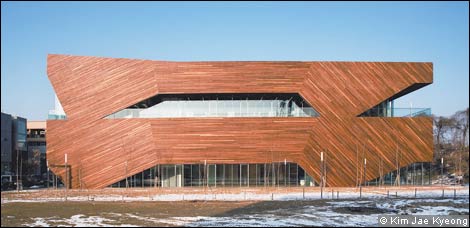
Publishing company Dulnyouk by Foreign Office Architects in Paju Book City, South Korea

Publishing company Dulnyouk by Foreign Office Architects in Paju Book City, South Korea

The idea of a city of books evokes a fantastical vision: towers of tottering volumes, narrow alleys formed by canyons and stacks of dusty hardbacks, formal avenues between loaded shelves. Like something imagined by Calvino or Borges, it conjures up a city of wisdom and surprise, of endless narratives, meaning, knowledge and languages. What it does not evoke is an industrial estate bounded by a motorway and the heavily guarded edge of a demilitarised zone. Yet somehow, South Korea’s Paju Book City begins to reconcile these two extremes into one of the most unexpected and remarkable architectural endeavours.

Built on marshland, former flood plains and paddyfields 30km north-west of Seoul, Paju Book City is an attempt to create an ambitious new town based exclusively around publishing. We may be reading obituaries of the book and the printed word almost daily, but the news has not reached Paju. Plans for the Book City were first proposed in 1989, as the country was emerging from a period of political repression. Publishing had gathered momentum and status after years of underground activity and censorship, and it re-emerged after the liberalisation of the regime in 1987 in an explosion of small, often family-run publishers. Their beautifully crafted books attempted to re-engage the nation with the history and culture that had been distorted, manipulated and lost over a period which included colonial rule from Japan, brutal civil war and military dictatorship. The project was also, at least in part, a reaction to the rapacious redevelopment of Seoul, the loss of the city’s historic fabric and its rapid embrace of the culture of bigness and congestion. That it was christened a “City to Recover Lost Humanity” tells us much about its creators’ intentions.

Publishing company Dulnyouk by Foreign Office Architects in Paju Book City, South Korea

Publishing company Dulnyouk by Foreign Office Architects in Paju Book City, South Korea

The project was initiated by publisher Yi Ki-Ung, whose ambition extended to creating a city of books that would also become a kind of museum of architecture: Paju features buildings by some of the finest architects working in the world today. The 1.5m sq m masterplan and the most sophisticated buildings on the site were carried out by the remarkable London-based Architectural Research Unit, run by Florian Beigel and Philip Christou. They wanted to create what they called, delightfully, an “urban wetland” – a paradoxical idea that allows them to root the new city in the landscape, to create something tied to its context rather than a suburban non-place. That context is beautiful, even epic, in its own way – the Han River, the mountain backdrop – but all that is cut off by the elevated motorway which also acts as a dyke. So the city is constructed on two levels: a dense street level, which accommodates the activity of the city itself, and a sparser upper level Beigel poetically refers to as “the strata belonging to the horizon”. Here a series of rooftop pavilions, elevated public spaces and buildings crowning bigger buildings below look over the road and out to the landscape beyond.

The city plan follows the contours and lines of the landscape, one main road snaking through it like a river and a series of tighter roads creating a denser network of small publishing houses, printers, distributers and so on. There are some extraordinarily ambitious buildings here. Just finishing construction is the Mimesis Museum, one of the Portuguese architect Alvaro Siza’s most arresting recent structures – its sheer concrete walls curve like the pages of a book in the wind, wrapping around a sculptural courtyard at its heart. SANAA, the Japanese architects of this year’s Serpentine Pavilion in London, have designed a stripped-down box, a publisher’s building of stark, striking elegance. London-based Foreign Office Architects have built a wonderfully theatrical publishing house which appears on the street as a modernist sliver, a delicately folded façade of glass which reveals sides with an almost nautical quality, clad in timber where they face a garden. There are exotically ambitious buildings under construction by Yung Ho Chang, Xaveer de Geyter, Stan Allen and some structures by Korean architects which would astound in any capital, let alone on a suburban Seoul industrial complex – notably those of Moogyu Choi and a bravado piece of concrete expressionism from Kim Jun-sung and Hallim Suh.

Youl Hwa Dang

Youl Hwa Dang

At the centre of the city stands a huge cultural complex, designed by Kim Byung-yoon, a combination of hotel (in which, it was pointed out to me, there are no TVs), restaurants, auditoriums and, on the roof, an urbane, elevated realm of seating, shops, libraries and galleries overlooking the sparkling waters of the river and the Simhak Mountain.

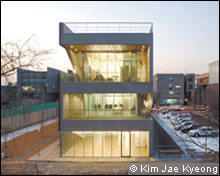
The finest buildings on the site, though, are by the ARU themselves (together with local partner Choi Jong Hoon). The first was for Yi Ki-Ung’s own Youl Hwa Dang publishing house, an enigmatic U-shaped building around a small courtyard. It looks like a bold pictogram, with a dark street façade, but to the courtyard there are “walls of light”, translucent membranes that recall the paper walls of traditional houses. An extension which contains a bookshop and café presents an intriguing contrast to the original buildings, retaining the subtlest memories of classical European urban architecture in moulding details, a portico and so on. This conservatism was conceived as a gentle provocation to the radical modernism all around and it works, with a startling clarity.

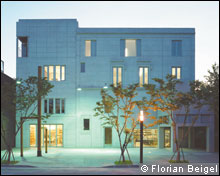
The ARU’s other structure, equally compelling, is for the Positive Thinking Publishing House. Designed as offices on a domestic scale and split into two units that create an intimate public plaza between them, they are built of traditional dark grey Korean brick set into a steel frame. The result is a hybrid of deeply embedded oriental and European archetypes. There is something here of Wittgenstein’s house, something of Beijing’s courtyard houses, a kind of Eurasian architectonic language which also, amazingly, manages to be conservative and deeply in thrall to the radical modernism of Mies van der Rohe. Inside, the surprises continue. The ceilings become an inverted urban landscape as a series of blocky paper lanterns break up the space from above. The domestic scale is wonderful: these feel like publishing offices, no plate glass, no open plan, rather a series of humane rooms, terraces and natural light.

If there is a problem at Paju it is that, as in all new cities, there is a kind of stillness, a lack of real density. This is compounded by zoning issues: as this is designated an industrial zone, the building of dwellings is difficult, and without places for people actually to live an area can never become a real city. Nevertheless, housing is slowly being built, and there are stirrings of the urban and commercial activity that constitute the beginnings of a real place.

It is not hyperbole to claim that this is one of the most extraordinary and most unsung cultural and architectural developments in the world. The idea that a city, right now, be dedicated solely to print and that an industrial estate could be a place of architectural pilgrimage could not be more heartening, more encouraging to anyone who delights in those very old information technologies – books and buildings.

Dedicated to a poetic Korea

Kevin O'Rourkehttp://www.irishtimes.com/newspaper/features/2009/0506/1224245988613.html
6 May 2009

Koreans have been described as ‘the Irish of Asia’, and after translating 2,000 of their poems, Fr Kevin O’Rourke is in a position to judge, writes DAVID McNEILL

IN HIS COURTING days, Kevin O’Rourke once walked the 17-mile journey from Cavan town to Clones, in nearby Co Monaghan, in pursuit of a girl. Adventures like that, in the countryside that inspired W Percy French, Patrick Kavanagh, Patrick McCabe and other writers may unwittingly have prepared him for his unusual path: becoming the world’s greatest translator of Korean poetry.

O’Rourke (70) gave up girls, Ireland and much else besides to achieve his task. “I set out to put out the entire Korean poetry tradition in English,” he says from his home in the Korean capital, Seoul. Nearly 45 years later, the job is almost done. Now a semi-retired Columban priest, O’Rourke is part of a tiny but renowned Irish group of Asian scholars, including Dublin-raised Lafcadio Hearn (1850-1904) and Co Mayo-born Eileen Kato, who died last year.

Fr O’Rourke’s journey from Cavan to professor of English literature in Kyung Hee University, Seoul, began after he was ordained in 1964. He plunged into his adopted culture, becoming the first foreigner to be awarded a doctorate in Korean literature at a local college in 1982. Early missionary work in a region that was recovering from the Korean war of 1950-53 was a delight, he recalls. “Every day was a new adventure, getting to these remote places in the countryside. Modernisation took a lot of fun out of it, to be honest.”

Like many translators, he was struck by similarities between his new language and the one he left behind. Ten years ago, he began working on the poems of the vagabond satirist, Kim Sak-kat (1807-1863), a deposed aristocrat who took to the road, recalling the wandering Gaelic poets of 16th-century Ireland.

“He earned his food, lodging and booze off his pen,” says Fr O’Rourke. “So when he went to your house and asked you for a bed and something to eat, he’d be very nice to you. But if you refused, he’d let you have both barrels and hang the result on your front gate, like the poets who went to the big houses in Ireland.”

The Koreans, with their history of colonialism, have been described as “the Irish of Asia” – not entirely complimentarily, he points out. “It means we’re rowdy, drink too much, a bit dirty in our habits, cry at the drop of a hat, and so on. But we do get along with them.”

Bringing Kim to the English-speaking world is part of an enormous labour of love that has made Fr O’Rourke a local celebrity. Over the years, he has translated about 2,000 poems, as well as stories and other literature, a task requiring a working knowledge of thousands of Chinese characters. Much of it has been published, but he is still grappling with his idea for an anthology of the collected poems, divided into two volumes, classical and post-1910.

“Korean poetry doesn’t sell, for some reason,” he says. “East Asian literature is occupied by Japanese and Chinese.”

He is also trying to finish a book that is a miscellany of his story, his own poems and lessons on “how to survive in an alien culture like Korea for 45 years”.

Every year, he makes the journey from the Missionary Society of St Columban in Seongbuk, northern Seoul, to Cavan, for the visitation of the local graves, and Rosslare, where he stays in his brother’s holiday home. The dictionaries stay on his desk in Seoul. “It’s difficult in Rosslare. The golf club is five minutes up the road and the sea is close by.”

Flaws in Korea in spite of a cutting edge

By Anna Fifield
http://www.ft.com/cms/s/1/4e7b6354-b073-11db-8a62-0000779e2340.html
Published: January 30 2007 18:24 | Last updated: January 30 2007 18:24

Diamond Dilemma
Shaping Korea for the 21st Century
By Tariq Hussain
Published in Korean by JoongAng Random House; available in English from www.lulu.com/diamonddilemma, $18.95

One of the biggest surprises when listening to Korean executives discussing business in their country is the level of complacency about the need for further corporate reforms.

“We have changed so much since the financial crisis,” they regularly say, citing the establishment of audit committees and the ap­pointment of outside directors.

It is true that the 1997 crisis and the spectacular collapse of the Daewoo conglomerate preceded wide-ranging improvements in corporate governance practices. At the same time, Korean companies have metamorphosed from copycat manufacturers into world-class producers of mobile phones, computer chips and cars.

But many of the governance changes have been superficial and are aimed at appeasing shareholder de­mands without eroding the founding family’s control.

The continuing shortcomings in corporate Korea have been starkly illustrated just in the past year by scandals at the two largest chaebol conglomerates – Samsung’s chairman is suspected of consolidating family power by illegally transferring equity to his son, and the head of Hyundai Motor is facing prison for operating slush funds.

The chaebol conglomerate groups are the cornerstones of the Korean economy, but if they continue to operate in this way they will soon go from economic champions to economic millstones.

In Diamond Dilemma, Tariq Hussain, a German who speaks fluent Korean and has worked as a management consultant in Seoul for the past decade, acknowledges the significant prog-ress made by corporate Korea since the crisis.

But, as he says in this constructive book, Korea needs continued reform to achieve its “brilliant” potential: “Korea is a diamond. It is small, tough and has proven its potential to shine,” Mr Hussain writes. “However, Korea is still unfinished. It has not yet been cut into its final shape and therefore underestimated by many who do not know it. Korea’s future could be literally bright – or the country could fail to achieve its potential and lose its shine.”

The diamond analogy on which the book, published in Korean last year and now being released in English, is predicated becomes a little strained by the end of the book. But as well as offering a concise, readable history of Korea’s astonishingly fast industrialisation from one of the world’s poorest countries half a century ago to the 10th largest economytoday, it also lays out in broad terms the areas that the nation must focus on if it is to avoid squandering its gains.

“Much of Korea’s dynamism is happening at the edges, and not at the core of the economy,” Mr Hussain says. “Korea Inc is still holding on to its old ways of doing business, and not changing fast enough to cope with necessary changes.”

Government rules and regulation remain too rigid and union militancy is still a major problem; but most of all Korea is too dependent on the chaebol and the few products they make.

If it continues on this path, Korea could fall into a German or Japanese-style rut, Mr Hussain warns. “Korea has emulated the best of Germany and Japan when it rose to prominence – it should avoid learning the worst as well,” he says, adding that Korea is already saddled with the worst aspects of each of those two countries – respectively, rigid labour unions and an overactive government.

To ensure it continues to shine, Mr Hussain says, Korea must be more aware of the threat of China, which is catching up with Korea in almost all industries.

Second, it should stop the chaebol from falling back into their pre-crisis habits and from operating under the assumption that they are too big to fail or be challenged.

Third, Korea needs a new generation of companies that are not dependent on the government or on the chaebol to drive future growth.

Fourth, foreign direct investment remains “woefully low” because of an overactive government, un­welcoming labour unions, and continued scepticism towards foreign companies, Mr Hussain says.

Korea is now at a critical juncture where it must choose between reaching its full potential as an entire economy, rather than just a few outstanding individuals, or carrying on, missing opportunities and facing economic stagnation.

“The new way of thinking will not be about ‘trying harder’ – rather, it will be about trying a different approach: for government, chaebol owners, and labour unions to let go of their grip on the economy and society,” he says. “Only then can Korea’s economy and society overcome its rigidities, factions and pseudo- globalisation.”

Samsung’s chairman Lee Kun-hee once famously ordered his executives to overhaul the electronics company with the directive: “Change everything but your wife and kids” – a lesson the Korean economy as a whole could learn from.

Ancestor worship

By Y. Euny Hong
http://www.ft.com/cms/s/2/0f721f38-ebb4-11da-b3e2-0000779e2340.html
Published: May 26 2006 15:28 | Last updated: May 26 2006 15:28
hong1
My parents have a very large, very ugly framed photo hanging in their living room. It was snapped by King Gustav VI Adolf of Sweden on one of his famed archaeological visits to Asia in the 1950s and depicts a prehistoric cave drawing of a dragon near the border of China and North Korea. The king presented the photo to my grandfather as a diplomatic gesture. It has been touted as material evidence of the splendour that was my family. I have always found this story odd, but my family has been in decline for more than five centuries, so it is important to cling to these things. This isn’t exactly what one would call raging against the dying of the light.

I can trace my ancestry 28 generations on my father’s side and 26 on my mother’s; in both cases the progenitors were Korean feudal monarchs. Here’s what the family is up to now. An uncle, who was in medical school 40 years ago, is a waiter in a restaurant, as is his son. A cousin began his career as a brilliant architect, but was unwilling to compromise with contractors and clients. While still in his 30s, he gave up on working altogether; he is now an amateur water-diviner. A beauteous aunt, banished by the family for some vague malfeasance that can only be described as excessive commonness, became a hand model in New York before falling in with some dubious rich fellow. She died in a fire in her hotel room. As I grew into adulthood, I came to suspect that she had lit it on purpose. It seems a fitting end for a goddess in her twilight: setting Valhalla aflame and going down with it.

In the US, where I have spent much of my life, most people imagine that the Old World aristocrats living among them lead fabulous lives; that they are like the most popular clique in high school. It was not like that at all for my family or for any of their fellow expat Korean bluebloods who lived here. Most of the ones I know are not gregarious at all; they are antisocial, often agoraphobic.

In his book The Periodic Table, Primo Levi compares his relatives to inert gases, remarking that such gases are also known as “noble” gases – so dubbed because they were thought not to react to things around them; to resist change. Perhaps the metaphor requires updating: noble gases do not live in mortal fear of contamination, whereas noble people do.

Most parents place restrictions on the kinds of friends their children are allowed to have, but few took it to the extremes that my parents and their friends did. From the day I was born until the day I left home for Yale, I never had a friend over at my house for dinner, unless of course their parents were friends of my parents, and they had been dragged along. Birthday parties were one of only a handful of exceptions. My parents’ unimaginative explanation was that they didn’t have liability insurance.

To avoid having to return invitations, they forbade me, on pain of thrashing, to eat or drink anything other than water at a friend’s house. Anyone who started to become close to me was put off sooner or later by my coldness and inability to give or receive hospitality. But no matter, because by early adolescence I had been fully indoctrinated in the belief that anyone outside my family was second-rate. My relatives were my only friends.

I didn’t spend too much time worrying about my future because I was too stupid to understand that while my family might have been symbolically important, it was no longer influential.

Contrary to the common stereotype that all Asian families want their children to become medical doctors, my father instilled in me and my sisters the belief that medicine was a manual trade and therefore far beneath us. He once sniped at his brother-in-law, a physician, “an MD isn’t a real doctor”. By this he meant that only academics should bear the title, as is the case in some parts of Europe. Recently, one of my sisters, somewhat estranged, called my father crying; a debt collector had threatened her with legal action. He bailed her out, as he always did, then wrote to all three of his daughters expressing deep regret for any inculcation on his part that discouraged us to learn a trade.

Upon graduation from Yale with a degree in philosophy, I found myself deeply in debt and, for a good while, unemployable. Reluctant to learn a trade, I often fantasised about being a 19th-century French courtesan, thinking that it was the only profession for which my upbringing, languages and knowledge of opera would not go to waste. Happily, I never pursued that scenario.

It is especially depressing to be an immigrant blueblood in the US if one also happens to be from an ethnic minority. The latter status always trumps the former; a price most of my family were unwilling to pay. My parents first settled here in the late 1960s to pursue their doctorates. They had three daughters, of whom I, at 33, am the eldest. When my parents saw that they had grossly overestimated their ability to live without a sense of entitlement, we moved to Korea. I was 12; my sisters were 10 and eight, respectively. It was a decision that brought extreme misery to us all. My sisters and I all fled to the west at our first opportunity, when it came time to go to university, and to the great disappointment of my father, we never resettled in Korea.

Many of my parents’ high-born Korean colleagues who had emigrated to the US as students repatriated to Korea shortly after we did, out of similar disgust.

Having at one time lived in Germany for several years as a freelance journalist, I find the continentals much more accommodating than Americans of minority bluebloods. Though Europeans are often defensive on this matter, they still take for granted the difficulty of changing one’s status, for good or for ill. They accept, with surprisingly little paranoia, that my background, education and so forth entitle me to certain privileges and opportunities, irrespective of race. Especially indulgent are the French, who coo over the fairy-tale exoticism of a petulant young Korean woman speaking their language. Not that Europeans are less racist than are Americans, mind you; but they have very small east Asian populations; I am never mistaken for a cab-driver, a job-stealer or a terrorist.

My friend Harold (not his real name), a fellow Korean-American, is distantly related to the last Korean royal line. His family is very well known in Korea, and is far more illustrious than mine. His entire family prepped at Andover (the school that moulded the Bushes) and attended Ivy League universities; they are financially comfortable but discreet about it, genteel and well-mannered. Harold now lives in Manhattan. A few years ago he entered a friend’s office building and was stopped by the concierge, who assumed that he was a Chinese-food delivery boy and told him to re-enter the building through the back door.

Families like mine and Harold’s are approaching obsolescence in our home country as well. My family’s heyday, in fact, had ceased by the time the last Plantagenet breathed his last.

It’s not modernity’s fault that my family has a poor work ethic. And despite all my father’s claims, there was never a time in the history of the world when our way of doing things would have fallen into the category of how ladies and gentlemen should behave. My family is belligerent with subordinates; we make waitresses cry.

After my family lost their feudal monarchies hundreds of years ago in some sort of skirmish with rival lords, they became court advisers to subsequent kings. Confucianism, which was in full swing by the 16th century, was the second big blow to my family line. Confucianism heavily emphasised scholarship, and consequently government posts were determined by exams. Fortunately for my ancestors, it was not a true meritocracy: one had to be of noble birth to sit for the exams. So my family was still protected, somewhat. Within a very rarefied environment, they were able to survive.

When the Japanese colonised Korea in 1919, it was not by invasion. At the time Korea was being courted by several world powers simultaneously, it had to choose one coloniser, or have the choice made for them. People like my ancestors advised the Korean royal family to hand the country peaceably over to Japan. Many Korean nobles believed they stood a better chance of retaining their power under the Japanese than the west. The Japanese government rewarded my relatives by giving them positions as viceroys, legal advisers and so forth, but with greatly limited autonomy.

When, at the end of the second world war, Japan relinquished Korea, the latter formed an independent republic. The new regime branded many of my ancestors as traitors; some were hanged, lynched or kidnapped. Very fortunately for me, my paternal grandfather was just unimportant enough to survive. Under the Japanese he had been a viceroy for a remote province in what is now North Korea; offing him just wasn’t worth the bother.

My grandfather had a stroke of luck. The purging left few people qualified to run a government, so imperial loyalists like him had to be given posts in the new government (a fate that also befell post-Third Reich Germany). He became a presidential cabinet minister.

Still, democracy proved the bluebloods’ greatest nightmare. My mother’s family lands were seized by the government and redistributed to the poor. Faced with the prospect of competing with the public at large, my family found itself unequipped for the battle of life.

My father failed two classes at the elite Seoul National University. The way he tells the story, he did it deliberately. “It was called a double-holster,” he would say. It was a way of distinguishing himself from the common upstarts who had been admitted to university based entirely on their exam scores. Those poor slobs would have to endure the humiliation of interviews with strangers in order to get jobs; my father and his family had never had a job interview in their lives.
hong2
There was just one problem: he wanted to go on to graduate school in the US. He was rather shocked to learn that the Americans did not recognise the symmetry and sublime gentility of two “F”s. American brahmins did have a tradition known as the “Gentleman’s C”, but it didn’t apply to foreigners, and at any rate an F is not a C. With some dues-paying, he got his doctorate and became a reasonably successful economist, first in the US, then in Korea. Still, he has always considered himself a failure. He is inconsolably upset that he can’t have the words “cabinet minister” chiselled into his tombstone after he’s dead.

Which brings us to the present day: we are finished.

Korea is now in its Fifth Republic, though it has only been a democracy for two decades.

An uncle in Seoul continues to wear a tiepin with the logo of his elite secondary school, though the school has long ceased to exist; it is his defiant “piss off” to the changing world around him. But he, like the rest of us, is a museum piece.

The Korean presidential election of 2002 was the most recent, and possibly final, cut of all. Lee Hwe-Chang, the fellow who lost, had gone to the same schools as my father. In fact, my father served as an ancillary adviser to Lee during his campaign. The Korean people, however, found Lee too patrician. When he lost, it was the shot heard round the world. Around my family’s world, at any rate.

President Roh Mu-Hyun, who won and who still occupies that post, is a man of the people. He very nearly wants to tar and feather families like mine. He has suggested dismantling Seoul National University, the school that educated most of my family for generations, on the grounds that it fosters an oligarchy. If he gets his way, the school will be split up and lose its grande-ecole status, as it were. My father saw the new regime as a sign of our family’s permanent disenfranchisement. He fell into a deep depression from which neither he nor the rest of my family will recover. To fill the void, he took up and dropped various hobbies. At one point, he suggested to my mother that the two of them fill their lives by taking in foster babies. (My mother’s horrified response: “We’re too old.”) He finally got out of his funk by burying himself in the writing of an economics textbook.

Still, we will never be the same. Evidence of my family’s acceptance of defeat is that no one seems to care any longer whether any of the family newborns are boys. My eldest male cousin, who would have been the head of the family for my generation, died of cancer 10 years ago. His father had placed many of the family holdings in this son’s name, because this practice seemed to have the magical effect of making the properties rise in value; using any of his other children’s names seemed to make prices stagnate. Because of a legal technicality, and the Korean tradition of honouring common law over personal wills, my cousin’s widow received a great deal of my family’s property, including the family cemetery. This would not be such a serious problem except for the fact that she has cut herself off from the Hongs. She eventually ceded the cemetery, after my father gave her a very hard time. So occasionally, the family bullying tradition does have its merits.

Still, having the cemetery is less important to my father’s generation than ensuring that someone will maintain it and organise the rituals of ancestor worship. There’s no one left. The next male in line is the aforementioned water diviner, who seems to have become Christian, which precludes it. The male after that is from yet another estranged branch of the family; the father-son waiter duo. The rest of my cousins are in the US. As for my generation, everyone keeps popping out girls – which, some say, is what happens to the weak. Our family line, in many ways, is finished.

In theory, the way our family has handled such tragedies is by convincing itself that bad luck was somehow a good thing. Whenever I have a setback of any kind, my parents repeat a fable they have been repeating since I was a child. The story tells of a farmer with a wife and son. One day a beautiful stallion wandered into their grounds; they kept it, and the villagers cried, “How lucky you are!” Then one day, the farmer’s son fell from the horse and was crippled, and the villagers cried, “How unlucky you are!” But soon a rival feudal lord came around to the village to recruit all able-bodied men into his army. Because the farmer’s son was crippled, he was left alone. “How lucky you are!” the villagers cried. The story has no end, in theory. Its veracity was borne out by several family anecdotes.

One of these is the aforementioned story of how my grandfather’s low bureaucratic rank under the Japanese prevented his execution in the subsequent Korean republic. Another is the fact that my father missed out on speculative investments in Korea for which his friends got in on the ground floor. This distressed him greatly; he blamed my mother for delaying our repatriation to Korea; if not for her, we would be making a killing, he said. It turned out, however, that the investments were fraudulent, and some of his friends are now in prison.

The lesson that my sisters and I were taught to draw from this are: (1) only idiots get excited about things, for good or for ill, and (2) good luck is actually bad luck, and vice versa.

So what happens when good luck is really bad luck, and fair is foul, and foul is fair? All words are emptied of meaning. A family can only pretend for so long that it has a healthy appetite for the absurd; soon indifference begets the desire to cease to be, and then the noble really do become inert.

Y. Euny Hong’s first novel, “Kept: A Comedy of Sex and Manners”, based partly on her family, will be published in the US by Simon & Schuster later this year.