Why Does Rage Define ‘Parasite’ and Other Popular East Asian Movies?

Thessaly La Force
https://www.nytimes.com/2019/11/25/t-magazine/asia-movies-parasite.html

Many thriller and horror films from Japan, China and South Korea reveal a complicated relationship between those societies and the ancient tenets of Confucianism.

THE CENTRAL OBJECT in the director Bong Joon Ho’s newest film, “Parasite,” which won the Palme d’Or at this year’s Cannes Film Festival, is a suseok, or an ornamental rock. Scholar’s rocks, as they are also called, represent the unity of humans and the cosmos as venerated in Confucianism. They are formed by nature into aesthetically pleasing shapes — and, as we soon learn in “Parasite,” are harbingers of good luck. The film opens with the Kim family, who live in a basement apartment on a dead-end street in Seoul. They are broke and unemployed, resorting to folding pizza boxes for a nearby restaurant to make money. By chance, the son of the family, Ki-woo, is visited by a former classmate, Min, who is quitting his gig as an English tutor to a wealthy schoolgirl to study abroad and wants Ki-woo to take over. Before leaving, Min gives the Kims a suseok that once belonged to his grandfather. Fortune is such an abstract idea to the struggling Kims that Ki-woo’s mother, Chung-sook, wonders why Min couldn’t have just brought them something to eat instead.

And yet, whether through coincidence or the rock’s ancient powers, the moment the suseok enters the Kims’ lives, their luck changes. Ki-woo arrives at the home of the Park family, a Modernist palace set in the upper-class Seongbuk-dong neighborhood situated high above the rest of the city. Going by the name Kevin, he shows the sweet and gullible Mrs. Park a doctored diploma, which she dismisses — personal recommendations matter more than paperwork. Her other child is a difficult and artistic little boy, and Ki-woo slyly suggests that Mrs. Park hire an art tutor he knows, Jessica, who is in fact his sister, Ki-jung. Soon, through a series of subtle deceptions and maneuvers, the Kims infiltrate every part of the Park household’s staff: Their father, Ki-taek, takes over as chauffeur after the Kims lead the Parks to believe that their previous driver is a sexual deviant; their mother replaces the housekeeper, Moon-gwang, after the Kims convince the Parks (falsely, of course) that Moon-gwang has tuberculosis.

In this way, the Kims turn the Parks into a financial life raft, and their scheme seems perfectly sound until they discover an even lower-class leech living among them: the former housekeeper’s husband, who, hunted by loan sharks, has been stashed away by his wife in a subbasement that even the Parks aren’t aware exists. The room is heavily symbolic — the poorer the person is in “Parasite,” the farther underground he dwells — and yet it is also a practicality: Rooms such as this, we are told, are a common amenity in wealthy homes, a safeguard against nuclear attack, perhaps, or a place to hide your worst secrets. This discovery throws the Kims’ plans into disarray and, like Chekhov’s gun, the suseok returns, not as a symbol of fortune but as a weapon, setting off an explosion of violence with a Shakespearean-level death toll.

If a desire for wealth propels “Parasite,” then class differences are the film’s foundation. Mrs. Park is “nice because she’s rich,” says Chung-sook, observing what money actually affords people. And yet the suseok is a metaphor for something more ancient — the Confucian philosophy that still influences South Korean society, a place where fundamental beliefs about obedience and respect have been manipulated to create a highly wealthy and functional economy, one in which women are not considered equal to men and where there is an ever-widening divide between rich and poor: the result of a relentless pursuit of rapid economic growth.

Like South Korean cinema, the staples of East Asian and some Southeast Asian cinema are steeped in florid personal vengeance narratives — from Akira Kurosawa’s 1957 “Throne of Blood,” an adaptation of Macbeth, to Kim Ki-young’s psychosexual 1960 thriller “The Housemaid” (and its equally disturbing 2010 remake by Im Sang-soo) to the vengeful ghosts of Japan’s 1998 horror film “Ringu” to the ultraviolence of Park Chan-wook’s vengeance trilogy, which includes the acclaimed 2003 movie “Oldboy.” These films are among the most violent and gruesome in cinematic history: gothic spectacles of anger and obsession. They present families and relationships that seemingly obey the tenets of a harmonious society. But eventually, something goes wrong, harmony is disrupted and violence ensues. All of the films contain elements of exoticism: Submissive women are seduced; a man eats a live octopus. These details reveal, in part, why these movies surprise and delight American audiences. But below the surface is a deeper rupture. These movies both reinforce certain Confucian values and simultaneously combat stereotypes about Asians: that they are obedient, dutiful, loyal, timid and fearful. Of course, nothing could be further from the truth.

Just as Alfred Hitchcock invented an entirely new genre of film by channeling European wartime anxiety, films such as “Parasite” challenge globalization and its effects. The Park family displays their wealth not just in their ability to afford a full-time staff but also in their embrace of Western culture. Mr. Park works for a multinational company; Mrs. Park casually drops English words into her speech. Yet what powers the story is the profound rage that runs beneath all the characters’ lives, an infection about to erupt.

CONFUCIANISM ORIGINATED IN ancient China with the scholar and philosopher Confucius, who was born in 551 B.C. After being formally adopted as a political ideology during the Han dynasty (from 206 B.C. to A.D. 220), a golden age of learning and law whose influence lasted for nearly two millenniums, it traveled east, first to Korea and then Japan, by means of its own popularity but also the dominance of the Chinese Empire. Confucianism proposes the idea that people are fundamentally good, that we are capable of improving ourselves through education and self-cultivation. It emphasizes loyalty, sacrificing one’s own goals and satisfaction in order to maintain traditional hierarchies and the status quo: A citizen is faithful to his country, the son to the father, the wife to her husband, the younger brother to his older brother. In more contemporary times, the philosophy has re-emerged as a political ideology: In 2013, President Xi Jinping of China made a pilgrimage to Qufu, Confucius’s hometown, and promised to make “the past serve the present.” But it has also occasionally been used — much in the way democratic ideals are employed to promote a neoliberal, Western agenda — to justify the larger mechanics of political maneuvering. On the one hand, it’s surprising that these East Asian societies that so value obedience should have perfected the revenge narrative in popular culture, though on the other, it isn’t at all: When the idea of obedience is used to justify authoritarian governments and socially rigid hierarchies, rebellion is never far-off.

But why is cinema, in particular, such a powerful tool for telling stories of rage and revenge? The contemporary literature of East and Southeast Asia also touches on these topics: The 2007 South Korean novel “The Vegetarian,” by Han Kang, tells of a wife’s revulsion to meat that upends her place in society; the short stories of the Japanese writer Taeko Kono, whose violent fantasies of disemboweling toddlers can be difficult to read, speak to a deep-seated rage of being an independent woman in 1960s Japan. But fear is more easily manufactured with movies, a visual medium that lends itself well to making the gruesome and ridiculous seem possible.

Movies are also easier to export. Martial arts films of the ’60s and ’70s required little in the way of dialogue — the plot was advanced by a well-choreographed fight. Similarly, these revenge films rely on a lexicon of violence: Nearly every culture understands the danger of a hidden gun, of looking into dark corners during the middle of the night. And as disparate as these films can be, they’ve also created visual tropes of their own: Eyeballs and ears are gouged with blunt objects, people are shot point blank, people fling themselves from buildings. Women — thin and unsparing, tough and uninterested in sex — often take center stage. Sex, incidentally, is rarely a focal point, but when it is, it is in service of character development or humor — “Buy me drugs,” Mrs. Park coos to her husband in “Parasite” in the middle of the act, in a scene that is as bizarre as it is pathetic. By contrast, in American horrors and thrillers, a woman who has been sexualized onscreen is usually the first to die.

THE REVENGE NARRATIVE of East Asian cinema is often rooted in the breaking of tradition. Jia Zhangke’s 2013 “A Touch of Sin” examines what happens when individuals choose to confront corruption and inequality. It tells four loosely intermingled stories of a group of ordinary Chinese citizens; the first centers on Dahai, a poor villager in Northern China’s Shanxi Province, who is angry that the village boss of the local coal mine hasn’t fairly distributed the profits from its sale. What follows is a classic sequence of violence, in which Dahai, rifle in hand, enacts bloody revenge against each person who has caused him distress — from the coal mine owner to the idiot farmer who savagely whips his horse. It’s hard not to cheer for Dahai, who represents a simple desire for equality, as he leaves a path of bodies behind him — here is someone who seems to be broadcasting his anguish beyond his private enemies and onto society as a whole.

Which is to say that the morality in “A Touch of Sin,” as in “Parasite,” is askew. This, too, has become one of the major emblems in today’s Asian cinema. Near the end of Chan-wook’s 2005 “Lady Vengeance,” a young woman named Lee Geum-ja, who has been wrongfully imprisoned for 13 years for the death of a 5-year-old boy, finally has the man actually responsible for the crime tied up before her. She offers the assembled group of parents whose children were also murdered by the man a choice: They can hand the case over to the detective (who is also present) or they can solve the problem themselves. They choose the latter, and the resulting scene is at once violent, cathartic, therapeutic, restorative but also utterly grotesque and horrifying.

It’s telling that most of these films, unlike most of Western cinema, rarely incorporate an authority figure such as the police or a judge — if they do appear, it is often as an accessory. The fight for justice nearly always happens on the individual level, but in the interest of a shared goal of vengeance, which is both a repudiation of Confucianism as well as an embrace of it. If Western films depict vigilantism as romantic, East Asian films embrace the idea that the individual is sometimes the best person to answer to his wrongs. Western horrors and thrillers operate with and against Puritanical values — evil is innate and must be purged, purity is often defiled and can never be recovered. But the Analects, an ancient text composed of ideas and sayings directly attributed to Confucius, espouses the transformative power of virtue. Nothing should be coerced, nothing forced. Confucius said: “Not to mend one’s ways when one has erred is to err indeed.” Justice is more complex when one has been wronged, and when morality becomes disconnected from a clear set of laws. In a Confucian society, where there is no distinct sense of heaven or hell, where a deity will not necessarily punish you for your sins and where citizens must ultimately manage one another, these movies suggest a different course of action. Violence is not necessarily immoral, if done for the right reasons. Just be aware of what such actions ultimately do to one’s self. As Confucius also said: “Recompense injury with justice, and recompense kindness with kindness.”

THERE IS A Korean word, han, that has been used to describe the violence of Asian cinema. The word doesn’t have an English equivalent but encompasses feelings such as suffering, anger, resignation, grief, pain, longing and revenge. The term became popular in the 1970s, as Koreans advocated for a kind of cultural authenticity. But its origins are from the Japanese occupation of Korea in the early 20th century, when the Japanese art critic Yanagi Soetsu described the artworks of Korea he admired as possessing a kind of “beauty of sorrow.” In the ’70s, the poet Kim Chi Ha likened han to a “people eating monster,” saying that “accumulated han is inherited and transmitted, boiling in the blood of the people.” “Han” may be a distinctly Korean term, but it is the one that best describes contemporary Asian cinema writ large as it attempts to reckon the present with its past — it stands for a collective trauma, a larger idea of suffering that can move through generations and settles into the bedrock of history. Today, the idea of loyalty, of obedience and self-improvement, can seem hopelessly outdated, as can the idea of achieving a collective harmony in the face of poverty and greed. Rage is a destructive emotion in this equation, but within art, it is also radical and, in rare moments, elucidating. The best of these films understand that the outcome of pitting people against one another can be violent, that it will invariably end badly. But they also understand that a repressive society can transform individuals into monsters.

In “Parasite,” none of the families involved are responsible for the inequality of the society that has made their situations so different, and neither are they necessarily best equipped to answer for it. These films appeal to a need to confront a deeply inflexible world. They’re not interested in showing the hero’s journey that results in both victory and a personal transformation. Which is why we cheer for our doomed protagonists even when we know that tragedy is inevitable. These films make us recognize that our desires and our impulses — our sense of what is wrong and right, but also what we irrationally want — are often rooted in a past that can be hard to see, like the edges of a riverbed from which a beautiful limestone rock was once lifted.

https://twitter.com/muqingmq/status/1199018928535568385

Artist Zadie Xa on Art Night festival, sea animals and highlighting minority stories

https://www.standard.co.uk/go/london/arts/artist-zadie-xa-art-night-festival-interview-a4170631.html
Ben Luke – Evening Standard

This slideshow requires JavaScript.

When I walk into a yard behind Zadie Xa’s East End studio, she’s in the middle of a fascinating process. With her husband, artist Benito Mayor Vallejo, she’s just revealed some unmistakable shapes from fibreglass moulds: the dorsal fins of orcas.

These cetacean curves are part of a rich, complex new performance and installation, Child of Magohalmi and the Echos of Creation, that Canadian-Korean Xa is developing for Art Night, the annual one-night-only visual arts extravaganza. This year it is happening in Walthamstow and Xa joins a great line-up, featuring established names like Barbara Kruger and Oscar Murillo alongside emerging artists such as Hannah Quinlan and Rosie Hastings.

There’s a big buzz around Xa: in May, a performance by her was part of the Venice Biennale opening, and once Art Night is done, variations of the project travel to Yarat in Baku, before heading to Tramway in Glasgow, and then on to De La Warr in Bexhill-on-Sea.

For now, though, the orcas are headed for Walthamstow Library’s reading room. They will be part of a subaqueous world with conch shell sculptures which are speakers for a sound work, video projections, and performers donning masks and wearing clothes that Xa has designed and made.

The orcas were inspired partly by a recent filming trip to her native Vancouver. Killer whales were a staple of her childhood imagination and “a mythologised animal within local indigenous cultures”, she says. “Subconsciously, whenever I think about that animal, I think about my home.”

She’s particularly fascinated by a small, endangered pod off the west coast of the US and Canada. A “grandmother orca” in the pod, named Granny, was thought to be 105 years old before her death in 2016 and Xa is interested in orcas’ matrilineal family structures. “They all learn their survival and social skills through their mothers and grandmothers,” she explains.

She’s long been preoccupied with matriarchies, and the Magohalmi in her title is the central figure of an old Korean creation myth — Grandmother Mago, who created “geological formations, bridges, fortresses, lakes… out of her excrement and mud”. Her mother would tell her Korean folk tales as a child. “So for me it was a nostalgic entry point into feeling like I could [explore] aspects of historical Korea.”

She was inspired by the research of the academic Helen Hye-Sook Hwang. The story had been passed down orally and it was only in the Eighties that it was rediscovered.

“Throughout history [Magohalmi’s] name and her memory has been washed away or really caricatured,” Xa says, “because male scholars didn’t find this an interesting story.” She sees the parallels in “women’s stories or ‘minority’ stories being washed away or erased because they’re not deemed important”, she explains. “It was something I felt passionate about highlighting.”

She weaves these disparate elements together, linking not just Magohalmi with Granny, but the reverberations of cosmic music that gave birth to the goddess with the orcas’ use of echo-location. “The underpinning of my story for Art Night is thinking about the environment and specifically the plight of these whales,” she says.

The orcas have suffered terribly from what Xa calls “all these obnoxious things humans do” — overfishing, fish farming, chemical and noise pollution. But, influenced by Art Night curator Helen Nisbet’s quirky idea to take East 17’s song It’s Alright as inspiration — this is Walthamstow, after all — Xa says the work is not pessimistic.

“I can be really nihilistic and think everything’s going really terribly,” she says. Instead, she thought about the strength in familial love, “in my case with the women in my family” — Xa says she doesn’t have a relationship with her father’s family.

There’s hope in Xa’s story: Magohalmi was written out of history, but has returned. “She’s basically saying, ‘Let me tell you what happened: they tried to write me out, but it’s not happening, because I’m here.’” And though it’s not didactically expressed, Xa’s work is a call to bring the environment back from the brink. “How are we able to move forward?” she asks.

Aside from this urgent eco-feminist message, the project reflects Xa’s defiant exploration of her Korean diasporic identity. Her work is full of colour, playfulness and visual thrills, inspired by Korea and perceptions of it. “In some ways I feel embarrassed about how garish I am,” she says with a laugh.

Growing up in Vancouver, racism made her recede into the background, she says. Now 35, and living here in London, “I’ve flipped that and I want to be hyper-visible and aggressive with it. This is just the way I feel comfortable with it, and it’s in no way that I need to convince myself how great it is to be a person who’s Asian. But I’m really excited to be at a point in my life where I can finally celebrate it.”

Art Night 2019 is part of Waltham Forest London Borough of Culture and takes place across venues in Walthamstow & Kings Cross this Saturday, June 22 (artnight.london)

Locked and Loaded for the Lord

After the Rev. Moon died in 2012, his church split apart. Two of his sons established a new congregation. Their followers are eagerly awaiting the end times. And they are armed.

https://www.washingtonpost.com/news/style/wp/2018/05/21/feature/two-sons-of-rev-moon-have-split-from-his-church-and-their-followers-are-armed/

Story by Tom Dunkel Photos by Bryan Anselm

Hyung Jin “Sean” Moon, leader of Sanctuary Church

Hyung Jin “Sean” Moon, leader of Sanctuary Church, wears a crown of rifle shells and holds a gold-plated AR-15.

Sanctuary Church — whose proper name is World Peace and Unification Sanctuary, but which also goes by the more muscular-sounding Rod of Iron Ministries — stands inconspicuously on a country road that winds through the village of Newfoundland, Pa., 25 miles southeast of Scranton. The one-story, low-slung building used to be St. Anthony’s Catholic Church. Before that, it was a community theater, which is why there are no pews, only a semicircle of tiered seats facing the old stage, now an altar.

On a Sunday morning in late February, 38-year-old Pastor Hyung Jin “Sean” Moon, son of the late Rev. Sun Myung Moon, entered stage right wearing a white hoodie and cargo pants. He strapped on a leather headband and picked up a microphone. “Okay, take it away,” he said to the electric pianist and two female vocalists who function as the choir. They launched into the first of four songs: “O, light of grace, shining above / lighting my dim shadowed way …”

The 200-plus congregants packed into the room sang along with gusto. Pastor Sean stood by his front-row seat with his wife at his side, wringing his hands like an orchestra conductor. The song cycle ended and, after a brief prayer, he took center stage. “Look at all these crowns of sovereignty!” he exclaimed, gazing upon his audience. One tenet of the Sanctuary Church is that all people are independent kings and queens in God’s Kingdom — a kind of don’t-tread-on-me notion of personal sovereignty. Hence, symbolic gold and silver crowns bobbed on row after row of heads.

TOP: Attendants hold assault rifles during a sermon at Sanctuary Church in Pennsylvania. LEFT: Members during a blessing ceremony in February. RIGHT: The congregation during a sermon.

This crowd was about twice the usual size because this service was the warm-up for a renewal-of-marriage-vows ceremony scheduled for Wednesday morning. Scores of couples already had arrived from Japan and Korea. That ceremony — officially, the “Cosmic True Parents of Heaven, Earth and Humanity Cheon Il Guk Book of Life Registration Blessing” — would cap a week of activities that thus far had included an arts festival, a survival skills contest and a goat-butchering demonstration.

The wedding-blessing event was generating nationwide attention — something new for Sanctuary Church, which, until now, hadn’t even registered on the radar of the Pocono Record, the local daily newspaper. A key pillar of Sanctuary dogma is the importance of owning a gun, particularly the lethal, lightweight AR-15 semiautomatic, which the National Rifle Association has proclaimed “the most popular rifle in America.” Last fall, Pastor Sean had studied the Book of Revelation. It makes multiple references to how Christ one day will rule his earthly kingdom “with a rod of iron.” Although Revelation was written long before the advent of firearms, Pastor Sean concluded that “rod of iron” was Bible-speak for the AR-15 and that Christ, not being a “tyrant,” will need armed sovereigns to help him keep the peace in his kingdom.

As a result, a recent Sanctuary Church news release had noted that “blessed couples are requested” to bring with them to the upcoming Book of Life ceremony an AR-15 semiautomatic rifle “or equivalents.” This was unfortunate timing for the Church: The next day a young man walked into Marjory Stoneman Douglas High School in Parkland, Fla., and killed 17 people with an AR-15. Shooters had used that same model rifle to carry out mass murders in Las Vegas; Orlando; San Bernardino, Calif.; and other cities.

That latest tragedy was freshly imprinted on millions of minds, among them Pastor Sean’s. He eased into his hour-long Sunday morning sermon by reminding everyone of what President Trump had pointed out after the Parkland shooting: “He said if the teachers were armed, they would have shot the hell out of that guy. This is the first time we’ve heard a president talk like that. This is God’s grace, folks.”

Virtually the entire congregation was coming back on Wednesday for the big blessing ceremony, so he reviewed some safety precautions, like securing rifle triggers with a zip tie: “Remember, folks, you can never take back a bullet.” That was not to say worshipers couldn’t pack heat. Anyone with a concealed-carry permit was welcome to bring their loaded pistol Wednesday (their “mini rod of iron”) in addition to their AR-15. You never know, “there may be a wolf in sheep’s clothing who tries to make trouble,” said Pastor Sean.

After delivering a few social announcements (parents seeking marriage partners for their adult children were meeting at 3 p.m.; tomorrow at 5 p.m. there would be an AR-15 “breakdown” tutorial on how to properly disassemble the rifle), Pastor Sean delivered the meat of his sermon. He plowed familiar ground at first, citing Bible passages where the “rod of iron” was used to smite evildoers. Pacing the altar, he then segued into a freewheeling, gunfire-and-brimstone diatribe.

“You must shed the slave mentality and adopt the royal mentality. … The Democratic Party has become the Communist Party funded by Nazi collaborator George Soros. … The fake ministers and fake priests are pushing a dictator-Christ.” He took potshots at some favorite targets: Hillary Clinton (“she was paying for the Russian dossier”), Pope Francis (“a socialist, communist devil”) and government that gets too big for its britches. “Jesus never centralized power. Jesus never created government,” he said. “The worst killer in all of humanity the last one hundred years is centralized government.”

He showed a video clip of younger Church members undergoing quasi paramilitary training as Sanctuary’s standby Peace Police/Peace Militia. They shoot rifles on the run in the woods. They wear camo for the Lord. They learn Filipino knife fighting. “It’s not about being a badass. It’s about practicing to be deadly because you love people,” Pastor Sean told his flock. “The way of the rod of iron is the way of love.”

In a few days, reporters, photographers and TV camera crews would swarm upon sleepy Newfoundland for the wedding-blessing ceremony — professional gawkers lured by the incongruous coupling of semiautomatic rifles and a house of worship. But the media circus also would quickly move on, without fully answering questions left dangling. Who, exactly, are these Sanctuarians? And, with their injection of guns into the country’s already divisive mix of politics and religion, what do they want?

When the Rev. Sun Myung Moon died of complications from pneumonia in 2012 at age 92, it set off a power struggle within his family. Sean, with backing from older brother Kook Jin “Justin” Moon, contends he was selected from among his 10 adult siblings to inherit the Unification Church mantle and be crowned the next-generation “Second King” — not a full-fledged messiah like his father purported to be, but nonetheless responsible for finishing the work of building God’s Kingdom. Meanwhile, their mother, Hak Ja Han, claims the Rev. Moon, her husband of 52 years, passed the baton to her.

The church they were fighting over has roots in both Korea and America. The Rev. Moon — born in 1920 in what is now North Korea but was then part of Japan — said Jesus appeared to him when he was 15 and asked him to take on the “special mission” of completing God’s Kingdom on earth, Cheon Il Guk in his native Korean. First, however, he went off to study electrical engineering in Japan and got arrested (and tortured) twice for his activity in the Korean independence movement. He returned home, married and after World War II moved to Pyongyang, where the communist government threw him in a labor camp for preaching Christianity. When that camp was liberated near the end of the Korean War, Moon headed south.

He established a church in Seoul in 1954, dubbing it the Holy Spirit Association for the Unification of World Christianity. He codified his beliefs in a text titled “Divine Principle.” One core construct says Satan seduced Eve in the Garden of Eden. This caused “the fall” of humankind by contaminating the bloodlines she and Adam transmitted through Cain and Abel. God sent Jesus to serve as a Second Adam to find sin-free love and salvage the family of man. But Jesus didn’t live long enough to marry. It thus became Sun Myung Moon’s destiny to step in as a Third Adam and redeem the world.

His ministry put a premium on the sanctity of traditional marriage and condemned premarital sex, divorce and homosexuality. That conservative message found an audience in Seoul, though police arrested him twice — for suspicion of having religious sex orgies and ducking the draft. (Both charges ultimately were dropped.) By 1957, he’d built a network of 30 churches and was wired into the South Korean business community and government. The only glitch was that his own marriage proved imperfect, ending in divorce. However, Hak Ja Han soon entered his life. They married in 1960, and followers hailed them as God’s anointed “True Parents.”

A decade later the Rev. Moon came to the United States, a necessary foothold for uniting the planet under his Unification banner. Moon spun a web of foundations and interlocking companies, reportedly becoming South Korea’s first billionaire. His followers were untroubled by his wealth, but Congress investigated his empire, and then the Internal Revenue Service came after him. In the mid-1980s Moon served 13 months in prison for failure to declare $162,000 in taxable income. Ever the entrepreneur, he made arrangements in prison to start the conservative Washington Times, saying he did it “to fulfill God’s desperate desire to save this world.”

Unification Church membership figures have always been elastic, ranging from tens of thousands to several million. In 2009, the Washington Times cited 110,000 “adherents.” Whatever the correct number, it had peaked by the late 1990s. Yet the Rev. Moon pressed on. In 2003, a double-page ad in the Washington Times trumpeted this news: All 36 deceased American presidents acknowledged Sun Myung Moon’s greatness. What’s more, each one had written an endorsement letter from the Great Beyond. “People of America, rise again. Return to the nation’s founding spirit,” said Thomas Jefferson, once characterized as a “howling atheist” by political opponents. “Follow the teachings of Rev. Sun Myung Moon, the Messiah to all people.”

Jefferson was, of course, one of the architects of America’s system of government — which will become obsolete if the Rev. Moon’s vision of God’s Kingdom on earth comes to pass. Pastor Sean is convinced that will happen, and in preparation, he has taken it upon himself to write a Constitution of the United States of Cheon Il Guk, grounded in principles articulated by his father.

If all proceeds according to divine plan, the country will be ruled by monarchs drawn from his branch of the Moon family. If the Kingdom comes in Sean’s lifetime, he’ll take the reins as king of the United States. Brother Justin — who serves as Sanctuary Church’s de facto assistant pastor — is set to be inspector general, a super special prosecutor charged with rooting out government corruption. Don’t worry. It’s not a theocracy, Sean says: “We would refer to it as a libertarian Christian monarchy or maybe a libertarian republican democracy.”

LEFT: The Rev. Sun Myung Moon’s crown sits atop his robe. RIGHT: Moon’s son Sean Moon.

The Moons primarily raised their 13 children on an estate north of New York City owned by the Unification Church. The main house at East Garden had 12 bedrooms, seven bathrooms and Church minions catering to their every need. But life was far from idyllic. One son died in a car accident, another committed suicide and a third succumbed at a relatively young age to drinking and drugs.

Sean Moon wrote about the downside of their gilded childhoods in a 2005 memoir. “We grew up many times seeing Parents one or two weeks, combined over various visits, out of the year,” he recalled. “I many times felt scared, abandoned, and neglected. … We were surrounded, constantly, by [Church] members. … I sat and seethed in anger many nights, as I drifted off to sleep.”

Rev. Moon fancied himself an outdoorsman. There were guns around the mansion, and, at 14, Justin fired one. It was love at first recoil: By 18 he had a permit to carry. He went on to major in economics at Harvard and earn an MBA at the University of Miami, tinkering with gun designs in his spare time. After graduate school he opened Kahr Arms in office space across the Hudson River from East Garden, using a $5 million loan from his father. His immediate goal, he later told American Handgunner magazine, was to create “an ultracompact 9-millimeter pistol.” And he did.

Kahr introduced its palm-size K9 model in 1995; people and police departments gobbled it up. Justin’s success with the company caught his father’s eye. Kahr soon was absorbed into one of the Unification Church’s corporations. Justin moved to Korea to take on the added role of president of a sister subsidiary. By 1999, Kahr had enough cash to buy the company that produced the storied Thompson submachine gun once toted by gangsters such as Baby Face Nelson. The Bureau of Alcohol, Tobacco, Firearms and Explosives reports Kahr sold 40,274 pistols and 9,086 rifles in 2016.

Justin Moon is a hyper defender of the Second Amendment. Private citizens, he says, should have unfettered access to any handheld weapon the U.S. military uses. “Were every woman in America to exercise their right to bear arms, America would basically eliminate its crime rate,” he told me one morning at Kahr Arms. “Nobody would be able to rape them or rob them.”

While Justin was climbing the Unification Church’s corporate ladder, Sean followed in his footsteps only as far as Harvard. He got a bachelor’s degree in liberal arts and a master’s of theology, and spent eight years studying Buddhism in the United States, Korea and India.

He had a compelling reason to go off in search of himself. Sean was in college in October 1999 when his brother Young Jin “Phillip” Moon jumped out the 17th-floor window of a Las Vegas hotel. He was 21, a year older than Sean. They had been inseparable growing up. “For most of our lives we shared the same room, the same video games, and the same Doritos chips,” Sean wrote in his memoir.

In July 2007, the prodigal son returned to the fold of the Unification Church. Sean had telegraphed his intentions the previous fall by doing 12,000 prayer bows over six days; on one of those days he also made a poster-size calligraphy of the Korean character seong (“sincere”), using a paintbrush dipped in his blood, which had been extracted by a physician.

Sean’s initial job was pastor of a Unification Church in Seoul. Within 10 months, he was put in charge of international Church operations. On three ceremonial occasions, he says, his father named him “heir and successor.” However, he also sent conflicting signals to oldest brother Preston and to Hak Ja Han. A few days after her husband’s passing in 2012, Hak Ja Han summoned Sean to the magnificent Peace Palace the Moons had built in the mountains north of Seoul. According to Sean, she put him on notice that “I’m God. I’m Hananim.” To which he replied, “Mummy, please, you can’t say that. Father’s not going to be happy.”

He says she phased him out of Church activities and stopped taking his phone calls. In September 2013, on the first anniversary of his father’s death, Sean went to the palace in hopes of seeing his mother. In his version of events, she had security guards shoo him away.

Justin Moon sided with his younger brother. Coincidentally, around that time, the New York legislature passed several gun-control measures that irked him. He decided to extricate himself and Kahr Arms from the Unification Church and move Kahr headquarters elsewhere. Eastern Pennsylvania beckoned: reasonable cost of living, excellent schools for his seven children, and 900,000 NRA members within a 300-mile radius of the state capital, Harrisburg.

A member of the church holds her assault rifle during a blessing ceremony.

By spring 2013, both brothers’ families were ensconced in Pennsylvania. Sean began holding Sanctuary Church services in his living room (in a town appropriately named Lords Valley). When the congregation outgrew the space, he did his preaching in the banquet room at a Best Western. In May 2014 Sanctuary settled into the former Catholic church in Newfoundland. Members voluntarily have dug into their pockets, contributing $683,000 in 2015 and $491,000 for the first six months of 2016. A foundation Justin runs in brother Phillip’s name supports Sanctuary with grants (almost $380,000 combined in 2015 and 2016), plus it bought the church site. That revenue stream should keep the lights burning for the foreseeable future and Pastor Sean’s camouflage-colored Jeep Wrangler on the road.

In January 2015, Sean publicly renounced his mother for hijacking the Unification Church and rewriting and editing his father’s religious texts. He has since taken to calling her the “whore of Babylon.” Last September, Sanctuary Church shunted Hak Ja Han aside, and a posthumous wedding was thrown for the Rev. Moon. He (well, his spirit) married 90-year-old Hyun Shil Kang, supposedly the first person to join his ministry in the early 1950s. She moved to Pennsylvania to live with Sean and his family.

Hak Ja Han did not comment on specific allegations made by her son, but Ki Hoon Kim, continental chairman of the Family Federation for World Peace and Unification USA, responded in an email: “I know with certainty that Dr. Moon has reached out to her son, Hyung Jin, numerous times since February 2013 asking him to come back to Korea to meet with her, but he has refused each request. … We can’t know exactly what took place in private discussions between mother and son, but it’s clear that he holds an escalating resentment towards her. … Even if Dr. Moon had made such a statement [that she is God], it is in line with our theological beliefs that she and her husband are one with God, just as Jesus said, ‘I and the Father are One.’ ”

In Jin Moon, second oldest of the surviving children, took an active role in the Unification Church until about eight years ago. She currently lives in New Jersey and has never before spoken out publicly about Sean and Justin. However, she says, “the language that’s coming out of Sanctuary Church is quite alarming,” so she feels obliged to raise her voice. She loves her brothers “ferociously” but says that the possibility their commingling of God and guns could inadvertently incite violence “is the great concern for the family.” And, yet, she thinks healing and reconciliation is possible. “I still believe in the unity of my family,” she says.

There seemingly is not much interest in reconciliation on the part of her brothers, however. Indeed, kicking Mom out of the family tree was not enough to satisfy Justin Moon. At a question-and-answer session with Church members in 2016, he explained that if a queen tries to usurp a king’s throne, the ultimate price must be paid: “It’s the king’s responsibility to arrest her and execute her.”

Any second thoughts about Hak Ja Han having committed a capital offense? Sitting at his office desk one morning, sporting his ever-present Kahr Arms baseball hat, Justin told me he stands by his earlier remarks: “It’s a comment on the record. I’m not going to walk it back.” All he was willing to do was change the analogy: “I love my mother,” he said, but what if she attempted to overthrow the U.S. government? “She should probably be tried for treason.”

A year and a half ago, Sanctuary Church bought a larger house for Pastor Sean, his wife and their five children. Heaven’s Palace is perched on a hill overlooking Matamoras, the easternmost town in Pennsylvania, hard by the Delaware River. Sean has a brown belt in Brazilian jujitsu and several nights a week teaches a class inside his converted garage. The students are Church members, most in their 20s, and most of them active in the so-called Peace Police/Police Militia.

On a Wednesday in late March, eight women and five men paired up for a practice session, trading positions as Moon guided them through a series of jujitsu holds and mini bouts. Dressed in a salmon-colored kimono top and loosefitting black pants, he sat yoga-style on his knees facing the class. “Work it! There you go! That’s definitely burning it into your muscle memory, your hippocampus.”

CLOCKWISE FROM TOP: Church members do outdoor circuit training. Some members are part of the church’s Peace Police/Peace Militia. Members during a martial arts class taught by Moon in a converted garage at his home in Matamoras, Pa. Moon holds a brown belt in Brazilian jujitsu.

A burst of action. A pause for sips of water and a few push-ups. Repeat, repeat. More guidance. Using his son as a prop, Sean stopped at one point to demonstrate the kimura hold, a double-wrist lock you can put on an opponent’s shoulder and upper arm. “Once we have the kimura position, we’re going to capture the shoulder with chest pressure,” he said while tying his son in a knot. “Basically, you’re sitting on the head so it doesn’t move.”

“He explains things well,” said Doug Williams, a retired police officer and Sanctuarian who lives next door and studied judo in his younger days. “He’s strict, but he’s inspiring at the same time. The kids know that.”

They obediently ground each other’s faces into the mat for two hours. Everyone then knelt and recited the Lord’s Prayer in unison. Sean lifted his arms and murmured, “All glory to God.” Class dismissed.

Sean Moon never raises his voice teaching jujitsu in the garage. Inside the house, however, he regularly unleashes the higher-octane side of his personality. Monday, Tuesday, Thursday and Friday from 5 to 8 a.m., Pastor Sean records a live webcast, called “The King’s Report,” in a room next to the kitchen. He sits at a desk with an AR-15 rifle prominently displayed next to his microphone, always decked out in a shirt and tie, the camouflage suit jacket he bought on eBay, and a crown made of polished rifle shells. He’ll interview an occasional guest and show clips from the NRA’s digital TV channel. But mostly he discusses the latest stories being featured by his conservative-media holy trinity — the Drudge Report, Breitbart News and Alex Jones’s paranoia-pushing Infowars — and riffs at length about current events, from Oprah Winfrey’s potential presidential bid (“She worships Satan. She promotes the New Age Christian view of God, which is a relevant God, which is, of course, Satan”) to gun-control advocates (“They are complete demons. … They want to make you completely vulnerable to the predations of the wicked”).

While the Rev. Moon seldom indulged in personal attacks, Sean and Justin regularly toss verbal grenades. They’re also more enamored with guns than their father — and more overtly political. “No question about it,” Sean told me one afternoon as we chatted in the orchestra section of the theater-turned-sanctuary: God’s hand was at work in the 2016 presidential campaign. A week before Election Day, Justin spoke to a group of Japanese Sanctuarians who were visiting Pennsylvania and described in biblical terms what was at stake: Hillary Clinton, he said, was the “Fallen Eve” who would start a war (possibly nuclear) with Russia. Donald Trump was the “Adam-type figure” who wanted to attack and “bring judgment on the government, on the archangel.” Depending on the outcome, he added, “the nature of God’s judgment on this world will be dramatically different.”

Both Moons shoot straight on and off the firing range. Sean on Al Gore: “A fricking nutbag.” Sean on 9/11: “False flag.” Sean on Hollywood liberals: “The most despicable, thieving, conniving, manipulating, evil, wicked, iniquitous demons on the planet.” Justin on the United Nations: “Satanic.” Justin on welfare recipients: “Parasites.” Justin on Democrats: “There are a lot of pedophiles in the Democratic Party. They realize that Trump is coming to get them. Literally. Round them up and put them in prison and execute them.”

Their straight talk caught up with them three weeks before the blessing ceremony. The Southern Poverty Law Center, which monitors extremists, issued a “Hate Watch” on Sanctuary Church — ironically, further raising its profile. SPLC took issue with a “cult leader” urging followers to carry guns and with comments Sean made about public school children “getting indoctrinated into the homosexual political agenda” and “the transgender agenda.” Sean responded by posting an alert of his own on Facebook: “Southern Poverty Law Center is well known as an extreme left hate group.”

Moon records “The King’s Report,” his live webcast, in his home studio.

In December 2013, Justin Moon paid $2 million in cash for a 620-acre industrial site north of Newfoundland. On Aug. 30, 2016, he held the grand opening of Kahr Arms’ Tommy Gun Warehouse showroom-store, the place to go for rifles, pistols, knives and the Brooklyn Smasher steel baseball bat that in an emergency can be used to club an intruder or a deer to death. The grand-opening guest of honor was Eric Trump. “That came about because God made it happen,” Justin told me. Somebody from the Trump campaign had called him out of the blue and said, “Eric wants to come.”

So Eric came, and Sean introduced him by saying: “It’s my opinion that we must elect a president that will protect and expand the right to bear arms. … I hope we can all agree that Hillary Clinton should never be the president of the United States. … God bless the U.S.A., and please buy some guns and ammo!”

Eric, in an open-collar shirt and dark sports jacket, stood in front of a wall of rifles and next to a U.S. flag. “This election for every gun owner is a huge thing. It will be the difference between adding to our Second Amendment freedoms or not adding to our Second Amendment freedoms,” he said, then switched to the topic of America hemorrhaging jobs. “We don’t make anything here anymore. That’s why Justin deserves a tremendous, tremendous round of applause. … Our government does not make it easy on you, either from a shooting perspective or from a manufacturing perspective.”

A year and a half later — on a Saturday night before the renewal-of-vows ceremony — Rod of Iron Ministries and Kahr Arms hosted a “President Trump Thank You” dinner at the Best Western in Matamoras. This time the only Trump in attendance was a life-size cardboard cutout of the president.

The event doubled as a fundraiser for Gun Owners of America, an organization Executive Director Emeritus Larry Pratt said takes “a more robust position” on guns than the NRA. Pratt lives in Northern Virginia and served one term in the House of Delegates in the early 1980s. His dinner speech not only denounced any restrictions on gun sales and possession, it went a giant step further by asserting “the feds should have nothing to do with law enforcement anywhere.”

Sean Moon echoed that ultra-libertarian theme. “Government is becoming a totalitarian crime syndicate,” he warned, on its way to creating “a dystopian, Christ-hating hell on earth.” Justin alluded to his father, saying, “without our property and our guns, we’re nothing but laborers in a communist death camp.”

The dinner opened with a moment of silence for the Parkland shooting victims, followed by a prayer led by Sanctuarian Ted O’Grady, who gave thanks for Trump: “This room knows that this is only the beginning … that you will be the president that ushers in God’s Kingdom on earth.”

It ended with Hyun Shil Kang, Mrs. Moon No. 3, selecting the winning raffle ticket for the door prize: an AR-15 rifle donated by Kahr Arms. The winner was a middle-aged woman whose reaction was surprisingly muted; it turned out she already owns an AR-15.

A few days later, on Wednesday morning, about 20 demonstrators gathered outside Sanctuary Church armed with only signs. “Father Forgive Them.” “Pickles for Peace, No More Absurd than Guns for God.” As a precaution, all students at the elementary school a half-mile away had been bussed to other classrooms for the day. But no wolves in sheep’s clothing tried to make trouble.

Moon, left, and wife Yeon Ah Lee Moon, right, lead prayers at church. Moon holds a crown to be placed next to Hyun Shil Kang, seated, to whom his father was posthumously married.

John Hind, a lifelong Newfoundlander, soaked in the scene from his front porch across the street. “They’re good neighbors,” he said of the Sanctuarians. “They haven’t bothered nobody.”

“But they’re weird,” snorted his friend Carol Wood, puffing a cigarillo. “And blessing their guns? It’s confusing and it’s irritating.”

Inside the church, Timothy Elder, acting as master of ceremonies, informed the overflow congregation and some 50 reporters and cameramen lining the walls (plus about a hundred people watching a video feed in the adjacent community room) that “this is not a blessing of inanimate firearms.” It was strictly a recommitment of sacred wedding vows — for people bearing firearms.

Just before 10:30, Elder asked everyone to remove their AR-15s from their cases, “being careful to point the muzzle up and remove your finger from the trigger.” Camera shutters clicked crazily. Attendants in pink-and-white vestments led a procession into the sanctuary, followed by a three-man, armed color guard dressed in combat fatigues. Next came Pastor Sean, the “Second King,” and his wife, Yeon Ah Lee Moon, the “Queen,” both clad in white. Justin Moon was on their heels, his dark suit topped off by his baseball hat. Mother Kang took a seat in a white-and-gold chair on the altar. A crown was placed on the chair next to her, representing the absent Rev. Moon.

Pastor Sean carried a bound copy of the Constitution of the United States of Cheon Il Guk, which he carefully laid on a table on the altar. His wife cradled a gold-plated AR-15. “The King and Queen will now place the Rod of Iron on its ceremonial stand where it will guard the Constitution,” Elder explained.

The brides and grooms in attendance, some 500 total, jointly sipped from tiny cups of wine. They took their vows (“Do you promise an eternal bond as husband and wife?”). The King said an extended prayer, acknowledging their “right to sovereignty, the right to keep and bear arms, the right to inherit the earth and protect it from socialism, communism and political Satanism.” Husbands and wives then exchanged rings. The sanctuary filled with applause, then cheers.

A group of protesters outside Sanctuary Church.

Outside a polite battle of words raged. On the front lawn, a contingent of Korean Sanctuarians unfurled a 20-foot-long banner referencing their divided country: “Thank you USA. We will never forget America’s grace. Trump chosen by God, relocate the tactical nucleus to the 38th line.” A chest-high rail fence runs along the property line, hugging the road. The Sanctuarians occupied one side, the protesters commanded the other.

Two adversaries faced off in gentlemanly mouth-to-mouth combat. Gideon Raucci is a second-generation Unificationist in his late 20s who switched allegiance to Sanctuary Church. He’s active in Sean’s Peace Police. Teddy Hose, 39, is a writer-graphic artist who flew in from San Francisco. He was part of a film crew shooting a documentary on cults. He’s also a second-generation Unificationist who grew up near East Garden in close contact with the Moon family. Hose left the Church years ago.

“It can take just one bullet to change everything,” he told Raucci.

“I totally hear you about being responsible with guns,” Raucci replied.

“What I feel is not coming across to the rest of the community around you, this is scaring people …”

“This might open up something beautiful where people understand where we’re coming from,” Raucci said. “Your focus is on loving your neighbor, I’m totally down with that. … We’re taught to never be the initiators of violence.”

“David Koresh and Charles Manson both used the Book of Revelations,” Hose reminded him, “because it’s a very extreme part of the Bible.”

It went back and forth like that for about 10 minutes. Then they reached over the fence, and hugged.

LEFT: Kook Jin “Justin” Moon, Sean’s older brother and owner of Kahr Arms’ Tommy Gun Warehouse. Justin Moon is Sanctuary Church’s de facto assistant pastor. RIGHT: Taxidermied animals shot by Justin Moon on safari in Tanzania are on display at the warehouse.

The day after the blessing ceremony Regis Hanna, a Georgetown University graduate in his late 60s who recently moved to Pennsylvania to join the Sanctuary Church congregation, walked into Kahr Arms’ Tommy Gun Warehouse showroom with his wife, Nancy. Right inside the door stands a taxidermy triptych: a lion and a leopard attacking an antelope, all three animals shot by Justin Moon on safari in Tanzania. “Infowars” was playing on the big-screen TV. Posters of beautiful women in spiked heels, flashing slit skirts and Kahr pistols, adorn two walls. Hanna was thinking of buying a handgun. He moved here from Panama, where gun laws are strict and where he spent 21 years doing missionary work for the Unification Church. He and Nancy did a lot of family counseling with unwed couples. Theirs was one of the early American marriages arranged by the Rev. Moon. They’ve been together 43 years and have seven children.

After the Unification Church rupture, the Hannas chose to cast their lot with Pastor Sean. Regis, a round-faced man of mellow temperament, is now part of Sanctuary’s paid staff, and today it was his job to field any post-ceremony calls. The Church’s main number had been forwarded to his cellphone, which rang shortly after he entered the showroom. It was a New Jersey area code. He put the call on speaker phone.

“Are you f—ing insane! You don’t know the meaning of religion! You ought to be ashamed of yourselves!”

A minute later, another call came in. Oklahoma area code: “I was wondering if you’re accepting more people into your group.” Hanna told the man he could catch Sanctuary services on YouTube.

Another call. British Columbia. “I love what you guys are doing. I love Sean.”

“Thank you, brother,” said Hanna.

Hak Ja Han’s ascension to the head of the Unification Church had ripple effects, and many hundreds of people faced the same decision the Hannas did. Friendships got torn apart, marriages blew up and families were divided as Church members declared different loyalties. Most Unificationists stayed with the parent church; some went with Pastor Sean; a few followed oldest brother Preston Moon, who established a secular Global Peace Foundation in Seattle. Others quit the movement altogether.

Kyle Toffey, 65, was a longtime Unificationist who lived in Korea for 10 years. He admitted to me that “at first it did sound a little bit off the wall” when Pastor Sean added an AR-15 twist to the blessing ceremony, but he and his wife participated. He has learned to “reserve my skepticism” and trust Sean’s judgment. Plus, he has grown to appreciate the responsibility and self-confidence that comes with being armed: “In the morning when you strap on a pistol, you feel like the sheriff of the town.”

Dan Fefferman used to worship with Regis Hanna at a Unification Church in Washington. He and his wife were married in the same group ceremony as the Hannas. They live in Bowie, Md., now and stayed with the Unification Church, but Fefferman visited Sean Moon’s congregation several times.

“A lot of us went to check it out,” Fefferman said in a phone interview, “hoping we could talk sense into him.” In his opinion, the Moon brothers “attract the more unbalanced members” that can be found in any religious sect. He considered Rod of Iron a “far-right group with a paramilitary aspect to it.” Not a hate group per se, “but I certainly hope and expect the FBI is watching them closely.”

For second-generation Church members, these choices are more emotionally complex. The Unification Church is the only anchor they’ve known. Andrew Stewart’s parents raised him in the Church. He spent several college summers as an intern on a nondenominational farm near Newfoundland, where he got exposed to Sanctuary Church. He helped with some minor building renovations and attended Sunday services. The vibe grew progressively darker, he said. Although personally fond of many people he met, it struck him as odd that, theologically, “the Church thrives off the ability to make people angry.” He gradually drifted away from Sanctuary and this spring left the Unification Church, too.

Somiya Chapman Gabb — whose father was part of the Unification Church support staff at East Garden — was so offended by Hak Ja Han’s revising of Rev. Moon’s religious texts that she jumped to Sanctuary in early 2015. She and her husband were then living in Yonkers, N.Y., a three-hour round-trip drive. But she and her family felt increasingly out of tune with Sanctuary’s often “scathing” sermons. Also, a member of the congregation told her that another Sanctuarian had pulled a loaded gun on him. By the end of 2017, the Gabbs stopped making that long Sunday drive to Pennsylvania. They read the Bible and pray at home now. Gabb thinks “there’s still hope” that Sanctuary Church can right itself but said Sean Moon “is one word away from a violent situation and he may not even know it.”

Sharon Barnett of Florida holds an AR-15 and bows her head in prayer during a blessing ceremony at Sanctuary Church.

Individually, Sanctuary Church members come across as honest, reasonable, upright folk, the stuff of good neighbors. Collectively, the dynamic changes. So much of the Church discourse can’t abide contrasting opinions and worldviews. You don’t hear much talk about, or empathy for, the poor, the infirm, the weak. Most enervating, though, is the steady drumbeat of dystopia. To be a devout Sanctuarian requires almost superhuman faith in the cleansing waters of catastrophe. It’s like standing on the deck of the Titanic and rooting for the icebergs.

Justin Moon told me we’ve entered “that End of Times time frame” prophesied in the Book of Revelation, when God and “his champions” will “take the political power in the earth” away from Satan. Viewed through that lens, the 2016 election was “very different.” Actually, hugely different. “I believe God is using Donald Trump,” he said, a sentiment his brother shares. “He is an imperfect person, a sinner, but God has chosen to use him. Just like King David was an imperfect person.”

The apocalyptic events predicted in the Bible began unspooling, Justin explained, during his father’s lifetime: World War II, the Cold War, famines, disease epidemics and “the continuing confusion we see today.” Biblical timelines are unpredictable, but he is confident the End of Times and the corresponding advent of Cheon Il Guk will come in his son’s lifetime, if not his own. His father, the Rev. Moon, said so.

Sean Moon’s Constitution of the United States of Cheon Il Guk is a powerful document. It throws the country in reverse and then steps on the gas. Consider just these few provisions: The House of Representatives will elect the president. The king will pick Supreme Court justices. Congress cannot levy income taxes or property taxes; nor can it fund health care, education, Social Security or Medicare. The constitution specifically states there will be no Central Bank, Environmental Protection Agency or national police force.

Oh, and there will be no standing military of any kind. Justin Moon says the United States will follow the “Swiss model” of national defense. For example, he says, the Swiss Air Force has a small number of paid managers who schedule airplane maintenance and design training regimens, but citizen volunteers take care of all the planes and fly them, too. He says the Swiss defense system has kept Switzerland safe and secure for a long time. This is true, though being a neutral country may have a little something to do with that.

President Trump was doing a fine job implementing God’s plan, the way Pastor Sean saw it — that is, until he signed the omnibus spending bill that added another trillion dollars to the national debt. Then came the April airstrikes on Syria. A few days later Sean Moon addressed these developments in a “King’s Report” webcast: “This is very, very disturbing for the actual Trump supporters who got him elected. We don’t want war. We’re sick of foreign entanglements. … He’s completely doing a 180. He’s becoming frickin’ Hillary Clinton. … If he continues down this road, America is dead, folks. … He’s a man with many flaws, many sins, and now he’s capitulating to the most evil wickedness on the planet.”

That wickedness kept getting worse. The day he recorded this particular “King’s Report,” news broke that the judge overseeing the court case of the president’s personal attorney, Michael Cohen, had officiated at the 2013 wedding of George Soros (“the Antichrist; he has his Rothschild fingers in everything,” Pastor Sean moaned) and Nancy Pelosi was a guest. The fix is in, he said. One way or another, the “deep state” is going to take Trump down.

Then again, for Pastor Sean, the good news is that all this bad news is actually great news. He perceived a hidden hand at work, puzzling it out live on “The King’s Report.” The quicker the country goes down the toilet, the quicker Americans will come to their senses and embrace the Rod of Iron and Cheon Il Guk. It now appears to him that God is using Trump to run America into the ground, not make it great again. “We didn’t know exactly how it would unfold,” Pastor Sean told his fellow Sanctuarians, YouTube watchers and the world, “but we knew that in the end times, it gets worse before it gets better.”

I Grew Up Around Korean Beauty Products. Americans, You’ve Been Had.

https://www.nytimes.com/2017/12/09/opinion/sunday/korean-beauty-products-america.html

By Euny Hong

I admit it: I use Korean snail slime face serum. It’s purported to contain anti-aging properties. I have no opinion as to whether snails are particularly young-looking, but my experience is that their excretions do work on humans. That aside, as someone who grew up among Korean beauty products, I find the world’s sudden fascination with Korean skin care, and its now-famous 12-step regimen, to be comical.

Dozens of articles in the Western press claim that Korean beauty innovation is 10 years ahead of the rest of the world. So … in beauty terms, South Korea is in the year 2027?

It gets better: “K-beauty,” as it is often called, is not just futuristic; it’s ancient as well. According to at least three English-language beauty websites, Korean skin care rituals date back to some purported document from 700 B.C. If Koreans have had a 12-step skin care program for 2,700 years, I’m not sure why they decided to sit on it until the 1990s. But no matter.

In the last six years, Korean cosmetics in the United States have gone from nonexistent to almost mainstream. According to data from Kotra, Korea’s trade promotion agency, K-beauty exports to the United States more than doubled from 2014 to 2016. The global cosmetics chain Sephora started carrying K-beauty products in 2011. Other retail chains followed suit, including Urban Outfitters, Ulta and the drugstore chain CVS, all of them touting products with ingredients like chrysanthemum and ginseng. How did Americans come to view South Korea as this beautiful-skinned Eden, when, until a few decades ago, it was impoverished and chokingly polluted.

I lived in Seoul from ages 12 to 18. South Korea was still a developing country when I arrived in 1985, when its inflation-adjusted per capita G.D.P. was about one-fourth of what it is today. Its growing pains showed in the country’s dodgy goods.

These days, K-beauty products come in sculptured packaging and smell like an upscale spa. But when I was growing up, Korean skin creams were all the same shade of toilet-paper pink, and they smelled like Glade PlugIns. Any Korean with means used French and American cosmetics (and the Japanese brand Shiseido). No one had ever heard of such a thing as a 12-step regime.

That all changed in the early 1990s. South Korea became wealthy; the quality of everything from cars to CD players improved. Then, in 1998, spurred by the Asian financial crisis, the Korean government altered its economic strategy, branching out from heavy industry and electronics-focused conglomerates into pop culture businesses. Korea was rebranded a “cool” country.

Most of this new “coolness” took the form of mass-produced and exported cinema, television and pop music. But all Korean industries benefited. The popular Korean beauty chains Innisfree and the Face Shop both opened in the early 2000s — around the same time that we first started hearing about the Korean triple cleanse.

Until very recently, K-beauty’s presence in the West was largely a matter of prestige, not money. It was the Asian market that really mattered, especially China. It still does: In 2016, China bought about 38 percent of K-beauty exports and Hong Kong 30 percent, according to Kotra.

But geopolitics may be forcing the K-beauty industry to pivot westward. South Korea has been rethinking the precariousness of an export strategy that is too dependent on China, a country that is not only allied with North Korea, but is also becoming a direct competitor in manufacturing and of late, pop culture and television dramas.

Korean industry got a glimpse of the perils of mixing politics and trade in July 2016, when South Korea announced that it would deploy the American-made Thaad missile defense system. China perceived the move as hostileand threatened sanctions; in March, Chinese tourism in South Korea was down 40 percent from the same month in 2016, resulting in an estimated loss of $6.5 billion in revenue.

South Korea put the Thaad project on hold this June, and the two nations appear to be on better terms now. Still, the backlash gave Korean business a fright and an impetus to seek out new markets. It’s no coincidence that South Korea’s top boy band, BTS, chose this year to make a splashy American debut, while the Korean bakery chain Paris Baguette announced recently that it was planning to open at least 300 more stores in the United States by 2020.

And K-beauty, too, has moved aggressively. Innisfree, which offers products from the volcanic Korean island of Jeju, opened a Manhattan branch in September. AmorePacific, one of South Korea’s oldest beauty companies, plans to open 100 American branches of its retail chain Aritaum, a sort of Korean Sephora, within the next three years.

It’s clear what the K-beauty industry wants from the West: a market that isn’t fraught with messy geopolitics. But what explains why K-beauty has been embraced in the West with such gusto? Has the old Orientalist belief in ancient Asian beauty secrets struck again? There are certainly echoes of this in the marketing. Sulwhasoo, part of the AmorePacific family, advertises its products as containing “Korean herbal medicine drawn from Asian wisdom.”

Or is it because Korean women themselves, with their glowing complexions, are serving as walking advertisements for the power of K-beauty? If so, America, you’ve been had: ginseng and Jeju volcano water are not the whole story behind that flawless skin.

For the past several years, beauty-obsessed South Korea has been among the world’s capitals of cosmetic surgery. Some 20 percent of Korean women have had some form of work done.

Then, there’s Botox. Several Korean news outlets this year reported a studyfinding that 42 percent of Korean women ages 21 to 55 have had either Botox or filler injections.

Many wrinkle creams worldwide contain retinol, a vitamin A derivative that is harmless in small doses but not large ones. Some Korean cosmetics contain concentrations of retinol as high as 3.8 percent — about twice that of their highest-concentrated American counterparts.

Ancient beauty secrets, or Accutane? Korean doctors prescribe isotretinoin-based acne medicine “indiscriminately,” to quote the Korean daily JoongAng Ilbo, despite the risk of serious side effects.

If there are such things as “Korean beauty secrets” they seem to amount to this: Put a lot of time, money and energy into your skin, and you’ll probably see results (just don’t export too much to China).

But what do I know? I’m the one putting snail slime on my face.

——————

Euny Hong is the author of “The Birth of Korean Cool: How One Nation Is Conquering the World Through Pop Culture.”

Neighboring Country’s Mean Behavior: Written by Jong Phil

#NorthKorea accuses #China of “dancing to tune of US” re sanctions. #DPRK‘s most explicit attack on #PRC yet

https://kcnawatch.co/newstream/1487844188-532730794/neighboring-countrys-mean-behavior-written-by-jong-phil/

Pyongyang, February 23 (KCNA) — The DPRK made a complete success in the test-fire of surface-to-surface medium to long-range strategic ballistic missile Pukguksong-2 on February 12 under the energetic guidance of respected Supreme Leader Kim Jong Un. The news instantly jolted the world and the international community is acknowledging the nuclear attack capability of the DPRK that has made rapid progress in quality.

Leading media of the world are unanimous in assessing that the acknowledged success in the test-fire of Pukguksong-2 was a demonstration of the DPRK’s strategic superiority as it proved impossibility of advance detection by satellite, interception and preemptive attack.

However, a neighboring country, which often claims itself to be a “friendly neighbor”, is downplaying the significance of the test-fire, branding it as a “nuclear technology just at the beginning” and threatening “the DPRK will suffer the biggest loss.”

In particular, it has unhesitatingly taken inhumane steps such as totally blocking foreign trade related to the improvement of people’s living standard under the plea of the UN “resolutions on sanctions” devoid of legal ground.

It has often stated that the UN “resolutions on sanctions” should not have negative impact on the people’s living. Its recent measures are, in effect, tantamount to the enemies’ moves to bring down the social system in the DPRK.

This country, styling itself a big power, is dancing to the tune of the U.S. while defending its mean behavior with such excuses that it was meant not to have a negative impact on the living of the people in the DPRK but to check its nuclear program.

The righteous voices of the world deride it, commenting that “a big neighboring country is imposing sanctions on the DPRK to curry favor with the U.S.” But the hostile forces are shouting “bravo” over this.

The DPRK manufactured a nuclear weapon in a few years, which would take others tens of years, and completed the new latest strategic weapon system in a matter of six months with its own efforts and indigenous technology. This shows the might of its tremendous defence industry.

It is utterly childish to think that the DPRK would not manufacture nuclear weapons and inter-continental ballistic rockets if a few penny of money is cut off.

The DPRK will produce the latest weapons unprecedented in history as many as it wants as it has the self-reliant defence industry, provided by President Kim Il Sung and leader Kim Jong Il with their lifelong dedication, and scientists and technicians in the field of defence industry working hard in do-or-die spirit guided by the faith that the strategic idea and intention of the Central Committee of the Workers’ Party of Korea must be put into practice.

These weapons would invest the DPRK with capabilities for protecting peace and stability in Northeast Asia and the rest of the world.

The present reality makes the people of the DPRK keenly feel once again the validity of the WPK’s line of simultaneously pushing forward the economic construction and the building of nuclear force.

The DPRK will invariably advance straight along the road indicated by the Party’s line and deal a heavy blow to the U.S. and its vassal forces by dint of powerful nuclear deterrence and thus win the final victory. -0-

The Irrational Downfall of Park Geun-hye

http://askakorean.blogspot.co.uk/2016/10/the-irrational-downfall-of-park-geun-hye.html

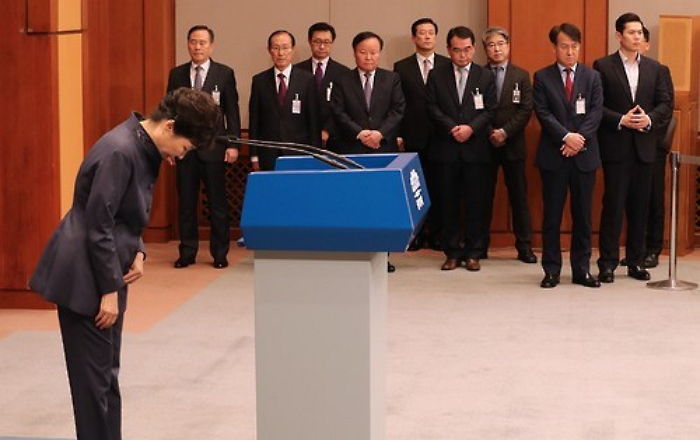
President Park Geun-hye issues a public apology

President Park Geun-hye issues a public apology on October 25, 2016. (source)

President Park Geun-hye is deep trouble. The stories have been out for a few days now, and even the English-language papers have caught on. Park’s confidant has been running a massive slush fund, as she extorted more than $70 million from Korea’s largest corporations. The confidant was receiving confidential policy briefings and draft presidential speeches–all on a totally unencrypted computer. The confidant rigged the college admission process so that her daughter, not known to be sharpest tool in the shed, would be admitted into the prestigious Ewha Womans University. That last bit turned out to be the first step toward the president’s ruin, as Ewha students’ protest over that preferential treatment developed into the larger investigation about the relationship between Park and her confidant, Choi Soon-sil.

But the English language coverage of this scandal is missing something. The newspapers do have most of the facts, which they recount diligently. But they fail to fully account for the Korean public’s stunned disbelief. Although the scale of the corruption here is significant, Koreans have seen much, much worse. Not long ago, Korean people have seen Chun Doo-hwan, the former president/dictator, made off with nearly $1 billion, and this was back in the mid-1980s when the money was worth more than $4 billion in today’s dollars. Even the democratically elected presidents of Korea–every single one of them–suffered from corruption charges. Lee Myung-bak, the immediate predecessor to Park, saw his older brother (himself a National Assemblyman) go to prison over bribery. Lee’s controversial Four Rivers Project, which cost nearly $20 billion, was widely seen as a massive graft project to push government funding to his cronies who were operating construction companies.

For better or worse (mostly worse,) Korean people have come to expect corruption from their presidents. So why is this one by Park Geun-hye causing such a strong reaction? It is not because Korean people discovered that Park was corrupt; it is because they discovered Park was irrationally corrupt. Koreans are not being dismayed at the scale of the corruption; they are shocked to see what the scale of the corruption signifies.

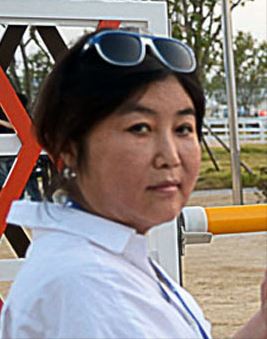
The “Rasputin”

Choi Soon-sil [최순실]

Choi Soon-sil [최순실] (source)

Park Geun-hye’s corruption scandal revolves around a central question: why would the president risk her administration for Choi Soon-sil? In fact, one of Park’s selling points as the presidential candidate was that she was less likely to be corrupt because she had no family. Her parents–former dictator Park Chung-hee and his wife Yuk Yeong-su–were dead, and she was estranged from her sister and brother. This argument had a modicum of plausibility, since all the previous president’s corruption involved their family in some way. (Kim Young-sam and Kim Dae-jung had issues with their sons; Roh Moo-hyun and Lee Myung-bak, their brothers.)

But the lack of family did not stop Park Geun-hye from being corrupt, because she apparently had to give money to Choi Soon-sil. But why did Park Geun-hye, the president, even bother with Choi Soon-sil, a nobody? To answer this question, we must look back into modern Korean history to trace the relationship between Park and Choi.

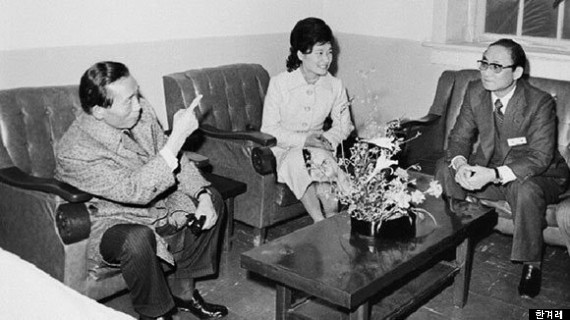
Choi Tae-min (right) meets with Park Chung-hee (left) and Park Geun-hye (center)

Choi Tae-min (right) meets with Park Chung-hee (left) and Park Geun-hye (center) (source)

Park Geun-hye met Choi Soon-sil through Choi’s father, Choi Tae-min. The elder Choi, born in 1912, was a pseudo-Christian cult leader. He started his adult life as a policeman and soldier, and at one point he worked at a small newspaper and a soap factory. By 1970s, Choi was fully engaged in the occupation for which he would be known: being a cult leader, claiming to heal people. Choi called himself a pastor, but he never attended a seminary.

Choi Tae-min met Park Geun-hye for the first time in 1975, when Park was 23. Park Geun-hye had just lost her mother, who was assassinated by a North Korean spy. (The spy was aiming for Park’s father, the dictator Park Chung-hee, but missed and killed the first lady instead.) Shortly after the assassination, the elder Choi sent several letters to Park Geun-hye, claiming that the soul of Park’s mother visited him, and Park could hear from her mother through him. Park invited Choi Tae-min to the presidential residence, and the elder Choi told her there that Park’s mother did not truly die, but merely moved out of the way to open the path for Park Geun-hye. This was the beginning of the unholy relationship between Park Geun-hye and Choi’s family, which included Choi Tae-min’s daughter Soon-sil.

Once the elder Choi won Park Geun-hye’s confidence, he leveraged the relationship to amass a fortune. Choi set up a number of foundations, with Park Geun-hye as the nominal head, and peddled influence. The influence-peddling and bribery became so severe that the dictator Park Chung-hee summoned Choi Tae-min to personally interrogate him. In the interrogation session and thereafter, Park Geun-hye would fiercely defend Choi, her spiritual guide and connection to her dead mother. In a Wikileaks cable from 2007 when Park Geun-hye first ran for president, the U.S. Ambassador for Korea noted: “Rumors are rife that the late pastor had complete control over Park’s body and soul during her formative years and that his children accumulated enormous wealth as a result.”

Choi Tae-min’s high times ended on October 26, 1979, when his patron lost her father in another assassination. (Fittingly, Park Geun-hye’s own downfall began around October 26 of this year.) The assassin Kim Jae-gyu, then-head of the Korean Central Intelligence Agency, said one of the reasons why he decided to assassinate his boss was because of the toxic relationship between Choi Tae-min and Park Geun-hye. Although Park Chung-hee was fully aware of Choi Tae-min’s grafting, the elder Park let it continue for the sake of his daughter. Kim believed that this was another indication that Park Chung-hee was losing his marbles.

For the next decade, Park Geun-hye and Choi Tae-min were removed from politics. The assassination of Park Chung-hee led to another round of murderous dictatorship, this time by Chun Doo-hwan, then finally democratization in 1987. During that time, Park operated several charitable foundations, which were in reality no more than private slush funds made up of the money that Choi grifted during her father’s reign. Park Geun-hye became so dependent on Choi Tae-min that she would be estranged from her remaining family, her sister Park Geun-ryeong and her brother Park Ji-man. In 1990, Park’s siblings went so far as to petition then-president Roh Tae-woo that their sister be “rescued” from Choi Tae-min’s control.

Choi Tae-min died in 1994, at which point Park Geun-hye’s confidence moved to Choi’s daughter, Soon-sil. Park entered politics in 1997, winning her first election as an Assemblywoman in 1998. She would prove to be a competent politician, earning the nickname “Queen of Elections.” She lost in the presidential primaries to Lee Myung-bak in 2007, but came back strong to win the nomination and eventually the presidency in 2012. Although Park’s relationship with the Choi family briefly became an issue during her two presidential runs, she dismissed them as baseless rumors, claiming that neither Choi Tae-min nor Choi Soon-sil was involved in her works as a politician.

As it turned out, Choi Soon-sil owned Park Geun-hye just as much as her father did. Peddling the presidential influence, Choi extorted tens of millions of dollars from Korea’s largest corporations. When they found a small and profitable company, Choi’s cronies would straight-up steal it, threatening the owner of the company with the company’s destruction and personal harm. More importantly, Choi effectively controlled the presidential power. Every day, Choi would receive a huge stack of policy briefs from the presidential residence to discuss with her inner circle–an illustrious group that included Choi’s gigolo (no, really) and a K-pop music video director (I’m serious.) Choi would receive ultra-confidential information detailing secret meetings between South and North Korean military authorities. Choi would receive in advance the budget proposal of more than $150 million for the Ministry of Culture, Sports, and Tourism, and distributed them to her friends’ projects. Choi went around saying North Korea would collapse by 2017 according to the spirits that spoke to her, and the Park Geun-hey administration may have set its North Korea policy based on this claim.

For years, Park’s aides complained about the mysterious off-line person to whom the president would send her draft speeches–when the drafts returned, the professionally written speeches were turned into gibberish. We now know that one of Choi Soon-sil’s favorite activities was to give comments on the presidential speeches. Even the famous Dresden speech, in which Park Geun-hye outlined her administration’s North Korea policy, had a number of markups from Choi Soon-sil. The aides who dug too deep into the relationship between Park and Choi were dismissed and replaced with those close to Choi, to a point that Choi’s personal trainer became a presidential aide. No, really. I wish I were joking. 

The Reckoning

Choi Soon-sil's selfie from the recovered Galaxy Tab

Choi Soon-sil’s selfie from the recovered Galaxy Tab (source)

It is entirely fitting that this sordid affair began unraveling because of a preferential treatment that Choi’s daughter received in her college admission. If there is one thing that Koreans cared more than their lives, it is their (and their children’s) college degree. As the heat rose against Choi and her daughter, they hightailed to Germany where they owned a horse farm.

The major breakthrough occurred on October 24, when a cable TV network JTBC discovered a Galaxy Tab belonging to Choi Soon-sil in the office that she abandoned. The tablet was the Pandora’s Box–it had the presidential speeches with Choi’s markups, presidential briefs for cabinet meetings, appointment information for presidential aides, chat messages with presidential aides, the president’s vacation schedule, draft designs for commemorative stamps featuring the president, and much, much more. The discovery of the tablet was worthy of “World’s Dumbest Criminals”–the tablet was simply left behind in Choi’s office with no encryption, and the files were available for anyone to open. And just in case Choi Soon-sil denied ownership of the tablet, its image gallery contained her selfie.

The next day, the president attempted to stem the tide by issuing a public apology, in which she said Choi was someone who “helped during [her] difficult past.” Although Park admitted that Choi had reviewed the draft speeches, she said Choi only conveyed her personal impressions, and at any rate stopped shortly after her presidential office was formed. The ensuing tsunami of revelations showed immediately that the president was lying; one of Choi’s cronies said Choi was receiving presidential briefing as recently as earlier this year. The president’s approval rating plummeted to around 17 percent, with more than 40 percent of the respondents demanding resignation or impeachment. Even conservative newspapers like Chosun Ilbo, which has been reliably in Park’s corner throughout her administration, has issued daily editorials demanding the Prime Minister and the entire cabinet to resign.

Meanwhile, Korean people’s collective heads exploded. As discussed earlier, it takes quite a bit for Korean politics to shock the Korean people. Having survived a particular tumultuous modern democratic history, Korean people may be the world’s most cynical consumers of politics. But this. Even the most cynical Koreans were not ready for this.

On some level, there is a tiny bit of perverse relief, as all the bizarre actions of Park Geun-hye administration suddenly began to make sense. Why did the president only hold just three press conferences in the first four years of her administration? Why does the president always speak in convoluted sentences that make no sense? Why did the president fly out of handle and sued a Japanese journalist who claimed that she was with Choi Soon-sil’s husband while the ferry Sewol was sinking in 2014, drowning 300 school children? Why did the ruling party randomly host a shamanistic ritual in the halls of the National AssemblyOhhhh, the relief went. Now it all makes sense.

But this brief relief soon gave way to the terrifying realization: actually, it does not make sense. None of this makes any sense.

In an ordinary case of political corruption, the politician is in it for himself. At most, the politician is doing it for his family, or other rich people who may end up helping him later. Obviously, corruption is bad. But this type of self-interested corruption at least gives some measure of predictability. We all know what self-interest looks like. Even though we would prefer that our politicians are not corrupt, at least we know how corrupt politicians behave.

But not with Park Geun-hye. Her corruption was not self-interested at all. If anything, her corruption was self-sacrificing in favor of Choi Soon-sil. Among the numerous revelations, I personally found this the most pathetic: Park Geun-hye gave Choi a sizable budget to purchase the presidential wardrobe, and Choi embezzled most of it. Instead of purchasing the clothes that befitted a head of state, Choi outfitted Park Geun-hye with crappy clothes that she had her cronies made with subpar material. There is a video of Choi’s staff smoking and drinking while eating fried chicken, right next to the suit meant for Park Geun-hye. At one point, one of the staffs handled the suit without even wiping chicken grease from his hands, while breathing smoke onto the clothes. Park Geun-hye would wear this suit on her presidential visit with Xi Jinping. For accessories, Choi gave Park the cheap leather purses and clutches that her gigolo designed. This could not have possibly escaped Park’s notice. Even assuming the unlikely possibility Park Geun-hye might not have had the discernment to know firsthand (unlikely because she grew up in the lap of luxury,) the obvious cheapness of Park’s clothes and bags even made the news. Yet nothing came of it. Choi Soon-sil dressed Park Geun-hye liked an unwanted doll, and Park, the president of the country, did not care.

Even in her apology, Park Geun-hye showed that she still might be under Choi Soon-sil’s hold. What would a self-interested politician would do, if the corruption of one of his cronies was revealed? The politician would sell the crony down the river, denying up and down that he ever knew or interacted with the crony. Such denial would be cowardly and dishonest, but at least it is predictable. But not with Park Geun-hye. She stood in front of the whole country and admitted that Choi Soon-sil fixed her speeches. Instead of cutting ties with her, Park reaffirmed that Choi was an old friend who helped her during difficult times.

This is utterly irrational. Rational people can expect that a corrupt politician may steal money for himself. They can even expect that he may steal for his family. But no one can expect that a corrupt politician would steal money for a daughter of a fucking psychic who claimed to speak with her dead mother. No one, not even the most cynical Korean, expects that the president would refuse to cut ties with Choi Soon-sil, a woman with no discernible talent other than manipulating the president and humiliating her in the process. Koreans may expect that the president would be corrupt, but they never could have expected that the president might be feeble in her mind.

In the Tyson Zone

Sports columnist Bill Simmons coined the term “Tyson Zone,” in which nothing you hear about a particular celebrity can possibly surprise you. Did you hear that Mike Tyson urinated on a police officer? Of course he did! Did you hear that Mike Tyson is attempting to breed unicorns? Of course he is! Given what you already know about Mike Tyson, none you hear about Mike Tyson could possibly surprise you.

With Choi Soon-sil-gate, Park Geun-hye put the entire country into the Tyson Zone. Every insane rumor about the president–the kind that you would see from some remote corner of the internet and laugh off–is now fair game. For years, there have been rumors that the name of Park’s political party, the Saenuri Party, is a code name for a cult named shincheonji. Well, why not? We already know that Choi Soon-sil was the one who actually produced Park’s inauguration, which featured numerous little multi-colored bags that are used for shamanistic rituals. Would it really surprise you Park Geun-hye named her party after a cult? Did you hear that Choi Soon-sil may have had a hidden son who worked at the presidential residence? Well, why not? We already know Choi made her personal trainer into a presidential aide–what’s another hidden son?

This much sounds like a joke, but it can easily take a terrifying turn. There has been much speculation about the “missing seven hours,” where the president’s whereabouts were completely unknown for seven hours in 2014 during the Sewol ferry disaster. Rumors are now running rampant that Park Geun-hye was attending a memorial shamanistic ritual for Choi Tae-min, who passed away 20 years on the day of the ferry disaster. The more lurid version of the rumor says that Park’s government actually caused the Sewol sinking, to offer human sacrifice for the dead cult leader. As ridiculous as these rumors are, Park Geun-hye’s behavior forces even reasonable people to think, maybe.

Even the way forward is not entirely clear. Politically, Park Geun-hye is finished, although it is unlikely that she would resign or be impeached. She would not resign because she fundamentally lacks the capacity to assess the reality around her. The opposition would not bother with the impeachment–they would prefer to let the administration bleed with non-stop investigation, until the presidential election comes next year.

But remember that we are now in the Tyson Zone, where everything is fair game. Choi Soon-sil is still on the run, and she still may be able to get in touch with the president. Even a politically finished president has a few remaining options to short-circuit the political process, and this president does not seem to have the instinct for self-preservation when it comes to Choi. I don’t want to actually write out what Park Geun-hye might do, because the mere thought of them sends chills down my spine. But I cannot get those thoughts out of my head, because they are no longer ridiculous. My worst nightmares for Korea’s democracy are now a realistic possibility. This is the shock that the Korean people are experiencing now.

A memoir: Shin Sang-ok, Choi Eun-hee and I

http://www.koreatimes.co.kr/www/news/nation/2016/10/180_215463.html

Film director Shin Sang-ok and actress Choi Eun-hee hold a press conference upon their escape from North Korea to the United States in 1986. / Korea Times file

Film director Shin Sang-ok and actress Choi Eun-hee hold a press conference upon their escape from North Korea to the United States in 1986. / Korea Times file

By An Hong-kyoon

My phone rang. The caller was the press officer at the Korean Embassy in Washington. “Mr. Shin Sang-ok and Ms. Choe Eun-hee are scheduled to hold a press conference. Our embassy wants you to act as their interpreter. Would you do it for us?”

Elated by the surprise request, I replied to him in one breath. “Of course I will.”

“The Watergate Hotel conference room at ten in the morning of the15th [May, 1986],” the press officer continued in a relaxed voice, obviously relieved that I had accepted his request. “More than a hundred American and foreign reporters are expected to attend the press conference.”

My thoughts ran back to the January, 1978 media report that Choe Eun-hee, whom her fans dubbed the “Liz Taylor of Korea,” mysteriously disappeared in Hong Kong. In July of the same year, her estranged husband and the renowned film director, Shin Sang-ok, disappeared, also last seen in Hong Kong. Several years passed and people learned that they were in North Korea, making movies for Kim Jong-il. Kim boasted that Shin and Choe came to North Korea on their own volition. In the mid-1980’s, Shin and Choe showed up in cities like London and Belgrade, and their words and demeanor appeared to attest, beyond question, their allegiance to Kim Jong-il.

Film director Shin Sang-ok and actress Choi Eun-hee pose as they enter South Korea in May 1989.

Then there was a bombshell. On March 13, 1986, the world learned that Shin and Choe had sought refuge in the American Embassy in Vienna, Austria. For over two months thereafter, people heard nothing.

Then came the May 12 call from the Korean Embassy. I could hardly believe my fortune. I would hear their story, tell the world their story, and above all, I would meet them in person.

Then the day arrived. I sat with the Shin couple in a small ante-room adjacent to the main hall. They were charming, but their smiles were stiff and wary. The subdued air was intensified by the presence of two white bodyguards towering behind them. I wondered momentarily if their press conference was voluntary.

As we entered the conference room, cameras flashed, and a large crowd of reporters rushed about, vying for better spots. Following a brief photo session, the conference began with many questions flying all at once. Shin gestured them to calm down. Choe would tell them her story first.

The couple appears on a Japanesemedia outlet in1984

She began by narrating the scene of her abduction. A group of men grabbed and placed her on a speed boat in Repulse Bay of Hong Kong. She screamed, “Where are you taking me?”

“To Kim Il-sung’s bosom!” one abductor shot back. She used the Korean word, Pum, a word that is reminiscent of the warm heart of a mother.

“Kim Il-sung’s what?” a reporter in the front row shouted.

Alarmed by the question, I repeated, “Kim’s bosom.” Suddenly a question flit through my head. “Does bosom refer only to female breasts?”

Choe continued, in minute detail, of her life in captivity in North Korea. In turn, Shin did the same as if to convince the world that, contrary to some rumors and Pyongyang’s claims, they had been taken to North Korea against their will.

People read stories on the couple’s escape from North Korea, which appeared in the Hankook Ilbo in 1986.
/ Korea Times

As the long narrations continued, the American reporters grew impatient. They wanted to hear about Kim Jong-il and what the Shin couple had thought of the North Korean dictator. If those reporters expected slanderous and quotable words from them about Kim Jong-il, they were disappointed. Shin and Choe did not attack the person of Kim. When pressed, Choe said Kim Jong-il was a man capable of committing “stupendous” acts. No reporter asked them if they feared Kim Jong-il’s reprisal. Or if they felt they were indebted to their captor for the generous treatment the evil man had bestowed on them.

The press conference lasted three hours. Two security guards reappeared from nowhere, and director Shin and Choe were hurried to a dark van. I hardly had time to say goodbye to them.

Seven months later, I received a Christmas card from them with a pleasant greeting. Although the card was postmarked Atlanta, Georgia, I later learned that the couple had actually been living in a townhouse all this while in Reston, VA, my own neighborhood.

Then there was a call from Shin on a spring day in 1988. They had decided to move to Hollywood to pursue film production careers in America. “Would you be available for dinner tomorrow?” He suggested a Chinese restaurant in our area.

When my wife and I arrived at the restaurant, Shin and Choe were already seated at a table far inside the spacious dining room, discreetly apart from other diners. Both looked bright and carefree. Their regained freedom had done wonders for the charming couple, letting their guard down finally.

“Sorry we had to wait for so long to meet you again,” Shin began apologetically. “We had to ponder about our future, what to do, where to live, and how.” He paused for a moment. “American friends had suggested we live in seclusion ― in retirement, and I almost decided to do just that. I thought of painting.” He paused again. “But Choe yeosa thought otherwise.” Yeosa is a Korean term for “lady” or “Madame.” I got the hint: she wanted to be addressed as yeosa, signifying her independence. “Choe yeosa insisted that we stay in America and make movies, and I agreed.” Shin smiled at his lovely wife. I thought it was more on the part of Choe yeosa who had engineered their bold escape from the North.

Shin said he knew the Korean people would wonder why he and his wife would choose America for home. “Of course we love Korea and want to go home, and our fans want us to come home.” But he said, “We are not comfortable with the Korean authorities. Shortly after we had sought refuge in the American Embassy, the Seoul government said it would leniently embrace us back to Korea. Leniency for what? We were taken to North Korea by force, and the South Korean government had the nerve to treat us as if we were North Korean collaborators.” Shin spoke calmly, but his indignation was scarcely concealed.

In an even tone, Shin continued. “We are not safe in South Korea. North Korean agents roam the streets of Seoul at will. Kim Jong-il once boasted to us that he could bring anyone he requested to Pyongyang from Seoul.” With a deep sigh, he said, “And Kim Jong-il has set millions of dollars on our heads.”

There was a pause as we munched sweet-and sour pork. Shin turned his head toward his wife. “Choe yeosa, when I saw you for the first time in Pyongyang at Kim Jong-il’s party, I thought you had completely sold your soul out to the little, bushy-haired dictator. You behaved so fresh with him.”

“Are you kidding?” Choe mischievously retorted. “People don’t call me Korea’s best actress for nothing.” We all laughed together.

I turned to her. “Madame Choe, I saw you for the first time in Daegu during the Korean War. You were playing Ophelia on stage.”

“Oh, you did?. I was a green novice then, and I hardly knew what I was playing. I had a role in Death of a Salesman, and I had no idea what mortgage meant in the script.”

While travelling in Eastern Europe, Choe continued, they had come across a tiny Catholic church. “We entered it and got married…with a solemn ceremony.”

“Over my objection,” Shin quipped, “I don’t believe in such formalities.” He looked at her with a smile that betrayed his ritualistic adherence to his creed.

The conversation turned to their plan for Hollywood. Shin had a lifelong dream to produce an epic movie on Genghis Kahn. One of his proposed desert battle scenes would employ over 3,000 horses, a record in motion picture history. He had written the script based on Aaoki Okami ― The Blue Wolf ― authored by Yasushi Inoue of Japan.

“Sitting up straight in the prison cells, I went over the script hundreds of times in my head, writing and polishing it mentally. The North Korean jailers had laughed at me when I requested a pen and paper.”

Shin was inspired by a character in the story, Quryang, a maiden warrior who, risking her life, withstood Genghis Khan’s attempt to take her by force. She triumphed when the Great Khan begged her for her love.

Over dessert, Shin abruptly asked me if I was familiar with General Dean. I told him I knew who the general was. Shin said his first project in Hollywood would be General Dean’s story, the anti-hero hero commanding general of the ill-fated U.S. 24th Infantry Division, that was smashed by columns of the North Korean Army in Daejeon.

Retreating soldiers reported that General Dean was last seen at a city crossroads with a bazooka on his shoulder¸ facing an approaching enemy tank. He then disappeared for many months. President Truman awarded him a medal of honor in absentia. In December, 1951, the world learned that the general had been held as a POW in the North. He returned home to a hero’s welcome after the armistice. He denied he was a hero.

“There is little information about his captivity in North Korea,” Shin said.

Oh, yes, I replied. General Dean had written an autobiography. I would find a copy, I promised Shin. I also told him that the current commanding general of the U.S. forces in Korea was an old acquaintance of mine. I had first met him in 1958 when he served in Korea as a green platoon leader. He is now a full general. He would gladly provide us with all the resources and assistance ― foot soldiers, tanks and bazookas. Shin’s face lit up with excitement.

It appeared that the move would be Shin’s way of returning the favor to the American establishment which had embraced Shin and Choe since their dash to the American Embassy in Vienna and were now providing a refuge from Kim Jong-il.

Walking toward the parking lot, Shin told me that after settling in Hollywood, he and Choe would travel to Seoul. They had to appear before a court and settle their legal case. After all, they had been in North Korea and had helped Kim Jong-il make movies in clear violation of the South Korean National Security Law. All had been pre-arranged, Shin said, and they would be given Korean passports, signifying their complete freedom at last. Nothing would then hamper their future, nothing, he appeared to reaffirm himself.

Waving at their automobile as they drove off, I wondered what Hollywood looked like.

In the late Fall of 1988, Shin wrote me a letter. He and Choe had settled in a Los Angeles suburb. I noticed that Shin signed his name Sheen Sang-okk. I later learned that the new name spelling had been advised by certain U.S. intelligence officials as a security measure.

Several months later, I wrote Shin that I had discovered where General Dean’s son, William, Jr., a retired Army colonel, lived.

In the spring of 1989, Shin and I met Colonel Dean at a hotel restaurant in San Antonio, Texas. He was an unassuming gentleman with a ready smile. He listened carefully to my account of Shin’s captivity in North Korea. While I had no way of fathoming his thoughts, he surely would have thought of his own father’s incarceration in the North as a POW. Colonel Dean was delighted with Shin’s plan to produce his father’s story, and was happy to transfer the copyright of his father’s book. We all shook hands and parted. A contract would be drafted and signed in due time.

The following month, Korean media reported that Shin and Choe had arrived at Kimpo Airport in Seoul to a tumultuous welcome by his fans. Customs inspectors found in their possession a large amount of material on the Korean War.

“They are for General Dean’s story,” I assured myself.

Then in the late fall of the year, I learned from a newspaper account that Shin, in Korea at the time, had announced a plan to produce a new film, Mayumi, in Korea. There was no mention about General Dean’s story. I was puzzled at first. Why the change of heart? Betrayal! I thought.

“Mayumi” was a code name for a young North Korean female terrorist who blew up Korean airliner in midair over the Indian Ocean. Again, what prompted Shin to change his plan? I could only speculate: a certain powerful element, most likely a South Korean intelligence establishment whose wishes Shin was not in a position to resist was behind it, and with ample funds. Eventually, Mayumi was produced. It turned out to be a box-office dud in Korea and overseas.

Another year passed. In September of 1990, I received a fax from Shin. A wealthy Japanese businessman had promised to invest in the production of The Blue Wolf: the Genghis Khan Story. “Please join me,” he wrote. “I know how to make movies but I know nothing about America. And you have a passion for the arts and a knack for motion pictures. I would expect you to run the office American style.”

Without a second thought, I told my wife that I was going to Hollywood. “You are crazy,” she cried out. I packed up and headed for Dulles Airport. My wife, behind the wheel, did not say much.

Shin and Choe lived in a small but attractive house in Beverly Hills. Its front yard was full of roses. An elderly maid, whom the Shins had brought from Korea, moved around like a family matriarch. There were two adorable children playing. They seemed to be deeply attached to the maid. They were the offspring of one Oh Su-mi, once Shin’s actress lover. The maid had raised the two toddlers while their father, Shin, spent eight years in North Korea. Choe was now their surrogate mother, and the children looked at their “stepmother” bashfully.

Shin delegated to me the power to sign bank checks for the office, a sure sign that he trusted me. But when I requested an employment contract, Shin declined. “We work together with an honor-bound trust, not by a signed paper.” That was not a good sign. I suggested that we retain a law firm, a public accountant, and a PR firm. Shin objected on the grounds that we did not have legal problems, we did not have any income presently, and a PR firm would be expensive. I told him that that was the “American way” to run a business. He did not answer. I took it as his acquiescence and retained a law firm, and so on. Shin instructed me to deny health coverage for office employees, but I did arrange coverage for them. If there were signs of discord between us, I did not sense it at that time.

Shin was a reticent, secretive person. He shared little with me about himself, his intentions, and what he expected of me. I wondered if this was his personality, or the result of the trials he had suffered in North Korea. He kept me in the dark about the details of his production plans. He shared little information with me about his Japanese patron and the investment the latter had promised.

Yet at certain unguarded moments, he told me revealing things. He considered North Korea a haven for film makers. Kim Jong-il provided everything, money, cast and staff, location sites, even a cargo train to blow up, and a helicopter to fly over to create snow-storm scenes. Above all, one did not have to worry about the prospect of box-office success. An audience would be mobilized, and told when to cheer.

“You know,” he once said over lunch, “I chiseled my name on the wall of my cell just to mark that I was there.” I recalled a scene from The Count of Monte Cristo. “I hope they don’t raze the prison.”

Shin remarked with an impish smile.

“When I went overseas, my minders wanted me to bring them gifts. The souvenir items most craved were sunglasses. I wondered if those bastard comrades wanted to look like Kim Jong-il.”

In mid-November of 1990, Shin and I traveled to Calgary, Canada, to look for location sites for a cavalry battle scene for Genghis Khan. The final cavalry charge scene of Kagemusha by Akira Kurosawa of Japan was previously shot in the open field of Calgary. “Kagemusha” meant “a body double” for a warlord. Calgary, however, was dropped because, besides its cost estimates, its topography hardly resembled that of the Great Steppes of Central Asia.

Mongolia, seemingly the best location site for The Blue Wolf, was out of the question. The Mongolian government would not allow a motion picture about its greatest khan drift one inch from its official history. Quyrang, the khan’s warrior-lover did not exist in the orthodox Mongol history as The Blue Wolf script portrayed her.

In the spring of the same year, Shin flew to Tokyo to confer with his Japanese investor. He looked content when he returned. One day soon after, Shin told me with a straight face. “I chose Natasha Kinski for Quyrang’s role.” He continued, “And I want you to go to Italy and meet with Sophia Loren. Tell her we need her for the role of Genghis Khan’s mother.”

I was dumbstruck. The task Shin purported to assign me was nothing like asking a movie star for an autograph. “Is this man serious?” I thought to myself. Did this man make a hollow commitment in order to placate his Japanese patron? To my relief, Shin never brought up the subject again.

Then Shin said he wanted to explore Tajikistan for locations. It was one of such occasions when the director spelled out brilliant ideas as if in passing. Besides the cost factor, the Central Asian region provided an excellent environment. After all, Genghis Khan and his horde rampaged and conquered the desert and steppes of Central Asia. In early 1991, the mysterious and closed land was wide open, thanks to Gorbachev’s perestroika.

I called the Soviet embassy in Washington, DC and spoke with a representative of Sovexporfilm, the Russian state corporation charged with film trade. Through his good offices, his Moscow headquarters sent a letter of invitation for Shin, Choe and me. The Soviet Consulate in DC quickly issued us our visas. Russians were eager to do business with the capitalist world.

Choe, however, was not allowed to go. Her fervent desire to travel together with Shin to Russia had been quashed by the South Korean Consulate in Los Angeles. Why was anyone’s guess.

I traveled to Moscow on February 9, 1991 and met with Boris, a lawyer from Sovexportfilm, who was our contact man and escort throughout our travels in the Soviet Union.

The following day, Shin arrived at the Sheremetyevo International Airport in Moscow. He was one of the last passengers to show up at the waiting area. Wearing a pair of sunglasses and a hat tipped way down, he walked in our direction quietly. Shin and I sat down on a corner bench while Boris went outside to hail a taxi. Shin, his head bowed down, did not stir. My heart started to pound faster and faster. What could I do if North Korean agents and their KGB comrades surrounded us? There was prize money on Shin’s head, and North Korea had been in the Soviet orbit until recently.

I noticed a tall and well-built Asian man in a long and loose trench coat and wearing a hunting cap walking briskly toward us. My heart froze. Shin remained motionless. I stood up. The man handed me his business card: First Secretary J.H. Choi, Embassy, the Republic of Korea. “Welcome to Moscow. Our ambassador would be happy to meet with you tomorrow.” He walked away. He looked like a core intelligence officer.

The following day, the first South Korean ambassador to Russia, and my high school classmate, greeted us cordially, but Shin appeared distant to our host. Meeting alone with me in his office, First Secretary Choi stressed that I stay in touch with him wherever Shin and I traveled. “Nothing to worry,” he assured me. When we parted, Shin failed to bow back to Choi.

Our two-day meeting with the executives of Sovexportfilm was pleasant and productive. They appeared sincere and eager to do business with us. Their figures for all the logistic support for our film was less than one-third that of Calgary’s. One executive suggested in jest that a Red Army cavalry regiment could be mobilized for combat scenes. Shin nonchalantly answered he would study the offer.

During a tea break, Shin asked if a replica of the best actress prize for the 1985 Moscow film festival could be made. The award Choe had won for her role in the North Korean film Salt had to be left behind in Pyongyang when they fled to the West. He was told that that could not be done.

Our first stop was Alma Ata, present day Almaty, of Kazakhstan. The city had a large ethnic Korean community. Obviously pre-warned by the South Korean embassy, several leaders of the Korean community came to our hotel to pay a courtesy call to Shin. They identified themselves with South Korea and praised Shin for his heroic escape from the North.

Our next destination was Tashkent, Uzbekistan, the famed hub of the ancient tea trade along the silk road. During the flight, I struck up a conversation with an Uzbek who sat next to me. When he heard the purpose of my trip, his expression turned incredulous. “Genghis Khan of all people, why?” he asked me. “You know, he burnt down our city in 1219. His soldiers killed our noblemen by breaking their spines by bending them backward.” He grew angrier. “Do you know what that evil khan and his hordes left behind? Ashes and their semen in the wombs of our women.” He turned his back on me.

Rhaman, the director of Vatan Film Studio greeted us in the Tashkent airport. Vatan was the best-known film producer in the region. We toured his studio, huge but run down. Its warehouse was full of art work, film sets, and props, mostly of bows and armors. Shin again did not say much, and he showed little interest in what he was seeing. Strange, I thought.

In the evening, Rhaman took us to an ethnic Korean festival entitled Transit, a musical that portrayed the story of ethnic Koreans being forcibly removed from the Soviet Far East to Central Asia in the mid-1930s. When an MC announced Shin’s presence, many people flocked to greet him. Elderly women hugged him. Shin was their hero, and he personified the image of their ancestral home called Korea. He tranquilized the nostalgia of the Korean diaspora.

The following day, Rhaman drove us eastward near the Afghan border to trace the routes that Genghis Khan’s Mongol horsemen had rampaged. Suddenly, Boris shook Rhaman’s shoulder. “Hey, we are in Kyrgyzstan. We have no visas to enter here.” Rhaman did not flinch and kept on driving. He couldn’t care less about what the Kremlin said. Moscow’s grip on its citizens was apparently waning fast. Indeed, the Soviet Union would fall half a year later.

Soon, the snow-covered Tian Shan Mountain range came into view. The Mongol’s ancestral spirits dwelled on the summits. Its sheer majesty humbled me. We all got out of the car and sipped the ice-cold water from the stream at the bottom of the steep-walled valley. Shin remained in the car, his head bowed and pensive. What was he thinking? I wondered.

In Bukhara, we saw gigantic mud-brick walls. A good location site for a cavalry assault, Rhaman suggested to Shin. Shin smiled back meekly. In town, we visited a timeworn mosque mantled in a rich patina of age. “This mosque,” intoned a village elder, “was saved from the Mongol invaders. We buried it underground before they came.” We were told, ad nauseam, of the Mongol atrocities in Urgenchi, Khiwa and other towns we visited. The Great Khan certainly was not popular in this part of the world.

Back at Vatan Film Studio in Tashkent, Rhaman and Boris wanted to hear from Shin. Would there be a contract for the production of The Blue Wolf? Shin was noncommittal. I was not surprised by his reaction. Throughout the trip, Shin remained aloof to the mission he had set out for. He acted more like a bored tourist.

We flew from Moscow to Tokyo and met with the Japanese investor. Shin told his patron that the trip to Russia had been highly productive. He had found excellent location spots and had nearly reached a contract agreement with the Russians.

The Japanese investor did not seem convinced.

Back in the Hollywood office, my misgivings about Shin and his intentions deepened. A disturbing thought lingered in my mind: Was Shin genuinely serious about producing The Blue Wolf film? Yes, at least in the beginning, I concluded. He envisioned producing a Hollywood epic. He fondly talked about Elia Kazan, John Ford, and Robert Wise. He liked to be compared with Akira Kurosawa. He believed his Genghis Khan was his raison d’etre. It deserved an Oscar.

However, his dream ended as just that, a dream. The funds he was promised shrank rapidly as Japan’s economic bubble burst. He discovered that the sheer scale of his imagined production outweighed his ability.

Shin was angry and disheartened, but his ego was too big to forsake his dream. So he kept on acting, literally acting. He was in denial about pursuing a phantom objective.

I decided that there would be no The Blue Wolf, ever. One day in mid-May, 1991, I tendered my resignation to Shin. He replied that he would not stop me from leaving.

I packed and returned home to Virginia.

Taehwa Market in Ulsan is flooded after typhoon Chaba struck the region, Wednesday. The typhoon caused five deaths with one person missing, as well as property damage on Jeju Island and southern coastal areas. Yonhap

Unethical Conductor and the fate of Seoul Philharmonic Orchestra

http://www.gramophone.co.uk/forum/general-discussion/unethical-conductor-and-the-fate-of-seoul-philharmonic-orchestra

I am Sang Soo Kim, a playwright, a producer, and culture critic living in Korea. I won the Dae Jong Award (the equivalent of a Korean Oscar) for the best screenplay in 1996.   As an artists, I pursue social justice.

Recently, Korean society has experienced some turbulent times with the alleged embezzlement perpetrated by Myung Whun Chung, the chief conductor and the artistic director of Seoul Philharmonic Orchestra (SPO).  Mayor Myung Bak Lee (who became the 10th President of South Korea, whose policy turned into a total failure and also is suspected for his possible involvement in Korean CIA’s illegal intervention in the 2012 Korean presidential election) appointed Chung as the chief conductor and the artistic director at SPO in 2005 and gave him near autocratic power over the SPO management. Upon arrival at SPO, Chung disbanded the union and fired 75 orchestra members without any proper procedure.  As the result of those illegal lay-offs, lives of many families were totally ruined.  As Chung’s illegal and unethical acts have been brought to light, the majority of the Korean public started asking Mayor Won Soon Park, the current mayor of Seoul, to fire Chung from SPO.  There is even a rising voice that Chung should be indicted for embezzlement which he has been involved in for the past 10 years.

As public opinion went against him, Chung’s side released an article written by a fictitious author, named Arnold Nielsen, who claimed to work in the classical music business, but the article did not provide the exact identification of its author. This article was linked to the Slipped Disc, a website on classical music, run by Norman Lebrecht. The purpose of this article is to refute the result of the special audit for Chung and SPO, done by the city of Seoul. The article suggested the accusation against Chung is not true and it was caused by either trivial mistakes or misunderstanding.

In this article, I will uncover all the wrongdoings and embezzlement which Chung Myung Whun has been perpetrating since he joined SPO as the chief conductor. The facts and evidences used in this writing to refute the Arnold Nielsen’s article are all true.

Chung says he knows only music.

“I know only music.”

When the public raised these issues, Myung Whun Chung, the chief conductor/music director of Seoul Philharmonic Orchestra (SPO) since 2006, responded with the same remark. This remark can be interpreted to mean that he is just a music artist who is not involved in any money or business matters.

In several Korean media, I disclosed many illegal and unethical acts of Conductor Chung and insisted that Mayor Park Won Soon should not continue the contract with him.  Although the special audit by the city of Seoul on Conductor Chung and SPO revealed most of my arguments were true, in January 2015, Mayor Park announced a one year extension of Chung’s contract saying there is no alternative to replacing Chung.

In this column, I want to discuss the reasons why the city of Seoul should not continue the contract with Chung.

Does Chung’s salary fit his worldwide reputation?

Chung’s reputation as a conductor is overestimated in Korea compared to his worldwide reputation. Currently in addition to SPO, Chung assumes Chief Conductor positions at two other orchestras, Radio France Philharmonic Orchestra (RFPO) (Paris, France) and Asia Philharmonic Orchestra (Incheon, Korea).  According to Ms. Mok Soo Jung’s investigation which was checked with an official who has been working at RFPO for over 20 years, RFPO rated Chung’s reputation as a conductor at the middle level of the second group (B Group) and thus his salary at RFPO was determined by such a position.

Considering the fact that Chung is under contract with RFPO with 20 annual performances, Chung’s salary at RFPO is between $674,000 and $719,000. At SPO, in addition to the base salary of $198,000, Chung’s conducting fee has reached at $44,000 this year, with a 5% increase every year and this fee is paid for each performance. Both his base salary and conducting fee paid by SPO are higher than his current level rated by RFPO.  Chung’s total pay of $1,811,000 at SPO is 3 times higher than the pay he receives from RFPO. Chung has been working at RFPO for 14 years and if he really was underpaid there, he could have moved to other places.

Although Chung’s name was not in the list of guest conductors at any of the top 3 orchestra (Berlin Phil, New York Phil, Vienna Phil), his pay at SPO corresponds to the second place among the top ten highest paid orchestra conductors in USA. The average conductor pay of orchestras in USA is much higher than the one of orchestras in Europe.

Is Chung’s extra pay reasonable?

Chung’s extra pay at SPO is even much higher than his salary. According to the contract between Chung and SPO (Dec 30th, 2008) and the financial statement of SPO for the year 2010, the city of Seoul paid Chung $1,811,000 for salary and conducting fees. In addition to this, Chung was paid $188,853 in 2010 and $94,000 for the unlimited first class airline flights (2 persons).  He was also paid $27,000 for his personal expense account, $40,000 for his foreign assistant (The existence of this assistant was claimed by Chung, but its authenticity has never checked yet.), and $54,000 for his oversee activities. These expenses were exchanged to Euro and transferred into Chung’s private account, but Chung has never provided the evidence of these costs. Considering these costs are paid by tax payers of the city of Seoul, Chung is in violation of Korean law by the failure of submitting required expense proofs. Furthermore, there were other incidents of expense claims, such as $36,000 for limousine rentals and $36,000 for hotel stays, which were not listed in his contract. There is no other chief conductor who is provided unlimited first class flights (including his/her spouse) by the orchestra. Also, SPO paid for the round trip airfares to Chung, who work back and forth between Seoul and Paris and RFPO has not paid any part of these airfares.

Chung has not responded to the request for special audit

Since there has been many questions raised about Chung’s possible embezzlement, in 2014, the city council initiated a special audit for Chung and SPO. The city council asked Chung to attend the business report, but Chung did not respond and the special audit had to be done without questioning Chung.

Chung did false claims for airfares

The special audit performed by the city council (presented in January 2015) revealed that Chung let his family (his son and daughter-in-laws) use the flight tickets which were paid by SPO for the use of Chung’s personal manager.  In this matter, the city of Seoul asked Chung to return $11,000. The Korean investigation TV program, “PD Note”, reported that Chung once claimed $40,000 for the round trip first class airfare, when in fact the actual price of the ticket at the time turned out to be only $10,000. In another incident, Chung received the amount of $37,000 with the copy of an electronic flight ticket. However, the investigation of PD Note revealed that the corresponding electronic ticket was never used for boarding. In the phone interview with PD Note, the former CEO of SPO, Park Hyun Jung, said Chung asked SPO to pay cash specifically for the airfares, although all other expenses were paid using his business credit card.

Chung asked the contract kept in private.

On the contract Chung made with SPO on December 30th in 2008, contrary to the list of only a few obligations that Chung needs to do for SPO, the rest of the contract is filled with the list of the requirements that SPO needs to do for Chung.  A careful study of the contract reveals that it is an unfair one sided contract not in conformity with international practices. According to the contract, in addition to the base salary of $198,000, Chung receives a conducting fee of $38,400 for each performance (in 2011), and the conducting fee increased 5% each year since 2010. Customarily, in the contract the chief conductor makes with the orchestra, the general practice is to specify the number of performances which the conductor must conduct in order to get the salary. Chief conductors of major orchestras are usually paid an annual salary and they do not receive additional conducting fees. However, Chung’s contract with SPO consists of both the annual salary and the conducting fee for each performance.

Also in this contract, when SPO induces a sponsor using Chung’s image SPO is obligated to give Chung the amount agreed upon in advance up to 30% of the sponsor donation, depending on the proportion that his image is used in the whole PR and marketing.  In addition, SPO has changed its performance schedules if there was a change in Chung’s personal schedule, whereas and this kind of performance schedule change was not possible in the contract with RFPO, unless for health reasons.  The contract also specifies Chung can work as the chief conductor in up to two orchestras including SPO and RFPO in which he has been working for 14 years. But he also works as the chief conductor at Asia Philharmonic Orchestras which he is running with his older brother and by doing so, he apparently is in violation of his contract.

Chung asked SPO to keep the contract private. Considering the one-sided nature of the contract it can be understood why Chung would not wanted it to be publicly revealed. However, it is not proper to keep the contract private, since most of SPO budget is supported from tax payers’ money.

SPO Operates as a One Man Chung Myung Whun Dictatorship.

Has the current SPO attained the status of one of “the most competitive orchestras” worldwide, as Chung had promised?  Chung possesses the absolute power over almost every aspect of SPO management, such as the selection, the dismissal, the evaluation and the request for the sanction of orchestra members, the appointment of vice conductors, the invitation of guest conductors and soloists, the selection of repertoires, and even the rejection right for any matter which was not agreed upon with the city of Seoul. He has determined by himself the selection and the dismissal of orchestra members and he set up the system in which 5% of the total members were fired each year. Under this system, over the past 10 years 75 SPO members have been fired by Chung. Among the five members who were fired last year, four filed a law suit for unfair dismissals and they have already won in the labor arbitration board.  Having 5% of orchestra members fired each year means the members need to remain in the good graces of Chung even aside from enhancing their musical skills.  Under such a system, orchestra members have to sacrifice their teammates in order to survive and it could be harmful to the harmony and the cooperation which is important for orchestras. This system has been working for the past 10 years without major discontents exposed to the outside partly because Chung has removed the union after his arrival at SPO.

The special audit conducted by the city council also revealed some unfair cases in the evaluation process for members. It also revealed that 66 SPO members were asked to perform as guest members of Asia Philharmonic Orchestras where Chung works as the chief conductor and considering the above dismissal system, they could not have refused such a request.

According to Mok Soo Jung, who investigated the case of RFPO, Chung was not given such power at RFPO. At RFPO the chief conductor is just one of the 12 jurors who decide the audition for selecting new members of RFPO and it is not the chief conductor who makes the decision regarding the dismissal of members. The chief conductor is supposed to discuss with the official of RFPO regarding matters relating to the general management of the orchestra. Although the chief conductor is mainly responsible for the selection of repertoires, soloists, guest conductors and guest members, the orchestra members also can provide their opinions through the representative they have selected.

As 5% of members are constantly being fired each year, 15% of the total members were brought from abroad and have played as guest members only at the performances in which Chung appeared. The cost of having such guest members such as airfare and hotel were also paid by SPO.  Some people said the sound of SPO has improved since Chung joined and such improvement was offered as evidence of the achievement of Chung. However, other people have expressed doubts as to whether such temporary input of guest members can be really considered the true sound of SPO.

Is SPO Chung’s private organization?

The former CEO of SPO, Hyun Jung Park, exposed that SPO was being operated as if it is Chung’s private organization. The CEO of SPO is supposed to be appointed by the Mayor of the city of Seoul. But the actual selection process was one in which Chung selected the CEO among candidates that the city of Seoul had listed from recommendation from various sources. The former CEO Park was selected after she was interviewed by Chung. After her arrival at SPO, she pointed out several problems where Chung had ignored the procedures or had violated the contract. She continuously raised issues about Chung’s wrong doing and eventually lost the power struggle by being dismissed from the CEO positon in January 2015.

The symptom which tends to prove that Chung has operated SPO as his private organization appeared in several. For example, two names were listed as the chief conductor in the list of the 2010 SPO Europe tour, one was Chung and the other was his wife. It means tax payers of the city of Seoul had to pay for the tour expense of his wife. There was a case where SPO paid the business class flight to USA for Chung’s son.

Chung also violated the contract by holding 5 piano recitals, which the former CEO Park did not approve since the recitals were for making his own profits. Also Chung participated in the fundraising of the non-profit organization he founded. This act itself was not illegal, but it was not proper for him to receive tax deduction as the business owner by donating his performance fee to his own organization.

Chung also asked SPO to rent out its musical instruments to the orchestra where Chung’s son is the chief conductor and sometimes asked SPO members to appear in the concert in which his son conducted. With respect to questions asked about such illegal rentals of SPO instruments, the SPO official said “The rental fee was paid.” However, since SPO is not supposed engage in rental services for profit, such response was not a proper one.

Is Chung’s achievements at SPO worthy of his pay?

Chung’s achievement at SPO claimed by Chung’s supporters are the following: 1. Increase in audience, 2. Europe tour, 3 Record release at Deutsche Grammophon (DGG). Chung’s supporters suggest that Chung deserves to get paid $1,811,000 a year because SPO audience has increased three times since Chung joined SPO. Although their logic is based upon the market theory, they talk about only the income, not the cost. The SPO budget has increased from $270,000 to $1,183,000 (in 2011), 4.3 times increase since Chung joined SPO. Out of the SPO budget in year 2014 ($1,536,000), $1,001,000 (65% of the SPO budget) comes from tax payers and the ticket income comprises only $171,000 (11% of the SPO budget).

Chung’s supporters also point to the Europe tour in 2010 as Chung’s major achievement. In most invited tours, it is the convention that the inviting sponsor pay most of the tour expense for the orchestra, such as airfares, hotel fee, and performance fees, etc. However, in the SPO Europe tour in 2010, the tour expense, $117,000, was paid by tax payers of the city of Seoul. The ticket income from this tour was only $29,000. Chung said, in the interview Chung did with the Korean Economy, a Korean newspaper on September 20th in 2011, Korean Economy, “I have a lesson from this Europe tour that certain income can be sure when there is substantial investment for SPO.” (September 20th, 2011) In fact, the only one who received such certain income was Chung himself. He earned a total of $153,000 from the four tour performances ($38,400 for each performance) and the amount which 105 SPO members earned from this tour was only $2,277. Chung’s conducting fee ($38,400) is 700 times higher than the amount a SPO member receives from the performance ($54).

Chung and SPO officials also claimed that the 5 records of SPO released from DGG are evidence that Chung is entitled to get such huge pay from SPO. “No other Asian orchestra even Japanese orchestras have had such accomplishment which a major record company like DGG has released their records.” (January 13th, 2011, Chosun Ilbo) Is the alleged claim “SPO is the first Asian orchestra which has received recognition from the major record company like DGG” true? If that claim is true, DGG should have paid the expense of the record production and release, such as performance and conducting fees, recording expense, PR and marketing etc. The reality is that SPO paid that total expense, which was over $243,000, not DGG.

From the above reasoning, I suggest the claim that Chung deserves such to get such big pay from SPO needs to be reconsidered.

What did the former SPO members fired by Chung have to say?

Former member A: “I had a high expectation when I heard Chung was coming to SPO. But upon his arrival I realized my hope was just an illusion. He did not talk with us, the members of SPO. The only time he talk to us is when he delivered his instruction. With the name of “the visiting concerts”, we performed at big churches. There are many members who are not Christian, but we had to pray before we perform at those churches. Since when has Chung become a world top class conductor? I think Korean media exaggerated Chung’s legacy.”

Former member B: “My experience of the concert when Lorin Maazel performed as the guest conductor with SPO is unforgettable. He showed me what a great conductor could do for the orchestra and its audience and what the performance was like with such a world-famed top class conductor. I had never felt the similar emotion when I performed with Chung. The audition for firing 5% of members each year scared us. We always felt uncomfortable. We had no opportunity to talk with Chung about music or our concerns. He seldom stayed in Seoul. He came to Seoul accompanying with foreign guest members, performed at concerts and left. This happened only when there was a concert. After the concert, we rarely see him again.”

Former member C: “I always felt anxious. I had to try my best to impress him and not to do anything which could offend him. There was no time when I play music at ease. After SPO became an independent company, we were not able to say NO. The atmosphere was that we could not give him any constructive suggestion. I suspected that there were some members who were monitoring us. After I got fired by Chung, my wife said I looked more comfortable than when I was working at SPO, even though our family had to find other ways to make a living. Since then I stopped playing the instrument.”

Former member D: “We, the SPO members, were only accessories to Chung. I am concerned about the new young members who have recently joined SPO, because they might be getting wrong ideas about how the orchestra should be like. The most important thing in the orchestra is the harmony and cooperation between the conductor and the orchestra members. However, Chung treated the members like parts of the machine. OK, I can admit I got fired because my musical ability was not good enough. However, after the 10 years of my devotion to SPO, when I heard a young office worker tell me “You cannot be part of next concert.”, I was devastated. It is hard to express my feeling when I saw my position filled with a foreign guest member who Chung brought from abroad… that was awful.”

What is the responsibility of an artist as a member of our society?

When Korean public asked Chung not to abuse his power or to justify his use of tax payers’ money, he said “I know only music.” People may feel genuine if this remark is uttered by an artist in poverty who cannot earn enough to provide for his/her family. However, when Chung says the same remark, people may be doubtful since he earns $1,811,000 a year and his family members (wife, son and daughter-in-law) are also paid for first class and business class flights and especially the substantial portion of these pays was supported by tax payers’ money.

Chung’s supporters say that social justice is not the area a great artist like Chung should pay attention to. Really? There are great music artists such as Daniel Barenboim who advocates human rights and Gustavo Dudamel who supports the music education of underprivileged children and the impact of these artists to our society is priceless.

Music is an expression of free spirit of mankind and a great orchestra performance can enrich our lives. An artist should respect other artists and share fellowship with them. As a member of our society, an artist should fill his/her responsibility and should not abuse the art as only means of moneymaking or being famous.

Therefore, I ask Mayor Park not to make an extension of Chung’s contract. For the past 10 years in the hands of Chung, SPO has been operating without proper regulations or procedures. SPO has been just a private organization which was misused by Chung as means for building his own personal wealth and fame. It is time to give SPO back to citizens of Seoul. I also ask Mayor Park to gather public opinions and ideas so that SPO can really serve citizens of Seoul as a sound public art institution.

Thank you very much for spending your precious time in reading my article.

Your interest and support will help Seoul Philharmonic Orchestra come back to normal and eventually will be able to better serve citizens of Seoul.

Sang Soo Kim

—————————————–

Unethical Diatribe Reveals Total Ignorance

Mr. Sang Soo Kim’s diatribe reveals him to be an embittered man without a clue as to the nature of the classical music world and what the norms are governing conductors and their roles, responsibilities and perks.  One can only assume that he is driven by jealousy of Maestro Chung’s incredible success and major standing in the international arts scene, and his own irrelevance.  With the numbers he bandies about, one wonders who is the source of his “information”?  Could he possibly be the mouthpiece for the inept but incredibly cruel former CEO of Seoul Philharmonic, who has now been dismissed in shame from two consecutive positions, and who has a reputation well known in Korea for her dogged pursuit of anyone she feels has bested her?

Had he done all this research himself, surely Mr. Kim also would have learned that it is quite common – indeed, almost a requirement – for Chief Conductors (in some cultures known as Music Directors) to make decisions regarding musical personnel within the orchestra, hiring and firing (which is an agonizing process for the conductor as well as the musicians), repertoire, approving soloists and guest conductors, etc – in short, they are responsible for every artistic aspect, even to the selection of instruments the orchestra purchases.  Some try to shirk these time-consuming and often emotionally-wrenching duties, and those who fulfill these ungrateful tasks do so at great personal cost.  Maestro Chung has accepted his responsibilities and carried them out with humility and humanity – in the cases where musicians have had to be removed from the orchestra because they were holding the rest back artistically, he strove to find them other responsibilities within the organization (such as working in the educational activities of SPO).  Mr. Kim’s reference to this without including the full picture leads me to believe two things:  That his attack is politically motivated (and this impression reinforced by his reference to the former Seoul mayor and later Korean president who brought Maestro Chung to the SPO) , and that he has been directed by an SPO insider to a particular inadequate musician who rejected offers of other ways to serve SPO and its public.  A question for you, Mr. Kim – if you had an actor in one of your productions who couldn’t learn their lines properly, who refused to or was unable to accept your direction and perform to the level of the rest of the company,  what would YOU do?  Jeopardize the success of the play or film and watch the other, competent actors descend into depression and despair? Or would you – after giving that actor instruction and opportunities to improve – finally replace him, for the good of the rest of the company?

I have to laugh at the reference to first class airfares.  On such long trips as the flight to Asia, this is standard for conductors even of a lower standing than Maestro Chung.  I know of another conductor who is in the same league as Chung, who was routinely given not only first class air for himself and his wife, but also for his infant and the nanny.  Indeed, certain top conductors frequently demand private jet.

Regarding Maestro Chung’s “sin” of performing piano recitals without the former CEO’s approval – it is absolutely ludicrous that this situation of Maestro Chung NEEDING her approval exists.  It reveals both her overpowering need to control and micro-manage those she saw as “beneath her” as well as her total ignorance of the field into which she fell after her previous failure with Samsung.  One would hope a person who was given this job as a political favor to her powerful family (as rumor has it) after her complete failure in another position, would at least take the trouble to study the field and learn what is normal, what is acceptable, and what isn’t.  She, apparently, couldn’t be troubled, or perhaps felt it was up to her to rewrite the profession.  In any case, she quickly became the butt of jokes in classical music circles, with her inflated sense of importance and ridiculous comments and demands which revealed her ignorance and sense of grandiose entitlement.

If there was to be any examination of the workings of SPO, it should have been into the dictatorial way in which the most recent CEO ran her ship.  The turnover of staff – many of them having been with the orchestra for many years – is a clear indication of something wrong.  People were ridiculed and harangued in front of their colleagues, sometimes for hours on end, in the most abusive terms by her.  At least one member of staff ended up in hospital as a result of her abuse.  And yet, the socially-conscious Mr. Kim doesn’t mention or isn’t concerned by THAT?  I have observed Maestro Chung’s work with the SPO in rehearsal on several occasions, and never have I seen him be abusive or even raise his voice.  He is known throughout the musical world for his respectful approach to his musicians.  Indeed, he is revered.  Despite Mr. Kim’s claims to the contrary, he conducts both the Vienna and Berlin Philharmonics (and not as frequently as THEY would wish, he often declines their invitations, at times because of conflicts with his commitment to Seoul Philharmonic), and the New York Philharmonic would desperately love to have him conduct, if only he would.

It seems to me that Mr. Sang Soo Kim has joined the dark forces who would wish to reduce Korea’s most important artist ever to their own level.  Success sadly often provokes jealousy.  I’m sorry to see Mr Kim using this as an opportunity to sink in his poison daggers, trying to slander a man who is not only a great artist but also a great humanitarian (and the great ones, like Maestro Chung, do not publicize and flaunt their acts of charity, but do them quietly).  This is clearly a politically-motivated attack, and one can only hope that Mr. Kim isn’t being financially rewarded for being someone else’s mouthpiece.

——————–

rubbish

Dear Sir,  You clearly have a non-musical agenda as you reference the former Mayor and President Lee Myung Bak.  Whatever you think of his politics, Maestro Chung’s music has nothing to do with this.  He was – and remains – the right man at the right time – for the future of orchestral music in Korea.  You quote the former CEO of the Seoul Philharmonic – a person of no credibility in the music field who harrassed and humiliated staff in a clear violation of human rights, not unlike the former KAL Vice President – but betrayed her ignorance when criticising a staffer who programmed Stravinsky’s ‘Le Sacre de Printemps’ in the fall.  Her personal vendetta against Maestro and other staff members has lead to chaos within the organisation and a loss of confidence with the orchestra’s partners in the business abroad.

My understanding – though I cannot confirm this – is that because she comes from a wealthy and powerful family – she was hired as Chief Executive to give her a second chance after she was fired for complete ineptitude by the Samsung Insurance group.  Rather than leaving the debacle she created at the SPO and going quietly, she has decided to continue a vendetta against the Maestro who created a musical miracle, an orchestra now invited to top festivals and venues, whose appearance at the BBC Proms was critically lauded, whose DGG recordings rank with the best in the world.

Maestro Chung only came to the SPO because of his desire to build a great Korean orchestra. What other major conductor would have done this?  The orchestra was in poor musical condition with no reputation even in Korea.  Under Maestro Chung’s leadership, it is viewed as an international success story (at least till the former CEO came along.)  Maestro Chung spent more time working and building this orchestra than most conductors spend with their more famous ensembles.  He has turned down engagements with famous ensembles to devote his time to the SPO project.  Because of the extraordinary work Maestro has done with the SPO, the orchestra is now able to attract a superb group of guest conductors who, ten years ago, would not have considered coming to this orchestra.

Unlike other famous Korean artists who charge a premium for playing in their home country, Maestro Chung’s per concert fee in Korea is similar to his fees abroad.  Unlike other important conductors, he does not travel by or demand a private jet.  The KBS Orchestra – not nearly on the same level as the SPO – was in negotiation with another top conductor for a much higher fee than Maestro Chung was paid.

You and the former CEO may be responsible for changing the history of orchestral music in Korea for the worse.  I know many conductors – most are not saints.  Myung Whun Chung, with his quiet, unsung charitable work round the world and his financial generosity – comes closer than any other conductor I know.  In Seoul, he always fought for the musicians – wanted a pension plan, for example.  When a musiciann had to leave for musical reasons and the good of the orchestra, he always wanted to make sure it was done in the kindest way possible and tried to help them find alternate employment.  You don’t know what you are talking about, Sir, and I suggest you limit your comments to your field of expertise, if indeed you have one.

—————————

To Music Insider & justamusician

I do not know who you are, but both of you might have inside information about Chung and SPO. All the information, especially the numbers (such as pay) are public information, which was either provided by the city of Seoul or published in Korean media.

Also, my remark that Chung was not invited in the 3 major orchestras as a huest conductor was based upon the list of guest conductors presented in the orchestra homepages. If Chung has turned down any of their offers and if you have any proof of such invitation (such as email conversations between SPO and the inviting orchestra), you may provide here.

I clearly say that I have no connection with any other party, like the former SPO CEO.  In my article, I speak using specific public information. If you have OTHER information to refute my arguments, please present what you have, instead of the irrelevant personal attacks.

The information on Chung’s pay at Radio France Philharmonic Orchestra is based upon the article written by Ms. Mok Soo Jung, which was published in the Lemonde Diplomatique:

http://www.ilemonde.com/news/articleView.html?idxno=2956 

Kim’s uncle Jang Song Thaek purged and killed

http://www.ft.com/cms/s/0/bfd390f6-63dd-11e3-b70d-00144feabdc0.html

Kim Il Sung, North Korea’s first leader, reportedly took such exception to the boyfriend of his daughter Kyung Hui that he had him expelled from university and despatched to the distant city of Wonsan.

Undaunted, Jang Song Thaek eventually returned to Pyongyang to claim Ms Kim’s hand in marriage, and began his rise to the highest level of the state apparatus. Reportedly purged from the central party in the late 1970s and again in 2003, Jang seemed to bounce back stronger from each setback, developing a reputation as the great survivor of North Korean politics.

Jang’s summary execution – reported by state media on Friday – marked a spectacular demise for a man seen until recently as the most powerful adviser to Kim Jong Un. It also raised questions about the potential for further instability in the court of the world’s youngest national leader.

Describing him as “despicable human scum”, state media said Jang had been put to death immediately after his conviction for treason by a military tribunal, where he confessed to having plotted a coup against Mr Kim.

“I was going to stage the coup by using army officers who had close ties with me,” Jang was reported as saying. “It was my intention to . . . become premier when the economy goes totally bankrupt and the state is on the verge of collapse.”

As vice-chairman of the powerful national defence commission and head of the ruling party’s administration department, Jang was seen by some analysts as a regent to the inexperienced ruler, and was shown frequently by his side at official events.

Yet that same media footage contained hints of an overly confident attitude that may have prompted his demise. During a big speech by Mr Kim in January, as other top officials sat ramrod straight in rapt attention, Jang slouched casually to one side. On a day of site visits two months earlier, he was shown strolling behind his nephew with one hand in his pocket, and later flanking him with both hands behind his back – a gesture of superiority in Korean culture.

“Jang tried hard to create [an] illusion about him by projecting himself internally and externally as a special being on a par with [Mr Kim],” state media said.
Some analysts have portrayed Jang’s demise as a natural step in Mr Kim’s assertion of power as he replaces an older generation of officials with new ones who will owe their positions to him. South Korean intelligence suggests he has overseen the replacement of about 100 of the top 218 party and military officials.

By ousting and shaming Jang so publicly – including vivid coverage on domestic television and the front page of the national Rodong Sinmun newspaper – Mr Kim appears to be seeking to demonstrate his absolute authority to the broader population, as well. “This is about flexing muscle,” says John Delury, a professor at Seoul’s Yonsei university. In recent days, state media has begun referring to him as uidaehan ryongdoja, or “great leader” – a title also used by his father and grandfather.

But the lurid detailing of Jang’s alleged crimes comes with risks. “Nobody can now say there isn’t factionalism in North Korea – there is clearly a form of intra-regime factionalism, and the window on that has now been opened to the ordinary North Korean people,” says Sokeel Park, research director at Liberty in North Korea, a non-governmental group.

Rather than present Jang’s as an isolated case of counter-revolutionary thought, state media described an extended network of senior dissenters. It also drew attention to rampant high-level corruption, as it condemned Jang for illicitly profiting from the country’s abundant natural resources.

Moreover, by describing Jang as expecting North Korean economic collapse, state media has indicated doubts at the highest level about Mr Kim’s promise to drive national development and raise living standards. In a speech in 2012, the leader said he would ensure the people “will never have to tighten their belts again”.

“There is now an explicit linking of the regime’s legitimacy with being able to deliver for the average person,” Mr Delury says.

Visitors to Pyongyang report conspicuous signs of greater prosperity, such as better stocked shops and more cars on the streets, as well as a spurt in construction activity. But this increase in consumption and state expenditure could prove dangerous, says Rüdiger Frank at the University of Vienna.

“The sudden increase in unproductive state spending without [major] reforms suggests that the North Korean state is living on its reserves,” Mr Frank wrote this week. “Once they are depleted, trouble is inevitable.”

Under Mr Kim, North Korea has experimented with allowing more autonomy in agricultural and manufacturing production, and announced new special economic zones to attract foreign investment. It has also maintained the policy of turning a blind eye to the thriving informal markets that have filled the gap left by the defunct state distribution system.

But the condemnation of the “reformist” Jang, “influenced by the capitalist way of thinking”, bodes ill for any hopes of sweeping structural change in North Korea.

“He was willing to listen . . . he was interested in the South Korean economy,” says Moon Chung-in, a former South Korean presidential adviser who met Jang three times. Even during a heavy late-night drinking session in 2002, Jang “never lost his composure”, Mr Moon recalls.

“I was surprised to see him accused of these counter-revolutionary acts . . . he was very prudent, unassuming. He was always trying to stay in the shadows.”

South Korea to exert “soft power” internationally through books

By Maya Jaggi
http://www.ft.com/cms/s/2/4cc3df70-f632-11e3-a038-00144feabdc0.html

Paju Bookcity, a 21st-century hub for the South Korean book trade less than an hour’s drive from Seoul, appears oddly deserted under limpid blue skies. But amid its understated eco-architecture are keys to understanding not just this harmonious, riverside industrial estate but also moves by South Korea to turn hardbacks into soft power.

At the library of Youlhwadang Publishers, designed by London-based architect Florian Beigel, an alcove holds authors’ portraits alongside sepia cameos of the publisher’s ancestors. Yi Ki-ung, Youlhwadang’s president and Paju Bookcity’s chief visionary, wants neglected values reinstated as guiding principles in industry.

“Korea has such a painful history,” Yi, a youthful man in his seventies, tells me in his office, where visitors leave their shoes at the door. “So much of our cultural heritage has been damaged. We have to rebuild it.”

A print workshop nearby is a museum for hot metal presses. Visitors are gifted a metal character – a reminder of the moveable type Koreans invented in 1377, more than half a century before the printing revolution of the Gutenberg Bible in Europe.

Korea’s long history of the printed word is a source of immense national pride. Hangeul, the phonetic alphabet invented by King Sejong the Great in the 1440s, is now sported on designer ties. Paju Bookcity flags a pillar of Korean identity to a world more familiar with K-pop and kimchi (pickled cabbage). Located beside the river Han (of the tiger economy’s “miracle on the Han”), the city is designed to recover not only a heritage suppressed during Japanese colonial rule between 1910 and 1945 but also values eclipsed in the rush to growth after the Korean war of the early 1950s. This national self-questioning was brought to a head by the Sewol ferry disaster this April, which president Park Geun-hye blamed on “long-running evils”.

When Paju Bookcity was dreamt up around the time of the 1988 Seoul Olympics by seven publishers who went hiking in the capital’s peaks, the government had little interest in investing in books. As construction began in 1999, aid for the private initiative was limited to tax breaks, infrastructure and “demilitarising” the dirt-cheap swampland 30km north of Seoul – close to the North Korean border – that was all the publishers could afford.

“This was the promised land,” Yi says with a gleam in his eye. “Nobody wanted to come. I had the foresight.” The city has grown to some 300 publishers, printers and related businesses, employing about 10,000 people. Paju Booksori, its literary festival, declares itself Asia’s biggest, with 450,000 visitors a year. A children’s book festival is thriving. Both receive government funds. “When we first wanted to build Paju, the government wanted to make money off us,” Yi says. “Now it approves.”

Sejong

A statue in Seoul of King Sejong, who invented the Korean alphabet in the 15th century

This change of heart accords with today’s policy of “cultural prosperity”, as manufacturing and export-led growth have faltered. “In the 21st century, culture is power,” president Park declared in her inaugural speech in February last year, vowing to “ignite the engine of a creative economy”. In 2013, South Korea recorded a trade surplus in cultural products and services for the second year running – and around double that of 2012, according to Bank of Korea. This is largely down to the hallyu , the South Korean cultural wave that engulfed east Asia at the turn of the century (not least as an alternative to Hollywood dominance) and rippled across continents. At the crest were TV serials such as Dae Jang-geum (Jewel in the Palace) of 2003. Just as the government poured funds into film then, it has now woken up to literature’s soft-power potential – for a fraction of the outlay. The South Korean book industry – the world’s 10th-largest by number of titles, and supreme in children’s books – is experiencing an export push.

“Korea is renowned for the Korean wave. But there is less interest in traditional culture,” Yoo Jin-ryong, South Korea’s minister of culture, said ruefully on an official visit to the UK in early April. He spoke to me after a recital by South Korean soprano Sumi Jo for guests from the London Book Fair. South Korea was this year’s market focus, following government drives at book fairs in Frankfurt in 2005, Beijing in 2012 and Tokyo in 2013.

“Building an economy without culture is like building a house on the sand,” Yoo tells me. “Korean society developed economically far too quickly. In our spiritual foundations, we have experienced a huge sense of loss.”

A thoughtful man and a former civil servant, Yoo points out that in past centuries, Korean officials were chosen for their skills as poets. “There is a fallacy in the west that Korea is only about economic development,” he says. “We decided that our long history and cultural traditions are important for the world to get to know.”
. . .
One motive may be to reclaim human values after the putative “Asian” ones touted by authoritarian regimes. But it is also a pragmatic strategy for extending the Korean wave, with its “spillover” effect. For every $100 of cultural exports, the government calculates there is a further $412 of knock-on consumer spending. Incoming tourists reached a record 12.2m in 2013, through a hallyu effect among fans of K-pop and K-drama. Amid fears that the wave is flagging, literature is gaining credit as a fount of “creative content”: the TV dramas that began the wave were based on historical novels. “For hallyu to be sustainable,” Yoo says, “we need to create new stories that are entertaining. That is why we promote literature.”

Soft power stems from the attractiveness of a country’s culture and values, according to Joseph Nye, the Harvard professor who coined the term in 1990. In getting what you want, he wrote, “seduction is always more effective than coercion”. Such use of literature is not new. Frances Stonor Saunders’ book Who Paid the Piper? detailed a covert US Central Intelligence Agency books programme during the cultural cold war. The agency distributed 10m books behind the Iron Curtain from the 1950s to the 1990s. Among its secret weapons was Boris Pasternak’s Doctor Zhivago, published by the CIA in Russian and smuggled into the Soviet Union – as revealed in The Zhivago Affair by Peter Finn and Petra Couvée.

Soft power can allow tiny but talented players with beefy neighbours to punch above their weight. “For a country as small as Korea, boosting economic power and military forces will be of limited success,” the culture minister says. “So pursuing cultural power is a very important goal for us.” Other small Asian powers, including Malaysia, Singapore and Thailand, are watching Seoul’s book strategy keenly.
. . .
Gangnam, Seoul’s flashily affluent southside district, is best known for “Gangnam Style” by K-pop star Psy, the first pop video to score 1bn YouTube hits. But I went south of the river in search of the quieter arts of the Literature Translation Institute of Korea (LTI), created by the Ministry of Culture in 2001 from an existing translation fund. A training institute for translators, the LTI has seen its annual budget rise from $5m to $8m in two years. The institute’s president, Kim Seong-Kon, says hallyu paved the way for “K-lit”. The LTI gives $2m a year in grants to translators and foreign publishers, so far supporting 930 titles in 30 languages. More than 100 Korean titles a year are published around the world as a result. Kim, whose father was an interpreter on a US military base, says the main target is English – a global lingua franca.

The national prestige accruing from recent international successes has caught the attention of Seoul in the same way that the “Pamuk effect” galvanised Turkish translations after novelist Orhan Pamuk’s Nobel prize in 2006. Kyung-sook Shin’s Please Look After Mother (“Mom” in the US edition), the tale of a country woman who goes missing in Seoul train station, has been published in 34 countries. It was bought by publisher Knopf for six figures, became a New York Times bestseller and won the Man Asian Literary Prize for 2011. Sun-mi Hwang’s The Hen Who Dreamed She Could Fly, a philosophical tale for all ages about breaking free of the battery farm, has also taken off, and its Korean anime spin-off was released in the UK in March. These two women join a posse of Korean authors who have found acclaim in English, including Kim Young-sam, Yi Mun-Yol, Gong Ji-young, Han Kang and Jung-myung Lee.

“I feel I have been drilling for oil for 10 years, and my gusher just came in,” says Barbara Zitwer, the New York-based literary agent who, together with her Korean co-agent Joseph Lee, spotted many of these writers. “Please Look After Mom was the breakthrough book.” Although she credits the LTI with providing sample translations, Zitwer sold the novels on her own synopses with short extracts and uses her own stable of translators.

It is a reminder that government agencies, which tend to measure quantity rather than quality, are seldom the best judges of literary potential. Commercial literature might even clash with the image a government wants to project. Popular genres such as crime fiction, surprisingly, are still scorned in Korean literary circles, despite the global respect for Scandinavian works.

“The best thing the government can do for the literary world is to keep supporting it and leave it alone,” Hwang Sok-yong, the revered Korean novelist, tells me in a café in Insadong, the old Seoul district of calligraphers’ suppliers. Hwang, whose novel The Shadow of Arms dissects the black market in arms during the Vietnam war, in which he fought, says: “Every time we have a new administration, they interfere in culture. They change the personnel and try to impose their political colour.”

Hwang Sok-yong

Purist: novelist Hwang Sok-yong opposes government interference in culture

As building work continues at Paju Bookcity, to incorporate the film industry, the hope is eerie calm will give way to a cultural buzz. There is government help with infrastructure. But Lee Sang, director of the Paju book festival, wants regulations stifling the industrial complex to be lifted. Burgeoning bookshop cafés, made legal only last year, can still “serve drinks but not food”.

Culture minister Yoo knows “the Korean wave wasn’t created by government” but “flowed organically”. Music and drama gained an edge precisely when censorship was lifted. As the government wakes up to the power of the book, it also needs to keep its distance. “Too much government help spoils you,” Paju Bookcity’s Yi nods sagely. “I’d like them to give us a fishing rod, not fish.”
——————————————-

When soft power backfires

One literary thriller making waves illustrates both the potential and limitations of literary soft power.

The Investigation by Jung-myung Lee is set in a Japanese prison in 1944. It focuses on a fictitious friendship between a Korean prisoner and a Japanese guard, but it alludes to real atrocities, including Japanese medical experiments on prisoners of war. The novel was acquired by a Japanese publisher more than a year ago, but cool relations between Seoul and Tokyo, and caution over the mood of Japan’s reading public, have, says Lee’s agent in Seoul, suspended publication indefinitely.

Lee had hoped his novel could be “a bridge to bring Japanese and Korean people closer”. “Japanese children don’t study their history, and politicians try to remove historical guilt from textbooks,” he says. “But they can’t apologise before they know what happened. Knowledge is the first step.”

The case may highlight the danger of a backlash abroad following too strenuous a push. Yoo Jin-ryong, the South Korean culture minister, puts his faith in reciprocity: “We want to go to countries where the Korean wave is prominent and introduce their cultures into Korea too.”