Kim’s uncle Jang Song Thaek purged and killed

http://www.ft.com/cms/s/0/bfd390f6-63dd-11e3-b70d-00144feabdc0.html

Kim Il Sung, North Korea’s first leader, reportedly took such exception to the boyfriend of his daughter Kyung Hui that he had him expelled from university and despatched to the distant city of Wonsan.

Undaunted, Jang Song Thaek eventually returned to Pyongyang to claim Ms Kim’s hand in marriage, and began his rise to the highest level of the state apparatus. Reportedly purged from the central party in the late 1970s and again in 2003, Jang seemed to bounce back stronger from each setback, developing a reputation as the great survivor of North Korean politics.

Jang’s summary execution – reported by state media on Friday – marked a spectacular demise for a man seen until recently as the most powerful adviser to Kim Jong Un. It also raised questions about the potential for further instability in the court of the world’s youngest national leader.

Describing him as “despicable human scum”, state media said Jang had been put to death immediately after his conviction for treason by a military tribunal, where he confessed to having plotted a coup against Mr Kim.

“I was going to stage the coup by using army officers who had close ties with me,” Jang was reported as saying. “It was my intention to . . . become premier when the economy goes totally bankrupt and the state is on the verge of collapse.”

As vice-chairman of the powerful national defence commission and head of the ruling party’s administration department, Jang was seen by some analysts as a regent to the inexperienced ruler, and was shown frequently by his side at official events.

Yet that same media footage contained hints of an overly confident attitude that may have prompted his demise. During a big speech by Mr Kim in January, as other top officials sat ramrod straight in rapt attention, Jang slouched casually to one side. On a day of site visits two months earlier, he was shown strolling behind his nephew with one hand in his pocket, and later flanking him with both hands behind his back – a gesture of superiority in Korean culture.

“Jang tried hard to create [an] illusion about him by projecting himself internally and externally as a special being on a par with [Mr Kim],” state media said.
Some analysts have portrayed Jang’s demise as a natural step in Mr Kim’s assertion of power as he replaces an older generation of officials with new ones who will owe their positions to him. South Korean intelligence suggests he has overseen the replacement of about 100 of the top 218 party and military officials.

By ousting and shaming Jang so publicly – including vivid coverage on domestic television and the front page of the national Rodong Sinmun newspaper – Mr Kim appears to be seeking to demonstrate his absolute authority to the broader population, as well. “This is about flexing muscle,” says John Delury, a professor at Seoul’s Yonsei university. In recent days, state media has begun referring to him as uidaehan ryongdoja, or “great leader” – a title also used by his father and grandfather.

But the lurid detailing of Jang’s alleged crimes comes with risks. “Nobody can now say there isn’t factionalism in North Korea – there is clearly a form of intra-regime factionalism, and the window on that has now been opened to the ordinary North Korean people,” says Sokeel Park, research director at Liberty in North Korea, a non-governmental group.

Rather than present Jang’s as an isolated case of counter-revolutionary thought, state media described an extended network of senior dissenters. It also drew attention to rampant high-level corruption, as it condemned Jang for illicitly profiting from the country’s abundant natural resources.

Moreover, by describing Jang as expecting North Korean economic collapse, state media has indicated doubts at the highest level about Mr Kim’s promise to drive national development and raise living standards. In a speech in 2012, the leader said he would ensure the people “will never have to tighten their belts again”.

“There is now an explicit linking of the regime’s legitimacy with being able to deliver for the average person,” Mr Delury says.

Visitors to Pyongyang report conspicuous signs of greater prosperity, such as better stocked shops and more cars on the streets, as well as a spurt in construction activity. But this increase in consumption and state expenditure could prove dangerous, says Rüdiger Frank at the University of Vienna.

“The sudden increase in unproductive state spending without [major] reforms suggests that the North Korean state is living on its reserves,” Mr Frank wrote this week. “Once they are depleted, trouble is inevitable.”

Under Mr Kim, North Korea has experimented with allowing more autonomy in agricultural and manufacturing production, and announced new special economic zones to attract foreign investment. It has also maintained the policy of turning a blind eye to the thriving informal markets that have filled the gap left by the defunct state distribution system.

But the condemnation of the “reformist” Jang, “influenced by the capitalist way of thinking”, bodes ill for any hopes of sweeping structural change in North Korea.

“He was willing to listen . . . he was interested in the South Korean economy,” says Moon Chung-in, a former South Korean presidential adviser who met Jang three times. Even during a heavy late-night drinking session in 2002, Jang “never lost his composure”, Mr Moon recalls.

“I was surprised to see him accused of these counter-revolutionary acts . . . he was very prudent, unassuming. He was always trying to stay in the shadows.”

South Korea to exert “soft power” internationally through books

By Maya Jaggi
http://www.ft.com/cms/s/2/4cc3df70-f632-11e3-a038-00144feabdc0.html

Paju Bookcity, a 21st-century hub for the South Korean book trade less than an hour’s drive from Seoul, appears oddly deserted under limpid blue skies. But amid its understated eco-architecture are keys to understanding not just this harmonious, riverside industrial estate but also moves by South Korea to turn hardbacks into soft power.

At the library of Youlhwadang Publishers, designed by London-based architect Florian Beigel, an alcove holds authors’ portraits alongside sepia cameos of the publisher’s ancestors. Yi Ki-ung, Youlhwadang’s president and Paju Bookcity’s chief visionary, wants neglected values reinstated as guiding principles in industry.

“Korea has such a painful history,” Yi, a youthful man in his seventies, tells me in his office, where visitors leave their shoes at the door. “So much of our cultural heritage has been damaged. We have to rebuild it.”

A print workshop nearby is a museum for hot metal presses. Visitors are gifted a metal character – a reminder of the moveable type Koreans invented in 1377, more than half a century before the printing revolution of the Gutenberg Bible in Europe.

Korea’s long history of the printed word is a source of immense national pride. Hangeul, the phonetic alphabet invented by King Sejong the Great in the 1440s, is now sported on designer ties. Paju Bookcity flags a pillar of Korean identity to a world more familiar with K-pop and kimchi (pickled cabbage). Located beside the river Han (of the tiger economy’s “miracle on the Han”), the city is designed to recover not only a heritage suppressed during Japanese colonial rule between 1910 and 1945 but also values eclipsed in the rush to growth after the Korean war of the early 1950s. This national self-questioning was brought to a head by the Sewol ferry disaster this April, which president Park Geun-hye blamed on “long-running evils”.

When Paju Bookcity was dreamt up around the time of the 1988 Seoul Olympics by seven publishers who went hiking in the capital’s peaks, the government had little interest in investing in books. As construction began in 1999, aid for the private initiative was limited to tax breaks, infrastructure and “demilitarising” the dirt-cheap swampland 30km north of Seoul – close to the North Korean border – that was all the publishers could afford.

“This was the promised land,” Yi says with a gleam in his eye. “Nobody wanted to come. I had the foresight.” The city has grown to some 300 publishers, printers and related businesses, employing about 10,000 people. Paju Booksori, its literary festival, declares itself Asia’s biggest, with 450,000 visitors a year. A children’s book festival is thriving. Both receive government funds. “When we first wanted to build Paju, the government wanted to make money off us,” Yi says. “Now it approves.”

Sejong

A statue in Seoul of King Sejong, who invented the Korean alphabet in the 15th century

This change of heart accords with today’s policy of “cultural prosperity”, as manufacturing and export-led growth have faltered. “In the 21st century, culture is power,” president Park declared in her inaugural speech in February last year, vowing to “ignite the engine of a creative economy”. In 2013, South Korea recorded a trade surplus in cultural products and services for the second year running – and around double that of 2012, according to Bank of Korea. This is largely down to the hallyu , the South Korean cultural wave that engulfed east Asia at the turn of the century (not least as an alternative to Hollywood dominance) and rippled across continents. At the crest were TV serials such as Dae Jang-geum (Jewel in the Palace) of 2003. Just as the government poured funds into film then, it has now woken up to literature’s soft-power potential – for a fraction of the outlay. The South Korean book industry – the world’s 10th-largest by number of titles, and supreme in children’s books – is experiencing an export push.

“Korea is renowned for the Korean wave. But there is less interest in traditional culture,” Yoo Jin-ryong, South Korea’s minister of culture, said ruefully on an official visit to the UK in early April. He spoke to me after a recital by South Korean soprano Sumi Jo for guests from the London Book Fair. South Korea was this year’s market focus, following government drives at book fairs in Frankfurt in 2005, Beijing in 2012 and Tokyo in 2013.

“Building an economy without culture is like building a house on the sand,” Yoo tells me. “Korean society developed economically far too quickly. In our spiritual foundations, we have experienced a huge sense of loss.”

A thoughtful man and a former civil servant, Yoo points out that in past centuries, Korean officials were chosen for their skills as poets. “There is a fallacy in the west that Korea is only about economic development,” he says. “We decided that our long history and cultural traditions are important for the world to get to know.”
. . .
One motive may be to reclaim human values after the putative “Asian” ones touted by authoritarian regimes. But it is also a pragmatic strategy for extending the Korean wave, with its “spillover” effect. For every $100 of cultural exports, the government calculates there is a further $412 of knock-on consumer spending. Incoming tourists reached a record 12.2m in 2013, through a hallyu effect among fans of K-pop and K-drama. Amid fears that the wave is flagging, literature is gaining credit as a fount of “creative content”: the TV dramas that began the wave were based on historical novels. “For hallyu to be sustainable,” Yoo says, “we need to create new stories that are entertaining. That is why we promote literature.”

Soft power stems from the attractiveness of a country’s culture and values, according to Joseph Nye, the Harvard professor who coined the term in 1990. In getting what you want, he wrote, “seduction is always more effective than coercion”. Such use of literature is not new. Frances Stonor Saunders’ book Who Paid the Piper? detailed a covert US Central Intelligence Agency books programme during the cultural cold war. The agency distributed 10m books behind the Iron Curtain from the 1950s to the 1990s. Among its secret weapons was Boris Pasternak’s Doctor Zhivago, published by the CIA in Russian and smuggled into the Soviet Union – as revealed in The Zhivago Affair by Peter Finn and Petra Couvée.

Soft power can allow tiny but talented players with beefy neighbours to punch above their weight. “For a country as small as Korea, boosting economic power and military forces will be of limited success,” the culture minister says. “So pursuing cultural power is a very important goal for us.” Other small Asian powers, including Malaysia, Singapore and Thailand, are watching Seoul’s book strategy keenly.
. . .
Gangnam, Seoul’s flashily affluent southside district, is best known for “Gangnam Style” by K-pop star Psy, the first pop video to score 1bn YouTube hits. But I went south of the river in search of the quieter arts of the Literature Translation Institute of Korea (LTI), created by the Ministry of Culture in 2001 from an existing translation fund. A training institute for translators, the LTI has seen its annual budget rise from $5m to $8m in two years. The institute’s president, Kim Seong-Kon, says hallyu paved the way for “K-lit”. The LTI gives $2m a year in grants to translators and foreign publishers, so far supporting 930 titles in 30 languages. More than 100 Korean titles a year are published around the world as a result. Kim, whose father was an interpreter on a US military base, says the main target is English – a global lingua franca.

The national prestige accruing from recent international successes has caught the attention of Seoul in the same way that the “Pamuk effect” galvanised Turkish translations after novelist Orhan Pamuk’s Nobel prize in 2006. Kyung-sook Shin’s Please Look After Mother (“Mom” in the US edition), the tale of a country woman who goes missing in Seoul train station, has been published in 34 countries. It was bought by publisher Knopf for six figures, became a New York Times bestseller and won the Man Asian Literary Prize for 2011. Sun-mi Hwang’s The Hen Who Dreamed She Could Fly, a philosophical tale for all ages about breaking free of the battery farm, has also taken off, and its Korean anime spin-off was released in the UK in March. These two women join a posse of Korean authors who have found acclaim in English, including Kim Young-sam, Yi Mun-Yol, Gong Ji-young, Han Kang and Jung-myung Lee.

“I feel I have been drilling for oil for 10 years, and my gusher just came in,” says Barbara Zitwer, the New York-based literary agent who, together with her Korean co-agent Joseph Lee, spotted many of these writers. “Please Look After Mom was the breakthrough book.” Although she credits the LTI with providing sample translations, Zitwer sold the novels on her own synopses with short extracts and uses her own stable of translators.

It is a reminder that government agencies, which tend to measure quantity rather than quality, are seldom the best judges of literary potential. Commercial literature might even clash with the image a government wants to project. Popular genres such as crime fiction, surprisingly, are still scorned in Korean literary circles, despite the global respect for Scandinavian works.

“The best thing the government can do for the literary world is to keep supporting it and leave it alone,” Hwang Sok-yong, the revered Korean novelist, tells me in a café in Insadong, the old Seoul district of calligraphers’ suppliers. Hwang, whose novel The Shadow of Arms dissects the black market in arms during the Vietnam war, in which he fought, says: “Every time we have a new administration, they interfere in culture. They change the personnel and try to impose their political colour.”

Hwang Sok-yong

Purist: novelist Hwang Sok-yong opposes government interference in culture

As building work continues at Paju Bookcity, to incorporate the film industry, the hope is eerie calm will give way to a cultural buzz. There is government help with infrastructure. But Lee Sang, director of the Paju book festival, wants regulations stifling the industrial complex to be lifted. Burgeoning bookshop cafés, made legal only last year, can still “serve drinks but not food”.

Culture minister Yoo knows “the Korean wave wasn’t created by government” but “flowed organically”. Music and drama gained an edge precisely when censorship was lifted. As the government wakes up to the power of the book, it also needs to keep its distance. “Too much government help spoils you,” Paju Bookcity’s Yi nods sagely. “I’d like them to give us a fishing rod, not fish.”
——————————————-

When soft power backfires

One literary thriller making waves illustrates both the potential and limitations of literary soft power.

The Investigation by Jung-myung Lee is set in a Japanese prison in 1944. It focuses on a fictitious friendship between a Korean prisoner and a Japanese guard, but it alludes to real atrocities, including Japanese medical experiments on prisoners of war. The novel was acquired by a Japanese publisher more than a year ago, but cool relations between Seoul and Tokyo, and caution over the mood of Japan’s reading public, have, says Lee’s agent in Seoul, suspended publication indefinitely.

Lee had hoped his novel could be “a bridge to bring Japanese and Korean people closer”. “Japanese children don’t study their history, and politicians try to remove historical guilt from textbooks,” he says. “But they can’t apologise before they know what happened. Knowledge is the first step.”

The case may highlight the danger of a backlash abroad following too strenuous a push. Yoo Jin-ryong, the South Korean culture minister, puts his faith in reciprocity: “We want to go to countries where the Korean wave is prominent and introduce their cultures into Korea too.”

Kim’s uncle Jang Song Thaek purged and killed

http://www.ft.com/cms/s/0/bfd390f6-63dd-11e3-b70d-00144feabdc0.html

Kim Il Sung, North Korea’s first leader, reportedly took such exception to the boyfriend of his daughter Kyung Hui that he had him expelled from university and despatched to the distant city of Wonsan.

Undaunted, Jang Song Thaek eventually returned to Pyongyang to claim Ms Kim’s hand in marriage, and began his rise to the highest level of the state apparatus. Reportedly purged from the central party in the late 1970s and again in 2003, Jang seemed to bounce back stronger from each setback, developing a reputation as the great survivor of North Korean politics.

Jang’s summary execution – reported by state media on Friday – marked a spectacular demise for a man seen until recently as the most powerful adviser to Kim Jong Un. It also raised questions about the potential for further instability in the court of the world’s youngest national leader.

Describing him as “despicable human scum”, state media said Jang had been put to death immediately after his conviction for treason by a military tribunal, where he confessed to having plotted a coup against Mr Kim.

“I was going to stage the coup by using army officers who had close ties with me,” Jang was reported as saying. “It was my intention to . . . become premier when the economy goes totally bankrupt and the state is on the verge of collapse.”

As vice-chairman of the powerful national defence commission and head of the ruling party’s administration department, Jang was seen by some analysts as a regent to the inexperienced ruler, and was shown frequently by his side at official events.

Yet that same media footage contained hints of an overly confident attitude that may have prompted his demise. During a big speech by Mr Kim in January, as other top officials sat ramrod straight in rapt attention, Jang slouched casually to one side. On a day of site visits two months earlier, he was shown strolling behind his nephew with one hand in his pocket, and later flanking him with both hands behind his back – a gesture of superiority in Korean culture.

“Jang tried hard to create [an] illusion about him by projecting himself internally and externally as a special being on a par with [Mr Kim],” state media said.

Some analysts have portrayed Jang’s demise as a natural step in Mr Kim’s assertion of power as he replaces an older generation of officials with new ones who will owe their positions to him. South Korean intelligence suggests he has overseen the replacement of about 100 of the top 218 party and military officials.

By ousting and shaming Jang so publicly – including vivid coverage on domestic television and the front page of the national Rodong Sinmun newspaper – Mr Kim appears to be seeking to demonstrate his absolute authority to the broader population, as well. “This is about flexing muscle,” says John Delury, a professor at Seoul’s Yonsei university. In recent days, state media has begun referring to him as uidaehan ryongdoja, or “great leader” – a title also used by his father and grandfather.

But the lurid detailing of Jang’s alleged crimes comes with risks. “Nobody can now say there isn’t factionalism in North Korea – there is clearly a form of intra-regime factionalism, and the window on that has now been opened to the ordinary North Korean people,” says Sokeel Park, research director at Liberty in North Korea, a non-governmental group.

Rather than present Jang’s as an isolated case of counter-revolutionary thought, state media described an extended network of senior dissenters. It also drew attention to rampant high-level corruption, as it condemned Jang for illicitly profiting from the country’s abundant natural resources.

Moreover, by describing Jang as expecting North Korean economic collapse, state media has indicated doubts at the highest level about Mr Kim’s promise to drive national development and raise living standards. In a speech in 2012, the leader said he would ensure the people “will never have to tighten their belts again”.

“There is now an explicit linking of the regime’s legitimacy with being able to deliver for the average person,” Mr Delury says.

Visitors to Pyongyang report conspicuous signs of greater prosperity, such as better stocked shops and more cars on the streets, as well as a spurt in construction activity. But this increase in consumption and state expenditure could prove dangerous, says Rüdiger Frank at the University of Vienna.

“The sudden increase in unproductive state spending without [major] reforms suggests that the North Korean state is living on its reserves,” Mr Frank wrote this week. “Once they are depleted, trouble is inevitable.”

Under Mr Kim, North Korea has experimented with allowing more autonomy in agricultural and manufacturing production, and announced new special economic zones to attract foreign investment. It has also maintained the policy of turning a blind eye to the thriving informal markets that have filled the gap left by the defunct state distribution system.

But the condemnation of the “reformist” Jang, “influenced by the capitalist way of thinking”, bodes ill for any hopes of sweeping structural change in North Korea.

“He was willing to listen . . . he was interested in the South Korean economy,” says Moon Chung-in, a former South Korean presidential adviser who met Jang three times. Even during a heavy late-night drinking session in 2002, Jang “never lost his composure”, Mr Moon recalls.

“I was surprised to see him accused of these counter-revolutionary acts . . . he was very prudent, unassuming. He was always trying to stay in the shadows.”

The secrets of my brilliant Korea

Please respect FT.com’s ts&cs and copyright policy which allow you to: share links; copy content for personal use; & redistribute limited extracts. Email ftsales.support@ft.com to buy additional rights or use this link to reference the article – http://www.ft.com/cms/s/2/ca8b7760-19e0-11e0-b921-00144feab49a.html

Seoul greeted me in the usual fashion early on Thursday morning: a ridiculously long drive into the city (I had too much luggage to try out the new high-ish speed train to Seoul Station), a warm welcome and my favourite room at the Park Hyatt, and a schedule that left little time for coffee, let alone pee breaks.

As we wove through the streets of the South Korean capital trying to avoid the chronic gridlock, my colleague Ariel and I chatted about the lack of holiday hangover compared with the west: everyone is back at work, nobody’s making idle chit-chat about the presents their children didn’t like and there’s just the vaguest nod to the start of a new year. By the close of business on Thursday, I felt quite happy that the holidays had come to a firm stop and that I didn’t have to relive them repeatedly for clients or colleagues.

It was so nice to cut out the chit-chat and get on with business that I thought this could be a new Korean cultural export – let’s dispense with niceties and pre-amble and get down to business. If we get on famously, then we can drink nice wine and gorge ourselves on bibimbap and bindaetteok later. Korea Inc. might also consider exporting the following:

1. A uniform mentality: Japan might have the best-dressed workers on its building sites but the Koreans come first when it comes to kitting-out staff at department stores and airlines. It’s hard to top the outfits for the girls and boys at Shinsegae or the women in taupe working the aisles on Asiana.

2. The warm sounds of Winterplay and W & Whale: if you add anything to your playlist this year, track down the melodic, dreamy and gently poppy tunes of these two Korean acts.

3. K is for cruising: given South Korea’s knack for hospitality and shipbuilding, I continue to wonder why one of the major chaebol business conglomerates haven’t combined the two and launched a cruise line to take on the Americans and Italians and own the Asian cruise market.

4. K is also for culture: given the innovation taking place in the pages of Korean magazines, I wonder how long it will be until the country’s more innovative media show dithering western publishers how to produce healthy, lively magazines.

5. Oksusu cha: Korean corn tea is just what the doctor ordered: like many a warm beverage, it’s supposed to cure myriad ailments. With the right marketing, could evolve into a holistic movement of its own.

Sulwhasoo

6. Sulwhasoo: for consumers seeking a skin miracle in a bottle or simply some great-looking packaging for the bathroom shelf, this premium range of skincare products has a distinctly fragrant Korean top-note (warm and earthy) and just might give you the complexion of a K-Pop star.

7. Girls Generation: speaking of K-Pop, it’s worth losing a few minutes on YouTube watching this ensemble of leggy girls belting out their hit single “Run Devil Run”.

8. Incheon airport’s management: this is a team that could do European air travellers a favour and take over some airports – Brussels would be a good place to start, followed by Vienna, Malpensa and Geneva.

9. Bindaetteok (savoury pancakes): these have all the elements needed to become a global fast-food favourite.

10. Korea’s major department stores: Shinsegae, Lotte, Hyundai could all do with taking their acts on the road to show consumers what it means to be a real store full of departments with all the service and trimmings. Lotte’s so far made a half-hearted attempt but there’s plenty of scope for it and its competitors to go global.

Tyler Brûlé is editor-in-chief of Monocle

Asia’s first Master of Wine

http://www.ft.com/cms/s/0/968cb2dc-27e0-11df-9598-00144feabdc0.html
FT, Published: March 5 2010 22:45 | Last updated: March 5 2010 22:45

What wine would do justice to the explosive taste of fried chilli prawns? How about beef satay, or chicken in a spicy coconut sauce? Now imagine you are in Singapore or Malaysia and that all three dishes, plus half a dozen more besides, are set before you. How could you possibly match wine to such a panoply of competing and powerful flavours?
Korean-born Jeannie Cho Lee, the only Asian among the world’s 279 Masters of Wine, spent two years trying to puzzle out precisely that. She travelled to 10 Asian food cities – Hong Kong, Shanghai, Beijing, Taipei, Tokyo, Seoul, Bangkok, Kuala Lumpur, Singapore and Mumbai – sampling dishes and figuring out which wines, if any, would make a worthy addition to an already sumptuous table. The resulting book, Asian Palate, published in November, is an attempt to understand food in its own context and to suggest appropriate wine without imposing alien tastes on some of the world’s complex cuisines.

“I wanted to see how wine fits in to our Asian food culture,” she says when I meet her in a private dining room in the China Club, a Hong Kong club that eschews the stuffiness of more traditional establishments. “I think food is place-driven,” she says, drawing a parallel with what wine experts refer to as the terroir to denote the characteristics that a grape draws from its geography. “It is the entire environment from which that particular ingredient comes from, the climate, the weather, the soil, even the people. It is the same with food,” she says. “I wanted to look at how to introduce wine to a table without disrespecting the harmony and the integrity of the dishes.”

Lee, who grew up eating Korean food cooked by her mother in the US and who now lives in Hong Kong, says the starting point must be a true love of Asian food. “I have an Asian palate,” she says. “My familiar tastes are of dried squid, salted anchovies, pungent soybean paste. You need to love the chewiness of intestines, the gelatinous and chewy texture of chicken feet and to appreciate jellyfish. You need to love that very soft mushy texture of sea cucumber and sea urchin. You can’t tell someone to like that.”

Lee’s love of wine began in Oxford, where she spent a year as part of her degree. She remembers being served “two or three clarets and perhaps a white wine to start”. Her interest piqued, she began to explore the wines of France and Italy and, when she returned to New York, she attended the famous Windows on the World Wine School, then on the top two floors of the World Trade Center. After moving to Hong Kong with her husband – whom she met at wine school – she continued to study, now with the UK-based Wine & Spirits Education Trust. At that time, wine taxes were high in Hong Kong – they were cut to zero in February 2008, transforming the city into Asia’s wine capital – and there wasn’t much of a wine culture. Lee pushed on, taking detailed tasting notes of every wine she came across in her job as a food and wine writer. By 2005, she felt ready to sit the daunting Master of Wine examination, a four-day test that includes four theoretical papers as well as a rigorous assault course of blind tasting, held annually in Sydney, London and Napa Valley. “I thought, ‘It’s a wine exam. How difficult can it be?’ ” she recalls. Like most first-timers, she failed. Second time around, in 2008, she cracked it.

Armed with that distinction, she set off on her 10-city quest to pair wine with Asian food. But she was determined not to force one culture on to another. Some food, she concluded, was simply better enjoyed without wine. “If you want chilli crabs in Singapore, whether the chilli or the black pepper crabs, perhaps it is better to have something thirst-quenching, like a beer, or cold water or some lemonade.” She understands why some Japanese chefs stick to rice-based sake, refusing to serve wine with their food, even though wine became popular in Japan a generation before it took hold in Hong Kong and mainland China. “Wine comes with unique flavours. It can intrude or take away from the balance of the food,” she says.

Her approach is to recommend wines in keeping with the flavours already present. “I would never suggest a sweet wine in northern China even though it would go well with the food in theory, because it is not culturally part of the local palate,” she says. But in Thailand, where a typical meal might include coconut, fresh fruit or sweet tea, she is comfortable recommending a medium-sweet wine. For Thai cuisine, her tips include an off-dry Riesling, an aromatic Alsace Gewürztraminer and an Austrian Grüner Veltliner.

In the same way, with spicy Sichuan food, often bobbing in red hot chilli-pepper oil, her training tells her that the tannins in red wine fight, and exaggerate, the spicy flavours. “You’re thinking to temper that with a white. But a lot of Asians want that taste to linger. So people who want that pungent taste to go on and on naturally reach for the red.” Whether white or red, her tip for Sichuan fare is for something with a lot of personality and not too expensive, since the grape will always lose the battle against the chilli.

Her sensibility to local tastes aside, she says some Asian food goes extraordinarily well with wine. She raves about the combination of sushi and vintage champagne, particularly if the fish is white and served with salt as opposed to soy sauce. Her preference is for something such as a 1996 Blanc de Blancs from Salon. For fattier tuna, she suggests a delicate, textured Pinot Noir. Tempura goes well with light-bodied reds with modest tannins or medium to full-bodied whites with crisp acidity.

Her native Korean food, packed with a range of flavours, demands versatile wines with refreshing acidity such as Sauvignon Blanc or a fruity Pinot Noir. Her tips for Indian food include a Sauvignon Blanc/ Semillon blend, old world full-bodied whites from Alsace or Rhône and, more surprisingly, a Rioja.

But the biggest challenge in pairing wine with Asian cuisine, she says, is the fact that Asians share their food, rather than ordering one dish at a time. “We are very communal and we like to dig in. We like to have different texture, bite and flavour combination with each mouthful. You dabble in and out of different flavours.”

That makes it impossible to match one wine with one flavour. One suggestion is to open a few different wines to cater for the variety of food on offer. Alternatively, the wine can be selected with one or two highlighted dishes in mind.

Her final piece of advice is not to have exaggerated expectations. “A wine is not going to make a meal so much better,” she says, “Asian flavours and the intensity of those flavours are already so high.” In the long run, she says, Asians will themselves gradually work out how best to incorporate the flavours of wine into their age-old cuisines. Their discoveries may shock and delight.

Who Ate up all the Shinga?

Who Ate Up All the Shinga?
by Park Wan-suh
translated by Yu Young-nan and Stephen J Epstein
Columbia University Press, £17, 248 pages
Source: Weekend FT, 3/4 Oct 2009 (not available on the internet)

One of Korea’s foremost authors, Park Wan-suh has published more than 20 books. Who ate up all the Shinga?, written in 1992 but only recently translated, sits somewhere between novel and autobiography, and tells the story of the author’s upbringing during one of the most turbulent years in her country’s history

From a child’s perspective, Park shows Japan’s colonial occupation reaching into the remotest parts of the countryside. The writer’s adolescent years then find her family caught in the ideological crossfire of the civil war, first praised then persecuted for their leftist sympathies. The struggle of an entire people seems concentrated in the figure of Park’s headstrong mother.

Lyrical in its descriptions of village life, this gripping book is weitten with a confessional chattiness that contrasts with the hardships it describes.

AT.

A city dedicated to books and print

By Edwin Heathcote
Published: August 21 2009 22:38 | Last updated: August 21 2009 22:38
http://www.ft.com/cms/s/2/26852872-8de2-11de-93df-00144feabdc0.html

Publishing company Dulnyouk by Foreign Office Architects in Paju Book City, South Korea

Publishing company Dulnyouk by Foreign Office Architects in Paju Book City, South Korea

The idea of a city of books evokes a fantastical vision: towers of tottering volumes, narrow alleys formed by canyons and stacks of dusty hardbacks, formal avenues between loaded shelves. Like something imagined by Calvino or Borges, it conjures up a city of wisdom and surprise, of endless narratives, meaning, knowledge and languages. What it does not evoke is an industrial estate bounded by a motorway and the heavily guarded edge of a demilitarised zone. Yet somehow, South Korea’s Paju Book City begins to reconcile these two extremes into one of the most unexpected and remarkable architectural endeavours.

Built on marshland, former flood plains and paddyfields 30km north-west of Seoul, Paju Book City is an attempt to create an ambitious new town based exclusively around publishing. We may be reading obituaries of the book and the printed word almost daily, but the news has not reached Paju. Plans for the Book City were first proposed in 1989, as the country was emerging from a period of political repression. Publishing had gathered momentum and status after years of underground activity and censorship, and it re-emerged after the liberalisation of the regime in 1987 in an explosion of small, often family-run publishers. Their beautifully crafted books attempted to re-engage the nation with the history and culture that had been distorted, manipulated and lost over a period which included colonial rule from Japan, brutal civil war and military dictatorship. The project was also, at least in part, a reaction to the rapacious redevelopment of Seoul, the loss of the city’s historic fabric and its rapid embrace of the culture of bigness and congestion. That it was christened a “City to Recover Lost Humanity” tells us much about its creators’ intentions.

Publishing company Dulnyouk by Foreign Office Architects in Paju Book City, South Korea

Publishing company Dulnyouk by Foreign Office Architects in Paju Book City, South Korea

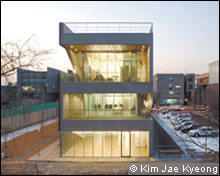
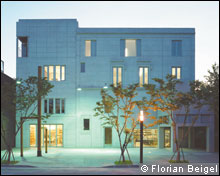
The project was initiated by publisher Yi Ki-Ung, whose ambition extended to creating a city of books that would also become a kind of museum of architecture: Paju features buildings by some of the finest architects working in the world today. The 1.5m sq m masterplan and the most sophisticated buildings on the site were carried out by the remarkable London-based Architectural Research Unit, run by Florian Beigel and Philip Christou. They wanted to create what they called, delightfully, an “urban wetland” – a paradoxical idea that allows them to root the new city in the landscape, to create something tied to its context rather than a suburban non-place. That context is beautiful, even epic, in its own way – the Han River, the mountain backdrop – but all that is cut off by the elevated motorway which also acts as a dyke. So the city is constructed on two levels: a dense street level, which accommodates the activity of the city itself, and a sparser upper level Beigel poetically refers to as “the strata belonging to the horizon”. Here a series of rooftop pavilions, elevated public spaces and buildings crowning bigger buildings below look over the road and out to the landscape beyond.

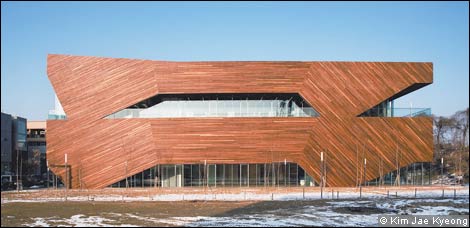
The city plan follows the contours and lines of the landscape, one main road snaking through it like a river and a series of tighter roads creating a denser network of small publishing houses, printers, distributers and so on. There are some extraordinarily ambitious buildings here. Just finishing construction is the Mimesis Museum, one of the Portuguese architect Alvaro Siza’s most arresting recent structures – its sheer concrete walls curve like the pages of a book in the wind, wrapping around a sculptural courtyard at its heart. SANAA, the Japanese architects of this year’s Serpentine Pavilion in London, have designed a stripped-down box, a publisher’s building of stark, striking elegance. London-based Foreign Office Architects have built a wonderfully theatrical publishing house which appears on the street as a modernist sliver, a delicately folded façade of glass which reveals sides with an almost nautical quality, clad in timber where they face a garden. There are exotically ambitious buildings under construction by Yung Ho Chang, Xaveer de Geyter, Stan Allen and some structures by Korean architects which would astound in any capital, let alone on a suburban Seoul industrial complex – notably those of Moogyu Choi and a bravado piece of concrete expressionism from Kim Jun-sung and Hallim Suh.

Youl Hwa Dang

Youl Hwa Dang

At the centre of the city stands a huge cultural complex, designed by Kim Byung-yoon, a combination of hotel (in which, it was pointed out to me, there are no TVs), restaurants, auditoriums and, on the roof, an urbane, elevated realm of seating, shops, libraries and galleries overlooking the sparkling waters of the river and the Simhak Mountain.

The finest buildings on the site, though, are by the ARU themselves (together with local partner Choi Jong Hoon). The first was for Yi Ki-Ung’s own Youl Hwa Dang publishing house, an enigmatic U-shaped building around a small courtyard. It looks like a bold pictogram, with a dark street façade, but to the courtyard there are “walls of light”, translucent membranes that recall the paper walls of traditional houses. An extension which contains a bookshop and café presents an intriguing contrast to the original buildings, retaining the subtlest memories of classical European urban architecture in moulding details, a portico and so on. This conservatism was conceived as a gentle provocation to the radical modernism all around and it works, with a startling clarity.

The ARU’s other structure, equally compelling, is for the Positive Thinking Publishing House. Designed as offices on a domestic scale and split into two units that create an intimate public plaza between them, they are built of traditional dark grey Korean brick set into a steel frame. The result is a hybrid of deeply embedded oriental and European archetypes. There is something here of Wittgenstein’s house, something of Beijing’s courtyard houses, a kind of Eurasian architectonic language which also, amazingly, manages to be conservative and deeply in thrall to the radical modernism of Mies van der Rohe. Inside, the surprises continue. The ceilings become an inverted urban landscape as a series of blocky paper lanterns break up the space from above. The domestic scale is wonderful: these feel like publishing offices, no plate glass, no open plan, rather a series of humane rooms, terraces and natural light.

If there is a problem at Paju it is that, as in all new cities, there is a kind of stillness, a lack of real density. This is compounded by zoning issues: as this is designated an industrial zone, the building of dwellings is difficult, and without places for people actually to live an area can never become a real city. Nevertheless, housing is slowly being built, and there are stirrings of the urban and commercial activity that constitute the beginnings of a real place.

It is not hyperbole to claim that this is one of the most extraordinary and most unsung cultural and architectural developments in the world. The idea that a city, right now, be dedicated solely to print and that an industrial estate could be a place of architectural pilgrimage could not be more heartening, more encouraging to anyone who delights in those very old information technologies – books and buildings.

A Korean composer talks about crossing genres

http://www.ft.com/cms/s/2/d91c082a-7d61-11de-b8ee-00144feabdc0.html
By Laura Battle

Published: July 31 2009 23:17 | Last updated: July 31 2009 23:17

Unsuk Chin

Were Unsuk Chin in any other arts profession, her name would be familiar – already a brand, perhaps – but as a composer, even as one of the foremost composers in the world, she remains an elusive figure.

Within this rarefied field – that of contemporary classical music – Chin is admired and celebrated, but this was not always the case. In her early life in South Korea, and for much of her later development in Berlin, where she has lived since 1988, her search for recognition proved arduous and protracted. Each piece of music has required a significant investment of time and labour – not that you’d guess: many are characterised by glassy, delicate and often lyrical sequences that unravel in a stream-of-consciousness style – and premieres of Chin’s music are few and far between. This year, however, three new works have come to fruition.

When I arrive at her elegant Charlottenburg apartment Chin admits that life has been “a bit hyper” recently. Today is no exception: not so much because of work, more to do with the fact that it’s her 48th birthday. I’ve caught her between family lunch with her husband, the Finnish pianist Maris Gothoni, and their young son, and a soirée she is throwing later that evening. We seat ourselves rather awkwardly at the dining table and Chin prepares herself as if for interrogation: her career has largely developed without media interference, and one senses she prefers it that way. But this season the glare of the public eye will be hard to avoid.

A recording of her Violin Concerto, which scooped the prestigious Grawemeyer Award in 2004, has just been released, and this month sees the premiere of her new Cello Concerto at the Proms in London. That Chin is one of five female composers to have new work presented during the festival is happy coincidence: the piece was originally scheduled for 2007, although it was hatched, like so many of the best ideas, at a party a number of years earlier. The cellist Alban Gerhardt and violinist Lisa Batiashvili “came round to this flat with Brahms’s Double Concerto, I think. It was the first time I’d heard [Gerhardt] play and I promised immediately, ‘I will write a cello concerto for you!’ But then he had to wait another seven years!” Chin adds, with a nervous volley of laughter.

Unlike her two previous concertos, where the solo part floats and flirts with its accompaniment, she describes the cello here as being “in conflict” with the orchestra: “I’ve put much more personal energy into this work, the cello has to hold the whole piece the whole time, and the soloist has a very strong psychological role,” Chin explains. It is clearly a highly developed work and, judging from Gerhardt’s rehearsal blog, fiendishly difficult to play: “Many passages are incredibly fast,” he wrote on July 10. “If I get lost in them, I will be lost. Arghhhh!”

This emphasis on speed and complexity seems to reflect Chin’s interest in musical virtuosity. As a young girl in South Korea she dreamt of becoming a concert pianist, learning western-style harmony by accompanying services at Presbyterian churches where her father ministered. But the family was poor and tuition funds were not available to the second daughter. “It was also very difficult to get records at that time but we had a small transistor radio and I listened to music every day, I was crazy for it.” This was the 1970s, under Park Chung-hee’s repressive regime, and Chin’s perception of western culture was shaped by her obsession with the Beethoven and Tchaikovsky symphonies.

Once at Seoul National University, and now determined to compose, Chin was in thrall to the new wave of European composers: Stockhausen, Boulez, Nono et al. “It was quite strange, a Korean composer learning this Darmstadt avant-garde style in Korea, and I always felt that this was not my music.” Still, it was this interest that inspired her self-exile to Hamburg, where she sought the tutelage of Hungarian composer György Ligeti. It was her first trip abroad, and a “culture shock” initially, but the hard work had only just begun. “I think everyone knows, [Ligeti] was extremely difficult,” Chin begins, before detailing how he dismissed her work as derivative and “destroyed” her self-esteem – to the extent that she felt unable to compose for three years.

In spite of Ligeti’s disciplinarian approach, his influence would, in the end, prove valuable and long-lasting. Alice in Wonderland, Chin’s first full-blown opera, explored a theme that Ligeti suggested before his death. But although the great master haunts the piece, Chin’s soundscape is very much her own. There were boos from the first-night audience in Munich in 2007 – “They came in evening dresses and diamonds and I think they were expecting Aida or something” – but her score received favourable reviews, even if Achim Freyer’s po-faced, expressionist production did not. In any case, she was undeterred by the experience and plans to start work on Alice Through the Looking Glass.

Chin seems to have an omnivorous taste for styles and genres, and I notice that the room is dominated by two massive floor-mounted speakers, some sophisticated hi-fi equipment and piles of CDs. “There are so many composers who are almost autistic and have no communication with the outside world, and I think that’s problematic,” she explains, “I seldom have time to go to concerts but I have a very good connection with publishers and I always have recordings sent of new works.” Gérard Grisey, George Benjamin and Jukka Tiensuu are cited as composers she admires but they sit alongside a range of other artists.

“I like pop music from the 1980s very much. I was always impressed by Michael Jackson, for example, that he could compose a melody for just two bars, with two harmonies, and could win millions of people through this small act. It’s fantastic and we can’t do that,” she says, speaking for classical composers. However, although there are chord sequences and melodic hooks in her own music that speak directly to the layman, Chin denies that popular music has influenced her work. Her next work, the Sheng Concerto, pays its respects to a tradition of Asian folk music.

“This is my first piece for a non-western instrument but I use the sheng very carefully; I’ve limited the sheng’s role and I wrap the orchestra around it.”

Chin first heard the sheng, a wind instrument capable of organ-like clarity and sustain, as a young girl, but had overlooked its potential until a chance encounter with the specialist Wu Wei. As with Gerhardt, Chin was so bowled over that she promised a concerto on the spot, and Wu is to perform the work at premieres in Tokyo and Los Angeles in the autumn.

This season will conclude with a new piece for the Ensemble Modern and further engagements with the Seoul Philharmonic Orchestra, where Chin is composer in residence. Since her appointment in 2006, she has quietly achieved great things there, not least the performance of more than 50 Korean premieres, including Boulez’s Notations and Ligeti’s Violin Concerto. I wonder aloud if the role has explored her own connection to both eastern and western cultures but her reply is evasive, and even a little disapproving: “For me, there is no border between western or Asian or Korean music. For me, music is music.”

Cello Concerto premieres at Prom 38, Royal Albert Hall, London, on August 13; www.bbc.co.uk/proms

Obituary: Roh Moo-hyun

By Christian Oliver in Seoul
http://www.ft.com/cms/s/0/571c01b4-4859-11de-8870-00144feabdc0.html
Published: May 24 2009 17:07 | Last updated: May 24 2009 17:07

Roh Moo-hyun, who committed suicide on Saturday, was devastated by an enquiry into his probity and had written on his blog of his shame at losing his reputation as South Korea’s only clean president. He was 62.

Prosecutors had been investigating payments of nearly $6m from a shoemaking tycoon to members of the family of Mr Roh, a leftist who left office last year. Even though prosecutors had not charged Mr Roh with corruption or tax evasion, by the time he threw himself from a mountainside, he was distraught about the damage to his reputation.

“I have lost the right to say anything about democracy, progress and justice. I fell into an abyss which I cannot escape,” he wrote earlier this month.

Within South Korea, Mr Roh’s supporters are portraying the case as a politically motivated assault by right-wingers. Although the sums involved are large, they are small by the standards of previous Korean presidents and the money is less clearly linked to direct political influence than in earlier scandals.

Mr Roh is popular mainly among Korea’s young people, who are sick of the traditional political caste. After his presidency, his home village became a pilgrimage site for day-trippers.

Of Mr Roh’s four predecessors, two were jailed for graft and the sons of two others were imprisoned on similar counts. Mr Roh was widely viewed as a highly principled man in a corrupt system. Many Koreans are viewing his suicide as an attempt to free his family from a painful investigation. If that was his motive, it worked.

Mr Roh was born to a poor farming family in Gimhae, south-east Korea in 1946. In a country where political success has normally been the preserve of graduates from Seoul’s top three universities, Mr Roh was an unusual autodidact who had spent nine years getting himself through the national bar exam.

He forged his reputation defending unionists and democracy activists during the turbulent democracy struggle of 1980s when the country was riven by bloody protests. In 1987, he spent three weeks in prison for supporting an illegal strike.

He entered parliament a year later and, ironically enough, gained stardom in a parliamentary hearing on the corruption of a former president, Chun Doo-hwan.

He became the protégé of Kim Dae-jung, president from 1998 to 2003, serving as his fisheries’ minister.

Although not expected to win the 2002 presidential election, he rode to victory on a wave of anti-Americanism, partly fired by the death of two Korean schoolgirls killed in an accident with a US military vehicle. He had campaigned on a platform of fighting corruption and reforming the mighty conglomerates that dominate the economy.

On becoming president, Mr Roh became well-known on the international stage for continuing Mr Kim’s “Sunshine Policy” of engagement with North Korea. Most famously he visited Pyongyang for a summit in 2007 and signed a raft of co-operation deals.

Mr Roh’s strategy was marred by the test of a North Korean nuclear weapon in 2006. However his diplomacy appeared to be paying dividends by the end of 2007 when international inspectors agreed North Korea was disabling its atomic facilities.

At heart a proud Korean nationalist, he was criticised for being too curt in some of his dealings with the US and Japan, the old imperial overlord.

On the domestic front, his presidency was marked by feuding, owing to his lack of a deep political support base. He was impeached in 2004 after publicly supporting his own party, contravening the constitutional neutrality of the president. He was reinstated after two months.

His government forged a trade deal with Washington, that has run into trouble under his successor, Lee Myung-bak.

He retired to the village of Bongha to work in an organisation dedicated to traditional farming methods. But the bribery scandal shattered his pursuit of rural tranquillity.

“Because of the state I am in, I cannot do anything. I cannot even write or read a book,” he wrote in his suicide note.

In the note, he also hankered after a return to nature.

“Do not be sad. Are not life and death all part of nature? … Please cremate me and leave a small tombstone near my home. I have thought about this for a long time.”

Additional reporting by Kang Buseong

Thousands in Korea mourn Roh’s death

By Song Jung-a and Christian Oliver in Seoul
http://www.ft.com/cms/s/0/f848bf9c-485d-11de-8870-00144feabdc0.html
Published: May 24 2009 13:46 | Last updated: May 24 2009 17:15

Tens of thousands of mourners gathered across South Korea to pay their final respects to Roh Moo-hyun, a former president who committed suicide at the weekend as he faced a growing corruption scandal.

Shortly after dawn on Saturday, Mr Roh, 62, went hiking on a mountain behind his home in Bongha, a village in the south-east of the peninsula. Police said he jumped from a cliff-face near the summit and suffered severe head injuries. He left a brief suicide note to his family.

South Koreans were stunned by the sudden death of Mr Roh, famed abroad for his attempts to build a rapprochement with communist North Korea. “This is hard to believe,” said Lee Myung-bak, the president. “It’s very sad and lamentable.”

Mr Roh, who left office in February 2008, had complained he was suffering from intense stress because of a scandal involving alleged corruption during his presidency. Prosecutors summoned him last month for an investigation into allegations that his family received $6m from a businessman while he was in office. His family has also been grilled.

Mr Roh’s supporters claimed the investigation was politically motivated to undermine the opposition and that the prosecutors’ probe into his family drove him to take his own life. The government on Sunday said the case against Mr Roh was closed but analysts speculate his suicide still threatens to catalyse the country’s political tensions.

Thousands of people queued up to burn incense and bow before a make-shift altar erected to Mr Roh in downtown Seoul. As Mr Roh was fond of smoking, many mourners left a cigarette rather than an incense stick. State radio reported 10,000 mourners had visited Bongha by Sunday morning.

“I am lost for words. His death is a great loss for the country,” said Kim Jae-suk, a 52-year-old housewife waiting for her turn in the tearful crowd gathered at the altar.

Mr Roh’s death came as prosecutors were due to decide whether to charge him. Mr Roh admitted his wife had taken money from a businessman to pay family debts. He had issued a public apology, but the scandal dealt a blow to his image as a clean politician in a rotten system.

Mr Roh, a former human rights lawyer, was elected in 2002 on a promise to reform powerful conglomerates, fight corruption, improve relations with Pyongyang and make Seoul more independent from the US, its long-standing military ally.

However, his five-year term proved turbulent, marked by political infighting and scandals. Mr Roh was impeached by lawmakers in early 2004 over a breach of election rules but was two months later reinstated after the Constitutional Court overturned the move.

His death may rekindle tensions between predominantly young liberals and older conservatives in South Korea, where President Lee, a conservative former businessman, came to power last year after a decade of liberal rule.

“A controversy is flaring up over whether the prosecutors were responsible for his death. If the government fails to handle this well, then the probe could be seen as a political revenge against Mr Roh. In that case, it will be a huge political burden for Mr Lee,” said Ham Sung-deuk, a politics professor at Korea University.