Slower pace would help Seoul to grow faster

Anna.Fifield
Financial Times
August 6 2008
http://www.ft.com/cms/s/0/1b22cb0a-63d2-11dd-844f-0000779fd18c.html

In South Korea, there is only one speed: full throttle.

Buildings go up almost overnight, trends pass no sooner than they have arrived and presidents’ approval ratings drop from 70 to 20 per cent in the blink of an eye. One of the first local sayings that foreigners learn is bballi bballi — fast, fast.

When I moved to Seoul four years ago, I was immediately impressed by Koreans’ determination and energy, the two biggest factors behind the country?s transformation from rural backwater to technological powerhouse. As I prepare to leave, I still marvel at this country’s verve. But I cannot help wondering whether South Korea can avoid falling into the kind of economic malaise that has afflicted Japan. The country remains overwhelmingly dependent on goods exports and the service sector is woefully underdeveloped and inefficient. But of all the challenges facing South Korea, there is one, often overlooked, area where reform would bring unparalleled benefits: education.

Devoid of natural resources, Korea?s recourse has been to its human capital. People propelled Korea to where it is today, thanks largely to Park Chung-hee, the former president and a military strongman who directed Koreans to study engineering in particular. One senior Samsung executive this week explained to me that two significant components of the conglomerate’s ‘success DNA’ were its ability to move quickly and the calibre of its engineers. Now, more than ever, human capital will be the deciding factor in how South Korea fares in the future and whether it makes its next transformation, into a knowledge economy.

Koreans perform exceptionally well in international performance rankings for subjects including reading comprehension, maths, science and problem solving, and the proportion of 25-34-year-olds with an upper secondary school education is the highest in the Organisation for Economic Co-operation and Development. Koreans now represent the largest group of international students in American universities.

But they have got there through the most arduous process, driven by the intense social pressure to get into the right school, then the right university, find the right job and meet the right spouse. One friend recounted how when her three-year-old?s kindergarten conducted psychometric testing, the other mothers earnestly jotted down the results, noting whether to push their tots towards law, medicine or finance.

Koreans spend more time at school than students in any other developed country and spend the most money on education (8 per cent of gross domestic product), with private education expenditure double that of the US, the second biggest spender. Bank of Korea data show that families spent more than $12bn (EUR7.7, £6bn) on after-school education last year.

The system rests largely on rote learning and places almost no value on analysis, creative thinking or practical application. High school students who can score 99 per cent in an English test are often unable to hold even a simple conversation, while university students who express a contrary view to their professor simply fail. So intense is the pressure to get good grades that 12-year-olds, after spending all day at school, routinely attend cram school, or hagwon, until midnight.

This obsession with education has contributed to a number of social and economic problems ? from the low fertility rate, partly the result of the cost of putting children through private tuition, to the real estate bubble in southern Seoul, where the best schools and hagwons are located.

It also augurs ill for the future, when South Korea will not need so many workers who can build ships and assemble cars, but will need more and more people who can be innovative, who can develop and apply knowledge. Indeed, despite Korea?s impressive headline performance in test scores, the World Economic Forum ranks the quality of the country?s education system at 60th in the world ? shockingly low for one of the world?s top dozen economies.

Creating a knowledge-based economy will be critical if South Korea is to maintain decent levels of growth — the potential rate is now 5 per cent — and to reach income levels of the world?s most developed countries. One of President Lee Myung-bak’s big pledges is to see Korea’s per capita income double to $40,000 within a decade.

Koreans have already performed remarkably in IT — particularly on the hardware side — but improving the education system would produce workers better equipped to meet the needs of the country?s fast-moving technology industries.

Further growth can be achieved through productivity gains — Korea’s productivity is 60 per cent below the US level. Service sector productivity is only half that of manufacturing, and has been stagnant for almost 15 years. Given the nature of the education system, this can be no coincidence.

Overhauling this system will be incredibly difficult. After all, another of my friends, an enlightened mother who would prefer her 14-year-old to play basketball after school and go to bed before 1am each night, can not even dissuade her son from going to hagwon.

However, for its future prosperity and to retain its economic prowess, Korea would do well to take its foot off the accelerator slightly, take stock and think about using its impressive drive and human capital in more efficient ways. The economy will benefit and the kids will love it.

When death is a reminder to live

By Anna Fifield
Published: July 21 2008
http://www.ft.com/cms/s/0/c8475c5e-574a-11dd-916c-000077b07658.html

Standing in front of a flower-covered altar in a dimly lit room, Baek Kyung-ah is reading out her will at her own funeral. “I can’t believe today is my last day,” she chokes through sobs, her voice barely audible above the solemn music.

“To my husband, knowing that this will be my last time seeing you, I would like to apologise for thinking only about myself and for not being a caring wife. To my parents, just thinking about you makes my eyes teary. I love you,” she cries, before heading off to lie down in a coffin and be “buried”.

Welcome to the new Korean craze of “well-dying”. In a country infatuated with “well-being” – living and eating healthily, even to the point where tobacco-makers offer vitamin-enriched “well-being cigarettes” – training companies are now offering courses on dying a good death.

“Korea has ranked number one in many bad things such as suicide and divorce and cancer rates, so I wanted to run a programme for people to experience death,” says Ko Min-su, a 40-year-old former insurance agent who founded Korea Life Consulting, which offers fake funerals as a way to make people value life.

Korean corporations – from Samsung Electronics and Hyundai Motor to Kyobo Life Insurance and Mirae Asset Management – send their employees on Mr Ko’s courses regularly, partly to encourage them to question their priorities in life and partly as a suicide prevention measure.

The course is now such an integral part of training at Samsung and Kyobo that they have even built their own fake funeral centres. International companies including ING and Allianz have also sent their staff on the courses.

Suicide is a serious problem in South Korea, which has the highest rate of self-inflicted deaths in the developed world, with 24.7 cases per 100,000 people, according to the latest report from the Organisation for Economic Co-operation and Development. The rate has doubled in the last five years.

Experts blame the sharp increase on the sudden changes in society resulting from South Korea’s rapid industrialisation, which has led to cut-throat competitiveness and financial stress. “We have seen a lot of social change over the last 30 or 40 years and people are having a hard time keeping up with capitalist values,” says Hong Kang-ui, president of the Korean Association for Suicide Prevention. “At the same time, social support networks have weakened.”

But quality of life is also an issue, with employees working extraordinarily long hours. Mr Ko’s course aims to make participants re-evaluate their priorities. About 50,000 people have taken part since he launched it in 2004, a move prompted by the premature deaths of his two older brothers in air and car crashes.

Lee Joo-heung, a 45-year-old company manager in a yellow Hawaiian shirt, attended a recent course because he wanted to reflect on his past and prepare for his death. “I have never thought about not being there for my family, and I realised that if I died all of a sudden my wife and children would be left alone,” he said.

Mr Ko, a smooth talker with a touch of the television evangelist about him, begins the course with a motivational presentation that includes a “life calculator” counting the time until one’s death down to the millisecond.

Then participants are led to a dark room where they are told to sit at candlelit desks and write their wills, prompted by some sample questions. If you died today, what would you tell your family? What would you say about your job and your life?

As they start to write, the room becomes filled with sniffing, women in particular struggling to hold back their tears.

Will completed, they collect their funeral portraits – participants are asked to pose on the way in – and enter the “death experience room”, a large, dark space containing a series of open coffins and decorated with posters of famous bygones such as Ronald Reagan, Diana, Princess of Wales, and Lee Byung-chull, Samsung’s founder.

In front of an altar covered with flowers and his funeral portrait, Mr Ko instructs his trainees to choose a coffin, put on a traditional hemp death robe and then read out their wills one-by-one.

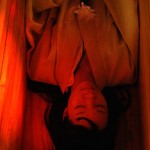
Next, it is time to be buried. Participants lie down in their coffins, while a man wearing the outfit of a traditional Korean death messenger places a flower on each person’s chest. Funeral attendants place lids on the coffins, banging each corner several times with a mallet. Dirt is thrown down on the lid, as loud as stones on a tile roof. The attendants leave the hall for five minutes – but it seemed like 30 minutes to those taking part.

Once the lids are lifted, Mr Ko asks the trainees how they felt. “When they were nailing the coffin and sprinkling the dirt, it felt like I was really dead,” Ms Baek says. “I thought death was far away but now that I have experienced it, I feel like I have to live a better life.”

Yoon Soo-yung, a manager at the Cheonnam Educational Training Institute, who was considering sending her staff on the course, said the experience was terrifying. “I felt like I was suffocating. I cried a lot inside my coffin,” she told the Financial Times. “I regretted so many things that I had done in my life and mistakes that I had made.”

Some medical experts are less convinced of the value of such programmes as a suicide prevention measure. “I think treating the fundamental causes like depression and impulsive behaviour is more important and should come before such programmes,” says Chung Hong-jin, professor of neuropsychiatry at the Samsung Medical Centre in Seoul.

Mr Ko, however, says those who have completed his course become more considerate, and attach greater value to their lives. “Life is a gift from your parents, but the way you live depends on the choices that you make,” he says. “People realise the beauty of life by experiencing death.”

—————————

Fake funerals operator sees an opening for mock incarceration

Fake funerals have become so popular in South Korea that Ko Min-su, the founder of Korea Life Consulting, now has competition in the death experience business.

“We’re like Nike – we have lots of imitators,” Mr Ko says in the sprawling complex he has just bought to house his expanding company.

But with patents to run the course in Korea and 17 other countries – including Japan, the US, Germany and India – Mr Ko is confident that he can retain his niche. “Since everyone will die at some point, I have registered international patents and would like to expand the programme abroad,” Mr Ko says, adding that Japan and China will be the first target markets.

In Korea, the company now has offices in Seoul and in Naju, in the south of the country, and employs eight full-time staff, as well as contract workers who help facilitate the courses. Each participant pays between $50 and $300 to attend.

With the fake funerals now well-established, Mr Ko is toying with the idea of expanding his business model to include other preventative courses.

Mr Ko is now thinking about expanding his business to include other courses with a death theme such as fake cremations, but is also considering ventures with other preventative lessons.

“I am thinking of developing other ideas such as a course involving living in a prison cell, to stop would-be criminals from breaking the law,” he says. “If they see what it’s like to lose their freedom, they might think twice.”

Architects bid to restore ‘soul of Seoul’

By Anna Fifield in Seoul
Published: July 14 2008

Yongsan development

Vision of the future: an artist’s impression of the Yongsan development, which will be sited close to the Han river and two big train stations

Hardly one of Asia’s most aesthetically pleasing cities, Seoul is undergoing a spectacular face-lift, with a range of multi-billion-dollar construction projects.

In the latest development, five internationally renowned architects are bidding to design the Yongsan international business district in the South Korean capital, a $28bn five-year project due to start in 2011.

“We’ve been invited to put the soul back in Seoul,” says Hani Rashid of the New York firm Asymptote, which designed Malaysia’s Penang Global City and is vying for the Seoul contract.

As South Korea rebuilt its razed capital after the Korean war and embarked on four dizzying decades of industrialisation, the emphasis was on function rather than form. The result is a mish-mash of concrete blocks. But in the past decade this has begun to change, with the construction of parks and plazas, and the emergence of more inspired buildings.

Now five architectural firms have been asked to design a “cutting-edge, future-oriented complex” on 566,000 square metres of land, currently home to railway warehouses, in the centre of Seoul.

The master plan is to include commercial, residential, cultural and leisure spaces, and must feature a landmark tower. The winner will be announced in December.

Close to the Han river and two important train stations, the Yongsan development borders the US military base, which will be turned into the “Central Park of Seoul” when the army relocates south of the capital in four years, and is in the middle of the three current business districts.

“Seoul is undistinguished in terms of its architecture and is not seen as an international player, and that is precisely what this project is about, what we have to answer,” says Nina Libeskind of Studio Daniel Libeskind, which is rebuilding the World Trade Center in New York. “It’s a very exciting, very optimistic moment in the city’s history.”

Local residents have mixed feelings.

Park Jin-ho, an interior designer who lives in an apartment near the railway station, says the area is “already good to live in because it is quite central, and I think it will be much better, with more benefits, once it is developed”.

However, others think the city government is not paying enough compensation to residents who will have to move.

“I don’t oppose the city’s plan to make Yongsan an upper-class town to raise Seoul’s competitiveness, but I really don’t like the way the city is pushing for the development project without consulting residents [or] guaranteeing our property rights,” says Chung Geun-soo, another resident.

The Yongsan area is nine times the size of the World Trade Center complex and each of the architectural firms has been given $1m to come up with a plan – compared with $40,000 for those offering to redesign Ground Zero.

Andy Bow of Foster and Partners, architects of the Swiss Re “Gherkin” building in the City of London, says the project has the potential to redefine Seoul. “It’s like Canary Wharf [in London] or La Défense [in Paris] in terms of the scale and the quantum of development,” says Mr Bow. “Canary Wharf moved the centre of gravity in London.”

The other architects bidding are Jerde Partnership, famous for Tokyo’s Roppongi Hills, and Skidmore Owings and Merrill, which is building the Burj Dubai, set to be the world’s tallest tower.

The project comes amid a dearth of office space and a flurry of construction. The vacancy rate among commercial buildings in Seoul is about 1 per cent, one of the lowest in Asia, and Jones Lang LaSalle, the property firm, estimates the lack of supply pushed up Korean office prices by about 25 per cent last year.

But Yongsan will be unique because of its central location and access to both parks and the river, the developers say. “I think it’s very important in a city of 10m or 20m people to have a place where people can come together into the centre,” says John Simones, design director of Jerde.

……………………………………………….

Billion-dollar developments lend touch of class

The Yongsan development is being built by a 26-member consortium, led by the state-run Korea Railroad Corporation, Samsung Corp and the National Pension Service. Total project finance could rise to $50bn (€31bn, £25bn), the developers estimate.

By common consent, Seoul is short of top class architecture. But two large-scale developments are under way in Youido, the island in the Han River and Korea’s financial centre.

The 486,000 sq metre Seoul International Finance Centre, being developed by the city government and a unit of AIG, the American insurer, will contain three office towers, a five-star hotel and a shopping mall.

Across the road, Skylan, a pan-Asian real estate development company, is running a similar $2bn project. New York-based Gale International is behind the $20bn construction of New Songdo City, near Incheon international airport It will feature residential and commercial buildings, a Jack Nicklaus-designed golf course, hospitals and schools. A 14km bridge linking the city to the Incheon international airport is almost complete.

Additional reporting by Song Jung-a

Heir apparent

http://www.ft.com/cms/s/0/2d89f85c-108c-11dd-b8d6-0000779fd2ac.html

As Lee Kun-hee’s only son, Lee Jae-yong has long been considered the heir apparent at Samsung, a view solidified last year when he was appointed to the specially created role of chief customer officer of Samsung Electronics, writes Anna Fifield.

Mr Lee, 40, is easy-going and candid. All his life he has been groomed to inherit the company, completing an MBA at Keio University in Japan before entering Harvard Business School.

His father instructed him to play golf with Samsung executives and study their personal styles.

In one of his first tasks at chief customer officer last year, Mr Lee Jr showed News Corp’s Rupert Murdoch around the Samsung showroom at the Las Vegas consumer electronics show.

Lost in Transit

FT Magazine coverBy Anna Fifield
http://www.ft.com/cms/s/2/04c2a02e-13f1-11dc-88cb-000b5df10621.html
Published: June 8 2007 17:20 | Last updated: June 8 2007 17:20

When he stepped off a flight into the glittering, almost science-fiction-like airport terminal near Seoul three years ago, Park Hyun-ki didn’t find South Korea all that different from the North. First, intelligence officers took him away for questioning, an experience not unusual in the North. And once he passed through detention, the fast pace of life in the capitalist South and the “pretty” accent of Southerners felt familiar thanks to the hours of South Korean soap operas he had watched while hiding in China. “It didn’t feel very foreign,” the 28-year-old says. “I did think all the demonstrations on the streets were a bit strange. You can’t even imagine staging protests in North Korea.”

To North Koreans, the South is at once familiar and alien. People who share their names, their language and their history drive down neon-emblazoned streets in Hyundai SUVs, watch television on their mobile phones and criticise the president at every opportunity. Park’s hometown of 3,000 people, lying just outside Musan, a mining city in the North Hamgyong province of North Korea, near the border with China, is a world away from this. The bleak, rocky province – once the centre of North Korean industry but now rusting – is considered backward even by the standards of the North.

Still, life there was “OK”, says Park. After 10 years of schooling, he had secured steady work in a munitions factory making bullets and grenades. But in the mid-1990s, a devastating famine struck, compounding shortages that followed the collapse of the Soviet Union; soon Park’s friends and workmates were facing starvation. “We were eating only three meals a week, sometimes even eating tree bark because that was all we had,” he recalls, sitting on the floor of a Korean restaurant in southern Seoul, the table crowded with bowls of the vegetables and rice, plates of fish and dishes of kimchi and pancakes he could once only dream about.

Then people started dying. “From 1995, four people were dying each day from the hunger.” Realising his fate if he remained in the North, Park started plotting his family’s escape. He surveyed the Tumen river, which separates North Korea from China, and befriended the guards patrolling the border. Finally, one night, he bribed one of the soldiers and escaped with his family into China. A gruelling journey followed, during which both of his parents died and his sister was captured by human traffickers hoping to sell her to a Chinese man. Park, alone and bewildered, found his way to the South Korean embassy in Beijing and eventually flew to Seoul.

Upon arrival in the South, refugees are sent to a government centre called Hanawon, where they spend 10 weeks learning about Southern culture as well as practical skills such as how to use a computer, a bank card, a mobile phone and the subway. As they leave, they receive government payments. A single refugee gets a lump sum of $3,000 for basic assistance, a further $7,000 paid out over the following two years, and $10,000 for housing – meant to cover five years’ rent. (This $20,000 is a sharp reduction from 2004, when a lone refugee could expect $35,000, and the amount is set to be cut further this year.)

Park blew most of his grant on drinking, karaoke and playing pool. “In North Korea we have no concept of money or budgeting or saving, so once we get here we don’t know what to do,” he says, shrugging his shoulders. With his downbeat expression, shaggy hair and black “Hugo Boos” (fake Hugo Boss) jumper, Park cuts a rather pitiful figure.

Not realising he had to be careful with his national identity card, he discovered that new acquaintances had racked up huge mobile phone bills in his name. He found a job in a bar to pay the debt, but soon had to quit because he got into fights with customers who mocked his country-bumpkin accent. He tried working as a broker for escaping North Koreans but that enterprise landed him in jail, charged with forging the documents North Koreans need to win passage to the South. Upon his release he discovered his girlfriend, also a refugee, was pregnant and had only $8 to her name. “I felt so frustrated with the treatment I received,” says Park, jobless again. “I spent three months in jail while my girlfriend was pregnant and now the government calls me a criminal. I think it’s the South Korean government that’s criminal, not me.”

After the Korean war ended in 1953 and the division of the peninsula, Pyongyang operated under a strict policy of isolationism, keeping people in and information out. In the four decades that passed between the Korean war and the end of the cold war, only 600 North Koreans sought asylum in the South. The vast majority were elite men – diplomats, party cadres or military officers. Upon their arrival in Seoul, they were celebrated as heroes, their defections portrayed as a triumph of capitalism over communism. With their high levels of education, social skills and ready-made jobs at government think-tanks, these early defectors easily slotted into South Korean society.

But that all changed after the North Korean famine of the mid-1990s, which killed an estimated 2 million people, or almost 10 per cent of the population. The escaping North Koreans were no longer elites seeking political respite but unskilled workers from rural areas who were driven into China by hunger. Between 1994 and 1999 the number of North Koreans arriving in the South rose to 50 a year, but then started multiplying rapidly, increasing from 312 in 2000 to 1,894 in 2004. The number of refugees living in the South this year passed the 10,000 mark.

Now, three-quarters of defectors are women, the vast majority in their 20s and 30s. About 80 per cent of the total are from North Hamgyong province, whose rocky landscape is not well suited to agriculture and left the residents most vulnerable to the famine. As far from the showcase capital of Pyongyang as it’s possible to get in North Korea, Hamgyong has long been home to those considered undesirable in the rest of the country, and is believed to house several of the labour camps where those deemed politically unreliable are put to work.

Nanyang, seen from across the border in China - a common escape route

Nanyang, seen from across the border in China - a common escape route


The vast majority of those fleeing North Korea escape across the Yalu or Tumen rivers, which form the 1,400km border with China, swimming and wading in the summer or running over the ice in the winter. The border is increasingly heavily monitored on both sides, and those captured by North Korean or Chinese police risk repatriation and the labour camps – or worse.

Most of those who do make it across spend about three years hiding in China before making their way – with the help of Christian missionaries or expensive brokers (charging anywhere from $3,000 to $30,000) – to countries such as Mongolia, Thailand or Vietnam, where they claim asylum and are sent to South Korea. There, a hero’s welcome is far from what they receive.

According to a 2004 survey, half of South Koreans hope for “gradual unification” with the North, while 39 per cent say their ideal would be “prolonged friendly coexistence”. President Roh Moo-hyun feels the same, saying he wants Korean unification “through a predictable process”. And as Seoul has tried to warm relations with Pyongyang through its “sunshine policy” of engagement – seeking to lessen the burden of eventually absorbing the North – so it has become loath to do anything that might antagonise Kim Jong-il and his regime, a category into which encouraging defection falls.

“The South Korean government does not have any intention of fostering the North’s collapse,” Roh said during a visit to Berlin two years ago. “Germany paid a high price to realise national unification and is still suffering from it. I hope Korea will not undergo the same.”

In fact, the cost of Korean unification is likely to be much higher than it was in Germany. In 1989, East Germany’s gross domestic product per capita was one-third of West Germany’s, and about 80 per cent of the German population lived in the West. But on the Korean peninsula, the North’s GDP per capita is about one-15th of the South’s, and the populations are more evenly divided, with only two-thirds of Koreans living in the South.

South Korea’s main preoccupation has been the financial and economic cost of unification, with young people in particular expressing concern over the impact that sudden unification might have on their high-tech, conspicuous-consumption lifestyles.

But this is obscuring a much bigger challenge – that of social integration. “There will be a lot of social problems, especially with this rather large middle class that is forming in North Korea,” says Andrei Lankov, a professor at Kookmin University in Seoul who once studied in Pyonyang. “What will South Korea do with people who are called engineers but who have never seen a computer?”

When Lee Ji-su arrived in Seoul four years ago, she found herself almost intoxicated with the opportunities South Korea offered. After 27 years of repression, brainwashing and then hunger in North Korea, and a terrifying journey through China, she arrived in a country of riches and possibilities she could not have imagined. “I was so excited about my new life. I wanted to get out there, into the real South Korea, as soon as possible,” says Lee, sitting on the floor in her cramped apartment in a commuter town outside Seoul. On the bustling main street, construction companies are building flash new apartment towers, and limousine buses zoom back and forth to the capital.

Lee, now 32, comes from Chongjin, a rusting port city in North Hamgyong not far from China. An accordion player, she was in the local Korean Workers’ party band. At rallies to whip up loyalty for Kim Il-sung and his son Kim Jong-il, she had to play songs such as “My Country, The Best Country” and “Kim Il-sung, Sing of the Love For Him”.

Because of her privileged position as a member of the Korean Workers’ party, Lee was well-off, living in a comfortable apartment, eating well, playing her music and enjoying something of a bourgeois lifestyle. But as the famine took hold and her mother died, Lee had to fend for herself. She started exporting dried fish to China to raise money, using the proceeds to buy cheaper foodstuffs for herself. “I was in the Workers’ party performance team so I had received a lot of political education,” she says. “But when I got to China I saw how much richer than us they were and I watched some South Korean TV. Then I realised just how much the regime had lied to us.”

The myth of Kim Jong-il’s “socialist paradise” exposed, Lee started using her fish-selling trips to investigate the opportunities for crossing the border and not returning. After several such trips, she started the arduous journey to South Korea.

Although it would be impossible to pick out Lee, with her carefully made-up face, gold dangling earrings and (fake) Prada bag in a South Korean crowd, neither her life in North Korea nor her time at Hanawon prepared her for the rigours of the South. She got a job as a waitress but the owner paid her only $300 a month, not the $1,300 he had promised; the work proved gruelling, and the customers looked down their noses at her. “South Koreans think the North Korean accent sounds very crude, so people treated me as ignorant,” she says, admitting this hit a nerve since she didn’t even know how to use a credit card when she first arrived.

In a survey of 300 North Korean refugees living in Seoul, half said they felt they were viewed as second-class citizens and the same proportion labelled discrimination the most difficult thing they had to cope with.

“Some South Koreans say things to me like: ‘It’s OK for you, you don’t have to work here because the government pays you with our taxes.’ I find that very distressing,” she says. “Even at the local council office, they say things like: ‘Why aren’t you at work?'” She had been living on instant noodles for the three days before our interview, and both she and Park asked to use aliases for fear of angering South Koreans.

Although Lee now has a job as an office assistant, for many, work is a struggle. Unemployment among refugees is at about 40 per cent – compared with 3 per cent for the general population – and those with jobs usually hold temporary or otherwise inferior positions. “We get ‘3D’ jobs,” says Lee. “Jobs that are dirty, difficult or dangerous.”

Defector Kim Seung-chol

Defector Kim Seung-chol


Then there is the challenge of forging new relationships. Marriage between South Koreans and previously married North Koreans is a legal minefield – what happens if the former spouse shows up in the South? – and social differences exist even at home. About 70 per cent of inter-Korean marriages end in divorce. Kim Seung-chol, a gaunt salaryman who married a South Korean woman a decade ago, tells me: “In North Korea, women feel happy when their husband brings home the bacon.” But “in South Korea, women need more than just money,” he says. “They want to communicate with their husbands and have fulfilment and things like that. I advise new arrivals that in South Korea they have to tell their wives that they love them every day – but they just laugh, they can’t believe it.”

Some experts argue this sort of advice should be harnessed by Seoul, with the government using refugees’ first-hand knowledge of both the North and the South rather than ostracising the new arrivals. Lankov says: “The number of refugees has reached 10,000 and Korean newspapers call this a ‘flood’ or ‘exodus’. But look at what was happening in Germany in the 1960s, 1970s, 1980s. The average number of people flowing from East to West each year was 21,000.

“These refugees are the avant garde of unification, and sooner or later unification will happen – whether people like it or not. The experience of dealing with these people will be very useful when the South has to cope not just with 10,000 but 24 million refugees.”

At tae kwon do practice in a classroom filled with the smell of teenage boys, Oh Tae-hoon’s face breaks out into a large smile as he kicks his buddy in the chest, his skinny frame rattling around in a protective vest. Born in North Hamgyong, Oh is 17 years old but the same size as a Southern 13-year-old.

Oh was six when his mother deserted the family during the famine. After his father died in 2000, he was alone. “I would hang around on the streets with a friend who also had no parents, looking for food or just killing time.”

Because he lived near the border, he learnt a lot about China, and saw chances for a better life elsewhere. One night in December 2003, he swam across the Tumen river, then walked and cadged rides to Mongolia, where missionaries helped him claim asylum in South Korea. But with no family in the South, Oh was sent to a special school south of Seoul, where he has lived in the dormitory since.

Because he is not an adult, Oh did not receive any lump-sum payments after Hanawon. Instead, he gets $50 pocket money a month from the government – sometimes enough to get by, sometimes not. But after years of living on the streets and skipping school, settling into life as a South Korean teenager is not easy. “I didn’t have much chance to study before I came here so I don’t know the basics,” he says.

Although Oh is a special case, learning is a struggle for most children from North Korea. Joanna Hosaniak, a Pole, works at the Christian NGO Citizens’ Alliance in Seoul, which runs the Hankyoreh Seasonal School where Oh is a pupil. She says many of the children live “almost like wild animals” while in China, so have trouble integrating into South Korea. “They look to their parents for emotional warmth,” she says, “but very often the adults themselves have so many problems that they can’t give that kind of care to their children.”

Indeed, after a repressive life in the North, followed by dangerous and stressful journeys through China, children and adults alike arrive in South Korea suffering from malnutrition and post-traumatic stress disorder. Simple things such as living in an apartment can become a “psychological killer”, says Chung Byung-ho, a cultural anthropologist who helps North Koreans integrate into the South.

“Most of these people have never lived by themselves, then suddenly they are given an apartment, and when they close the door, they feel that nobody cares,” he says. “Socialist societies never leave people alone – they are always interfering, organising, mobilising.”

All this is compounded by the unimaginable level of brainwashing North Koreans experience in the world’s most aggressive personality cult. For many refugees, Christianity fills the gap and helps refugees cope with the South’s sink-or-swim policies. More than half of refugees were baptised during their years in hiding in China, where mainly Protestant missionaries provide the support networks so many refugees lack. To help lay the groundwork for social unification, South Korean attitudes may have to change. “South Korean people no longer think of this as subsidising heroes but as subsidising migrants,” says Chung.

Lankov, meanwhile, has suggested in a report on refugees for the US Committee for Human Rights in North Korea, that Seoul do more to encourage elite defection, perhaps increasing the payments made to people who bring valuable information and skills with them. Refugees should also be provided with more educational opportunities once they arrive in the South. Although they might not be particularly suited to academic study, they could benefit from more vocational training, he says.

Indeed, the hope of many young refugees knows no bounds. Fifteen-year-old Hong Sung-min had been living in South Korea for only two weeks before starting at the Hankyoreh school, alongside Oh, in January. With a broad smile across his spotty face, he is full of excitement about what life in the South could offer. “I am interested in foreign languages, especially English and Chinese. And I want to own my business later in life,” he says between lessons. “Yes, I want to be rich.”

Why only the well connected thrive

By Anna Fifield
http://www.ft.com/cms/s/0/8b04772c-b4bd-11db-b707-0000779e2340.html
Published: February 5 2007 02:00 | Last updated: February 5 2007 02:00

While South Korea has many large business groups, only a few have succeeded in becoming competitive in overseas markets, says Kwon Oh-seung, the head of the Fair Trade Commission, writes Anna Fifield.

That is partly because of the lack of competition at home and the distorted supply chains that favour companies with links to chaebol rather than small and medium enterprises, so called SMEs, without such relationships.

“If you do not belong to a large business group, it is very difficult to do business,” Mr Kwon says. “That is especially true for SMEs: they cannot grow into large companies. I’m very concerned about that and want to correct this situation so that companies can grow in the domestic market and then enter the international market.”

For example, in the electronics market, Samsung and LG belong to business groups with many affiliates, so there is “direct or indirect pressure” to buy products from affiliates and only those companies that have links or relationships to the affiliates get contracts, Mr Kwon says. “That hampers competition in individual markets,” he adds.

Hank Morris, a business consultant, agrees that chaebol are stifling the development of South Korea’s small and innovative businesses.

“Chaebol companies have been known to tell potential customers that if they deal with such-and-such then they won’t get any business from them,” Mr Morris says. “They are essentially trying to corner the market by using unfair tactics. These threats can be very intimidating and they can make it very difficult for small companies to survive.”

S Korea watchdog tries to rein in cartels

By Anna Fifield in Seoul
http://www.ft.com/cms/s/0/00d89e1e-b479-11db-b707-0000779e2340.html
Published: February 4 2007 23:25 | Last updated: February 4 2007 23:25

South Korea’s Fair Trade Commission has pledged to this year take an even tougher line against companies that allegedly abuse their market dominance, focusing on cartels and mergers in particular.

Kwon Oh-seung, the FTC chairman, said companies outside the chaebol conglomerates need a chance to grow. “In the past we have been focusing on unfair practices,” Mr Kwon, who took over leadership of the FTC last year, told the Financial Times. “But from this year we will strengthen our law enforcement on the abuse of market dominance and merger control.”

His vow comes as the National Assembly prepares this month to consider ­government plans to ease restrictions on South Korea’s big businesses, allowing them to invest more in their affiliates. This runs contrary to Mr Kwon’s attempts to impose tougher regulations on cross-investment among chaebol companies such as Samsung and Hyundai, and curtail their ability to control megalithic enterprises with single-digit shareholdings. Instead, Mr Kwon will this year turn to enforcing competition law.

“There is no problem with large companies who have become large through their competitiveness but companies that are dominant in the market should not abuse their dominance. We’re going to strictly regulate or prohibit any anti-competitive practices,” he said.

The watchdog is already active. In the past year it has launched investigations into Qualcomm and Intel, the US technology companies, and forced Microsoft to unbundle the Korean version of its Windows operating system, as well as fining it Won33bn ($31m).

Last month it fined Hyundai Motor Won23bn for violating competition rules by putting excessive pressure on its independent car dealers to promote sales.

Mr Kwon said he saw “some concerning signs” that Hyundai Motor was becoming unfair but the carmaker is already bristling at the FTC’s new-found muscularity.

“These investigations are very intrusive,” said Oles Gadacz, Hyundai spokesman. “How can a government agency decide where we can have distributors?”

Hyundai has been going through a tumultuous period, which will come to a head on Monday when a Seoul court delivers its verdict on chairman Chung Mong-koo, who is charged with embezzlement and breach of trust. Prosecutors are seeking a six-year jail term.

In the 1960s and 1970s, South Korea’s chaebol propelled the then poor country’s explosive growth. Now, South Korea is the world’s 10th largest economy, yet the family-run conglomerates have become what some see as untameable beasts in need of reining in.

Rather than pursue a crackdown on the chaebol, South Korea’s government is pushing a plan to ease the regulations that govern the conglomerates and the often tangled shareholding structures via which their controlling shareholders run vast industrial empires, often with formal shareholdings of 5 per cent or less.

The National Assembly is this month to consider a change that would see the number of companies subject to cross-shareholding restrictions fall from 343 units of 24 chaebol to only 24 companies belonging to seven groups.

The finance ministry says the move is intended to encourage corporate investment, which is forecast to slow sharply because of economic uncertainties caused by the strong won and December’s presidential election.

The view is backed by industry groups. According to the Federation of Korean Industries, the country’s 30 largest business groups expect to invest Won52,000bn this year, only 0.6 per cent more than in 2006.

The finance ministry argues that any efforts to tame the chaebol would potentially halt an already slowing economy. Indeed, within South Korea there is a fear that the country’s GDP would not grow without the chaebol.

But Mr Kwon, whose efforts to push through stricter cross-shareholding limits have been stymied by the government, argues that the new rules will simply help distort the Korean economy further.

Many analysts say it is time for Korea to wean itself off its dependence on both the chaebol and on manufacturing, for it to start developing the service sector, and to allow small- and medium- size enterprises – which employ 80 per cent of the working population – to grow.

Mr Kwon argues that in Korea “power is concentrated in too few hands”, singling out Samsung, Hyundai Motor, Hyundai Group, LG, SK and Doosan as the main offenders.

“When I compare Korea with other countries, like the US, the UK, Germany, I see that large business groups here have the power to hamper the functioning of markets so I am very concerned,” Mr Kwon says.

The chaebol have vehemently resisted attempts to curb their power. Lee Seung-chol of the FKI chaebol club argues that the restrictions on large business that the FTC wants to pursue are simply “wrong”.

“Even though big companies dominate the domestic market they don’t dominate international markets. In a global, open economy, market share does not equate to market power,” he says.

S Korea tries to clip wings of the chaebol

By Anna Fifield in Seoul
http://www.ft.com/cms/s/0/708700b0-b4a7-11db-b707-0000779e2340.html
Published: February 4 2007 23:43 | Last updated: February 4 2007 23:43

In the 1960s and 1970s, South Korea’s chaebol propelled the country’s explosive growth, helping to transform it from one of the world’s poorest countries into an Asian tiger.

Now, South Korea is the world’s 10th largest economy yet the family-run conglomerates have become what some see as untameable beasts in need of reining in.

“The chaebol have become too powerful,” argues Kwon Oh-seung, the chairman of the Korean Fair Trade Commission and the anti-trust regulator leading the charge to stop what he sees as the conglomerates’ distortion of the Korean economy.

But rather than pursue a crackdown on the chaebol, South Korea’s government is pushing a plan to ease the regulations that govern the conglomerates and the often tangled shareholding structures via which their controlling shareholders control vast industrial empires, often with formal shareholdings of 5 per cent of less.

The National Assembly is due this month to consider a change that would see the number of companies subject to cross-shareholding restrictions fall from 343 units of 24 chaebol to just 24 companies belonging to seven groups.

Under the current regulations, chaebol affiliates with assets of more than Won2,000bn ($2.14bn, €1.65bn, £1.09bn) belonging to groups with assets of more than Won6,000bn are prohibited from holding more than 25 per cent of shares in an affiliated company.

Under the proposed revision, only chaebol with assets of more than Won10,000bn will be affected. Furthermore, the cross-shareholding limit will be relaxed to allow companies to hold up to 40 per cent in affiliates.

The finance ministry says the move is intended to encourage corporate investment, which is forecast to slow sharply because of economic uncertainties caused by the strong won and December’s presidential election.

The view is backed by industry groups. According to the Federation of Korean Industries, the country’s 30 largest business groups expect to invest Won52,000bn this year, only 0.6 per cent more than in 2006.

The finance ministry argues that any efforts to tame the chaebol would potentially hobble an already slowing economy. Indeed, within South Korea there is a fear that the country’s GDP would not grow without the chaebol.

But Mr Kwon, whose efforts to push through stricter cross-shareholding limits have been stymied by the government, argues the new rules will simply help distort the Korean economy further. Mr Kwon says the current limits can already see affiliates control 40-45 per cent of a chaebol company while owners technically hold just 5 per cent.

“The affiliates of large business groups can survive even if they are not competitive,” he says. “I wanted to make the market function properly so that all those who make quality goods can survive in the market.”

Many analysts say it is time for Korea to wean itself off its dependence on both the chaebol and on manufacturing, for it to start developing the service sector, and to allow small and medium size enterprises – which employ 80 per cent of the working population – to grow.

The huge size of the chaebol is being called into question, especially as Samsung and Hyundai Motor prepare to install third-generation chairmen, a process aided by complex webs of cross-shareholdings.

Mr Kwon argues that in Korea “power is concentrated in too few hands”, singling out Samsung, Hyundai Motor, Hyundai Group, LG, SK and Doosan as the main offenders.

Samsung, the biggest chaebol, now has more than 60 affiliated companies – ranging from hotels and a securities trader to shipbuilding and petrochemicals – and accounts for almost a quarter of the Korean stock market’s capitalisation and more than 20 per cent of total exports.

“When I compare Korea with other countries, like the US, the UK, Germany,– I see that large business groups here have the power to hamper the functioning of markets so I am very concerned,” Mr Kwon says.

The chaebol have vehemently resisted attempts to curb their power. Lee Seung-chol of the FKI chaebol club argues that the restrictions on large business that the FTC wants to pursue are simply “wrong”.

“Even though big companies dominate the domestic market they don’t dominate international markets. In a global, open economy, market share does not equate to market power,” he says.

But analysts see logic in Mr Kwon’s calls for stricter monitoring. “The resources that the chaebol can deploy are massive compared with their potential competitors,” says Hank Morris, a business consultant in Seoul. “So it makes sense for the government to play referee and be on the look-out for dirty tricks.”

Flaws in Korea in spite of a cutting edge

By Anna Fifield
http://www.ft.com/cms/s/1/4e7b6354-b073-11db-8a62-0000779e2340.html
Published: January 30 2007 18:24 | Last updated: January 30 2007 18:24

Diamond Dilemma
Shaping Korea for the 21st Century
By Tariq Hussain
Published in Korean by JoongAng Random House; available in English from www.lulu.com/diamonddilemma, $18.95

One of the biggest surprises when listening to Korean executives discussing business in their country is the level of complacency about the need for further corporate reforms.

“We have changed so much since the financial crisis,” they regularly say, citing the establishment of audit committees and the ap­pointment of outside directors.

It is true that the 1997 crisis and the spectacular collapse of the Daewoo conglomerate preceded wide-ranging improvements in corporate governance practices. At the same time, Korean companies have metamorphosed from copycat manufacturers into world-class producers of mobile phones, computer chips and cars.

But many of the governance changes have been superficial and are aimed at appeasing shareholder de­mands without eroding the founding family’s control.

The continuing shortcomings in corporate Korea have been starkly illustrated just in the past year by scandals at the two largest chaebol conglomerates – Samsung’s chairman is suspected of consolidating family power by illegally transferring equity to his son, and the head of Hyundai Motor is facing prison for operating slush funds.

The chaebol conglomerate groups are the cornerstones of the Korean economy, but if they continue to operate in this way they will soon go from economic champions to economic millstones.

In Diamond Dilemma, Tariq Hussain, a German who speaks fluent Korean and has worked as a management consultant in Seoul for the past decade, acknowledges the significant prog-ress made by corporate Korea since the crisis.

But, as he says in this constructive book, Korea needs continued reform to achieve its “brilliant” potential: “Korea is a diamond. It is small, tough and has proven its potential to shine,” Mr Hussain writes. “However, Korea is still unfinished. It has not yet been cut into its final shape and therefore underestimated by many who do not know it. Korea’s future could be literally bright – or the country could fail to achieve its potential and lose its shine.”

The diamond analogy on which the book, published in Korean last year and now being released in English, is predicated becomes a little strained by the end of the book. But as well as offering a concise, readable history of Korea’s astonishingly fast industrialisation from one of the world’s poorest countries half a century ago to the 10th largest economytoday, it also lays out in broad terms the areas that the nation must focus on if it is to avoid squandering its gains.

“Much of Korea’s dynamism is happening at the edges, and not at the core of the economy,” Mr Hussain says. “Korea Inc is still holding on to its old ways of doing business, and not changing fast enough to cope with necessary changes.”

Government rules and regulation remain too rigid and union militancy is still a major problem; but most of all Korea is too dependent on the chaebol and the few products they make.

If it continues on this path, Korea could fall into a German or Japanese-style rut, Mr Hussain warns. “Korea has emulated the best of Germany and Japan when it rose to prominence – it should avoid learning the worst as well,” he says, adding that Korea is already saddled with the worst aspects of each of those two countries – respectively, rigid labour unions and an overactive government.

To ensure it continues to shine, Mr Hussain says, Korea must be more aware of the threat of China, which is catching up with Korea in almost all industries.

Second, it should stop the chaebol from falling back into their pre-crisis habits and from operating under the assumption that they are too big to fail or be challenged.

Third, Korea needs a new generation of companies that are not dependent on the government or on the chaebol to drive future growth.

Fourth, foreign direct investment remains “woefully low” because of an overactive government, un­welcoming labour unions, and continued scepticism towards foreign companies, Mr Hussain says.

Korea is now at a critical juncture where it must choose between reaching its full potential as an entire economy, rather than just a few outstanding individuals, or carrying on, missing opportunities and facing economic stagnation.

“The new way of thinking will not be about ‘trying harder’ – rather, it will be about trying a different approach: for government, chaebol owners, and labour unions to let go of their grip on the economy and society,” he says. “Only then can Korea’s economy and society overcome its rigidities, factions and pseudo- globalisation.”

Samsung’s chairman Lee Kun-hee once famously ordered his executives to overhaul the electronics company with the directive: “Change everything but your wife and kids” – a lesson the Korean economy as a whole could learn from.

South Korea to encourage investment abroad in bid to curtail rise in won

By Anna Fifield in Seoul
http://www.ft.com/cms/s/0/9d658a58-a506-11db-b0ef-0000779e2340.html
Published: January 16 2007 02:00 | Last updated: January 16 2007 02:00

The South Korean government yesterday unveiled its much-heralded measures to encourage companies to invest more abroad, exempting domestic investors from capital gains tax on overseas equity earnings and easing restrictions on foreign real estate purchases.

Concerned about the impact of the soaring won on exporters such as Samsung Electronics and Hyundai Motor, the central bank has been intervening heavily in foreign exchange markets at the same time as the finance ministry tries to engineer a longer-term solution by encouraging greater capital outflows.

Among the measures announced yesterday, domestic investors will be exempt for three years from capital gains taxes – currently 14 per cent – on earnings from overseas equity investments. Pension funds will be allowed to invest in overseas securities.

The cap on investment in overseas real estate was raised from $1m to $3m (€2.3m, £1.5m), and the finance ministry signalled the limit would be scrapped within three years. To increase financial support for Korean exporters, the state-run Export-Import Bank will issue Won1,700bn ($1.83bn, €1.42bn, £950m) in won-denominated bonds this year.

“We expect a considerable effect,” Kwon O-kyu, finance minister, said of the changes. “The measures will probably lead to an annual outflow of capital worth $10bn to $15bn,” he said, describing this as a conservative estimate.

The won rose by about 9 per cent against the US dollar last year, leading the Bank of Korea to intervene heavily in the currency markets. Its foreign exchange reserves, the world’s fifth largest, rose by $4.7bn last month to $239bn.

South Korea is gradually abandoning its decades-long practice of limiting outbound investment, an attempt to keep its wealth at home but which has contributed to a surplus of foreign currency and exacerbated the recent upward pressure on the won.

“The measures are to maintain a balance of the supply and demand in the foreign currency market by promoting an outflow of foreign currencies and adjusting the inflow to an optimum level,” the finance ministry said.

However, analysts said the package was more limited than hoped and would have little impact in the short term. “This is definitely not a big bang,” said Oh Suk-tae, economist at Citigroup in Seoul. “The main change is in tax exemptions but tax is not the primary concern for investors – the market outlook is much more important.”

Likewise, South Korean real estate investors are most interested in the US market, but are likely to be influenced more by concerns about a housing slowdown there than the easing of restrictions.

For that reason, Mr Oh was sceptical about the finance minister’s estimates of the impact, saying the recent surge in outbound equity investment took the total invested to $12bn last year. The government’s expectation of doubling that looked excessive, he said.

Yesterday’s measures would not offer any immediate respite for South Korean exporters suffering from the strong won, said Lim Ji-won of JP Morgan.

“The mid-term effects are probably quite meaningful but I’m not sure how much short-term impact it will have,” she said. “The Korean won appreciation is driven by exporter-selling so it depends on whether exporters’ expectations of the won’s strength will be undermined by this.”

*US and South Korean negotiators yesterday began a sixth round of talks on a $29bn trade accord after failing to reach an agreement last year and with only a few months left before US authority to deal expires, Bloomberg reports from Seoul.

South Korean imports of US beef, one of the most contentious issues, must be resolved separately, Wendy Cutler, assistant US trade representative, said. Anti-dumping rules, drugs and automobiles also would not be formally discussed.

President George W. Bush’s administration is rushing to reach trade agreements with countries including South Korea before its ability to present Congress with complete deals for approval expires in July.