A city dedicated to books and print

By Edwin Heathcote
Published: August 21 2009 22:38 | Last updated: August 21 2009 22:38
http://www.ft.com/cms/s/2/26852872-8de2-11de-93df-00144feabdc0.html
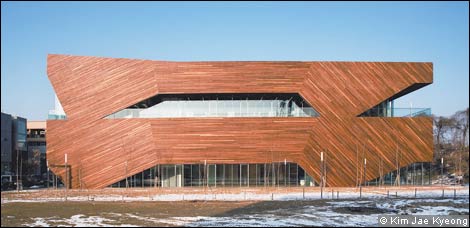
Publishing company Dulnyouk by Foreign Office Architects in Paju Book City, South Korea

Publishing company Dulnyouk by Foreign Office Architects in Paju Book City, South Korea

The idea of a city of books evokes a fantastical vision: towers of tottering volumes, narrow alleys formed by canyons and stacks of dusty hardbacks, formal avenues between loaded shelves. Like something imagined by Calvino or Borges, it conjures up a city of wisdom and surprise, of endless narratives, meaning, knowledge and languages. What it does not evoke is an industrial estate bounded by a motorway and the heavily guarded edge of a demilitarised zone. Yet somehow, South Korea’s Paju Book City begins to reconcile these two extremes into one of the most unexpected and remarkable architectural endeavours.

Built on marshland, former flood plains and paddyfields 30km north-west of Seoul, Paju Book City is an attempt to create an ambitious new town based exclusively around publishing. We may be reading obituaries of the book and the printed word almost daily, but the news has not reached Paju. Plans for the Book City were first proposed in 1989, as the country was emerging from a period of political repression. Publishing had gathered momentum and status after years of underground activity and censorship, and it re-emerged after the liberalisation of the regime in 1987 in an explosion of small, often family-run publishers. Their beautifully crafted books attempted to re-engage the nation with the history and culture that had been distorted, manipulated and lost over a period which included colonial rule from Japan, brutal civil war and military dictatorship. The project was also, at least in part, a reaction to the rapacious redevelopment of Seoul, the loss of the city’s historic fabric and its rapid embrace of the culture of bigness and congestion. That it was christened a “City to Recover Lost Humanity” tells us much about its creators’ intentions.
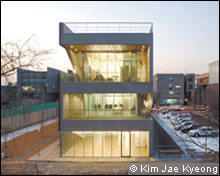
Publishing company Dulnyouk by Foreign Office Architects in Paju Book City, South Korea

Publishing company Dulnyouk by Foreign Office Architects in Paju Book City, South Korea

The project was initiated by publisher Yi Ki-Ung, whose ambition extended to creating a city of books that would also become a kind of museum of architecture: Paju features buildings by some of the finest architects working in the world today. The 1.5m sq m masterplan and the most sophisticated buildings on the site were carried out by the remarkable London-based Architectural Research Unit, run by Florian Beigel and Philip Christou. They wanted to create what they called, delightfully, an “urban wetland” – a paradoxical idea that allows them to root the new city in the landscape, to create something tied to its context rather than a suburban non-place. That context is beautiful, even epic, in its own way – the Han River, the mountain backdrop – but all that is cut off by the elevated motorway which also acts as a dyke. So the city is constructed on two levels: a dense street level, which accommodates the activity of the city itself, and a sparser upper level Beigel poetically refers to as “the strata belonging to the horizon”. Here a series of rooftop pavilions, elevated public spaces and buildings crowning bigger buildings below look over the road and out to the landscape beyond.

The city plan follows the contours and lines of the landscape, one main road snaking through it like a river and a series of tighter roads creating a denser network of small publishing houses, printers, distributers and so on. There are some extraordinarily ambitious buildings here. Just finishing construction is the Mimesis Museum, one of the Portuguese architect Alvaro Siza’s most arresting recent structures – its sheer concrete walls curve like the pages of a book in the wind, wrapping around a sculptural courtyard at its heart. SANAA, the Japanese architects of this year’s Serpentine Pavilion in London, have designed a stripped-down box, a publisher’s building of stark, striking elegance. London-based Foreign Office Architects have built a wonderfully theatrical publishing house which appears on the street as a modernist sliver, a delicately folded façade of glass which reveals sides with an almost nautical quality, clad in timber where they face a garden. There are exotically ambitious buildings under construction by Yung Ho Chang, Xaveer de Geyter, Stan Allen and some structures by Korean architects which would astound in any capital, let alone on a suburban Seoul industrial complex – notably those of Moogyu Choi and a bravado piece of concrete expressionism from Kim Jun-sung and Hallim Suh.
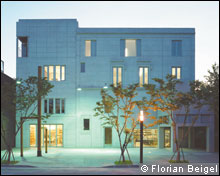
Youl Hwa Dang

Youl Hwa Dang

At the centre of the city stands a huge cultural complex, designed by Kim Byung-yoon, a combination of hotel (in which, it was pointed out to me, there are no TVs), restaurants, auditoriums and, on the roof, an urbane, elevated realm of seating, shops, libraries and galleries overlooking the sparkling waters of the river and the Simhak Mountain.

The finest buildings on the site, though, are by the ARU themselves (together with local partner Choi Jong Hoon). The first was for Yi Ki-Ung’s own Youl Hwa Dang publishing house, an enigmatic U-shaped building around a small courtyard. It looks like a bold pictogram, with a dark street façade, but to the courtyard there are “walls of light”, translucent membranes that recall the paper walls of traditional houses. An extension which contains a bookshop and café presents an intriguing contrast to the original buildings, retaining the subtlest memories of classical European urban architecture in moulding details, a portico and so on. This conservatism was conceived as a gentle provocation to the radical modernism all around and it works, with a startling clarity.

The ARU’s other structure, equally compelling, is for the Positive Thinking Publishing House. Designed as offices on a domestic scale and split into two units that create an intimate public plaza between them, they are built of traditional dark grey Korean brick set into a steel frame. The result is a hybrid of deeply embedded oriental and European archetypes. There is something here of Wittgenstein’s house, something of Beijing’s courtyard houses, a kind of Eurasian architectonic language which also, amazingly, manages to be conservative and deeply in thrall to the radical modernism of Mies van der Rohe. Inside, the surprises continue. The ceilings become an inverted urban landscape as a series of blocky paper lanterns break up the space from above. The domestic scale is wonderful: these feel like publishing offices, no plate glass, no open plan, rather a series of humane rooms, terraces and natural light.

If there is a problem at Paju it is that, as in all new cities, there is a kind of stillness, a lack of real density. This is compounded by zoning issues: as this is designated an industrial zone, the building of dwellings is difficult, and without places for people actually to live an area can never become a real city. Nevertheless, housing is slowly being built, and there are stirrings of the urban and commercial activity that constitute the beginnings of a real place.

It is not hyperbole to claim that this is one of the most extraordinary and most unsung cultural and architectural developments in the world. The idea that a city, right now, be dedicated solely to print and that an industrial estate could be a place of architectural pilgrimage could not be more heartening, more encouraging to anyone who delights in those very old information technologies – books and buildings.

Slower pace would help Seoul to grow faster

Anna.Fifield
Financial Times
August 6 2008
http://www.ft.com/cms/s/0/1b22cb0a-63d2-11dd-844f-0000779fd18c.html

In South Korea, there is only one speed: full throttle.

Buildings go up almost overnight, trends pass no sooner than they have arrived and presidents’ approval ratings drop from 70 to 20 per cent in the blink of an eye. One of the first local sayings that foreigners learn is bballi bballi — fast, fast.

When I moved to Seoul four years ago, I was immediately impressed by Koreans’ determination and energy, the two biggest factors behind the country?s transformation from rural backwater to technological powerhouse. As I prepare to leave, I still marvel at this country’s verve. But I cannot help wondering whether South Korea can avoid falling into the kind of economic malaise that has afflicted Japan. The country remains overwhelmingly dependent on goods exports and the service sector is woefully underdeveloped and inefficient. But of all the challenges facing South Korea, there is one, often overlooked, area where reform would bring unparalleled benefits: education.

Devoid of natural resources, Korea?s recourse has been to its human capital. People propelled Korea to where it is today, thanks largely to Park Chung-hee, the former president and a military strongman who directed Koreans to study engineering in particular. One senior Samsung executive this week explained to me that two significant components of the conglomerate’s ‘success DNA’ were its ability to move quickly and the calibre of its engineers. Now, more than ever, human capital will be the deciding factor in how South Korea fares in the future and whether it makes its next transformation, into a knowledge economy.

Koreans perform exceptionally well in international performance rankings for subjects including reading comprehension, maths, science and problem solving, and the proportion of 25-34-year-olds with an upper secondary school education is the highest in the Organisation for Economic Co-operation and Development. Koreans now represent the largest group of international students in American universities.

But they have got there through the most arduous process, driven by the intense social pressure to get into the right school, then the right university, find the right job and meet the right spouse. One friend recounted how when her three-year-old?s kindergarten conducted psychometric testing, the other mothers earnestly jotted down the results, noting whether to push their tots towards law, medicine or finance.

Koreans spend more time at school than students in any other developed country and spend the most money on education (8 per cent of gross domestic product), with private education expenditure double that of the US, the second biggest spender. Bank of Korea data show that families spent more than $12bn (EUR7.7, £6bn) on after-school education last year.

The system rests largely on rote learning and places almost no value on analysis, creative thinking or practical application. High school students who can score 99 per cent in an English test are often unable to hold even a simple conversation, while university students who express a contrary view to their professor simply fail. So intense is the pressure to get good grades that 12-year-olds, after spending all day at school, routinely attend cram school, or hagwon, until midnight.

This obsession with education has contributed to a number of social and economic problems ? from the low fertility rate, partly the result of the cost of putting children through private tuition, to the real estate bubble in southern Seoul, where the best schools and hagwons are located.

It also augurs ill for the future, when South Korea will not need so many workers who can build ships and assemble cars, but will need more and more people who can be innovative, who can develop and apply knowledge. Indeed, despite Korea?s impressive headline performance in test scores, the World Economic Forum ranks the quality of the country?s education system at 60th in the world ? shockingly low for one of the world?s top dozen economies.

Creating a knowledge-based economy will be critical if South Korea is to maintain decent levels of growth — the potential rate is now 5 per cent — and to reach income levels of the world?s most developed countries. One of President Lee Myung-bak’s big pledges is to see Korea’s per capita income double to $40,000 within a decade.

Koreans have already performed remarkably in IT — particularly on the hardware side — but improving the education system would produce workers better equipped to meet the needs of the country?s fast-moving technology industries.

Further growth can be achieved through productivity gains — Korea’s productivity is 60 per cent below the US level. Service sector productivity is only half that of manufacturing, and has been stagnant for almost 15 years. Given the nature of the education system, this can be no coincidence.

Overhauling this system will be incredibly difficult. After all, another of my friends, an enlightened mother who would prefer her 14-year-old to play basketball after school and go to bed before 1am each night, can not even dissuade her son from going to hagwon.

However, for its future prosperity and to retain its economic prowess, Korea would do well to take its foot off the accelerator slightly, take stock and think about using its impressive drive and human capital in more efficient ways. The economy will benefit and the kids will love it.

Architects bid to restore ‘soul of Seoul’

By Anna Fifield in Seoul
Published: July 14 2008

Yongsan development

Vision of the future: an artist’s impression of the Yongsan development, which will be sited close to the Han river and two big train stations

Hardly one of Asia’s most aesthetically pleasing cities, Seoul is undergoing a spectacular face-lift, with a range of multi-billion-dollar construction projects.

In the latest development, five internationally renowned architects are bidding to design the Yongsan international business district in the South Korean capital, a $28bn five-year project due to start in 2011.

“We’ve been invited to put the soul back in Seoul,” says Hani Rashid of the New York firm Asymptote, which designed Malaysia’s Penang Global City and is vying for the Seoul contract.

As South Korea rebuilt its razed capital after the Korean war and embarked on four dizzying decades of industrialisation, the emphasis was on function rather than form. The result is a mish-mash of concrete blocks. But in the past decade this has begun to change, with the construction of parks and plazas, and the emergence of more inspired buildings.

Now five architectural firms have been asked to design a “cutting-edge, future-oriented complex” on 566,000 square metres of land, currently home to railway warehouses, in the centre of Seoul.

The master plan is to include commercial, residential, cultural and leisure spaces, and must feature a landmark tower. The winner will be announced in December.

Close to the Han river and two important train stations, the Yongsan development borders the US military base, which will be turned into the “Central Park of Seoul” when the army relocates south of the capital in four years, and is in the middle of the three current business districts.

“Seoul is undistinguished in terms of its architecture and is not seen as an international player, and that is precisely what this project is about, what we have to answer,” says Nina Libeskind of Studio Daniel Libeskind, which is rebuilding the World Trade Center in New York. “It’s a very exciting, very optimistic moment in the city’s history.”

Local residents have mixed feelings.

Park Jin-ho, an interior designer who lives in an apartment near the railway station, says the area is “already good to live in because it is quite central, and I think it will be much better, with more benefits, once it is developed”.

However, others think the city government is not paying enough compensation to residents who will have to move.

“I don’t oppose the city’s plan to make Yongsan an upper-class town to raise Seoul’s competitiveness, but I really don’t like the way the city is pushing for the development project without consulting residents [or] guaranteeing our property rights,” says Chung Geun-soo, another resident.

The Yongsan area is nine times the size of the World Trade Center complex and each of the architectural firms has been given $1m to come up with a plan – compared with $40,000 for those offering to redesign Ground Zero.

Andy Bow of Foster and Partners, architects of the Swiss Re “Gherkin” building in the City of London, says the project has the potential to redefine Seoul. “It’s like Canary Wharf [in London] or La Défense [in Paris] in terms of the scale and the quantum of development,” says Mr Bow. “Canary Wharf moved the centre of gravity in London.”

The other architects bidding are Jerde Partnership, famous for Tokyo’s Roppongi Hills, and Skidmore Owings and Merrill, which is building the Burj Dubai, set to be the world’s tallest tower.

The project comes amid a dearth of office space and a flurry of construction. The vacancy rate among commercial buildings in Seoul is about 1 per cent, one of the lowest in Asia, and Jones Lang LaSalle, the property firm, estimates the lack of supply pushed up Korean office prices by about 25 per cent last year.

But Yongsan will be unique because of its central location and access to both parks and the river, the developers say. “I think it’s very important in a city of 10m or 20m people to have a place where people can come together into the centre,” says John Simones, design director of Jerde.

……………………………………………….

Billion-dollar developments lend touch of class

The Yongsan development is being built by a 26-member consortium, led by the state-run Korea Railroad Corporation, Samsung Corp and the National Pension Service. Total project finance could rise to $50bn (€31bn, £25bn), the developers estimate.

By common consent, Seoul is short of top class architecture. But two large-scale developments are under way in Youido, the island in the Han River and Korea’s financial centre.

The 486,000 sq metre Seoul International Finance Centre, being developed by the city government and a unit of AIG, the American insurer, will contain three office towers, a five-star hotel and a shopping mall.

Across the road, Skylan, a pan-Asian real estate development company, is running a similar $2bn project. New York-based Gale International is behind the $20bn construction of New Songdo City, near Incheon international airport It will feature residential and commercial buildings, a Jack Nicklaus-designed golf course, hospitals and schools. A 14km bridge linking the city to the Incheon international airport is almost complete.

Additional reporting by Song Jung-a

‘The point was to be part of nature’

By Mark Ellwood
Published: May 10 2008 01:50 | Last updated: May 10 2008 01:50
http://www.ft.com/cms/s/0/6d0193fa-1ca3-11dd-8bfc-000077b07658.html

Businessman Kim Chang-il accrued a billion dollar fortune in restaurants, real estate and retail in Cheonan, Korea, then used his wealth to build one of the world’s top private contemporary art collections. He also opened his own gallery, Arario, which has three sites across Korea and China; its fourth outpost, a 20,000 sq ft space designed by architect David Adjaye, recently opened in Manhattan, New York.

How many homes do you own?

Two – one in Cheonan and the other in Jeju Island, at the southern end of Korea. It’s still very rural down there. Migrating birds often pass by in front of my house and iIt’s located in front of a small pond and right after that is the ocean, so you can see both from the house. As my business is getting bigger, and as I need more time away to look atthink about the future, I go to Jeju Island. It’s also where I make my artwork.

You are as much a creator as a collector of art.

Yes. I have a studio in Cheonan, but it’s on the top floor of the [Arario] gallery, so I can only work there from 9am to 5pmbecause the building is closed after hours. But in Jeju Island I can work at 2am in the morning if I want to. But I didn’t want to have a work place in my home, so I have a separate studio that is connected to the main house.

Tell me about that house.

I built it two years ago. The main point was to be a part of nature. From the outside you can’t see in but from the inside you can really see out.

You grew up in Seoul. What was your childhood home like?

It was in a traditional wooden house. I was always scared because the winds would go through the house and when I walked, the floors would creak. I kept asking my mother to let us move.

But she never agreed?

Well, I moved to Cheonan from Seoul in 1978 after I graduated from college. And I lived in the same apartment for 30 years; I moved for the first time to a new home in Ssang Yong-Dong [Two Dragons] last July.

That suggests you’re a creature of habit.

I don’t like change: my work takes up so much of me. Home is just somewhere I’m comfortable and I don’t want to waste energy on that.

It must have been the perfect apartment to stay that long.

I’ve always dreamt of having a home near a school; when I first purchased my home I was going to have children and wanted them to be able to walk to school; it was safe and convenient. But I feel like being close to a school is very healthy too; in Korea, schools open up their courtyards to the public, so I go there in the morning to exercise then play basketball with my son. I’ve never needed to join a gym.

Can you describe your dream home?

If I were to build another home, I would pay a lot of attention to the kitchen. I want to start inviting a lot of people round and I was thinking about building [another] home in Jeju Island. I want an all-glass kitchen with an island in the center where you can cook, and a table round it where I can serve people, like in a restaurant.

Is the kitchen your favourite place at home?

Actually, in Cheonan, it’s my library; everything I want to read or think about is very accessible. But in Jeju Island my favourite place is a duplex in the art studio, on the second floor, where I can sit overlooking the pondand everything. I have two dogs, Chinese chow chows, and I’m happy when they are there next to me.

How do you choose what art to put on show at home?

Well, there are places you need to accentuate with a work of art but I don’t do it to excess. One of the walls in my bedroom is designated just for my own work; my photography. I have a studio in Jeju; I built a residence for artists with seven studios and nine apartments. People can’t come and just rent out the place – the artists have to be invited – but I wanted them to experience what I’ve experienced. A lot of artists enjoy the chance to be with nature and they choose to stay for up to six months. I’ve been to many artists’ studios and I realise how important the space is. And I feel like I’m providing something that takes them away from their regular studios. Being in nature and seeing the pond is a really good environment. I have lunch, which my chef prepares, with the artists at the cafeteria – though for dinner I usually cook at home myself.

No wonder you want that chef’s kitchen. Are you a cordon bleu cook?

Not really. Just egg fried rice, kimchi, broth and fish barbecue.

A new soul, and style, for Seoul

By Michael Fitzpatrick
Published: March 22 2008 00:40 | Last updated: March 22 2008 00:40
http://www.ft.com/cms/s/0/7daae0d4-f625-11dc-8d3d-000077b07658.html

Heyri Artists' Village

Heyri Artists' Village

It was only a trip to the local shop but Park Danbi had quickly donned a cocktail dress, Cleopatra earrings and full warpaint. “Style is everything in Seoul, especially in fashion-conscious Hongdae,” explains the 23-year-old art college student and interior designer, referring to the area where she studies and works.

It is also where South Korea hatches and develops much of its creative talent – architects, interior designers and product designers.

Park is very much of her milieu. With her steely determination for money and desire for a more “beautiful life in a more beautiful Seoul,” she represents a generation of Koreans keen on distinguishing themselves from their parents, who sought, on the whole, a more mundane life with functional buildings and interiors to match.

“Koreans are the most hard-working of all the countries belonging to the Organisation for Economic Co-operation and Development [OECD],” suggests Park Seong-Tae, editor of South Korea’s leading architecture magazine, Space. “As a result, urban structures are not so important. Instead, people have traditionally valued convenience, not lifestyle.”

The results are plain to see in the incoherent, unlovely mess of signage, concrete and utility poles that makes up much of urban South Korea.

However, it was not always thus. Korea did have style, says Park, but it was largely swept away in the rush to mimic America.

The post-Korean war period was marked by deep poverty. Bulldozing the country’s heritage to build tawdry, western-style homes certainly helped boost the economy and quickly housed its people, but sadly, it was done at such breakneck speed that much of Seoul verges on slum dwelling.

Lee Ansoo's House

Lee Ansoo's House

The younger generation says it would do things differently. Its members want money, yes, but they also want beauty and style, which is why ambitious art student Park works for one of the country’s now booming interiors and architect firms.

“Everybody wants homes like film stars these days, so we are very busy,” she says. Tired of the shambles that is the result of war and unrestrained economic development, today’s Koreans look to their past, to Japan and to the west’s best architects for inspiration.

What is emerging is a new vernacular – a hybrid style that is sparse and lucid like the best Japanese contemporary architecture, but also marked by renewed interest in the peninsula’s own cultural heritage.

Kim Jong-ho, director of Design Studio and one of the country’s top architects, says this is an important step towards South Korean design gaining worldwide recognition.

“To compete on an international level, we need to develop our own design language that has distinctive cultural elements,” he says.

He argues that South Korea has been the Cinderella of north-east Asia’s architectural and cultural renaissance for too long. But he suggests that thanks to a plethora of savvy designers and architects who, like himself, have studied abroad, the country is starting to punch – in design terms at least – more in line with its economic weight.

Like Tokyo, Seoul is rethinking its philosophy of building cheaply, quickly and unimaginatively. Instead it is re-evaluating past design triumphs and producing – albeit on a small scale so far – works that stand out boldly, such as the Leeum Samsung Museum of Art, which comprises three outstanding buildings rising out of suburban Itaewon.

The movement, kickstarted by Seoul’s design elite, has political converts, too. The country’s new president, Lee Myung-bak, once nicknamed “the Bulldozer” because of the redevelopment work that made him rich in the 1970s, declares he is now reformed and keen to emphasise preservation and more sensitive town planning.

“Koreans have a tendency to follow the trends in lifestyle matters as well as fashion,” points out Kim. “Although this makes Korea one of the fastest-evolving markets in interior design, it also means architecture tends to be stylish and trendy while lacking in concept.”

But there are changes for the better, says Marcia Iwatate, a Japanese restaurant and design consultant and co-author of Korea Style, a handsome compilation of some of South Korea’s best residential architecture and interiors.

She suggests that, with the return of Korean graduates of top foreign architectural schools, the country is starting to rediscover its distinctive vernacular style – one so potent that elements of it were purloined by the Japanese over a thousand years ago. Iwate says her own interest in Korean architecture and interiors arose from researching the origins of Japanese minimalism.

“I wanted to point out to the world that Zen and the simplistic style is not just Japanese, so I came to Korea 16 years ago to find out more. Now I see it in these returnee architects. They have an architectural nationalism.”

What impresses these former expatriates is the work of past Korean master builders – the buildings all but obliterated by zealous modernisers a generation ago.

Korean contemporary style might still borrow heavily from Japan and the western modernist tradition – employing concrete, glass and high-tech materials – but a Korean character is fast emerging, says Iwatate.

“And what characterises Korean style? Simplicity, modernisation, restraint and a deep respect for all things natural,” she says. It is a style that has its roots in the traditional Korean house, the hanok.

This is strikingly akin to traditional Japanese wooden homes, with latticework doors and paper windows, but a peek inside reveals heated flooring, rather than reed mats and a womb-like, intimate rusticity.

Features include exposed pine pillars rough hewn with a knife, rice-papered walls and, for lighting, the moon reflected in a shallow courtyard well.

“I admire the older Korean traditional style as it is good architecture not just because it is traditional,” says Choi Wook, an architect who builds and renovates hanok-inspired homes for contemporary living.

“The Korean aesthetic is very thick, very heavy; you can really sense weight in these interiors.”

His work has a distinctly luxury feel. “To build like this is very expensive,” he says. But others believe hanoks can be re-invented or renovated in a 21st century setting, even for the non-super rich.

Doojin Hwang is spearheading a hanok revival movement in Seoul. His mission? To rescue and modernise what is left of the city’s ravaged stock of traditional homes on a hill in the city centre.

Yoon Young-Ju, a restaurant business owner, lives in a 70-year-old home renovated to the modern standards expected in ultra high-tech Seoul. The wooden-beamed, six-room, one-storey structure built around a courtyard has lightning-fast wireless, a modern kitchen and a state-of-the-art security system that at first seem at odds with the disarmingly simple living space, with its white-papered walls and calm light diffused through paper windows.

“There is certainly a joy of serenity that these old houses offer,” he says, “but we need our conveniences too.

“These houses teach us a lot. They evolved over a long period of time and whereas modern construction is toxic, you will find hanoks are actually quite healthy,” says Yoon’s architect, Jin Hwang, referring to the unecological nature of many modern building techniques and the use of unhealthy chemicals, plastics and solvents that contrasts strongly with the hanok’s use of natural, renewable materials such as pine wood.

Lee Ansoo

Lee Ansoo

Artist, writer, musician and hanok fan Lee Ansoo goes further, suggesting it is not just the construction methods that promote well-being but the traditional Korean use of space and natural materials that makes for health, tranquillity and harmony.

“It has lot to do with our use of pine. You could say we are a pine culture,” he says, pointing to the heavily cut, low tea table in his otherwise exceedingly modern architect-built home, Motif One.

It is one of many examples of Korean creativity at its best in the hamlet of Heyri – an eight-year-old architectural showcase also known as “The Artists’ Village” near the border with North Korea.

The community exemplifies new Korean style. Despite the village’s thoroughly modern aspect, wood, especially pine, is everywhere. Tree stumps make engaging stools while strips of timber add harmony and elegance to two of the key buildings – the Book House and the award-winning Camerata music studio designed by Jo Byung Soo.

Lee’s six-bedroom house, which he also runs as a bed and breakfast, is another harmonious blend of Korean tradition and western comforts. Externally it is a sleek, boxy ode to modernist style but inside Lee worked with the architect to bring in more Korean elements: the ondol heated floor, a feature in even the most humble of Korean homes, multi-purpose rooms and, through large glazed features, an interplay between indoors and outdoors that pays homage to the hanok and its traditional garden or courtyard.

Lee is something of an ambassador for Korea’s emerging new style. “It is true we have been vastly influenced by the west, where we all seem to have been educated, but there is movement towards a more Korean design and that inspiration comes from the hanok.”

The rooms in Lee’s home are large and filled with paper-filtered light. Tea is taken sitting on the polished oil paper ondol flooring, the immense untreated pine table brimming with Korean earthenware. The rooms fulfil many purposes: clever detailing means bookshelves double as a film screen, a kitchen is tucked behind folding white panels and gaudy mirrors are hidden inside doors.

“Life is good here in Heyri with all its artists and wonderful buildings and of course it all looks very modern and contemporary,” he says.

“But look closer and you will see we still live hanok-style. That is the secret of the Korean way.”

New life for an old way of building

By Anna Fifield
http://www.ft.com/cms/s/0/80473f90-5496-11db-901f-0000779e2340.html
Published: October 6 2006 12:17 | Last updated: October 6 2006 12:17

Walking the streets of Bukchon, it’s hard to believe you’re in the middle of one of the world’s most populous cities. Located only a short walk from Jongno, Seoul’s central drag, where neon competes with carbon monoxide in the pollution stakes, the neighbourhood embodies the Korea of five centuries ago. Rows of hanok, Korea’s traditional houses, with their wooden lattice windows and patterned brick walls, line quiet narrow streets where cats prowl and birds flit across the sloping tiled roofs. One could easily imagine aristocrats being ferried past on carriages held on men’s shoulders.

Such areas are rare in Seoul because construction of new hanok stopped in the 1960s when industrialisation began. Those that already existed were flattened during the Korean war or bulldozed to make way for faceless, functional apartment tower blocks.

Now, however, Korea is a developed country and its citizens are increasingly valuing form as much as function. Many are restoring old hanok or building new ones. And Bukchon, a neighbourhood that is nestled between two of Seoul’s biggest Chosun-era royal palaces, which is said to have the best feng shui in the capital, is a hub for such activity.

“There is definitely a hanok restoration boom going on,” says Lee Moon-ho, an architect who specialises in renovating the old houses. “As soon as [one] is put on sale in this area, it is snatched up. As a hanok architect, I feel very proud of this. As every day goes by, new renovated hanok pop up in this area.”

Although Bukchon lost about 600 hanok when local building restrictions were lifted in the early 1990s, there is now a concerted effort to preserve the remaining 920 and ensure that new construction is in keeping with the traditional aesthetic. Five years ago the Seoul metropolitan government started offering up to Won30m (about $30,000) to any hanok owner wanting to restore his or her home and so far about 250 have been remodelled. Officials have also promoted broader initiatives, burying cables underground and relaying plumbing works, as well as tightening restoration and new construction rules, spending about Won41bn in total.

“Korea developed at breakneck speed after the Korean war,” says Kim Woo-sung, of Seoul’s urban design team. “Because of that rapid expansion, the government could not set a long-term city plan like European cities have. But now we are setting out a long-term plan.”

The government’s efforts have been successful in drawing new residents to the area. Lee Myung-bak, the former mayor of Seoul who advanced the “greening” of the capital through projects such as the rebuilt Cheong-gye-cheon stream through the city centre, is just one of the people who recently moved into Bukchon, as did this correspondent.

Park Jong-duck from Daesung Real Estate, an agency that specialises in hanok, reports a steady rise in inquiries since the restoration craze started. And “prices are rising steadily,” he adds. “There are some people who want to buy just an ordinary house near hanok village. The area is developing day by day so they expect the overall house prices in the neighbourhood to go up.”

Hanok prices vary wildly depending on proximity to Bukchon’s main road and the state of repair. A house on a small narrow street can cost only Won9m per pyong (3.3 sq metres) while a renovated property in a convenient area can cost as much as Won50m per pyong. This compares with an average price of Won14m for an ordinary apartment in Seoul. Building a hanok from scratch usually costs Won13m per pyong on top of the Won10m-15m one might pay for the land.

According to Korean tradition, all buildings are regarded as parts of a wider environment, so houses are typically positioned based on the principle of baesan-imsu – having a mountain at the back and a river in the front. Hanok usually face south to expose the living areas to the sun and are built as a series of inter-connecting rooms opening up to a central courtyard – to allow the energy to flow through the house. They are single-storey with stone foundations, wooden frames and soil in the walls and on the roof for insulation.

Heating and cooling is achieved through ondol, a system of ducts carrying hot air from the kitchen stove (or more likely a boiler nowadays) to the stone floors of the house in winter, which conversely helps aerate the rooms during the oppressive summers while the stones keep the floor cool. (This is one of the reasons why Koreans habitually sit on the floor.) Hanok also have glorious curved roofs made of tiles with edges that are engraved with patterns, usually of flowers, animals or insects, particularly spiders. They are useful as well as beautiful, further protecting the house from the sun’s heat.

“In this area, the hanok are very old so it is difficult to renovate them partially, so most of the time I rebuild them from scratch,” says Lee, the architect. “The rule that I try to follow is to build in a traditional way. You have to follow certain rules – the house should face south and everything in the bedroom should be low to make sure the energy does not drain from your body. According to Korean beliefs, when your bedroom is low, you sleep very soundly. I use Korean woods and try to make modern facilities, such as heating and air-conditioning systems, inconspicuous.”

Although hanok are widely admired for their quaintness, most Koreans still think consider them to be inconvenient for modern living, especially when compared with standard high-tech apartments. In most restored houses, the walls and roofs are still made of earth and air-conditioning units are embedded into the ceilings so not so as to not be too obtrusive.

But residents of Bukchon – such as restaurateur Choi Mi-kyoung who lives in a newly built hanok on a quiet alley with her Swedish husband and their two teenage sons – are proving that it’s possible to marry traditional character with contemporary comfort. The design of the house, which she worked on with an architect, is traditional; the living room opens out onto the courtyard, complete with wooden shutters that can be hung from the eaves while the doors are open. But the stainless steel kitchen is ultra-modern and downstairs, where the boys’ bedrooms and workroom are located, is all Swedish minimalism. Construction took 11 months.

“My husband has lived here for 20 years and likes Korean-style houses very much,” Choi explains. “Our friends think it would be uncomfortable to live in a hanok but they are envious.”

She acknowledges that life in Bukchon can be slightly inconvenient – there is no parking and few shops – but says the family enjoys their modern-traditional home. “It feels so peaceful and like we are close to nature because we have a garden and there are always birds flying around but actually we are in the middle of Seoul,” she says.

Next door is a hanok that serves as a guest house for visiting suppliers to Casamia, a ritzy Korean furniture company. As in Choi’s house, old blends with new. Interconnecting living rooms circle a garden but also lead to a huge modern kitchen. The minimalist bathroom with its square, inset tub is more boutique hotel than bygone house.

As with any project involving historic buildings, the rejuvenation of Bukchon’s hanok is not without its controversies. Families who have lived in the area for decades complain about noisy development and unwanted trendiness, while traditionalists complain that many new houses are built with modern materials and are not complying with tradition. But Kim argues that the transformation will allow Koreans to pass on an appreciation for indigenous architecture to future generations.

“Because people’s lifestyles have changed, it is inevitable that hanok will change,” he says. “Cultural heritage is not something that should only be protected. Preservation should be protection plus evolution. We live in modern times so we have to accept changes and that’s why we need boilers or air conditioners in hanok.”

Lee, the architect, agrees. “I think reinvigorating this area is much more important than reviving Cheong-gye-cheon [the Won330bn ($330m) stream reconstruction] because there is no culture in Cheong-gye-cheon but there is here,” he says. “You should feel a human, natural and ecological touch. I believe this area will become the Montmartre of Seoul.”