Mr Vengeance

http://www.nytimes.com/2006/04/09/magazine/09park.html
Ian Buruma, 9 April 2006

09chanwook.190Park Chanwook does not look like a violent man. When he isn’t wearing glasses, his soft, round face resembles that of a gentle Tang dynasty Buddha. He speaks quietly and smiles a lot, more like a hip college professor than the director of an ultraviolent revenge trilogy. Pinned on the walls of his office in Seoul, among the movie posters and postcards, are photographs of his wife and 12-year-old daughter. His wife, whom he met at a university film club in the 1980’s, reads all his scripts and is his most trusted adviser. Their daughter has seen most of his films. A nice, quiet, reflective family man, then, this 42-year-old director who also happens to be a master of imagery at times so brutal that it is almost unbearable to watch.

Sitting in his office not long ago, we talked about violence, or more specifically about Park’s terror of violence. “In my films, I focus on pain and fear,” he said. “The fear just before an act of violence and the pain after. This applies to the perpetrators as well as the victims.” To illustrate his point, Park described a scene from his last film, “Lady Vengeance,” in which the father of a kidnapped and murdered child finally has the kidnapper at his mercy, tied to a chair in an abandoned schoolhouse. The father is there with his family and relatives of the child murderer’s other young victims. They all patiently wait their turns to wreak a terrible revenge on the defenseless killer.

“The father,” Park continued, “has picked up his ax. His daughter tries to restrain him. The audience expects her to say something like, ‘No, don’t do it!’ Instead, she asks him to leave the victim alive, so the rest of the family can also have a go at him. The audience laughs. The next shot shows the father with his ax dripping blood, terrified of what he has just done. The audience can’t be cynical anymore and regrets having laughed at the preparation for such a brutal act.”

Park didn’t smile while he told me this. Violence, for him, is a serious business. He may have a disturbing way of manipulating the viewers’ emotions, but as he explained to me, the focus of his work is not “the beauty or humor of violence.” As far as his films are concerned, he thinks of himself “as an ethical man.” To Park, the psychology of the perpetrator is as important as that of the victim. His main characters are often a bit of both.

Their suffering might easily be written off as a black farce were the gory details not piled up with such relentless, and in the end often numbing, force. The second film of his trilogy, “Oldboy” (2003), follows a man who is suddenly released after 15 years of solitary confinement. We see him stuffing a live octopus down his throat, battling a gang of armed thugs in a narrow corridor, cutting off his own tongue with a pair of scissors and slithering across a bloody floor in a final deadly encounter with the man who had him locked up. Ah, yes, and along the way, he commits incest with his daughter.

Park’s daughter was allowed to see “Lady Vengeance” but not “Oldboy,” because of the incest. A faint, slightly embarrassed smile illuminated Park’s face. “If it had been a mother and son,” he said, “I might have felt better about it, but since it is about a father and daughter, I would have felt awkward.”

09chanwook.2.190Park’s films are usually classed as “Asian Extreme,” something of a catchall term for a new crop of hyperviolent films made in South Korea, Japan, Hong Kong and Thailand that have garnered a cult following not just in Asia but also in Europe and the United States. The films take many of the elements of exploitation flicks and twist them — the violence is stylized and inventive, the plots often tinged with political attitudes. Both Takashi Miike’s postapocalyptic yakuza epic, “Dead or Alive,” and Fruit Chan’s macabre parable of the beauty industry, “Dumplings,” use extreme situations to underscore social ills. The two filmmakers were included along with Park in an anthology of the genre, “Three. . .Extremes,” released in the United States last year. Park has become the most modish figure in the world of Asian Extreme. Art houses and college festivals have been quick to screen installments of his revenge trilogy, his films win prizes at festivals and he was rated on the taste-making Web site aintitcool.com as the No. 1 filmmaker of 2002 and 2003. But he has also received more mainstream acceptance. In 2004, he won the Grand Prix at Cannes for “Oldboy.” Universal bought the rights to remake it and tapped Justin Lin, a 33-year-old Taiwan-born American director, with one hit behind him, to direct it.

Park is also enormously popular in Korea. In 2003, more than three million Koreans went to see “Oldboy.” Three years earlier, his feature film, “Joint Security Area” — a tale of two South Korean border guards who sneak across the cease-fire line to fraternize with their counterparts in North Korea — was one of the highest-grossing films in South Korean history. (“Joint Security Area” is also scheduled to be remade for an American audience, by David Franzoni, a writer and producer of “Gladiator,” with the story reimagined on the United States-Mexico border.)

In large part, Park’s success is a product of a newly energized Korean cinema, part of the so-called Korean Wave, which first swept Asia and then Europe and the United States. The end of Korea’s military dictatorship in the late 1980’s meant the end of rigid censorship, and the country’s film industry, once tightly controlled, began to attract a much wider audience. (Korea’s minister of culture was until recently Lee Chang-dong, whose own film “Oasis” won an award at Venice in 2002.) Many of the new Korean films are explicitly violent — Kang Je-gyu’s terrorist-thriller hit “Shiri”; Kim Ki-duk’s hard-boiled noirs; “A Tale of Two Sisters,” Kim Jee-woon’s horror smash — but not all. Some deal with sex, at times of a rather unusual kind, like the protracted love scene between septuagenarians in “Too Young to Die,” which initially prompted the Korea Media Rating Board to declare the film unfit for public viewing. Some are subtle human dramas set in the past. There are comic films, too, and then there are the television tear-jerkers, like “Winter Sonata,” which reduced millions of Japanese, as well as Koreans, to weekly floods of tears.

South Korea offers the kind of state support that many filmmakers would envy. Since 1966, Korean theaters have been required to show Korean films a certain number of days a year. The figure has been set at 146 days since 1984. (The number was halved during negotiations last month for a U.S.-Korea free-trade agreement, which prompted widespread protests from the local film industry.) The largest distributor of Korean films, CJ Entertainment, is also the owner of one-third of the country’s multiplexes, and its parent company helps to finance the productions of studios like Park’s, Moho Film. But the ease of financing and distribution do not account entirely for the success of local films, which often outperform Hollywood blockbusters, a sign, perhaps, of Korea’s new mood of cocky nationalism. “We are feeling confident,” Park said, “perhaps a bit too confident.”

There appear to be almost no limits on what can be shown in Korean films. I asked Park whether there were any taboos left in cinema at all. He thought for a while and shook his head. The only thing, he said, was a category called “outside ratings.” If the sex and violence are too extreme, then a movie can be shown only in restricted cinemas. I asked him whether any films were ever criticized for their political content anymore.

Well, Park said, “when ‘Joint Security Area’ was released, the public was quite shocked, because the North Koreans were portrayed as human beings and not monsters, but this actually helped the film commercially.” But of course “you can’t praise North Korean politics. That would be very scandalous.” Was that the only thing? Yes, Park replied, that was it. Otherwise, there was no longer any censorship. I was surprised, perhaps still haunted by memories of recent authoritarianism, and pressed him again. He reconsidered, shutting his eyes in thought. Well, he said, “there is one thing that can never be said in Korea. You could never say that the Japanese occupation of Korea had been beneficial. That would create even more hostility than a movie praising North Korea. It would be like telling Jews that the Holocaust didn’t exist.”

From a man who revels in moral ambiguities, this was a surprising statement. The Japanese occupation lasted from 1910 until the end of World War II, and it was often brutal, but it was no Holocaust. Much of the Korean elite collaborated, as they later would with postwar dictatorships, because the occupation brought benefits too: railroads, schools, industry, efficient administration. Park admitted that the paradoxes of collaboration could be interesting and said that there were books and novels that dealt with such cases but that they couldn’t yet be touched in the movies. It is a curious notion: you can show the most terrible violence in Korean films, even children being tortured, but the cherished myths of nationalist history have to be left untouched.

Children, especially little girls, play a big role in Park’s imagination. They often die by drowning, torture or other violent means. In the short film “Cut,” Park’s contribution to “Three . . . Extremes,” he tells the story of a successful, well-liked movie director who comes home one night to find his wife tied to her grand piano by an intruder, an extra on one of the director’s films. The extra threatens to chop off the wife’s fingers one by one (she’s a pianist) if the director doesn’t agree to kill a kidnapped child, huddling in terror on the couch.

It may be that there is no contradiction between Park the quiet, loving family man and Park the master of cruelty. His films can be read as the nightmares of a doting father. This comes out most clearly in “Sympathy for Mr. Vengeance” (2002), the first film in his revenge trilogy and perhaps his darkest. A deaf-mute kidnaps the small child of his former boss, a ruthless businessman who once fired him. But that is not the reason for the kidnapping. The deaf-mute man needs to raise money for his dying sister, who needs a kidney transplant. His girlfriend, a member of a vaguely left-wing terrorist group, argues that the kidnapping will actually be a blessing to the father and child, for after the ransom is paid, they will be so happy to be together again. But when the sister finds out what he has done, she kills herself. And before the child can be returned, she accidentally drowns in a river, and the enraged father slices the kidnapper’s Achilles’ tendons and lets him bleed to death. Some of that scene is filmed underwater, making the killing more sinister, the water turning a dark crimson.

“Sympathy for Mr. Vengeance” was, for Park, a rare commercial failure. I asked him why. “In the first half of the film,” he explained, “the audience invests a lot of emotion on the deaf-and-dumb kidnapper. Then, in the second half, things are reversed. The audience now has to identify with the father. I find the structure of this movie interesting, because it forces the audience to identify with the perpetrator as well as the victim. And the audience doesn’t necessarily like doing this.”

When I first met Park in New York, after the U.S. premiere of “Lady Vengeance” at the New York Film Festival last fall (it will be released in U.S. theaters later this month), he said that only a psychiatrist could explain his preoccupation with horror and violence. In fact, however, his background offers some clues. Park’s first ambition was to be not a filmmaker but an art critic. As a student of philosophy at Sogang University in Seoul, he was mainly interested in aesthetics. Since this was barely taught at his university, he devoted himself to photography and watching films. In an interview, Park once described what happened next: “Then one day, I saw Hitchcock’s ‘Vertigo.’ During the movie, I found myself screaming in my head, ‘If I don’t at least try to become a movie director, I will seriously regret it when I’m lying in my deathbed!’ After that, akin to James Stewart when he was blindly chasing after some mysterious woman, I searched aimlessly for some kind of irrational beauty.” Park’s films, even, or perhaps especially, in the most violent scenes, have a haunting beauty whose aesthetic owes something to Hitchcock, to be sure. One scene in “Oldboy,” of the hero chasing his younger self up a stairway, rather like Jimmy Stewart in “Vertigo,” is a direct homage to the master of suspense. But Park has a visual language all his own too: sequences that even in their violence are often dreamlike (a half-man, half-dog pulled through the snow by the female lead in “Lady Vengeance” or the protagonist of “Oldboy” mutely embracing his daughter in a snowy wood); richly textured interiors and images built around a single color, to eerie, symbolic effect.

I asked Park what kinds of films he grew up watching. He said that as a child he’d had little opportunity to go to the cinema. Born in 1963, Park was raised in the last grim decades of the military dictatorship, when Seoul was still under curfew. Japanese films were not allowed to be shown in Korea, because the wounds of colonial rule were still raw. Park’s movie education came from Hollywood classics on television. “If I had grown up seeing films by Kurosawa, Mizoguchi or Ozu,” he said, “I might be a different kind of person.” Instead, he watched “Shane,” “High Noon,” “The Man From Laramie” and his favorite film, “Apache,” with Burt Lancaster as the last Apache warrior. At first, he said, “seeing Lancaster play an Indian was ridiculous, but then the idea of one man taking on the white race made me cry.” The image of Lancaster, “half-naked like Tarzan, rolling about in the desert, being cut and bruised by rocks and stones, is still vivid in my mind. I can still feel it.”

Images of physical suffering are clearly important to Park. They move him. And the images that stick in his memory appear to be mostly from Western movies. Such cross-cultural pollination is not a new phenomenon. Akira Kurosawa’s samurai movies were an inspiration to many Western directors. John Sturges’s “Magnificent Seven,” starring Steve McQueen, was a remake of Kurosawa’s “Seven Samurai,” and “A Fistful of Dollars,” directed by Sergio Leone, the great Italian maestro of the spaghetti western, was a version of Yojimbo. Less well known is Kurosawa’s own debt to Hollywood: his samurai films were inspired by John Ford’s westerns. Park is openly in awe of certain Western filmmakers. When he was awarded the Grand Prix for “Oldboy” (the jury was headed by Quentin Tarantino) at Cannes, he told the audience: “I met Roman Polanski at a party, and we had our photograph taken together. That was already such an honor that I really didn’t expect to win a prize.”

And yet, despite sharing some of Polanski’s morbid obsessions, or Tarantino’s Hollywood flash, Park’s films seem to belong to a different tradition, one more rooted in East Asia — manga (Japanese comics), anime (the Japanese form of animation that, in its adult guise, can take on a cyberpunk feel) and kung fu films, but also the computer games spread around the world from Tokyo and Seoul, are part of this tradition. Park says that young Koreans “no longer have a problem with Japanese popular culture.” “Oldboy” was in fact based on a Japanese manga, by Tsuchiya Garon and Minegishi Nobuaki. In manga, as in the traditional Japanese woodblock print that could be considered its forerunner, everything, including the sex and violence, is wildly exaggerated. And scenes are cut, not seamlessly as in a Hollywood movie, but more, as Park once put it, “like a knife cutting through tofu.” “Oldboy,” Park’s most mangalike film, is a kind of visual circus full of violent excess, at once beautiful and painful to watch.

This taste for the grotesque and the absurd can also be found in the stylized Chinese, Korean and Japanese theater, which depend on deliberately exaggerated effects and theatrical gestures. Kabuki, Chinese opera and the Korean masqued dance theater called Talchum are never meant to be realistic. Where the Japanese excelled in stylized violence — murder, ritual suicides, battle scenes — Koreans have a long tradition of humorous social satire. Like anime, Korean and Japanese computer games are part of this stylized theatrical tradition and appear to have influenced Park’s work as much as his early viewings of Hitchcock. Bending reality through digital effects, which allows the camera to jump around and move through space at dizzying speeds or to cut out an entire side of a building to follow the hero in a fight sequence in one continuous take, a technique common to side-scrolling video games, are just some of the things that make Park’s films resemble computer games.

“Funny you should say that,” Park responded when I brought up the subject of computer games. “I can see why my films remind people of computer games, but I’ve never played one. Actually, I was approached by a Japanese designer of a PlayStation game called Metal Gear Solid. When I met him, I found that there was nothing really to talk about. But I was told that I was idolized in the world of computer games.”

09chanwook.3.190There is another explanation for Park’s violent preoccupations, one based less on aesthetics than on political circumstances. He was at college in the mid-80’s, the height of the student demonstrations against the military regime. Confrontations with the riot police often had an oddly ritualistic character: the screaming students charging like a rebel army, the clouds of tear gas and the inevitable retreat. The worst brutalities didn’t actually happen in the streets, in front of the world’s television cameras, but in army barracks and police jails, where students were sometimes beaten to death.

Park, always the bookish movie buff, stayed away from the demonstrations. He was too afraid. This left him with feelings of guilt and fear that he was never able to shake off. “Young people set fire to themselves,” he recalled. “Others were taken away to be tortured. Some fell off buildings. The fear of violence made a big impression on me.” Since the 80’s, he said, “young people have fallen into two distinct groups. Those who participated actively are proud of their sacrifices. They changed society, but they also feel deprived, because they were unable to enjoy their youth. Then there are the others, who feel guilty for not having taken part. We enjoy our freedoms without having done anything to earn them. One of the worst legacies of military dictatorship is that it polarized a whole generation.”

Guilt, as well as fear, is one of the themes that run through all of Park’s movies. The bloodiest acts are carried out by people whose rage is fueled by guilt — for kidnapping a child, an act committed by the protagonists in both “Sympathy for Mr. Vengeance” and “Lady Vengeance,” or cheating on a wife, like the movie director in “Cut.” Often, the brutality of his characters is fueled by class resentment — the fury of poor, marginalized people against the newly rich. Student politics of the 80’s are also reflected in such themes as the black market for human organs, brutal prison conditions, the sexual exploitation of women and the summary dismissal of factory workers. Perhaps Park, with all his talent for manipulation, is really a moralist, working out his feelings of rage, fear and guilt in scenes of cinematic horror. By doing so, he has hit a nerve in a country whose history of colonial rule, civil war and military dictatorship has burdened many people with these emotions.

I met Park again on a wintry afternoon in a fashionable European-style restaurant in Kangnam-gu, a newly developed area of Seoul that matches the mood of his films: it is a slickly modern district of Internet cafes, wine bars, design companies and high-end boutiques. Park was dressed casually in black, as usual, but was in a more jovial mood than I’d seen him in before. We were now on his home turf. Sitting next to him was the lead actor of “Oldboy,” an affable baby-faced man named Choi Min-sik. A big star in South Korea, Choi first made his reputation as a theater actor and became famous for a variety of movie roles: a 19th-century painter, a North Korean agent, a trumpet-playing music teacher and a gangster. He has made two films with Park, playing the vengeful victim in “Oldboy” and the child-killer in “Lady Vengeance.” For someone who could be a pampered movie star, he has submitted to some remarkably grueling scenes, not just gobbling up live octopuses, but standing in icy rivers, crawling in pools of blood and being pummeled and beaten and slashed by more than a dozen men in single long takes. This last, a scene in “Oldboy,” was the hardest, Choi said. Park giggled: “Every time I called ‘cut,’ Choi would look up at me with his sad puppy eyes, and I had to tell him to carry on.” I asked Choi whether he thought there was a sadist lurking in the heart of every film director. “In his case,” Choi said, “absolutely.” Park giggled again. “Only with male actors.”

The two men seemed to have an extraordinary rapport. Choi collaborated closely with Park on the script for “Oldboy.” “We talked throughout the process of making the script,” Choi said. “This was not a case of a famous actor wanting to get his way. When you work together on a script, you have to have enormous respect and trust for each other.” Park later explained to me that he typically works on scripts by getting a lot of input from others. He has two computers on his desk, one for himself and one for his collaborators, who take part in the writing. These can be actors or other members of his staff. Ideas are thrown back and forth, lines added or deleted, narratives revised, until finally the result passes the eyes of Park’s wife. The process can be remarkably fast. “Sympathy for Mr. Vengeance,” Park told me, was written in 20 hours of nonstop work.

I wondered what, precisely, Choi’s input on “Oldboy” had been. I knew that Choi had played Hamlet on the stage. In Asia, “Hamlet” is usually interpreted as a revenge play. I asked him whether this was because Korean theater was often about revenge. He replied that the “Hamlet” production he starred in interpreted the play that way, but both he and Park quickly assured me that this had nothing to do with Korean tradition. Japanese theater is often about revenge, but Korean culture, in Park’s words, is “more about forgiving — forgiving too easily, in fact.”

Despite this rather sweeping statement, Park, quite rightly, is wary of being pinned down to generalities about culture or tradition. I had mentioned the word han to him in New York, the word that Koreans often use to define their national character. Han, like most clichés claiming to explain national character, is not easy to translate. It means something like “long-smoldering resentment about past wrongs.” I thought it might shed some light on Park’s obsession with revenge. But Park was quick to dismiss it: “We don’t like to use that kind of language anymore,” he said. It reminded him of traditional society, when women were said to carry lifelong grudges because they couldn’t have children.

Still, there are elements in Park’s films that seem particular to Korean and Japanese culture. One is the almost casual appearance of ghosts. In Park’s trilogy, murdered children haunt the guilty consciences of the living. The drowned daughter in “Sympathy for Mr. Vengeance,” for example, appears in her father’s apartment days after drowning, with water dripping from her body. (Water, perhaps not incidentally, often has sinister connotations in East Asia; bad spirits frequently emerge from swamps and lakes.) I asked Choi whether Korean ghosts were usually benign or vengeful. He said that traditionally they were both. He mentioned a mythical Korean character in the shape of a 100-year-old fox who often disguises herself as a woman. The fox is envious of humans and capable of doing them harm. But she also wants to make peace with them. “Western ghosts,” Choi said, “are evil, but Korean ghosts are about making peace. That is part of our Korean psyche.”

“Yes,” Park said with a straight face, “and I’m thoroughly sick of that. That’s why I make movies about revenge, as a reaction.” Choi smiled and nudged Park in the ribs, as if his director were a naughty child. But the fox story was interesting. I thought of the characters in Park’s movies, the good father who murders the kidnapper of his daughter, the angelic woman who exacts her hideous revenge against a child-killer in “Lady Vengeance,” the “old boy” who is tormented by his own efforts to take revenge against a tormentor. Like the fox-woman, they are all soaked in moral ambiguity.

One thing conspicuously lacking in Park’s fearful world of murder and revenge is sexual passion. There are sex scenes in his movies, to be sure: incest in “Oldboy”; men masturbating to the sound of a moaning woman in the apartment next door in “Sympathy for Mr. Vengeance”; lesbian prison scenes in “Lady Vengeance.” But none of these scenes are joyful or even erotic. Passion, in Park’s films, is between fathers and daughters, or between siblings. With one possible exception: “Joint Security Area.”

There is undoubtedly passion in it — between the men. As the two South Korean border guards become increasingly comfortable slipping across the cease-fire line to visit their North Korean counterparts, they drink and sing, exchange presents and horse around like little kids. When they are discovered by a North Korean officer, two North Koreans are killed in the shootout that ensues. One of the South Koreans manages to get back to the South Korean side safely. The other is wounded. Rather than implicate his buddies, on both sides of the border, one of the men ends up committing suicide.

“Joint Security Area” is a melodrama that perfectly expresses the modishly left-wing nationalism that grips many young South Koreans today: North Koreans are depicted as mostly nice, gentle people; much of the brutality is in the South; and the partition of Korea is the work of foreigners. What is remarkable about this film is not the passionate male bonding but the sentimentality. Even Park loses his hard-boiled airs when it comes to national sentiment.

Violence, of course, can be a form of passion, and sometimes perhaps the only form of human communication. Park’s films describe a world without much physical contact, a society in which the traditional comforts, and constrictions, of family relations, or any collective social life, have disappeared; in which individuals are locked in their private spaces, communicating through the Internet or other mechanical devices. South Korea is one of the most wired societies in the world. Earlier, in Park’s office, I asked him if violence, even imaginary violence, was perhaps an exaggerated response to this virtual new world, an extreme form of human contact.

Park didn’t answer my question immediately, but took his time, screwing up his eyes, working up a coherent answer, and then went off on a political riff on the nature of modern society. “Because of capitalism,” he said, “relationships between people and their communities — family, or clan, or region — have largely broken down, especially in Asia.” He had told me earlier that compared with filmmakers in the West, Koreans were “more sensitive about the tensions between individuals and society.” The characters in his films, he said, were “bound to feel lonely and isolated from the world.” That is why he often shows them communicating by e-mail or mobile phones, instead of actually seeing one another. “This puts a distance between people, leading to misunderstandings, which is interesting.”

The same could be said of any modern society, but then Park told me a story that showed how much tradition can matter, even in cyberspace: “A young woman, working in our office, fell in love with a man through the Internet. The young man was so taken with her that he not only scrutinized her blog but followed all the links in her blog as well. He traced her family relationships, but also her entire private history, including her boyfriends going back to high-school days. Not only their names, but even their digital pictures came up through the links. In the end, he knew everything about her, without having to hire a detective.”

Park continued: “You might find this invasion of privacy a bit scary, but young Koreans like it. It is, in a way, a revival of village life, a revival of community, where everyone knows everything about everyone else.” But it is a peculiar community, where human intimacy takes place without physical contact. I returned to my question about violence. “Yes,” Park said, “violence is a form of communication, whether good or bad — that isn’t the issue. It is symbolic of a kind of human communication.”

Park’s films, then, reflect the virtual nature of our contemporary world, as well as the Korean past, soaked in blood and guilt and oppression. Park has responded to harsh political issues in the way East Asian writers, painters and playwrights have so often done before, by expressing their violent emotions in fantasy, by stylizing cruelty and exorcising fears by acting them out in a world of irrational beauty. Perhaps it is this, more than anything, that has made Korean, Chinese and Japanese directors into such masters of the absurd. Park’s next film will feature a combat cyborg who falls in love with a thief of human souls — in a mental hospital. Things cannot get much stranger than that.

Queer Pal For The Straight Gal – Wanee & Junah and Queer Friendship

https://web.archive.org/web/20150316114414/http://www.thefilmjournal.com/issue7/wanee.html
By Adam Hartzell

Originally from Berea, Ohio, Adam Hartzell now lives in San Francisco where he focuses his writing primarily on Korean Cinema. He manages the bibliography at Darcy Paquet’s Korean film website, www.koreanfilm.org, where he also contributes many reviews and essays. He will have an essay on Hong Sang-soo’s The Power of Kangwon Province and Kang Je-gyu’s Shiri published in 24 Frames Japan & Korea in mid-2004 by Wallflower Press. He can be reached at [email protected].

——————–

Wanee

One of the most successful of World Cinemas in the past six years has been that of South Korea. Part of the reason for it’s success is what Chris Berry calls “Full-Service Cinema,” that is, a cinema that is not dependent on one genre nor one aspect of the industry, such as solely festivals, location shooting, or venture capital. Rather than focusing on primarily commercial fare, such as Hong Kong, or primarily art house fare, such as Taiwan, South Korea has excelled in multiple genres.1

Along with the wide-range of genres populating recent Korean Cinema, a more diverse array of Koreans are appearing on screen, particularly Gay and Lesbian characters and couples. For a country where Lesbians and Gays do have to remain, for the most part, closeted2, it is refreshing to see amongst the problematic portrayals a few progressive, respectful representations coming out of South Korea.

The film Memento Mori (Kim Tae-yong and Min Kyu-dong, 1999), placed in an all-girls high school, has two of the three main characters involved in a Lesbian relationship that does not fall easily into stereotypical portrayals and does not rely on sex scenes to titillate Straight male audiences. Plus, the character of Min-ah (played by Kim Min-sun) is a spunky ally to the Lesbian couple. The poorly titled, even in Korean, Bungee Jumping of Their Own (Kim Dae-song, 2001), allows for an open display of love between two men through the allusion that the female ex-lover of the main character In-woo (played by Lee Byung-heon) is reincarnated as a man. In-woo is married when he meets his reincarnated ex-lover, and the reincarnation is yet to be a man, that is, below the age of consent in South Korea. Thus, we have three nice little taboos rolled into one, the latter taboo, posing problems because it could be seen as re-enforcing stereotypes of Gay men as lecherous pursuers of underage boys. However, the characters are never shown to be affectionate beyond holding hands and the film struck a positive chord with many Koreans, allowing, perhaps, some borderline homophobic individuals a safer forum within which to critically engage their homophobia. A Bizarre Love Triangle3 (Lee Moo-young 2002) also poses problems, appearing to justify a heterosexual rape scene between two of the characters. And the Lesbian relationship is mostly one of Straight Male fantasies demonstrated by the number of dildos that wiggle throughout the scenes, and dildos that resemble penises at that. However, you are left respecting the Lesbian character (played by Kang Hyo-jin)4 much more than the other two main characters in the film. For some reason, Jang Sung-woo felt it was time to bring back the Lesbian Man-Hater trope for his Resurrection of a Little Match Girl (2002). The sissy has a history in South Korea in films such as Two Cops (Kang Woo-suk, 1993) and Flower Island (Song Il-gon 2001). And Transvestites have appeared in films like A Hot Roof (Lee Min-yong, 1996), a film where a group of women rebelling against the patriarchy terrorizing their apartment complex establish solidarity with the transvestite character.

This is not an exhaustive list, but it shows that Lesbian and Gay Koreans are receiving screen time, good and bad. Most recently, Kim In-shik’s Road Movie (2002) asks the audience to immediately confront any lingering homophobia. In the very first scene before the opening credits, we are given a shimmering, stylized, hunk of sweaty gay sex. Dae-sik (played by Hwang Jung-min), a homeless day laborer whom Korean society will not let signify his Queerness, nonetheless is not as ashamed as one might think he would be when found having sex with a man in a restroom. The person who finds him in the restroom is Suk-won (played by Jung Chan), the stockbroker down on his luck that Dae-sik has been helping out, and, falling in love with. Although not Gay himself, Suk-won eventually begins to appreciate the love and affection Dae-sik has for him, but, as melodrama will have it, he comes to terms with this a little too late.

Unlike the 1970’s American films with homosexual characters, where American critics would force homosexuality to “take the rap for the heterosexist woman-hating attitudes that permeate buddy films” (p. 85)5, Road Movie, the buddy-est of genres in that it’s also a road movie, (one of the few genres not strongly represented in Korean Cinema), provides a wonderful critique of masculinity by challenging those men who need to define their masculinity through acts of misogyny. Kyu Hyun Kim summarizes well the impression one is left with after watching Road Movie:

For me, the heart of Road Movie is perhaps best expressed in a rather small scene that occurs mid-point. Il-joo [the third main character, a prostitute who joins Dae-sik and Suk-won] challenges Dae-sik, who is about to leave her: instead of slapping, berating or smooth-talking her, or responding with a baleful gaze and ‘cool’ silence, Dae-sik softly intones, “I am so sorry,” and gives her a gentle hug, stroking her hair with his big, callused hands. We suspect that a Korean man is indeed capable of such gentleness and affection toward a woman (or man, for that matter) who is not an object of sexual desire or related by blood: it is just that we seldom encounter such a character amongst the endlessly churned-out gangster ‘comedies’ and art house hits suffering from madonna-and-whore dichotomitis. Sometimes we need an honest and thoughtful film like Road Movie to be reminded of such simple truths.6

Road Movie, in its expert handlings of issues of gender, shows why it’s been so difficult for those involved in making mainstream films in any country to portray Gay and Lesbian characters outside of stereotypes. When such is done sans the cliches, the presence of Queerness brings into question all our definitions about what men and women are supposed to be. This is why the women on the roof of their apartment complex in A Hot Roof were initially threatened by the Transvestite Yoo-mi (played by Kim Al-eum) since Yoo-mi challenges their concepts of womanhood. The women do eventually see solidarity with Yoo-mi’s cause because they know quite well that homophobia is as much about sexism as anything else. It appears that a subset of Korean directors have chosen to tackle both prejudices fully, with varying results.7 seems to allude to this challenge to gender norms by noting the changing expectations of what type of person a Korean director is expected to be. “In the past, people had preconceived notions of what kind of a person should become a director — sort of a macho, strong image. But all of that changed in the 1990s.”))

However, like too many American Gay and Lesbian films, the Gay character in Road Movie must commit suicide. Sadly, with limited Gay portrayals, this can provide further false evidence to Gay and Lesbian Koreans that they are alone and that they won’t live for very long. Even more frustrating is that Dae-sik chooses suicide when throughout the film we not only see Dae-sik rescue characters from their acts of self-annihilation, but we see a strong character who seemed capable of overcoming all the obstructions society placed before him. Still, the constant obstacles Lesbian and Gay Koreans must face can eventually frustrate the spirit of even this quite resilient character. Yet, before we completely allow the ending to define the film, we still need to hold all that happened before and how, in the final scene, Suk-won wholeheartedly accepts Dae-sik’s love for him. We do not know what happens to Suk-won after this scene, but he obviously has been greatly affected by Dae-sik’s affection for him. And, to some degree it is the constraints of Korean melodrama that require the death of Dae-sik to signify love un-attained, not just to signify the a Gay man cannot live in this society.

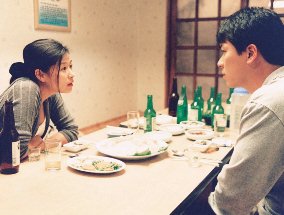
Yet, the Gay man still dies at the end. So how about a Korean film where the Gay character doesn’t die? And how about we let him have a loving relationship too? A year before Road Movie, Kim Yong-gyun’s Wanee & Junah (2001) did just that. The film follows a couple, Wanee (played by Kim Hee-sun), a woman who is a well-respected animator at the studio where she works, and Junah (played by Joo Jin-mo), an aspiring writer just on the verge of his first film credit. Early on, Wanee begins to distance herself emotionally from Junah due to the return of her younger half-brother, Young-min (played by Cho Sung-woo), and the memories his return causes to surface. The reason she retreats from Junah is because, in Young-min’s return, she is forced to deal with the incestuous relationship she had w/ Young-min before his departure for Europe and the death of her father that she connects with that relationship. Whether or not Wanee and Young-min were sexual is left ambiguous, but it is clear through the excerpts shown from their past that they had a bond beyond brother and sister.

Whereas Road Movie queers masculinity by asking a Straight character to confront his homophobia by accepting sincere affection from a Gay man, Wanee & Junah presents a challenge to a Straight woman to queer her perceptions of what type of man she can have a relationship with. Wanee’s relationship with Jung-woo allows her to address her personal struggle and to eventually fully accept the man who loves her. Wanee’s co-worker, Jung-woo (played by Choi Kwang-il) is a Gay man whose boyfriend, Hyun-soo (played by Son Se-gwang), is a policeman. This Gay relationship is integrated into the film fully as common place. It is not seen as a deviation but as another valid expression of ourselves. It’s as everyday in this segment of Korean society as kimchi.

Nowhere does this relationship receive any fundamentalist immoral-lashings. In fact, when Jung-woo and Hyun-soo have a fight, the whole office appears to express great concern and to hope that the two will resolve their differences and get back together. We are informed of the circumstances around their fight on the roof of the studio when Jung-woo shares his troubles with Wanee.

Jung-woo – “Hyun-soo’s mother wants him to get married. It’s not like I can’t understand.”

Wanee – “Then why did you two fight?”

Jung-woo – “He wants to separate for a while.”

As is the case for so many Gays and Lesbians throughout the world, family members will often insist the Gay family member get married to meet society’s expectations, to satisfy society’s prejudices. Hyun-soo asks for space from Jung-woo to sort through this obstacle in his life. It is here that Wanee first seems to acknowledge how her boyfriend might be feeling regarding her need for distance from him. She feels her friend Jung-woo’s suffering and knows Hyun-soo’s request for space causes this suffering. She begins to sense how her request for space could be effecting Junah.

Still, her situation is not analogous to Jung-woo’s for many reasons. She knows that Jung-woo can understand his boyfriend’s experience because Jung-woo’s family is most likely asking the same thing of him. But Wanee’s secret is unique to her, she can’t imagine that Junah might understand. Still, in Jung-woo’s pain she sees the pain she might be causing Junah.

It can be dangerous to talk about this film as a progressive portrayal of Gay Koreans since the topic of incest is dealt with in the film without harsh moral judgments. Considering the fact that to make their weak cases against equal treatment for Gay and Lesbian relationships, self-appointed public moralists often use perverted arguments such as ‘If we accept Gay and Lesbian relationships, then what’s next? Incest? Bestiality?’, one may feel that even touching on this topic of Incest can seem to reinforce these deluded arguments. However, the parallel that Wanee sees with Jung-woo and Hyun-soo is not that she sees her relationship with Young-min as parallel to theirs, thus justified and moral, or the opposite. She actually realized long ago how harmful her relationship with Young-min was to her growth and how she needed to let go of her attachment to him to experience a healthier relationship in her future. The memories she revisits anticipating Young-min’s return do not resurface because she is still attached to him as a lover. Her memories are attempts to sort out her guilt that her announcement to her father of her love for Young-min was, in her mind, the cause of their father’s death.

Wanee & Junah demonstrates the difference between homosexuality and incest that the homophobic so often illogically connect. In this way, the film works differently from Maureen Turim’s interpretation of Oshima Nagisa’s French production, Max Mon Amour (1987). Max Mon Amour is a story about an upper-class family wherein the wife (played by Charlotte Rampling) is having an affair with a chimpanzee. Turim sees the dinner table scene, where the wife “position[s] herself outside such inquiries” about her relationship with her chimpanzee lover, as a sign of “the strength of her self-possession as a woman who lives her own desire.” Turim goes on to argue, “In the context in which right-wing advocates of repression link homosexuality to bestiality to condemn both, this film makes the daring move of humorously defending bestiality, using this defense to satirize, between the lines, homophobia.”8 Whereas the satire of Max Mon Amour links bestiality with homosexuality to defend the latter, the melodrama of Wanee & Junah dissociates homosexuality from any attempts to connect it with incest. In this way, the healthy Gay relationship counters the inherently unhealthy incestuous one.

Also, incest is not the only taboo present in Wanee & Junah, presenting not a parallel between homosexuality and incest, but an exploration of all the relationships, personhoods and experiences we are told to keep secret. Taboo after taboo abound within the film once you start looking for them and part of the enjoyment of watching the film is arguing for the existence of other taboos in the subtext. The most obvious is the fact that Wanee and Junah are cohabitating lovers who are not married, an arrangement still not accepted in general Korean society. Another taboo involves Wanee’s Deaf co-worker, Young-sook (Kim Su-jin). Rather than require her to speak Korean or to communicate through written Hangul, the whole office has taken to learning basic Korean Sign Language.9 Thus we have the presence of a non-verbal language, rarely shown in any films, regardless of national origin. (I acknowledge that the overwhelming majority of viewers will see Young-sook as a character with a disability rather than as a member of a linguistic minority, so I will also present that the presence of a “disabled” character also breaks a taboo since persons with disabilities are rarely shown in films.) Furthermore, one of the Hearing co-workers may be courting Young-sook. However, since the Korean Sign Language is un-translated for viewers solely reliant on the English subtitles such as myself, this is only speculation based on their interaction. Still, the mere hint of a cross-cultural/cross-linguistic – and able-bodied/”disabled”-bodied – relationship represents further breaking down of taboos.10 Other taboos include the brief reference to a striking age difference between a couple on a TV program and the possible infidelity between Wanee’s and Young-min’s parents in that Wanee and Young-min share the same father but not the same mother. And the most important taboo to the film’s plot is not the incest, but the taboo of talking about death. This taboo is the real reason Wanee is distancing from Junah and is having difficulty letting go of her past. Talking about her father’s death is further complicated with the exhausting complications of the history that leads up to it. It is very easy to understand why Wanee can feel that no one could possibly understand her guilt around her father’s death. No one but Young-min, that is. So Wanee & Junah, does not portend to argue that being Gay is like being incestuous, it merely presents the hidden identities and experiences around us that society makes it difficult to talk about, thus difficult for each of us to process through.

As far as we know, Wanee does not decide to tell Junah about her father’s death nor her possibly incestuous relationship with her half-brother, although scenes hint that Junah might have an idea about the latter. What we know is that Wanee has taken on the responsibility to continue working on her relationship with Junah.

Jung-woo also plays a part in Wanee’s decision to return to Junah. As Wanee struggles with her past and her present, Jung-woo presents a hopeful future to her. Jung-woo oversees the Sketching department at the studio. As the hierarchy is presented to us through the dialogue at the studio, Sketching is seen to provide more opportunities for creativity than Animation, where apparently you are simply duplicating the creations of others. Wanee is hesitant to pursue the career opportunity Jung-woo has for her in Sketching. We later learn this is because she was scared of taking on the responsibility of the position. This is paralleled with her fear of letting go of her guilt about her past and taking on the responsibility in a relationship with Junah. Her letting go of her past and accepting her future with Junah is signified in her acceptance of the Sketching position. Wanee’s acceptance of the Sketching position represents her refusal to perpetuate the unhealthy pattern she was stuck in with Young-min and her past, deciding to create something new and mature with Junah and with her career.

And Jung-woo’s influence on Wanee further resonates in how she is in love with a Metrosexual such as Junah. For those who have yet to come across the tern, “Metrosexuality” is the emerging nomenclature for Straight men who signify Gay-ness. These are Straight guys who don’t need the Queer eye. They are often described as having a Queer aesthetic in dress, decorating and other areas Straight men were not previously seen as experts in. Although most discussions of Metrosexuals center around how they consume products or lifestyles11, Metrosexuals are also men who are not scared to talk about their emotions, particularly their sadness or their desire to be in loving relationships that rely less on, to make up a word, “genderfication,” that is, gender as insurmountable divisions argued by the ‘Men are From Mars, Women are from Venus’ industry. These are Straight men women can talk to like they can their female and Gay male friends. Metrosexuals can cry and acknowledge their partner’s feelings rather than try to fix things like manly men are always accused of doing.12

Junah is definitely a Metrosexual. He dresses the part, cooks lavish meals for Wanee, and is constantly expressing concern for her position. In a blatant example of product placement13, Junah considers buying a new computer for himself, something he desperately needs to advance as a writer. Instead, he provides another opportunity for a product placement14 by buying Wanee a new TV. Wanee’s female friend So-young provides the womanly approval of this purchase in the scene where the TV is unveiled whereas Wanee is upset that Junah didn’t buy the computer for himself, always thinking of her and not himself. This product placement isn’t as intense as what we’ll find on Queer Eye for the Straight Guy, (off which, of course, I worked the title of this essay), but it definitely reinforces that tradition.

Interestingly, although Metrosexuality has emerged out of the friendships between Straight and Gay men, we never see Junah and Jung-woo actually interact in the film. Rather than suggest homophobia on Junah’s part, this reinforces the Jung-woo/Junah parallels for Wanee as Mentor/Lover in her life, helping her embrace her love for Junah at home while accepting the responsibility and respect she has for her work and for Jung-woo.

Although the film focuses on a heterosexual couple, Jung-woo is not depicted as the lonely Gay friend who provides relationship advice to his struggling Straight friend. In the Gay friend of the Straight woman trope, the Gay friend is forever doomed to a life of singlehood. Like a modern priest. he offers advice to couples regarding an aspect of life kept from him. Whereas, in Wanee & Junah, Jung-woo has a real loving relationship. He has to struggle within the homophobic confines of modern South Korea, but his relationship doesn’t end tragically.

And Wanee appears to acknowledge how the relationship she has with Junah comes with privileges Jung-woo does not have. Noy Thrupkaew has noted the main contradiction of Queer Eye for the Straight Guy. In the episode where our Gay Super(Consumer)heroes aid a nervous Straight man about to propose to his girlfriend, Thrupkaew notes,

As for the actual proposal, the experts watched it unfold on a TV in their chic “loft.” The men were breathless, fanning themselves, holding hands. And when girlfriend Tina struggled out a “yes,” they screamed and jumped up in delight. The moment would prove cruelly ironic not 12 hours later, when President Bush declared his opposition to gay marriage with the announcement that his lawyers were drafting legislation strictly defining marriage as a union between a man and a woman. This came after news of a growing backlash against gay rights, perhaps prompted by the recent Supreme Court ruling against a Texas anti-sodomy law, or, conservatives speculated, the increased visibility of queer people in culture and entertainment. (9Noy Thrupkaew, “Queer Factor: Are Bravo’s latest shows the new gay minstrelsy?,” The American Prospect Online, August 4, 2003. Available at http://www.prospect.org/webfeatures/2003/08/thrupkaew-n-08-04.html))

There is a moment in Wanee & Junah when Wanee appears to be aware of this contradiction as it relates to Korean society, where she is being indirectly counseled in relationships by a Gay man who, by being Gay, is denied the right to marry the man he loves. Wanee, from the roof of the studio, watches the playfulness in Hyun-soo returning to Jung-woo. The two lovers jokingly push each other while sitting on traffic barriers, as if to symbolize the barriers they must work around, and play around, in Korean society as Gay men. The rooftop provides a panopticon-like view. Except in this case, the initial power of the panopticon to repress, to keep people confined within supposed cultural norms and rules, is being subverted. The original idea of the panopticon was a guard house in the middle of a prison chamber that allowed for the viewing of all the prison cells circling it, thus, giving prisoners the impression that they are always on view by authority and must act properly and police themselves because they never know when they might be caught for their transgressions.15 Wanee is not policing cultural expectations16 from her panopticon perch. She is attempting to free her culture from this policing, hoping for her culture to accept the love that, in present efforts to maintain face, dare not show its face.17

Like the distance of the rooftop, Hyun-soo is always shown from a distance. And his face is never shown in focus, as if to show how Gay and Lesbian Koreans have to present themselves out of focus in Korean society. We could parallel this out of focus view of Hyun-soo with director Kim Yong-gyun’s choice to occasionally use blurry shots as Wanee’s point of view as a sign of the physical toil of her job. The first example of this POV shot shows up when we see Wanee first see her Metrosexual Junah in the film. Ironically, Wanee’s blurry vision allows her to see what others keep out of focus.

Upon seeing Hyun-soo return to Jung-woo, Wanee smiles, happy and hopeful for them. She then enunciates this joy with a satisfied sigh, “The weather’s so great!” Immediately after this utterance, thunder erupts, as if to let her know all is not well. The thunder’s primary signification is that she needs to continue the work of mending her relationship with Junah, but it also signifies that Jung-woo and Hyun-soo still have obstacles before them.

It is in movies like Wanee & Junah and Road Movie that we see greater space being provided for the multicultural in Korea, especially concerning the Gay and Lesbian Korean experience. Of course, improvements are still to be made. I still can’t interpret Jang Sun-woo’s Lesbian man-hater as anything more than a weak cliche if not a vicious stereotype. But for those who looked at South Korea as a place that would never find a cross-legged space at the table for Lesbian and Gay Koreans, one might want to reconsider that position. There are signs flickering on the screen that are gradually opening up the cinematic space for Queer Koreans that will hopefully fully limn societal space as well.

  1. Adam Hartzell, “Notes from the Hong Sang-soo Retrospective.” Koreanfilm.org. Available at http://www.koreanfilm.org/hongss2.html []
  2. Recently, Hong Suk-chon, an openly Gay television actor, returned to TV in the miniseries Perfect Love after a three year hiatus. Prior to this hiatus, Hong was a popular character on a popular children’s television show. He had trouble finding television work after he publicly affirmed rumors about his being Gay during an interview where the interviewer brought up the rumors as a joke to be discounted. Excised from the actual televised portion of the interview, Hong’s affirmation that he was Gay was leaked by a magazine two weeks later and Hong refused to deny what the magazine claimed. The producer of the children’s television show wanted Hong to deny these rumors. Since Hong refused, he was quickly fired from the show. (Norimitsu Onishi, “Korean Actor on Comeback After Coming Out.” San Francisco Chronicle, Monday October 6, 2002, D4.) Whether or not Hong’s return to TV represents a trend in South Korea towards greater acceptance of Lesbian and Gay Koreans would require more than just a sample of one. []
  3. Yes, the New Order song was very popular in South Korea. []
  4. Choosing to cast Kang Hyo-jin in this role as a confident, self-assured Lesbian is interesting since she played a homophobic “friend” of the character of Min-ah in Memento Mori. []
  5. Vito Russo, The Celluloid Closet. HarpersCollins: New York, 1987. []
  6. Kyu Hyun Kim, Brief review of Road Movie (Kim In-sik, 2002), Koreanfilm.org. Available at http://www.koreanfilm.org/kfilm02.html#road []
  7. In an interview with Darcy Paquet at Koreanfilm.org (http://www.koreanfilm.org/ejyong.html), director E J-yong (An Affair (1998), Asako In Ruby Shoes (2000), and Untold Scandal (2003 []
  8. Maureen Turim, The Films of Oshima Nagisa: Images of a Japanese Iconoclast. University of California Press: Berkeley, 1998. All quotes are taken from page 213. []
  9. I have been unable to confirm if Kim Su-jin is really Deaf. Nor have I been able to confirm if the character of Young-sook is signing in Korean Sign Language, another Sign Language such as Japanese or American, or gestures merely meant to signify a Sign Language. Since it does not appear to be a gibberish created by Hearing people, since the character is a Deaf Korean, and since Sign Languages observe as much diversity as Spoken Languages, sometimes even more so, I refer to Young-sook’s language as Korean Sign Language. []
  10. Much to the disagreement of my roommate, (Sorry, Thien.), I will utilize the function of footnotes to argue my case that Young-sook is being courted by a colleague. In the only scene where her Korean Sign Language is translated in English-subtitles, Young-sook asks Wanee if the drawing on her desk is of her “boyfriend.” (To which Wanee responds, “It’s a secret,” further underscoring the many secrets in the film.) Since disabled characters are so often de-sexualized in film, Young-sook asking about someone else’s “boyfriend” can be argued as setting her character up as one possessing romantic agency. Later, a colleague leans towards Young-sook with a beverage can in each of his hands and she smiles as if she knows he’s trying to woo her. Since, contrary to how mainstream media portray Deaf people, not all Deaf people can read lips, when her colleague says out loud, “She’d want coffee,” we can make a fair assumption he’s admonishing himself out of his previously unsuccessful attempts to express his interest to Young-sook. In response to this effort, Young-sook proceeds to laugh coyly and takes the can from him, signing to him something, perhaps “Thank you.” My roommate argues here that the colleague is merely asking Young-sook about advice concerning his attempts to woo another woman in the office. However, this colleague never interacts with any other woman in the office besides Young-sook. His two other scenes with Young-sook involve him playing badminton with her as her “partner” and later congratulating her in KSL about a job done well on their most recent assignment. All this tends to suggest that Young-sook is being courted by a Hearing colleague, crossing a taboo of cross-linguistic, cross-cultural lines as well as the taboo against “able-bodies” courting “disabled” bodies. And the fact that so much of this courtship goes un-translated keeps these secrets, these taboos, “unspoken.” That is, at least for those who are not knowledgeable in Korean Sign Language. []
  11. For a good introduction to this phenomenon, see discussion of the premier Metrosexual, David Beckham, in this article: Mark Simpson. “Meet The Metrosexual.” Salon.com, July 7, 2002. This article may require subscribing and is available at http://archive.salon.com/ent/feature/2002/07/22/metrosexual/index.html
    Also see Genevieve Roja “Here Come The Metrosexuals.” Alternet.org, September, 29, 1993 available at www.alternet.org/story.html?StoryID=16847 []
  12. As I reinforce in my summary, Metrosexuality is more often discussed in relation to changing definitions of maleness rather than changing definitions of femaleness. The emergence of Metrosexuals is full of complex issues, such as the issues that arise when a majority group appropriates aspects of the cultural identity of a minority group, that deserve greater discussion than I give here. []
  13. Here is the dialogue of the male salesperson who is slightly cut off from view behind Junah that exposes this as the commercial it really is. “So I can use this notebook as a phone simultaneously.” As if this isn’t enough, to show time lapse, another new female salesperson is brought in after a quick editing cut to add, “You can use it as a phone and pick different melodies.” I won’t assist in this blatant product placement by naming for you what the brand of computer is. []
  14. Nor will I assist the brand identification here. []
  15. Michel Foucault. Discipline and Punish: The Birth of the Prison. New York: Vintage Books, (Reprint Edition) 1995. []
  16. And “policing cultural expectations,” under which Lesbian and Gay Koreans must struggle, is further underscored by the character of Hyun-soo being a policeman. Hyun-soo has to police himself within Korean society, making him the one in his relationship more likely to feel the familial pressure to get married. []
  17. Interestingly A Hot Roof also subverts the initial symbolism of the panopticon. It is on the roof of their apartment complex that the women rebel against the men below. The panopticon of both A Hot Roof and Wanee & Junah places women in the panopticon-view and allows them to expand what is permissible in the societal cells they gaze upon. For it is from this position that the women can better see the big eyes the patriarchal panopticon has. Ironically, both directors use the panopticon to free Korean society from some of its cultural shackles rather than to tighten those shackles. []

Hong Sangsoo’s Unsexy Sex

By Adam Hartzell
https://web.archive.org/web/20030117144948/http://www.thefilmjournal.com:80/issue4/unsexy.html

Originally from Berea, Ohio, Adam Hartzell now lives in San Francisco where he’s nurtured a strong interest in Korean film. He manages the bibliography at Darcy Paquet’s Korean film website, www.koreanfilm.org, where he also contributes many reviews and essays. Currently he is working on an essay about HONG Sang-soo’s The Power of Kangwon Province for a soon to be published book on Korean and Japanese film.

———————-

Turning Gate

Every time I return to the films of HONG Sang-soo, new insights and reflections on us humans arise. Much of the power of Hong’s work has to do with the fact that he tosses aside cinematic conventions. He refuses to happy-end his films. As Kyung Hyun Kim argues, “He refuses to grant us pleasure at all.” His heroes are not anti-heroes as much as they are exercises in humiliation.

The cinematic cliché that Hong subverts which most resonates with me is his de-sentimentalizing of relationships. Hong challenges the romantic cliché of “True Love.” Hong doesn’t challenge these clichés through the use of cynicism as he’s so often accused . He is not telling us to forgo love, nor telling us that True Love is a lie. He’s not of the opinion that Love Stinks. No, Hong simply strips romantic relationships of all their accoutrements to show us the ambivalent partners we really are. We have moments of True Love, but those moments are fleeting. With the fantasy removed, we can see what we really have to work with. From that starting point, in concert with our partners, we can begin building relationships that are more life affirming. Rather than creating pessimism, Hong creates hope for what we can become as partners.

The particular facet of Hong’s de-romanticizing romance that I wish to discuss in this essay is Hong’s trope of “Unsexy Sex.” The sex scenes in The Power of Kangwon Province (1998), Virgin Stripped Bare By Her Bachelors (2000), and Turning Gate (2002) all have one thing in common: They are not sexy. What I mean by “not sexy” is that they are not scenes that allow for the buildup and experience of sexual pleasure on a voyeuristic level. Hong prohibits any sexual pleasure from viewing his scenes where sex is implied. Hong utilizes two tactics to unsexy his sex scenes: something prior to the sex scene readies us with discomfort or something enters the scene that disrupts the sexiness that was transpiring.

The Power of Kangwon Province follows a young female college student, Jisook (OH Yoon-hong) and a college professor, Sangkwon (BAEK Jong-hak), on their separate sojourns into the mountains of Kangwon Province. We learn that these two people had an affair that had ended just prior to their trip to Kangwon. The film contains four basic sex scenes, none of which is pleasurable for the viewer. Each scene comes with baggage Hong requires us to carry into the scene and keep with us so as not to expect any sense of sexy. The first two scenes involve Jisook and the Policeman (KIM Yoo-suk) both in a state of drunkenness. Jisook had been looking for her friends just before the Policeman took her into his room. Her friend Eunkyoung (PARK Hyun-young) had left the couple alone prior to that after receiving indirect reassurance from the Policeman that Jisook wouldn’t be taken advantage of. However, despite Eunkyoung’s indirect efforts, Jisook and the Policeman end up making out on his cot. Jisook thanks the policeman for taking care of her and her friends at the moment when the Policeman is acting with the least concern for Jisook’s well-being. Hong takes leave of the scene without confirming whether or not the two had sex. We are not sure if anything happened, but we are sure we wouldn’t feel good about it if something did. The next sex scene occurs after Jisook returned to visit the Policeman alone. Drunk, again, Jisook whines much protest to the Policeman’s advances in a motel room. This scene makes clear that no sex occurred, having them wake up separately from one another. In this scene, the audience is comforted with the results because the buildup presented us a couple that shouldn’t have sex. Thankfully, they didn’t.

The other two sex scenes both involve Sangkwon. His tryst with a prostitute exhibits all the sexiness of working a fax machine. The prostitute’s mechanic, commodified movements are followed with commands that Sangkwon hurry up and not mess up her hair in the process. The next sex scene involving Sangkwon involves Jisook. They have returned to a Love Motel to make out. Jisook reveals to Sangkwon that she’s had an abortion, one of the unsexiest comments one could utter while making out with someone. Rather than comfort Jisook, Sangkwon eventually asks for a blowjob that Jisook willingly gives. Jisook’s confession of her abortion warrants emotional comfort. What Sangkwon asks for is a complete withdrawal from any emotional intimacy, tainting the fellatio with enough discomfort that the audience receives it with no pleasure.

In Virgin Stripped Bare By Her Bachelors, the sex scenes are stilted and thwarted by the female lead’s solely traumatic sexual experiences, (Soojung, played by LEE Eun-joo), and the male lead’s impatience, (Jaehoon, played by JUNG Bo-seok). Virgin Stripped Bare By Her Bachelors presents a narrative of the two characters getting to know each other from three perspectives: Jaehoon’s memory, Soojung’s memory, and privileged viewer. Two scenes provide examples of how scenes, which appear to be leading us towards sexy, are unsexy-ed in Hong’s films. When Jaehoon travels to the city of Ansan to meet up with Soojung in a hotel, this is in Jaehoon’s perspective, we are led to believe we are witnessing a sexy scene. Jaehoon suckles Soojung’s breasts as Soojung cradles his head, which she kisses. But Jaehoon’s frustration, almost anger, with Soojung regarding her further refusals of intercourse intrudes the sexiness towards which this scene appeared headed. Later, the same scene from Soojung’s perspective, we see a more fully bare-chested Soojung with her arms way above her head, arched in ecstasy as Jaehoon suckles her breasts and rubs between her legs. The erotic charge of this moment is disrupted by Jaehoon calling Soojung by another woman’s name. It’s all over after that. All sexiness is lost.

Soojung’s character is a virgin in the sense that she’s never had intercourse. However, she has had sexual relations that didn’t involve intercourse, all of which were either traumatic or clearly not desired by her. Soojung’s perspective of the film shows us a scene where her older brother, who is possibly developmentally disabled, urges her to give him a handjob. She resists quite assuredly but eventually gives in to stop his whining. Later, we witness Soojung’s boss attempting to rape her, which she is able to thwart. However, he is unsympathetic to her calling his actions what they are, rape. “Rape? Rape, my foot!” he exclaims.

Obviously, due to the unequal power relations, those two scenes are so discomforting, sexiness doesn’t even come into the picture. And the audience is asked to keep Soojung’s past experiences with them when witnessing the final sex scene. Further unsexy-ing this scene is the fact that it is set around a lie. Presented in the perspective of privileged viewer, Jaehoon promises Soojung he won’t hurt her. But, as evidenced through her painful yelps, he does hurt her. And he doesn’t stop. It is an extremely disturbing scene to watch. We don’t receive any pleasure from this scene, only disgust and a wish that Jaehoon would live up to his promise and stop hurting her. The audience is one with Soojung in this scene, experiencing her pain along with her. When they tell each other they love each other at the end of the film, the section of the film told by the privileged narrator, we know that Jaewoon’s lie has continued, sadly, with Soojung taking part in the ‘I Love You’ lie as well.

Turning Gate portrays an actor recently turned down for a role meeting up with an old friend to escape from his Seoul for a while. During this excursion he meets two women enamored with him in different ways. Whether or not the actor, Kyungsoo, (KIM Sang-kyoung, learns that much about himself, the audience definitely learns much about him through his actions and statements. As in Virgin Stripped Bare By Her BachelorsTurning Gate also disrupts the sexiness of the sex scenes. However, this time they are not unsexy-ed by discomforting intrusions such as uncaring men or physical pain. Most often, this film uses humor to unsexy. Kyungsoo makes the first sex scene unsexy by wondering aloud why Myongsuk (YEH Ji-won) won’t look at him while they’re having sex. Kyungsoo’s question disrupts the scene, providing it with clumsiness rather than fluidity. Later Myongsuk is pouts about Kyungsoo not being in love with her. Kyungsoo then re-enters her, much to the discomfort of Myongsuk. However, when Kyungsoo starts moving his hips in a way that causes Myongsuk to admit “You could please any woman if you do this,” the scene becomes absolutely laughable. The dialogue between the two is so bizarre that any sexual pleasure on the part of the viewer is replaced with laughter. Later, when having sex with Sunyoung (SANG Mi-chu), Hong returns to the moves that Myongsuk loved and Kyungsoo asks “Do you like my moves?” to confirm his prowess. Sunyoung’s answer is not an answer, but a command, “Please don’t ejaculate inside me. Soon, Kyungsoo asks again about his moves. And, again, Sunyoung’s does not provide confirmation, but declaration, “I don’t want to get pregnant.” The only pleasure we’re allowed in these scenes is the pleasure of laughter through Kyungsoo’s concern about his moves. Sunyoung’s concerns about pregnancy unsexy the scene even further.

The final sex scene invokes humor as well, such as when Sunyoung squeezes one of her breasts and asks Kyungsoo to appraise them. However, humor is not the only tool used to strip the sexy from this scene. The scene began with reality stepping in to disrupt the sexiness. Kyungsoo finds himself unable to maintain an erection that will allow for intercourse. His impotence forces them to talk rather than fuck. When Kyungsoo begins to talk about Sunyoung’s husband, Sunyoung loses her interest in sex. But when Kyungsoo tells her he loves her, this is when she seeks appraisal from him of her breasts. Plummeting his head in between them, Sunyoung begins to stroke Kyungsoo to help him become erect. Kyungsoo inhibits this moment by asking Sunyoung if she wants to die together. “I don’t want sex anymore. Just die, pure and innocent. This is not talking dirty. Bringing death into the picture, we lose our brief voyeuristic pleasure like Kyungsoo lost his erection.

In every sex scene of these three films, Hong disrupts in someway to keep the scene from becoming yet another example of voyeuristic pleasure. Such unsexy sex is a welcome subversion in Asian film. Hong refuses to Orientalize, that is, to eroticize and exoticize his Asian characters for Western consumption. He’s not reinforcing Western stereotypes of the exotic, hypersexual Asian woman. At the same time, he’s not reinforcing the Western stereotype of the de-sexualized Asian male. Unsexy-ing is not de-sexing. His men are attractive and desirable. Hong’s sex scenes simply refuse to perpetuate stereotypes or clichés about Asian bodies as solely meant for a Westerner’s viewing pleasure. Hong refuses to Orientalize because he refuses to direct for Westerners. He has said his films are written for Koreans. Apparently, Westerners never come into his pictures so their stereotypes of the exotic Oriental don’t either.

As Hong de-sentimentalizes to show relationships that are real rather than romanticized, using unsexy sex as one of his techniques to establish a de-sentimentalized view, Hong allows us to see sex closer to its reality. Sex can be blissful, orgasmic, fun, and spiritual, but it can also be painful, clumsy, messy, and/or wrong. We often have sex to escape our reality. When we seek this escape, we are more likely to ignore our partner’s needs and their pleasure. Hong won’t allow us to escape. Reality will always disrupt. Ironically, through Hong’s disruptions, he shows us the hope of relationships through survival of the discomforts. In showing us the horrors/humiliations of sex, he provides hope for the ecstasy of sex as well.

Interestingly, Hong appears to be gradually developing a more mature cinematic sex scene through his insistence to disrupt sexiness. The Power of Kangwon Province shows us sex scenes that are discomforting in how unhealthy they are and Virgin Stripped Bare By Her Bachelors takes this even further showing instances where sex is clearly wrong. Turning Gate presents a scenario of more mature sex where the mature body inhibits the act. Impotency is not seen here as a problem which we need to overcome with Viagra. It is seen as a teacher, or at least a teaching moment where a different type of closeness can be reached. What can bring us closer than talking, naked, with a partner about death?

And death, as much as we seek to ignore it, is always with us. Let’s just accept it for what it is, Hong appears to say. As if challenging the Hollywood commentators who tell us that we go to movies to escape, Hong knows many of us go to confront that which we can’t escape. We can’t escape the ambivalences surrounding our relationships as much as we try to romanticize them. We can’t escape the ambivalence towards life or our ambivalence towards death. As much as we may think we’re too sexy for it, reality will keep disrupting. We might as well learn from it, take inventory, and grow, together.

————————

1. Kim, Kyung Hyun. The Awkward Flaneur: Reading the Fictions of Hong Sang-soo and Kim Sang-ok. Unpublished manuscript presented at the Hong Sang-soo Retrospective at the University of California, Irvine, October 24, 2002.

2. Hartzell, Adam. My Moments with the Master, HONG Sang-Soohttp://www.koreanfilm.org/hongss1.html, October, 2002.

3. I am limiting “sex scenes” to mean those scenes where characters are in or near a bed with the intent to be physical in some way. Many of these scenes do not culminate in the characters having sex, but the context of exploring the sexual realm of their relationships within the space of the bed can be easily inferred.

4. Unfortunately, I have yet to have access to Hong’s first film The Day a Pig Fell Into the Well (1996) outside of one single viewing too long ago, and when I was too tired, to trust my recall ability. Thus, I have had to leave that film out of all my discussions regarding Hong’s oeuvre until opportunities for sufficient re-viewings are provided.