The cultural life of North Korea

North Korea’s 65th anniversary of the Workers’ Party offered a rare insight of every day life in the capital Pyongyang.
http://www.guardian.co.uk/world/2010/oct/15/north-korea-pyongyang-secret-culture
Tania Branigan

A street scene in Pyongyang. Photograph: Dan Chung/Guardian

A street scene in Pyongyang. Photograph: Dan Chung/Guardian

Old men playing cards in a park; a woman shopping for vegetables; tired workers jostling for space on a rusting trolley bus. These tiny glimpses of daily life would be unremarkable anywhere else. But this is Pyongyang, capital of one of the world’s most insular countries, and even the mundane is an extraordinary sight – more fascinating to a journalist than the pomp of North Korea’s largest military parade, the real reason we have been allowed in.

We expect to see the portraits of Eternal President Kim Il-sung and his son, the Dear Leader Kim Jong-il, gazing down at us from roadsides. We have been well briefed on socialist haircuts and vinalon, the miracle fabric made from limestone and better known for durability than comfort. We have read the propaganda, combining revolutionary fervour, the vocabulary of 30s potboilers and accounts of Kim’s visits to potato-starch factories.

But who knew that The Da Vinci Code was a hit in this strictly controlled city? That Céline Dion is a karaoke favourite? Or that the mass performances are not only a tribute to the leadership and motherland, but the way that many young people find partners?

Few foreigners see this city at all. Around 2,000 western tourists visited last year, plus perhaps 10 times as many Chinese visitors. The expatriate population, excluding Chinese and Russian diplomats, and including children, stands at 150. Mobile phones are confiscated at entry; visitors are accompanied by official escorts at all times; tourists’ photos are inspected and frequently deleted, even when their subject matter is – to outside eyes – entirely innocuous.

A family passes before the Party Foundation Monunment in Pyongyang. A family passes before the Party Foundation Monument. Photograph: Dan Chung/Guardian

A family passes before the Party Foundation Monunment in Pyongyang. A family passes before the Party Foundation Monument. Photograph: Dan Chung/Guardian

Information is so sparse that interpreting North Korea is not so much like reading tea leaves in a saucer as examining them while they float in a milky brew. People devote their careers to the country yet acknowledge they know little about it – one Seoul-based expert, Park Hyeong-jung, is reportedly writing a paper on “just how terrible our research and predictions are”, though others say information about daily life – such as market prices – is much better than two decades ago.

Our rare media trip has been organised by the government at little notice to show the world that Kim Jong-un, the leader’s youngest son, is now heir apparent. We arrive in Pyongyang less than 24 hours after flinging scribbled applications at the Beijing embassy and officials admit they hadn’t expected so many journalists. With minders in short supply we have more freedom than usual, visiting the railway station, department store, vegetable shops and kiosks and a local restaurant. This is by far the wealthiest section of the wealthiest part of the country.

“Nobody who lives in Pyongyang is an ordinary person. This is the top five to 10% of the population,” points out Barbara Demick, whose book Nothing To Envy offers a vivid account of ordinary life in North Korea.

On top of that, we have arrived amid unusual celebrations. The party has promised special supplies to households in the capital, including a bottle of alcohol, cooking oil and sweets. Most passersby are drab, in grey, khaki or navy outfits; their only colour the red Kim Il-sung badge pinned to each lapel. But women attending the military parade have brought out their bright traditional gowns for the holiday and others show a thirst for colour, with vivid bags or jackets. Hot pink is a surprisingly popular shade in Pyongyang. Most are immaculately made-up and all are neatly coiffed. Hair is a serious matter in North Korea, which licences a limited range of haircuts – in 2005, state television launched a series titled Let’s Trim our Hair in Accordance with the Socialist Lifestyle.

On the streets, a handful of residents lick ice lollies; one tiny girl holds a candy floss stick in each hand. Across from our hotel, people jostle at food stalls for savoury pancakes, fritters and pizza (reportedly a favourite of Kim Jong-il’s). An enormous white frosted cake with pink icing roses is priced at 9,000 won (£6.25), while a dish of shaved ice with syrup costs just 5 won. Young men take aim at shooting stalls, and around town crowds gather to watch open-air concerts, the bands lined up in neat rows like Merseybeat-era Beatles.

But some who know the city suggest that attractions such as the street lighting will vanish once we have gone. Even during our visit, most roads away from our hotel are dark. The sleek restaurants surrounding it are almost empty. The central department store is gloomy, illuminated only by late-afternoon light and a string of fairy lights. As at a rainy English fete, the effect of the bunting above the counters is more plaintive than festive. Stock lies untroubled in glass counters or on the shelves behind them: lengths of plaid fabric, clocks, footballs, pastel towels, TVs and even a cafetiere set. There are perhaps 20 visitors sprinkled across four sizeable floors and the only actual customer appears to be a small child buying a cheap plastic toy.

Old men play Korean Chess near the Party Foundation Monunment in Pyongyang. Old men play Korean Chess in Pyongyang. Photograph: Dan Chung/Guardian

Old men play Korean Chess near the Party Foundation Monunment in Pyongyang. Old men play Korean Chess in Pyongyang. Photograph: Dan Chung/Guardian

There are certainly signs of change here: Air Koryo has new planes and three gleaming airport buses to ferry passengers from runway to terminal. Last week a vast new theatre opened, as did an apartment complex, although it may be destined for officials. The 105-storey Ryugyong hotel – more than two decades in construction – is finally glass-sheathed and due to open in 2012. That year will mark the 100th birthday of the country’s founder, Kim Il-sung. But it is hard to see how it can achieve its pledge to become “a great, powerful and prosperous nation” by then – even given the Stakhanovite industrial efforts lauded in its newspapers.

Life must be good for some in Pyongyang. A journalist spots a North Korean handing over $2,000 to buy two Longines watches. Orascom, the Egyptian mobile phone company that opened a network here last year, already has 200,000 subscribers, although the handsets cost anywhere between £65 and £190 and their use is strictly limited: Koreans can only call other Koreans, while foreigners can only call each other or abroad.

But away from the handful of show projects there is little sign of improvement in ordinary lives. Overloaded trolley buses wheeze along, more rust than steel. One reporter sees a woman and child apparently digging for roots in a park. The country has been heavily reliant on food handouts since the 90s, when hundreds of thousands died. Those who have visited the countryside recently say residents are visibly gaunt, even in farming areas.

Pyongyang is lucky: no one is plump, but nor is there noticeable emaciation. Dr Andrei Lankov, associate professor at Kookmin University in Seoul, says the official income in Pyongyang is around 3,000 won a month, but many have ways of making money on the side and – unlike other North Koreans – its residents receive subsistence food rations. Most top those up at markets that are legal though never formally acknowledged (officials insist that “everything is public”). At the turn of the year, the government embarked on currency reforms to eradicate an increasingly independent group of “kiosk capitalists”. But wiping out hard-won savings caused highly unusual public discontent and even, reportedly, unrest.

“It was a near complete disaster; the first time in my memory that high-level North Korean officials openly complained to their counterparts about government policy,” says Lankov.

The government swiftly reversed the changes and reportedly executed a senior official for the blunder. Now, says one frequent visitor, the economy is exactly as it was – except that prices have risen sharply and people are unhappier. The government would like foreign investors to help revive the economy, but the country’s unpredictability and the international sanctions imposed over its missile and nuclear tests make that unlikely, despite its rock-bottom wages.

Armaments are its big earner and those aside, its existing production base seems unlikely to save it. The current issue of Foreign Trade, designed to woo international business, advertises a curious selection of goods – homemade wigs, rabbit fur, steel cutlery and Kaesong Koryo Ginseng Extract, recommended “for treating radiation diseases, cancer and Aids”. Amid these problems, culture becomes more important than ever as a tool to bind support for the regime. Often, it makes little attempt to disguise its pedagogic intent – songs include Vinalon is a Textile Made from Stone and My Youngest Daughter, Pok Sun, Became an AA-Machine Gunner.

But music is a genuine passion as well as a political tool for North Koreans, and other tunes combine political themes with romance. Our foreign ministry escorts grow misty- eyed when The Night of Pyongyang City starts playing at the mass dance. Young lovers walk hand-in-hand at night murmuring the romantic melody, they say. Many of those couples have met through the months of drilling for such performances.

“Lots of people also find love in the Grand People’s Study Hall. I found my love there,” says one minder. “People usually keep loving relationships for a long time and try to help each other in study or work . . . You can’t achieve CNC technology [technological production] if people don’t have that aspiration,” he adds.

Tired commuters cross Pyongyang on an old bus. Photograph: Dan Chung/Guardian

Tired commuters cross Pyongyang on an old bus. Photograph: Dan Chung/Guardian

More surprisingly, The Da Vinci Code was a big hit here, though it seems unlikely that Dan Brown’s publishers are aware of the fact – or are benefiting much. So, too, was Harry Potter. Young women love Jane Eyre and Anne of Green Gables – a translation of the third volume in the series is due out shortly. Though banned, foreign films are also increasingly – albeit surreptitiously – popular. The government hoped people would watch films such as the sprawling patriotic series Nation and Destiny when it authorised DVD players. But smuggled movies from China have provided residents with a glimpse of life outside. One NGO worker recalls a teenager requesting shyly whether she could ask her a question: Who did she think was better – Brad Pitt or Keanu Reeves? Though they might sound trivial, such anecdotes show that the information seal is not airtight.

Koreans in border areas are also using smuggled handsets and sim cards to make calls via Chinese networks. Many have slipped across the border, too, or have relatives living covertly in China. The country is becoming increasingly porous.

“People are beginning to suspect that the world lives better than they do,” says Lankov. But he adds that very few realise how much better, and that North Korean propaganda has adapted. “It doesn’t insist any more that it is a prosperous and rich nation and everything else is hell. They say, ‘Well, there are other places, but we have our leader and our pure national blood . . .’,” he notes.

It is impossible to know whether North Koreans find such statements convincing. Tears stain the faces of some performers at the mass dance when they glimpse Kim Jong-il watching them – but the cheering is piped through speakers and apparently pre-recorded.

“North Koreans do criticise the leaders and politics, just not in public – especially to foreign visitors. That is the quickest way to be arrested, tortured and sent to prison. It’s a society where pretty much all freedoms are restricted,” says Kay Seok, the Seoul-based researcher for Human Rights Watch.

State news agency KCNA describes such reports as lies, insisting: “The independent and creative life the Korean people enjoy is a dignified, worthwhile and happy life unimaginable in the capitalist society.”

In the absence of open conversation, analysts seize on the tiniest signs to read the mood of the country. If rising hemlines indicate optimism in western economies, so too can trousers show defiance in North Korea, one observer suggests. Women are banned from wearing them in Pyongyang in the summer, apparently because Kim Jong-il considers them alien to Korean culture. Neighbourhood committees monitor compliance and send offenders home to change. Yet as the temperatures rose this year, several women defiantly clung to their slacks. Is that, asks the Korea watcher in all seriousness, a sign of increasing disaffection and feistiness following the disastrous currency reforms?

Only North Koreans know for sure. And they are not telling.

Asia’s first Master of Wine

http://www.ft.com/cms/s/0/968cb2dc-27e0-11df-9598-00144feabdc0.html
FT, Published: March 5 2010 22:45 | Last updated: March 5 2010 22:45

What wine would do justice to the explosive taste of fried chilli prawns? How about beef satay, or chicken in a spicy coconut sauce? Now imagine you are in Singapore or Malaysia and that all three dishes, plus half a dozen more besides, are set before you. How could you possibly match wine to such a panoply of competing and powerful flavours?

Korean-born Jeannie Cho Lee, the only Asian among the world’s 279 Masters of Wine, spent two years trying to puzzle out precisely that. She travelled to 10 Asian food cities – Hong Kong, Shanghai, Beijing, Taipei, Tokyo, Seoul, Bangkok, Kuala Lumpur, Singapore and Mumbai – sampling dishes and figuring out which wines, if any, would make a worthy addition to an already sumptuous table. The resulting book, Asian Palate, published in November, is an attempt to understand food in its own context and to suggest appropriate wine without imposing alien tastes on some of the world’s complex cuisines.

“I wanted to see how wine fits in to our Asian food culture,” she says when I meet her in a private dining room in the China Club, a Hong Kong club that eschews the stuffiness of more traditional establishments. “I think food is place-driven,” she says, drawing a parallel with what wine experts refer to as the terroir to denote the characteristics that a grape draws from its geography. “It is the entire environment from which that particular ingredient comes from, the climate, the weather, the soil, even the people. It is the same with food,” she says. “I wanted to look at how to introduce wine to a table without disrespecting the harmony and the integrity of the dishes.”

Lee, who grew up eating Korean food cooked by her mother in the US and who now lives in Hong Kong, says the starting point must be a true love of Asian food. “I have an Asian palate,” she says. “My familiar tastes are of dried squid, salted anchovies, pungent soybean paste. You need to love the chewiness of intestines, the gelatinous and chewy texture of chicken feet and to appreciate jellyfish. You need to love that very soft mushy texture of sea cucumber and sea urchin. You can’t tell someone to like that.”

Lee’s love of wine began in Oxford, where she spent a year as part of her degree. She remembers being served “two or three clarets and perhaps a white wine to start”. Her interest piqued, she began to explore the wines of France and Italy and, when she returned to New York, she attended the famous Windows on the World Wine School, then on the top two floors of the World Trade Center. After moving to Hong Kong with her husband – whom she met at wine school – she continued to study, now with the UK-based Wine & Spirits Education Trust. At that time, wine taxes were high in Hong Kong – they were cut to zero in February 2008, transforming the city into Asia’s wine capital – and there wasn’t much of a wine culture. Lee pushed on, taking detailed tasting notes of every wine she came across in her job as a food and wine writer. By 2005, she felt ready to sit the daunting Master of Wine examination, a four-day test that includes four theoretical papers as well as a rigorous assault course of blind tasting, held annually in Sydney, London and Napa Valley. “I thought, ‘It’s a wine exam. How difficult can it be?’ ” she recalls. Like most first-timers, she failed. Second time around, in 2008, she cracked it.

Armed with that distinction, she set off on her 10-city quest to pair wine with Asian food. But she was determined not to force one culture on to another. Some food, she concluded, was simply better enjoyed without wine. “If you want chilli crabs in Singapore, whether the chilli or the black pepper crabs, perhaps it is better to have something thirst-quenching, like a beer, or cold water or some lemonade.” She understands why some Japanese chefs stick to rice-based sake, refusing to serve wine with their food, even though wine became popular in Japan a generation before it took hold in Hong Kong and mainland China. “Wine comes with unique flavours. It can intrude or take away from the balance of the food,” she says.

Her approach is to recommend wines in keeping with the flavours already present. “I would never suggest a sweet wine in northern China even though it would go well with the food in theory, because it is not culturally part of the local palate,” she says. But in Thailand, where a typical meal might include coconut, fresh fruit or sweet tea, she is comfortable recommending a medium-sweet wine. For Thai cuisine, her tips include an off-dry Riesling, an aromatic Alsace Gewürztraminer and an Austrian Grüner Veltliner.

In the same way, with spicy Sichuan food, often bobbing in red hot chilli-pepper oil, her training tells her that the tannins in red wine fight, and exaggerate, the spicy flavours. “You’re thinking to temper that with a white. But a lot of Asians want that taste to linger. So people who want that pungent taste to go on and on naturally reach for the red.” Whether white or red, her tip for Sichuan fare is for something with a lot of personality and not too expensive, since the grape will always lose the battle against the chilli.

Her sensibility to local tastes aside, she says some Asian food goes extraordinarily well with wine. She raves about the combination of sushi and vintage champagne, particularly if the fish is white and served with salt as opposed to soy sauce. Her preference is for something such as a 1996 Blanc de Blancs from Salon. For fattier tuna, she suggests a delicate, textured Pinot Noir. Tempura goes well with light-bodied reds with modest tannins or medium to full-bodied whites with crisp acidity.

Her native Korean food, packed with a range of flavours, demands versatile wines with refreshing acidity such as Sauvignon Blanc or a fruity Pinot Noir. Her tips for Indian food include a Sauvignon Blanc/ Semillon blend, old world full-bodied whites from Alsace or Rhône and, more surprisingly, a Rioja.

But the biggest challenge in pairing wine with Asian cuisine, she says, is the fact that Asians share their food, rather than ordering one dish at a time. “We are very communal and we like to dig in. We like to have different texture, bite and flavour combination with each mouthful. You dabble in and out of different flavours.”

That makes it impossible to match one wine with one flavour. One suggestion is to open a few different wines to cater for the variety of food on offer. Alternatively, the wine can be selected with one or two highlighted dishes in mind.

Her final piece of advice is not to have exaggerated expectations. “A wine is not going to make a meal so much better,” she says, “Asian flavours and the intensity of those flavours are already so high.” In the long run, she says, Asians will themselves gradually work out how best to incorporate the flavours of wine into their age-old cuisines. Their discoveries may shock and delight.

Korean couple let baby starve to death while caring for virtual child

http://www.telegraph.co.uk/news/worldnews/asia/southkorea/7376178/Korean-couple-let-baby-starve-to-death-while-caring-for-virtual-child.html

Prius-game

The couple had become obsessed with the online game Prius

Kim Yoo-chul, 41, and his partner Choi Mi-sun, 25, fed their three-month-old baby only on visits home between 12-hour sessions at a neighbourhood internet cafe, where they were raising an avatar daughter in a Second-Life-style game called Prius online, police said.

Leaving their real daughter at their home in a suburb of Seoul to fend for herself, the pair, who were unemployed, spent hours role-playing in the virtual reality game, which allows users to choose a career and friends, granting them offspring as a reward for passing a certain level.

The pair became obsessed with nurturing their virtual daughter, called Anima, but neglected their real daughter, who was not named.

Eventually, the couple returned home after one 12-hour session in September to find the child dead and called police. The pair were arrested on Friday after an autopsy showed that the baby died from prolonged malnutrition.

“The couple seemed to have lost their will to live a normal life, because they didn’t have jobs and gave birth to a premature baby,” Chung Jin-won, a police officer in Suwon, the Seoul suburb, told the Yonhap news agency.

“They indulged themselves in the online game of raising a virtual character so as to escape from reality, which led to the death of their real baby.”

More UNESCO World Heritage Listings Planned

By Chung Ah-young
Staff Reporter
http://www.koreatimes.co.kr/www/news/nation/2010/02/117_60078.html

Yi Kun-moo, head of Cultural Heritage Administration

Following a number of Korean cultural heritages being inscribed on UNESCO lists last year, the Cultural Heritage Administration (CHA) is seeking to promote the value of national cultural assets to the world.

The Joseon Royal Tombs were inscribed on UNESCO’s World Heritage List while “Dongui-bogam,” (The Principles and Practice of Eastern Medicine) was listed on UNESCO’s Memory of the World Register and five intangible cultural elements were included in UNESCO Representative List of the Intangible Cultural Heritage of Humanity.

The administration also expects the additional registration of Yangdong and Hahoe villages in North Gyeongsang Province on the World Heritage List. The International Council on Monuments and Sites (ICOMOS) has conducted on-the-spot inspections of the sites following Seoul’s application last year.

“The listing standards are getting tougher and pickier. UNESCO has asked us to provide additional information. It’s a difficult process, but we are doing our best for the inscription,” CHA Administrator Yi Kun-moo, said in an interview with The Korea Times.

The government will submit “Daemokjang,” a wooden architecture master, as an Intangible Cultural Heritage of Humanity, and “Ilseongnok” (Records of Daily Reflections of the Joseon Kingdom) for Memory of the World registration.

He emphasized, however, that the preparation process is as important as the registration itself as it is an opportunity to collect resources and conduct research about the cultural heritages to have them internationally acknowledged.

“The status of World Heritage means more than that of Korean heritage. It has universal value for all humans. We are responsible for preserving the assets to hand them down to the next generation,” he said.

But in addition to preservation, a moderate tourism development plan should be considered for the designated cultural heritage sites.

The administration is currently pondering plans to link palaces and the Joseon Royal Tombs ― under the theme, King Sejong, it can make a connection between Gyeongbok Palace and Yeongneung in Yeoju, Gyeonggi Province, and the Silleuksa Temple. Under the theme, King Jeongjo, it can tie Yunggeonneung Cluster, Suwon Fortress, Changgyeong Palace and the Jongmyo Shrine.

“To make this a reality, it’s important to use story-telling methods to promote the related heritage sites,” he said.

The administrator admitted that there were concerns over possible damage to the historical sites due to the growing number of tourists.

“But it doesn’t mean we should only preserve them. Just preserving the designated heritages doesn’t conform to the intention of the World Heritage List. The ICOMOS recommended that the government develop a comprehensive tourism plan and an on-the-spot explanation program to better protect the historical and cultural environment and promote the value of the cultural heritages,” he said.

Thus, striking a balance between preservation and development is the top priority in managing the sites. The CHA has already finished equipping the royal palaces and other heritage sites with automatic fire extinguishing systems, and has strengthened the security and tour guide systems.

“More importantly, Koreans’ awareness of the heritages has been raised a lot recently. So we expect people to show a mature consciousness about the conservation of the historical sites,” he said.

When Yi participated in the 33rd session of the World Heritage Committee in Seville, Spain in June, he felt it was a kind of “culture war.” “More and more countries are vying for registration of their assets. But the follow-up measures are crucial because maintaining the World Heritage status is as difficult as having them registered,” he said.

Yi said that it was shocking to see UNESCO remove Dresden’s Elbe Valley in Germany from its list because of the construction of a bridge across the valley. “This case tells us a lot ― how to protect cultural heritages and continuously maintain their status after the designation is really important,” he said.

Efforts to Reclaim Cultural Heritages

A French court’s recent decision to reject a request to return Korea’s royal texts that were looted by French troops during a 19th-century invasion has rekindled the public’s desire to restore their stolen cultural assets.

On Dec. 24 the court ruled that the Korean royal books held by the National Library of France were “national property” that cannot be handed over.

The collection that records most of the royal history of the Joseon Kingdom (1392-1910) was stored in an archive called “Oegyujanggak” on Ganghwa Island off Korea’s west coast. French troops took away the royal documents from the archive and destroyed other books when they raided the island in 1866.

The National Library in Paris had classified them under its Chinese category until they were discovered by a Korean historian named Park Byeong-seon living in France in 1978.

“As we saw in the Oegyujanggak case, there are many obstacles to repatriating cultural assets. It is true that the government cannot take bold action to bring them back home because there are no legally binding regulations over the illegal ownership of the looted assets and the breach of property rights. In addition, there are no international accords for retroactive applications for the case,” said Yi.

UNESCO adopted the Convention on the Means of Prohibiting and Preventing the Illicit Import, Export and Transfer of Cultural Property in 1970. Under its supervision, the Intergovernmental Committee for Promoting the Return of Cultural Property (ICPRCP) has urged each nation to return stolen cultural properties to their home countries.

However, the convention only applies to the cultural properties stolen after 1970. Thus, UNESCO’s requests for the return of such plundered properties are mostly ineffective.

The Korean government hosted the ICPRCP’s extraordinary session in Seoul in 2008 on the occasion of its 30th anniversary and it urged the unconditional return of Korean artifacts held by Japan and France.

The government has so far reclaimed several lost cultural assets ― for example, the seal of King Gojong of the Joseon Kingdom and General Oe Jae-yeon’s flag ― in cooperation with government agencies and civic organizations through purchases or donations.

Currently, a total of 107,857 cultural properties are scattered throughout 18 countries. They were taken during chaotic periods such as the Japanese colonial rule and the Korean War.

Japan has 61,000, the largest number of Korean cultural properties, followed by the United States with 27,000 and China with 3,000.

“We estimate more cultural properties might remain abroad than we know now because they were taken away during social upheaval. To bring them back, it is important to track down how these properties were taken out of the country. We are trying to figure this out,” he said.

chungay@koreatimes.co.kr

Selling South Korea

Lee Myung-bak wants to move his country to the center of the world.

Confident: South Korean consumers

By B. J. Lee | NEWSWEEK
Published Jan 29, 2010
From the magazine issue dated Feb 8, 2010
http://www.newsweek.com/id/232786/

For the first time in modern history, South Korea is laying claim to lead the club of rich nations. South Korea became the first member of the Organization for Economic Cooperation and Development—the group of 30 wealthy nations—to emerge from the global recession when it recorded 0.4 percent growth in the third quarter of last year. This year the OECD expects South Korea’s GDP to expand by 4.4 percent, the highest growth rate of any of its members.

Now President Lee Myung-bak wants to turn the end of the economic crisis into an opportunity. He knows the crash has accelerated the decline of American might, as well as the rise of China and other emerging powers, and he aims to exploit the gap between them. His goal is to transform South Korea from a successful but self-involved economic power into a respected global soft power with the clout to mediate between rich and poor nations on global issues such as climate change and financial regulation. In particular, Lee is pushing to revive momentum on a global free-trade deal—stalled in large part due to hostility from poor nations—while defending the poor by pushing for more international supervision of the global financial system. At the same time, he is trying to establish South Korea as a leader in the fight against global warming by agreeing that the country will cut emissions by 30 percent by 2020—one of the most aggressive targets in the world—even though it is not obligated to do so because it is still considered a developing nation under the Kyoto Protocol. To many in South Korea, the selection of Seoul as the site of the November 2010 summit of the G20—the group of 20 leading economic powers—is an acknowledgment of how well it has managed the current economic and environmental crises. “The old order is being dismantled and replaced by the new order,” Lee said from the Blue House in a televised New Year’s speech. “We have to make our vision the world’s vision.”

Lee is one of only two former CEOs to lead a major trading power—Italy’s Silvio Berlusconi is the other—and he runs South Korea like the just-do-it boss he was at Hyundai, where staff called him “the Bulldozer.” At Hyundai he led a company known for fearless forays into foreign markets, whether it was building huge bridges in Malaysia or selling cars with stunning success in the crowded U.S. market. Now he is trying to make South Korean culture—still on the defensive after a long history of colonial occupations—as cosmopolitan as Hyundai’s culture. He’s pushing for greater use of English and generally trying to open up South Korea to the world. In his first big political job, as mayor of Seoul, he created a huge ruckus when he ripped up the downtown to expose a boarded-up stream—but it is now a major draw for commerce and tourism. Lee’s grand domestic ambition as president is a multibillion-dollar plan to refurbish South Korea’s four major rivers despite protests from environmentalists and opposition members. Lee believes the project will boost local economies by creating jobs and promoting tourism and commerce. Lee’s popularity ratings, after an early plummet driven by a decision to allow U.S. imports of beef, are now at more than 50 percent as voters warm to his vision of newly developed South Korea as a model nation to be emulated by many developing countries.

South Korea’s successful management of the economic crisis surely helps. Early on, the country was battered like the rest of the world. The South Korean won dropped 30 percent in the first three months of the crisis, the stock market dropped by half, and foreign investors left in droves. But unlike most other rich nations, South Korea had recent experience with a major financial meltdown. Many of its current leaders are veterans of the Asian crisis that crippled the country’s economy in 1998, and they knew how to manage a free fall. Lee’s team immediately moved to save threatened banks and companies by setting up $200 billion in various funds to guarantee payment of their debts and for other forms of emergency aid. They struck currency-swap deals with major economies such as the U.S. to secure dwindling reserves of foreign currency and front-loaded public spending so that 65 percent of the country’s $250 billion budget was spent during the first half of 2009, ensuring that the money got into the economy rapidly—but without adding new debts. A government focus on protecting jobs kept consumer sentiment relatively high, and the Bank of Korea cut interest rates by 3.25 percentage points to 2 percent, a historic low.

All the while, Lee worked relentlessly to quiet calls for protectionism at home and abroad, at a time when many other leaders, including Barack Obama and Hu Jintao, were beginning to succumb. Lee’s administration is pushing for a slew of free-trade agreements with the U.S., the European Union, Peru, Colombia, Canada, Australia, and even China and Japan, if possible, says Abraham Kim, a Korea analyst at the political-risk consultancy Eurasia Group. Lee also lobbied hard at the Pittsburgh meeting of the G20 last year to have Seoul selected as the site of the next summit this autumn, an event he hopes to organize as a coming-out party. “He is trying to use the crisis to enhance the reputation of South Korea and help it to be widely recognized as a developed-world state,” says Kim. “This is partly a nationalism thing, but more importantly, they are trying to get out from under Japan’s and China’s shadow. South Korea needs to find its niche for its long-term competitive survival.”

South Korea was further protected from the crisis because its economy was built on pillars other than the collapsing financial-services industry. Decades of government efforts to nurture globally competitive conglomerates through massive infusion of capital had helped build export machines such as Samsung, Hyundai, and LG. As the crisis unfolded, the weakening currency allowed these companies to expand global market share, especially against key Japanese and other rich-world competitors. As a result, South Korea registered a record trade surplus of $42 billion last year, surpassing that of Japan for the first time. South Korean companies and banks were also ready to compete because the crisis of the 1990s had forced them to improve corporate governance, get their finances in order, and invest heavily in new technology. “We just had to dust off the old measures we used a decade ago and use them again,” says Vice Finance Minister Hur Kyung-wook.

In short, the South Korean model is a more mature cousin of China’s—a hybrid economy, part free market, part state-controlled—but with more freedom for the market and for political dissent. Now Lee is positioning South Korea within Asia as a dynamic alternative to both China’s mighty command economy and Japan’s no-growth economy. In Southeast Asia, South Korea has long been admired for completing an economic miracle in just one generation, moving its 48 million people out of poverty and entering the ranks of fully industrialized nations, with average per capita income that surpassed $20,000 in 2007. And, unlike China, South Korea has achieved economic and political growth at the same time, with an increasingly well-established multiparty democracy that respects free speech and election results. South Korea, says U.S. Ambassador Kathleen Stephens, is “the best example in the post–World War II era of a country that has overcome enormous obstacles to achieve this kind of success.”

Many Southeast Asian nations, alarmed by the harsh sides of the China model, look to South Korea as an alternative. Vietnam is sending civil servants there, studying how in the 1970s and ’80s Seoul used massive government support, such as cheap loans, to develop strategic industries such as steel and petrochemicals as the backbone of its export economy. As part of Vietnam’s effort to develop capital markets, it also now runs a stock exchange in Hanoi, built with the help of the Korea Stock Exchange. Officials from Vietnam, Cambodia, Indonesia, and Uzbekistan regularly visit South Korea to join training programs that teach economic and business management. “Developing countries are eager to learn South Korea’s economic model because of its relevance to them,” says Euh Yoon-dae, a Korea University economist currently heading a presidential committee to promote the national brand. “Our open economic system is more appealing to them than, say, that of China.”

Surrounded by bigger powers—China, Russia, and Japan—South Korea needs to carve out a global role for itself to “ensure its prosperity and security,” says David Straub, a Korea expert at Stanford University. So, in his first year in office, Lee made a point of systematically reaching out to foreign leaders in the United States and other major powers. The following year he headed to Europe. This year, Straub says, Lee is expected to target Africa. At the same time, he is upping South Korea’s profile abroad, posting 3,000 volunteers from its version of the Peace Corps to Asia and Africa, where they will focus on public health and childhood education, with plans to increase that number to 20,000 by 2013. Last year South Korea officially became the first former recipient of international aid to graduate to the donor ranks, sending $1 billion to dozens of poor countries, and it plans to triple that sum within five years. Likewise, the number of troops it commits to U.N. peacekeeping operations will jump from 400 in 2009 to 1,000 this year and will work in roughly 10 nations, including Lebanon and Pakistan.

Lee has big plans for Brand South Korea, too. At Hyundai, he turned what had been a small contractor into a global manufacturing powerhouse. He speaks English, unlike his predecessor as president, and he is comfortable playing national pitchman. Just after Christmas, following six rounds of telephone calls with United Arab Emirates President Khalifa bin Zayed Al Nahyan and a last-minute visit to the country, Lee helped South Korea beat out a French and a joint U.S.-Japan consortium to win its biggest foreign contract ever: a $40 billion nuclear-power-plant contract in the U.A.E. While Hyundai and Samsung have overcome the perception abroad that “made in South Korea” still means poorly made, many other South Korean brands have not. According to a survey by Simon Anholt, a British expert on national branding, the country ranks 33rd in global branding power, although its economic size ranks 13th in the world. What’s more, more than half of U.S. college students believe Hyundai and Samsung are Japanese brands. “Our job is to narrow the perception gap between the national and corporate brands,” says Euh, the head of the branding committee.

Lee plans to build on that success at the G20 summit. He has already distinguished himself from his predecessors by embracing foreign investment and free trade, rather than focusing on rigid ideology, and he intends to use the meeting to showcase the rewards of that strategy. Lee’s hope is that he can send a message to smaller, poorer countries, particularly in Asia, that South Korea’s less insular, more global approach can be a model they can follow, too. Of course, as his opponents are quick to point out, the fate of his country will not change because the leaders of 20 advanced nations get together for a few days. But Lee says it is part of a larger effort to move his country “away from the periphery of Asia,” as he put it recently, “and into the center of the world.”

Who Ate up all the Shinga?

Who Ate Up All the Shinga?
by Park Wan-suh
translated by Yu Young-nan and Stephen J Epstein
Columbia University Press, £17, 248 pages
Source: Weekend FT, 3/4 Oct 2009 (not available on the internet)

One of Korea’s foremost authors, Park Wan-suh has published more than 20 books. Who ate up all the Shinga?, written in 1992 but only recently translated, sits somewhere between novel and autobiography, and tells the story of the author’s upbringing during one of the most turbulent years in her country’s history

From a child’s perspective, Park shows Japan’s colonial occupation reaching into the remotest parts of the countryside. The writer’s adolescent years then find her family caught in the ideological crossfire of the civil war, first praised then persecuted for their leftist sympathies. The struggle of an entire people seems concentrated in the figure of Park’s headstrong mother.

Lyrical in its descriptions of village life, this gripping book is weitten with a confessional chattiness that contrasts with the hardships it describes.

AT.

The Caged Bird Sings – A review of The Old Garden

http://www.nytimes.com/2009/09/13/books/review/Myers-t.html

Hwang Sok-yong. Photo by Park Jae-Hong

Hwang Sok-yong. Photo by Park Jae-Hong

THE OLD GARDEN
By Hwang Sok-yong
Translated by Jay Oh
539 pp. Seven Stories Press. $30

One must never speak ill of nonchronological storytelling in America, where it is considered innately more serious than the other kind. But it is worth pondering the fact that flashbacks are nowhere more common than in North Korea. A writer will start with a woman getting a medal, say, then explain how she got there; this approach leaves less room for intellectual uncertainty and divergent responses. I make the point because although Hwang Sok-yong’s “Old Garden” was written south of the 38th parallel, it resembles a North Korean narrative in structural as in ideological ways. This is not a good thing. If I never read another mournful account of the fall of the Berlin Wall, it will be too soon.
Park Jae-Hong

“The Old Garden” begins interestingly enough. The description of a former political prisoner’s first day of freedom after almost 20 years, when the mere sight of open space exhausts him, is vivid and moving. (Hwang, one of South Korea’s most famous novelists, was himself a dissident who served prison time after an unsanctioned visit to the North.) Unfortunately the protagonist, Hyun Woo, soon learns that his lover and comrade Yoon Hee has died of cancer, whereupon the novel starts going back and forth in time. We read her letters to him, his cards to her, and so on. Much of this correspondence is of the implausible kind in which the recipient is reminded in great detail of shared experiences, but the transition to Yoon Hee’s notebooks from the 1980s does not help matters. To recount the student movement’s struggle against Chun Doo Hwan in such a disjointed and meandering fashion is to take all the drama out of it.

Jay Oh’s translation is basically functional, but it feels too youthful and distinctly American. The standard Korean expression for “24 hours a day” is rendered into English as “24/7,” a word meaning “shy” becomes “totally embarrassed,” and so on; this is hardly how a middle-aged man emerging from a long prison term would express himself. Other characters are made to swear in ways that could not seem less Korean: “Jesus, my mouth is watering.” The original at least has more gravitas — but that’s about it. Especially baffling is the author’s choice of a narrator. Hyun Woo is a man for whom “everything is unexciting and ordinary,” and he obviously wants us to feel the same way.

Indeed, the students’ opposition to the Chun regime is taken so much for granted that they barely seem to think at all, let alone engage in moral or philosophical debate. Does Hwang know how fatuous they sound? His later novel “The Guest” (which preceded this one into English translation) is a more nuanced affair, but here there is little sign of a critical or ironic distance between the author and his characters. When Hyun Woo says the Kwangju massacre of 1980 made him realize “our enemy was not the North,” we are evidently to agree that this was the only possible conclusion. And when another man explains his newfound sympathy for Pyongyang with the words “I just decided to be on their side, O.K.?” (the Valley Girl tones of the translation are not always inappropriate), we are to feel something other than the urge to hurl him across the DMZ. Yoon Hee, who is clearly the author’s favorite, grows more insufferable with every page. Having chosen to live in West Berlin, she is horrified when East Germany collapses, and worries that North Korea may follow suit. “This is not the solution. At least they had the correct beginning, didn’t they?”

The striving for simplicity and emotionality among students bewildered by long reading lists is, as the historian Ernst Nolte once wrote, “almost disgustingly easy to explain.” Harder to understand is why a man of Hwang’s age and experience would want to present this striving as something the world needs more of. (According to the publisher, Hwang is organizing a “peace train” that will go from Paris through North to South Korea — though I suspect he wants to stay on until Stockholm.) Having studied in Seoul in the mid-1980s, and witnessed the bravery of the demonstrators on many occasions, I was ready to like Hwang’s characters for helping to end military rule. Alas, he has so little apparent respect for the ensuing bourgeois democracy that he describes them cursing the transition to it. The hunch that we are dealing here with an ideology even sillier than Marxism is confirmed in one of Yoon Hee’s lines: “It’s a fight that has continued for over a hundred years since we opened up the port.” In other words, Korea’s problems began when it ceased to be the Hermit Kingdom. The penny drops: this is how the students could have fought so heroically against a pro-American dictator in Seoul, yet found so little cause to criticize the paranoid nationalist thugs in Pyongyang. “The Old Garden” thus raises an interesting question despite itself. Should we admire these people for making South Korea less like North Korea, if they were aiming for the opposite effect?

B. R. Myers, the author of “A Reader’s Manifesto,” is a researcher at Dongseo University in South Korea. His forthcoming book, “The Cleanest Race,” is about North Korea’s worldview.

A city dedicated to books and print

By Edwin Heathcote
Published: August 21 2009 22:38 | Last updated: August 21 2009 22:38
http://www.ft.com/cms/s/2/26852872-8de2-11de-93df-00144feabdc0.html

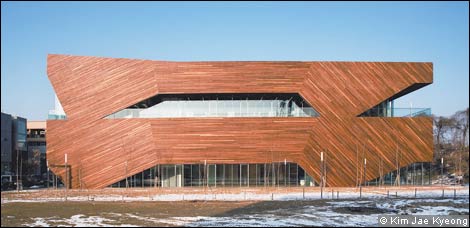
Publishing company Dulnyouk by Foreign Office Architects in Paju Book City, South Korea

Publishing company Dulnyouk by Foreign Office Architects in Paju Book City, South Korea

The idea of a city of books evokes a fantastical vision: towers of tottering volumes, narrow alleys formed by canyons and stacks of dusty hardbacks, formal avenues between loaded shelves. Like something imagined by Calvino or Borges, it conjures up a city of wisdom and surprise, of endless narratives, meaning, knowledge and languages. What it does not evoke is an industrial estate bounded by a motorway and the heavily guarded edge of a demilitarised zone. Yet somehow, South Korea’s Paju Book City begins to reconcile these two extremes into one of the most unexpected and remarkable architectural endeavours.

Built on marshland, former flood plains and paddyfields 30km north-west of Seoul, Paju Book City is an attempt to create an ambitious new town based exclusively around publishing. We may be reading obituaries of the book and the printed word almost daily, but the news has not reached Paju. Plans for the Book City were first proposed in 1989, as the country was emerging from a period of political repression. Publishing had gathered momentum and status after years of underground activity and censorship, and it re-emerged after the liberalisation of the regime in 1987 in an explosion of small, often family-run publishers. Their beautifully crafted books attempted to re-engage the nation with the history and culture that had been distorted, manipulated and lost over a period which included colonial rule from Japan, brutal civil war and military dictatorship. The project was also, at least in part, a reaction to the rapacious redevelopment of Seoul, the loss of the city’s historic fabric and its rapid embrace of the culture of bigness and congestion. That it was christened a “City to Recover Lost Humanity” tells us much about its creators’ intentions.

Publishing company Dulnyouk by Foreign Office Architects in Paju Book City, South Korea

Publishing company Dulnyouk by Foreign Office Architects in Paju Book City, South Korea

The project was initiated by publisher Yi Ki-Ung, whose ambition extended to creating a city of books that would also become a kind of museum of architecture: Paju features buildings by some of the finest architects working in the world today. The 1.5m sq m masterplan and the most sophisticated buildings on the site were carried out by the remarkable London-based Architectural Research Unit, run by Florian Beigel and Philip Christou. They wanted to create what they called, delightfully, an “urban wetland” – a paradoxical idea that allows them to root the new city in the landscape, to create something tied to its context rather than a suburban non-place. That context is beautiful, even epic, in its own way – the Han River, the mountain backdrop – but all that is cut off by the elevated motorway which also acts as a dyke. So the city is constructed on two levels: a dense street level, which accommodates the activity of the city itself, and a sparser upper level Beigel poetically refers to as “the strata belonging to the horizon”. Here a series of rooftop pavilions, elevated public spaces and buildings crowning bigger buildings below look over the road and out to the landscape beyond.

The city plan follows the contours and lines of the landscape, one main road snaking through it like a river and a series of tighter roads creating a denser network of small publishing houses, printers, distributers and so on. There are some extraordinarily ambitious buildings here. Just finishing construction is the Mimesis Museum, one of the Portuguese architect Alvaro Siza’s most arresting recent structures – its sheer concrete walls curve like the pages of a book in the wind, wrapping around a sculptural courtyard at its heart. SANAA, the Japanese architects of this year’s Serpentine Pavilion in London, have designed a stripped-down box, a publisher’s building of stark, striking elegance. London-based Foreign Office Architects have built a wonderfully theatrical publishing house which appears on the street as a modernist sliver, a delicately folded façade of glass which reveals sides with an almost nautical quality, clad in timber where they face a garden. There are exotically ambitious buildings under construction by Yung Ho Chang, Xaveer de Geyter, Stan Allen and some structures by Korean architects which would astound in any capital, let alone on a suburban Seoul industrial complex – notably those of Moogyu Choi and a bravado piece of concrete expressionism from Kim Jun-sung and Hallim Suh.

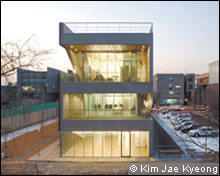
Youl Hwa Dang

Youl Hwa Dang

At the centre of the city stands a huge cultural complex, designed by Kim Byung-yoon, a combination of hotel (in which, it was pointed out to me, there are no TVs), restaurants, auditoriums and, on the roof, an urbane, elevated realm of seating, shops, libraries and galleries overlooking the sparkling waters of the river and the Simhak Mountain.

The finest buildings on the site, though, are by the ARU themselves (together with local partner Choi Jong Hoon). The first was for Yi Ki-Ung’s own Youl Hwa Dang publishing house, an enigmatic U-shaped building around a small courtyard. It looks like a bold pictogram, with a dark street façade, but to the courtyard there are “walls of light”, translucent membranes that recall the paper walls of traditional houses. An extension which contains a bookshop and café presents an intriguing contrast to the original buildings, retaining the subtlest memories of classical European urban architecture in moulding details, a portico and so on. This conservatism was conceived as a gentle provocation to the radical modernism all around and it works, with a startling clarity.

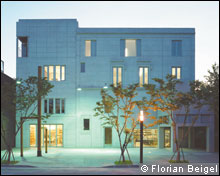
The ARU’s other structure, equally compelling, is for the Positive Thinking Publishing House. Designed as offices on a domestic scale and split into two units that create an intimate public plaza between them, they are built of traditional dark grey Korean brick set into a steel frame. The result is a hybrid of deeply embedded oriental and European archetypes. There is something here of Wittgenstein’s house, something of Beijing’s courtyard houses, a kind of Eurasian architectonic language which also, amazingly, manages to be conservative and deeply in thrall to the radical modernism of Mies van der Rohe. Inside, the surprises continue. The ceilings become an inverted urban landscape as a series of blocky paper lanterns break up the space from above. The domestic scale is wonderful: these feel like publishing offices, no plate glass, no open plan, rather a series of humane rooms, terraces and natural light.

If there is a problem at Paju it is that, as in all new cities, there is a kind of stillness, a lack of real density. This is compounded by zoning issues: as this is designated an industrial zone, the building of dwellings is difficult, and without places for people actually to live an area can never become a real city. Nevertheless, housing is slowly being built, and there are stirrings of the urban and commercial activity that constitute the beginnings of a real place.

It is not hyperbole to claim that this is one of the most extraordinary and most unsung cultural and architectural developments in the world. The idea that a city, right now, be dedicated solely to print and that an industrial estate could be a place of architectural pilgrimage could not be more heartening, more encouraging to anyone who delights in those very old information technologies – books and buildings.

Finally, laid to rest in Pyongyang

By Michael Rank
http://atimes.com/atimes/Korea/KH14Dg01.html

LONDON – There can be no lonelier grave anywhere on Earth. Amid fields close to the North Korean capital, Pyongyang, lie the remains of Flight Lieutenant Desmond Hinton, a British fighter pilot who flew for the United States Air Force as a member of United Nations forces in the Korean War.

Hinton is officially listed as missing in action (MIA), but his brother David, himself a retired Royal Air Force pilot, traced records of how and where Desmond died and managed to visit his grave in highly secretive North Korea.

“I was very close to my brother who was very much my role model and a father figure to me. I have never stopped missing him every single one of the 57 years since he died,” said David Hinton of Desmond, who was just 29 when he was shot down, leaving a widow and two small children.

David, now 77, is 12 years younger than Desmond, who had been awarded the Distinguished Flying Cross in World War II for shooting down two Japanese Zero fighter aircraft over Burma (now Myanmar). Having survived that ordeal, Desmond Hinton was one of 41 RAF officers seconded to the USAF during the Korean War.

“A tour lasted about three months. They were short of replacements, so Desmond offered to do a second tour and it was on his second tour that he was shot down and killed,” said David. “There’s an old maxim in the armed forces, ‘Never volunteer,'” he added with a wry smile.

David discovered in RAF archives a graphic report of how his brother died on January 2, 1952.

F/Lt [Flight Lieutenant] DFW Hinton had been ordered to undertake an interdiction and reconnaissance mission in the area of Sunan-Pyongyang with three other aircraft from his unit … After making a bomb run on railroad tracks just north of Sunan, he called the other members of his flight saying he was hit and on fire.

The aircraft was then seen to crash into the ground and explode on impact. The remaining three aircraft flew over the wreckage of F/Lt Hinton’s aircraft for 15 minutes, but returned to their home base after seeing no evidence that F/Lt Hinton was alive. Sadly, F/Lt Hinton is still reported as missing.

From this account, David had a good idea of where his brother had gone down in his F84e Thunderjet, over the Sunan area of Pyongyang which is now the location of the city’s airport.

He managed to buy a US military map of North Korea, and contacted the Foreign Office in London in the hope that the recently opened British Embassy in Pyongyang would be willing to ask the North Koreans if they could provide any further evidence concerning his brother’s fate. The British ambassador David Slinn and his colleague Jim Warren were only too happy to help, and found the North Koreans surprisingly cooperative.

It turned out that despite the North Korean government’s reputation of being deeply xenophobic, the remains of Desmond Hinton, who was fighting for the hated “Yankee imperialists”, had been given a decent burial close to where his body fell to ground.

David was therefore determined to pay his respects to his brother at his grave and in 2004 embarked on a remarkable journey to North Korea, taking the train from Beijing to Pyongyang.

Despite bitterness still evident in North Korea over the Korean War, he was treated as an honored guest and enjoyed the rare distinction of being accompanied during his visit by a senior Korean People’s Army officer, Colonel Kwak Chol-hui, who is director of Negotiations for Remains at the armistice site at Panmunjom.

The grave consists simply of a mound of earth surrounded by a white picket fence, without any inscription. It lies close to a narrow footpath on a hillside 200 meters from the road, near the village of Kuso-ri and 2.5 kilometers east of Pyongyang airport.

David was told that not long before his visit, his brother’s remains had been moved about 50 meters to a more accessible location.

He was introduced at the grave to two witnesses to Desmond’s crash, a Mr Ri and Mr Han, local villagers who were only 13-years old at the time but appeared to have perfect recollections of the event. “They told how the aircraft passed directly over their houses at very low level and they were at the crashed aircraft within minutes,” David said.

He asked his hosts if they could dig up a piece of Desmond’s clothing, and was deeply moved when he was presented with part of his flying suit.

He would have loved to have been given Desmond’s identity disc too, but was told this had been taken by Chinese troops who were fighting with the North Koreans against the US and other forces.

David gave a short speech at the grave, thanking Colonel Kwak and the ambassador for making his visit possible, while the head of the village promised to tend the grave and paint the fence regularly.

As a former RAF officer, David was also anxious to fix the position of the grave. “I went to the memorial to the Great Leader Kim Il-sung near the village in sight of the grave and took a compass bearing. The grave bears 160 degrees, 500 meters from the obelisk,” he noted in his diary.

He was also taken to the demilitarized zone at Panmunjom, where Colonel Kwak hosted a formal lunch and told him that Dear Leader Kim Jong-il had been made aware of and had approved his visit.

Reflecting the importance that North Korea attached to his visit, it was even reported by the official news agency KCNA, but for personal reasons David has not spoken about it until now.

The current British ambassador to North Korea, Peter Hughes, is aware of this lonely grave and said in an e-mailed statement: “Staff from this embassy visit the grave regularly to ensure it is kept in good order, and we carry out a small service there on Remembrance Day each year. I presided over the last such ceremony on November 9, 2008.”

Desmond Hinton’s grave is the only known one of its kind, but there has been one much larger-scale, much more official attempt to trace servicemen missing in action in North Korea.

In the 1990s, during a mild thaw in the frigid history of US-North Korean relations, the countries reached agreement on permitting American experts to search for the remains of US troops missing in North Korea.

More than 8,000 American troops are listed as MIA in the Korean War – far more than in the Vietnam War – but results from this unprecedented US-North Korean joint project were modest.

It “resulted in the recovery of 225 probable US remains; 27 have been identified to date and returned to their families for burial in US soil”, according to the US Department of Defense.

David Hinton is content for his brother’s remains to stay in North Korea, and he is now planning to visit Desmond’s grave again later this year.

There is every indication that the North Koreans are looking forward to welcoming him again, suggesting that despite its recent missile launches and atomic bomb test, Pyongyang has a human face after all.

Michael Rank is a former Reuters correspondent in China, now working in London.

A Korean composer talks about crossing genres

http://www.ft.com/cms/s/2/d91c082a-7d61-11de-b8ee-00144feabdc0.html
By Laura Battle

Published: July 31 2009 23:17 | Last updated: July 31 2009 23:17

Unsuk Chin

Were Unsuk Chin in any other arts profession, her name would be familiar – already a brand, perhaps – but as a composer, even as one of the foremost composers in the world, she remains an elusive figure.

Within this rarefied field – that of contemporary classical music – Chin is admired and celebrated, but this was not always the case. In her early life in South Korea, and for much of her later development in Berlin, where she has lived since 1988, her search for recognition proved arduous and protracted. Each piece of music has required a significant investment of time and labour – not that you’d guess: many are characterised by glassy, delicate and often lyrical sequences that unravel in a stream-of-consciousness style – and premieres of Chin’s music are few and far between. This year, however, three new works have come to fruition.

When I arrive at her elegant Charlottenburg apartment Chin admits that life has been “a bit hyper” recently. Today is no exception: not so much because of work, more to do with the fact that it’s her 48th birthday. I’ve caught her between family lunch with her husband, the Finnish pianist Maris Gothoni, and their young son, and a soirée she is throwing later that evening. We seat ourselves rather awkwardly at the dining table and Chin prepares herself as if for interrogation: her career has largely developed without media interference, and one senses she prefers it that way. But this season the glare of the public eye will be hard to avoid.

A recording of her Violin Concerto, which scooped the prestigious Grawemeyer Award in 2004, has just been released, and this month sees the premiere of her new Cello Concerto at the Proms in London. That Chin is one of five female composers to have new work presented during the festival is happy coincidence: the piece was originally scheduled for 2007, although it was hatched, like so many of the best ideas, at a party a number of years earlier. The cellist Alban Gerhardt and violinist Lisa Batiashvili “came round to this flat with Brahms’s Double Concerto, I think. It was the first time I’d heard [Gerhardt] play and I promised immediately, ‘I will write a cello concerto for you!’ But then he had to wait another seven years!” Chin adds, with a nervous volley of laughter.

Unlike her two previous concertos, where the solo part floats and flirts with its accompaniment, she describes the cello here as being “in conflict” with the orchestra: “I’ve put much more personal energy into this work, the cello has to hold the whole piece the whole time, and the soloist has a very strong psychological role,” Chin explains. It is clearly a highly developed work and, judging from Gerhardt’s rehearsal blog, fiendishly difficult to play: “Many passages are incredibly fast,” he wrote on July 10. “If I get lost in them, I will be lost. Arghhhh!”

This emphasis on speed and complexity seems to reflect Chin’s interest in musical virtuosity. As a young girl in South Korea she dreamt of becoming a concert pianist, learning western-style harmony by accompanying services at Presbyterian churches where her father ministered. But the family was poor and tuition funds were not available to the second daughter. “It was also very difficult to get records at that time but we had a small transistor radio and I listened to music every day, I was crazy for it.” This was the 1970s, under Park Chung-hee’s repressive regime, and Chin’s perception of western culture was shaped by her obsession with the Beethoven and Tchaikovsky symphonies.

Once at Seoul National University, and now determined to compose, Chin was in thrall to the new wave of European composers: Stockhausen, Boulez, Nono et al. “It was quite strange, a Korean composer learning this Darmstadt avant-garde style in Korea, and I always felt that this was not my music.” Still, it was this interest that inspired her self-exile to Hamburg, where she sought the tutelage of Hungarian composer György Ligeti. It was her first trip abroad, and a “culture shock” initially, but the hard work had only just begun. “I think everyone knows, [Ligeti] was extremely difficult,” Chin begins, before detailing how he dismissed her work as derivative and “destroyed” her self-esteem – to the extent that she felt unable to compose for three years.

In spite of Ligeti’s disciplinarian approach, his influence would, in the end, prove valuable and long-lasting. Alice in Wonderland, Chin’s first full-blown opera, explored a theme that Ligeti suggested before his death. But although the great master haunts the piece, Chin’s soundscape is very much her own. There were boos from the first-night audience in Munich in 2007 – “They came in evening dresses and diamonds and I think they were expecting Aida or something” – but her score received favourable reviews, even if Achim Freyer’s po-faced, expressionist production did not. In any case, she was undeterred by the experience and plans to start work on Alice Through the Looking Glass.

Chin seems to have an omnivorous taste for styles and genres, and I notice that the room is dominated by two massive floor-mounted speakers, some sophisticated hi-fi equipment and piles of CDs. “There are so many composers who are almost autistic and have no communication with the outside world, and I think that’s problematic,” she explains, “I seldom have time to go to concerts but I have a very good connection with publishers and I always have recordings sent of new works.” Gérard Grisey, George Benjamin and Jukka Tiensuu are cited as composers she admires but they sit alongside a range of other artists.

“I like pop music from the 1980s very much. I was always impressed by Michael Jackson, for example, that he could compose a melody for just two bars, with two harmonies, and could win millions of people through this small act. It’s fantastic and we can’t do that,” she says, speaking for classical composers. However, although there are chord sequences and melodic hooks in her own music that speak directly to the layman, Chin denies that popular music has influenced her work. Her next work, the Sheng Concerto, pays its respects to a tradition of Asian folk music.

“This is my first piece for a non-western instrument but I use the sheng very carefully; I’ve limited the sheng’s role and I wrap the orchestra around it.”

Chin first heard the sheng, a wind instrument capable of organ-like clarity and sustain, as a young girl, but had overlooked its potential until a chance encounter with the specialist Wu Wei. As with Gerhardt, Chin was so bowled over that she promised a concerto on the spot, and Wu is to perform the work at premieres in Tokyo and Los Angeles in the autumn.

This season will conclude with a new piece for the Ensemble Modern and further engagements with the Seoul Philharmonic Orchestra, where Chin is composer in residence. Since her appointment in 2006, she has quietly achieved great things there, not least the performance of more than 50 Korean premieres, including Boulez’s Notations and Ligeti’s Violin Concerto. I wonder aloud if the role has explored her own connection to both eastern and western cultures but her reply is evasive, and even a little disapproving: “For me, there is no border between western or Asian or Korean music. For me, music is music.”

Cello Concerto premieres at Prom 38, Royal Albert Hall, London, on August 13; www.bbc.co.uk/proms