Mother of All Mothers

The leadership secrets of Kim Jong Il – B.R.Myers
https://www.theatlantic.com/magazine/archive/2004/09/mother-of-all-mothers/303403/

REVIEWS

You’ve just finished your life’s work, a bold new history of the Watergate burglary in which you manage to prove that the White House was out of the loop, but the ink is hardly dry when an eighteen-minute tape surfaces in a Yorba Linda thrift shop, and soon the whole country is listening to Nixon gangsta-rap about how he personally jimmied the door open. It’s every revisionist’s nightmare, but Bruce Cumings, a history professor at the University of Chicago, has come closest to living it. In a book concluded in 1990 he argued that the Korean War started as “a local affair,” and that the conventional notion of a Soviet-sponsored invasion of the South was just so much Cold War paranoia. In 1991 Russian authorities started declassifying the Soviet archives, which soon revealed that Kim Il Sung had sent dozens of telegrams begging Stalin for a green light to invade, and that the two met in Moscow repeatedly to plan the event. Initially hailed as “magisterial,” The Origins of the Korean War soon gathered up its robes and retired to chambers. The book was such a valuable source of information on Korea in the 1940s, however, that many hoped the author would find a way to fix things and put it back into print.

Instead Cumings went on to write an account of postwar Korea that instances the North’s “miracle rice,” “autarkic” economy, and prescient energy policy (an “unqualified success”) to refute what he calls the “basket-case” view of the country. With even worse timing than its predecessor, Korea’s Place in the Sun(1997) went on sale just as the world was learning of a devastating famine wrought by Pyongyang’s misrule. The author must have wondered if he was snakebit. But now we have a new book, in which Cumings likens North Korea to Thomas More’s Utopia, and this time the wrongheadedness seems downright willful; it’s as if he were so tired of being made to look silly by forces beyond his control that he decided to do the job himself. At one point in North Korea: Another Country (2004) we are even informed that the regime’s gulags aren’t as bad as they’re made out to be, because Kim Jong Il is thoughtful enough to lock up whole families at a time.

The mixture of naiveté and callousness will remind readers of the Moscow travelogues of the 1930s, but Cumings is more a hater of U.S. foreign policy than a wide-eyed supporter of totalitarianism. The book’s apparent message is that North Korea’s present condition can justify neither our last “police action” on the peninsula nor any new one that may be in the offing. It is perhaps a point worth arguing, particularly in view of the mess in Iraq, but Cumings is too emotional to get the job done. His compulsion to prove conservative opinion wrong on every point inspires him to say things unworthy of any serious historian—that there was no crime in North Korea for decades, for example—and to waste space refuting long-forgotten canards and misconceptions. Half a page is given over to deriding American reporters who once mistook Kim Il Sung’s neck growth for a brain tumor—talk about a dead issue.

Cumings is even harder to take when he’s in a good mood. By the time he has noted a vague resemblance between Kim Jong Il and Paul Anka, sniggered about “horny” Korean housewives, and mocked both a tour guide’s English and an African man’s surname (“I dissolved in hysterics”), most readers, with no photograph of the author to go on, will find themselves mentally exchanging his professorial tweeds for a very loud leisure suit. Most offensive of all is the book’s message that we shouldn’t be too hard on the dictatorship in Pyongyang, because human rights aren’t as important to Koreans as to the rest of us.

Does this system promote human freedom? Not from any liberal’s standpoint. But from a Korean standpoint, where freedom is also defined as an independent stance against foreign predators—freedom for the Korean nation—here, the vitriolic judgments do not flow so easily. This is a cardinal virtue among a people that has preserved its integrity and continuity in the same place since the early Christian era … After all, there is one undeniable freedom in North Korea, and that is the freedom to be Korean.

It seems to have slipped the professor’s notice that many countries manage to stay independent without dragging children off to gulags, and that North Korea is a place where a lot of characteristically Korean behavior—speaking bluntly, for example—is punishable by execution. The only significant part of the culture that can be freely indulged under Kim is its ethnocentric streak, which is what Cumings all but reduces it to; confusing cause and effect, he sees propaganda as the reflection of the popular soul instead of (to use Stalin’s metaphor) the engineer of it. The Korean people have always been more outward-looking than their insecure leaders, and for centuries this was especially true of those in the northern part of the peninsula. Even in the months after our disgraceful bombing campaign during the war—a campaign that Cumings rightly calls a holocaust—diplomats in Pyongyang noted no signs of indiscriminate xenophobia.

This was soon to change. Throughout the 1950s the regime resorted to crude racism in its anti-American propaganda, often treating inset eyes, big noses, and other Caucasian features as the manifestation of villainy. To the consternation of the diplomatic community, little effort was made to enlighten people about the existence of friendly big-noses, even though—as this spring’s Cold War International History Project bulletin makes clear—North Korea’s cities were rebuilt and its people fed and cared for with enormous amounts of assistance from Eastern Europe. “They expect foreign countries,” one Hungarian diplomat noted, “to give them everything.” Reading the CWIHP bulletin has the odd effect of making one realize what a relatively sensible bunch of people the Soviets were. In the mid-1950s they opposed Kim Il Sung’s brutal collectivization of agriculture; Kim brushed off their advice, only to demand food aid when a murderous famine ensued.

The more the regime evinced its incompetence by relying on foreigners, the more it needed to restrict the people’s contact with them. By the 1960s the party line had taken a turn that reminded a Soviet diplomat of Nazi Germany, as citizens who married Europeans were banished to the provinces for “crimes against the Korean race.” A diplomatic report translated in the CWIHP bulletin shows how the masses finally got into the spirit of things. In March of 1965 the Cuban ambassador was driving his family and some Cuban doctors around Pyongyang when they stopped to take pictures. Hundreds of adults and children quickly swarmed the diplomatic limousine, pounding it with their fists, tearing the flag off, and ordering the occupants to get out. Their rage and insults, directed mainly at the ambassador “as a black man,” abated only when a security force arrived to beat back the mob with rifle butts. (Not for nothing did Eldridge Cleaver say that the North Korean police made him miss the Oakland police.)

“The level of training of the masses is extremely low,” a party official later admitted to the ambassador. “They cannot differentiate between friends and foes.” In other words, everything was going as planned. The regime went on to blur the distinction further by excising all mention of outside assistance from the history books, even as it continued to squeeze billions of dollars from its cash-strapped allies. For decades a foreign proletariat toiling in dingy factories from Vladivostok to Karl-Marx-Stadt helped bankroll Pyongyang’s transformation into a proud monument to ethnic self-reliance, so that someday a Bruce Cumings could boast that it is anything but the ugly Communist capital one might expect. Well into the 1980s Kim was telling leaders of aid-donating states that he was having trouble meeting the basic needs of his people. If South Korea’s dictatorships were America’s running dogs, then North Korea was the Eastern bloc’s house cat: intractable, convinced of its superiority, and to some observers a more independent creature, but never much good at feeding itself—even after the can openers started falling silent in 1989.

The question of where Europe ends and Asia begins has troubled many people over the years, but here’s a rule of thumb: if someone can pose as an expert on the country in question without knowledge of the relevant language, it’s part of Asia. Europeans hoping to lay claim to North Korea should therefore brace themselves, because Bradley Martin’s publisher is touting Under the Loving Care of the Fatherly Leader (2004) as the definitive work on its subject, though it belongs squarely in the “a puzzled look crossed the faces of my guide and interpreter” tradition of monoglot scholarship. Although hardly definitive, it is still an excellent book, well researched and lucidly written. It is especially refreshing to find someone showing serious interest in North Korean propaganda instead of merely hooting at it.

The problem is that the official translations on which Martin was forced to rely do not always reflect the original. Kim Il Sung’s title Eobeoi Suryeong means not “Fatherly Leader”—a common rendering that encourages Martin to exaggerate the influence of Confucianism on the personality cult—but “Parent Leader,” the most feminine title the regime could get away with. As the country’s visual arts make clear, Kim was more a mother to his people than a stern Confucian patriarch: he is still shown as soft-cheeked and solicitous, holding weeping adults to his expansive bosom, bending down to tie a young soldier’s bootlaces, or letting giddy children clamber over him. The tradition continues under Kim Jong Il, who has been called “more of a mother than all the mothers in the world.” His military-first policy may come with the title of general, but reports of his endless tour of army bases focus squarely on his fussy concern for the troops’ health and comfort. The international ridicule of his appearance is thus as unfair as it is tedious. Anyone who has seen a crowd of Korean mothers waiting outside an examination hall will have no difficulty recognizing Kim’s drab parka and drooping shoulders, or the long-suffering face under the pillow-swept perm: this is a mother with no time to think of herself. When it comes to the Workers’ Party, the symbolism is even more explicit, as in this recent propaganda poem:

Ah, Korean Workers’ Party, at whose
breast only
My life begins and ends
Be I buried in the ground or strewn
to the wind
I remain your son, and again return to
your breast!
Entrusting my body to your
affectionate gaze,
Your loving outstretched hand,
I cry out forever in the voice of a child,
Mother! I can’t live without Mother!

It’s easy to imagine what Carl Jung would have made of all this, and he would have been right. Whereas Father Stalin set out to instill revolutionary consciousness into the masses (to make them grow up, in other words), North Korea’s Mother Regime appeals to the emotions of a systematically infantilized people. Although the propaganda may seem absurd at a remove, it speaks more forcefully to the psyche than anything European communism could come up with. As a result, North Korea’s political culture has weathered the economic collapse so well that even refugees remain loyal to the memory of Kim Il Sung.

The Yangs, for example, are former Party members who recently defected to the South with their two boys. As part of a campaign to prevent the formation of a refugee ghetto in Seoul, the family was resettled in Mungyeong, a charmless sprawl of apartment blocks and love hotels a few hours to the southeast. I visited them there in May. As we sat on the floor of their tiny living room, I told them how a young refugee once shrank from my approach because—as she later explained—I looked like the stick-nosed Yankee effigies she used to run knives into after school. “Yes, you do have …” the mother shouted over the general laughter, but she caught herself in time. Turning to the older boy, who is sixteen, I asked what wisdom he could remember from the Parent Leader. “Man is the master of his own destiny,” he said shyly, his voice trailing off. What about his parents? “We didn’t memorize sentences,” the mother said, embarrassed, so I asked her to explain Kim Il Sung’s ideology of Juche for me in her own words. “The main thing is, man is the master of his destiny,” she said briskly. “And?” I asked. Silence. “Well,” I said, “if people are the masters of their destiny, why do they need a leader?” The younger boy came to his mother’s aid: “It was something about flowers needing the sun to grow.” Everyone frowned at my pen scratching away; they were letting the Parent Leader down. “It wasn’t so much what Kim Il Sung said,” the father blurted out at last.

This is of course true. Expanses of tautological prose have been ghostwritten to fatten the spines of the two Kims’ collected works, but few people ever read them. North Korea is a unique socialist country in that its ruling ideology is conveyed through what is written about its leaders, not by them, and the message could hardly be simpler: Foreigners bad, Koreans good, Leader best. “The most important thing to us was that Kim Il Sung suffered for the people; he fought for us,” the boys’ mother said. With a start I realized that this elegant fortyish woman, who now sells American cosmetics for a living, had tears in her eyes. “The Leader would sit on the ground with farmers, just like we’re sitting here now. And if he shook someone’s hand, that person would be happy forever. Of course, Kim Jong Il is not like that.” Conversation turned to the railway explosion in the North at the end of April, and to the regime’s immediate focus on the material damage. “It’s because Kim Jong Il never suffered,” the father said bitterly. “What does he know about the common people?”

It would appear that Kim knows just enough. The border with China remains so porous that even children often sneak back and forth, and yet no more than three or four percent of the population has chosen to flee for good. The regime obviously did the smart thing by publicly acknowledging the food shortage and then blaming it on American sanctions, instead of pretending there was no food shortage at all, as Stalin used to do. The Dear Leader has also deftly exploited the tradition according to which Koreans care for their parents in old age: the masses are told that it is their job to feed him, not the other way around, and his famed diet of “whatever the troops are eating” is routinely invoked to shame everyone into working harder. Never has a dictator been such an object of pity to his people, or such a powerful source of guilt. In 2003 North Korean cheerleaders, living it up on a rare visit to a sports event in the South, responded to a rain-soaked picture of Kim by bursting into a hysterical lament that baffled their hosts.

To concede the effectiveness of the personality cult is not to agree with Selig S. Harrison’s startling assertion, in Korean Endgame (2002), that Koreans have a “built-in readiness … to accept as truth what is dispensed from higher authority.” No regime ever needed to subject its citizens to a lifetime of brainwashing in order to make them follow their natural inclinations. What must be acknowledged is that Kim Jong Il has evinced a genius for propaganda ever since managing the efflorescence of his father’s cult in the 1960s. Even so, he cannot cover his lack of charisma completely; it’s as if Hitler died and left the Third Reich to Goebbels.

Kim must also be aware that the infantilization of the people has come at a price. Away from Pyongyang’s carefully monitored tourist sites, North Korea is a much more raucous place than any dictator could be comfortable with. “One surprising thing,” Michael Breen writes in Kim Jong Il: North Korea’s Dear Leader (2004), “surprising because you expect robots, is … how frequently fights break out.” According to refugees, even women fight out their differences, and young female teachers are said to hit children the hardest. This lack of restraint is a problem for many North Koreans trying to adjust to life in the South. Social workers complain that the refugees pick fights with strangers, and storm off jobs on the first day. “I’d have thought they’d be better at controlling themselves, coming from a socialist system,” is a common lament.

In short, the conventional Western view of North Korea’s official culture as a stodgy combination of Confucianism and Stalinism—two ideologies that prize intellectual self-discipline above all else—could not be further from the truth. Fortuitously enough, this view has so far encouraged Americans to stay cool in the face of Kim Jong Il’s missile-rattling. But misperceptions of hostile regimes are inherently dangerous, especially when Uncle Sam is doing the misperceiving, and this one has as much potential to excite tensions as to reduce them. On August 18, 1976, a detail of U.S. and South Korean soldiers at the DMZ were pruning a tree when People’s Army soldiers demanded that they stop. The Americans refused, prompting the North Koreans to wrest away their tools. In the ensuing clash two American officers were killed. Unable to conceive that Communist troops could act out of spontaneous rage, Washington assumed that Kim Il Sung had ordered the incident. Troops were set on high alert, and nuclear-capable B-52s dispatched to skirt North Korean airspace. Luckily for everyone, the Parent Leader issued an apology for his children on August 21. As the Americans saw it, of course, Kim had “backed down.”

Perhaps the most unsettling thing about the nuclear accord brokered by Jimmy Carter in 1994 is the decade of crowing it set off in North Korea. A high-school textbook remembers, “The Great Leader dragged the Americans, who had fallen into a state of extreme terror and unease, to the negotiating table … All problems discussed during the talks between America and Korea were resolved to Korea’s advantage, and the intense nuclear standoff ended in our victory.” This is evidently sincerely believed; if it weren’t, the North Koreans would not still be so enamored of Carter and Robert Gallucci, the chief U.S. negotiator back then. Both men—and this must thrill them no end—are praised in propaganda literature as fervent admirers of Kim Il Sung.

It is reassuring, then, to read in Harrison’s book that the agreement actually represented a victory of high-ranking North Korean “doves” over their hardline colleagues. I just wish he had explained why even the most hawkish propagandists remember it so fondly. What bothers me more is the author’s insistence on interpreting the two Kims’ every act as part of a rational pursuit of national security. We are told, for example, that the deployment of atomic weapons in South Korea in 1958 frightened Pyongyang into starting its own nuclear program. As the CWIHP bulletin makes clear, however, Eastern European diplomats in the early 1960s were aghast at the North Koreans’ assertions that a nuclear confrontation was nothing to be afraid of, and that the time had come for another invasion of the South. It is by no means certain that this sort of adventurist thinking has been abandoned. In a propaganda novel set in 1993, Kim Jong Il and his generals regard a likely American air strike on the Yongbyeon nuclear facility as the perfect opportunity for a “sacred war” (seongjeon) of reunification. Harrison ignores such things, which may well be better than overreacting to them; but to approach North Korea as if it were the détente-era Soviet Union is asking for trouble. When he gets his next update on the hawk-dove struggle from officials in Pyongyang, a city where most foreigners count themselves lucky to learn their tour guide’s name, he should perhaps keep in mind that North Korea has always viewed the existence of similar factions in Washington as the manifestation of a ludicrous disunity. No one under Kim Jong Il would describe his government in such terms to a Yankee visitor unless the goal were to extract more concessions from the outside world.

Considering that for decades the North Koreans refused to listen to their own allies, it seems naive for the author of Korean Endgame to assume that what Washington does “will largely determine what the North … will do.” The Juche regime has received substantial U.S. aid since the famine, but the dominant slogans of anti-American prop-aganda remain “A hundred thousand times revenge” and “A jackal can never become a lamb.” In other words, even as the regime tells the outside world it wants nothing but better relations with Washington, it tells its own people that better relations are neither desirable nor conceivable. In January of 2003 Pyongyang issued a taunting poster of a missile attack on the Capitol.Later that year, with the six-party talks in progress, an old tale of murderous missionaries was reprinted in four North Korean magazines, complete with racist caricatures.

Still, the thrust of Harrison’s book is valid.

The goal of the United States should be to disengage its forces gradually … over a period not longer than ten years, whether or not this can be done as part of a negotiated arms-control process … The stage would then be cleared, as it were, with the initiative left to Seoul and Pyongyang. Washington would have its hopes and its advice but would recede into an unaccustomed posture of detachment, ready to let the two actors make their own mistakes.

This is excellent counsel. Far from being a stabilizing factor on the peninsula, the U.S. presence serves only to rally the North Koreans around their military-first government. As Harrison makes clear, this is no time to get sentimental about our old ally. Seoul asks that U.S. troops stay, but at the same time it poses as a neutral mediator of the resulting tensions, often playing down the nuclear threat just as Pyongyang seems bent on playing it up; a disastrous miscommunication among the three parties seems all but preordained. It is a shame that Harrison does not place greater stress on the need to extricate our troops even if the arms-control process fails, because it’s hard to see how it can succeed. Kim Jong Il refused to let South Korean doctors tend to blinded children after the North’s railway explosion last spring; such a pathologically secretive man must be expected to balk at an early stage in the verification of nuclear dismantlement, no matter what agreement he has signed. Washington will then renege on its part of the bargain, prompting Seoul to voice regret over American “intransigence.” This, in turn, will embolden the North to demand a re-negotiation of the point in question, and we will all be right back where we started, albeit with even more nukes to worry about.

In the meantime, anything can happen. Having predicted the speedy downfall of the regime back in 1994, Pyongyang-watchers now predict that it will be around forever, but North Korea is already well into a precarious post-totalitarian phase. Thousands of citizens in border regions chat with refugees by smuggled cell phone, and millions more enjoy illegal access to television broadcasts from outside the country. The majority of the population has bought and sold things at open-air markets, and many young people in rural areas have simply stopped attending school and political meetings. The personality cult will find it hard to adjust to this kind of change without routine recourse to anti-American alarmism, and if there are no grounds for confrontation, Kim Jong Il can be expected to create them. All the more reason, then, for America to heed Harrison’s advice and pull out. But will we do so? Our patriotic dash into the Iraqi quagmire hardly inspires confidence that we wouldn’t follow our own Dear Leader into a new conflict in North Korea, especially since the WMD really do look like a “slam dunk” this time.

The only comfort to be had from the new batch of Korea books is provided by Breen’s biography of Kim Jong Il, which details a hedonistic streak as wide as the DMZ. Apparently the dictator lives in a huge palace stocked with Paradis cognac, and every summer a fresh “Joy Brigade” of high school beauties gets to admire the ceiling. Breen waxes indignant about this, but would he rather Kim were sharing a tent with a mountain goat and a well-thumbed Koran? We can all breathe a little easier knowing that our most formidable adversary wants his virgins in the here and now.

Also: https://adamcathcart.com/2010/02/03/koreanist-schisms/
http://www.slate.com/articles/news_and_politics/fighting_words/2010/02/a_nation_of_racist_dwarfs.html

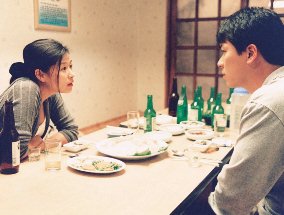
Queer Pal For The Straight Gal – Wanee & Junah and Queer Friendship

https://web.archive.org/web/20150316114414/http://www.thefilmjournal.com/issue7/wanee.html
By Adam Hartzell

Originally from Berea, Ohio, Adam Hartzell now lives in San Francisco where he focuses his writing primarily on Korean Cinema. He manages the bibliography at Darcy Paquet’s Korean film website, www.koreanfilm.org, where he also contributes many reviews and essays. He will have an essay on Hong Sang-soo’s The Power of Kangwon Province and Kang Je-gyu’s Shiri published in 24 Frames Japan & Korea in mid-2004 by Wallflower Press. He can be reached at epinionator_atom@yahoo.com.

——————–

Wanee

One of the most successful of World Cinemas in the past six years has been that of South Korea. Part of the reason for it’s success is what Chris Berry calls “Full-Service Cinema,” that is, a cinema that is not dependent on one genre nor one aspect of the industry, such as solely festivals, location shooting, or venture capital. Rather than focusing on primarily commercial fare, such as Hong Kong, or primarily art house fare, such as Taiwan, South Korea has excelled in multiple genres.1

Along with the wide-range of genres populating recent Korean Cinema, a more diverse array of Koreans are appearing on screen, particularly Gay and Lesbian characters and couples. For a country where Lesbians and Gays do have to remain, for the most part, closeted2, it is refreshing to see amongst the problematic portrayals a few progressive, respectful representations coming out of South Korea.

The film Memento Mori (Kim Tae-yong and Min Kyu-dong, 1999), placed in an all-girls high school, has two of the three main characters involved in a Lesbian relationship that does not fall easily into stereotypical portrayals and does not rely on sex scenes to titillate Straight male audiences. Plus, the character of Min-ah (played by Kim Min-sun) is a spunky ally to the Lesbian couple. The poorly titled, even in Korean, Bungee Jumping of Their Own (Kim Dae-song, 2001), allows for an open display of love between two men through the allusion that the female ex-lover of the main character In-woo (played by Lee Byung-heon) is reincarnated as a man. In-woo is married when he meets his reincarnated ex-lover, and the reincarnation is yet to be a man, that is, below the age of consent in South Korea. Thus, we have three nice little taboos rolled into one, the latter taboo, posing problems because it could be seen as re-enforcing stereotypes of Gay men as lecherous pursuers of underage boys. However, the characters are never shown to be affectionate beyond holding hands and the film struck a positive chord with many Koreans, allowing, perhaps, some borderline homophobic individuals a safer forum within which to critically engage their homophobia. A Bizarre Love Triangle3 (Lee Moo-young 2002) also poses problems, appearing to justify a heterosexual rape scene between two of the characters. And the Lesbian relationship is mostly one of Straight Male fantasies demonstrated by the number of dildos that wiggle throughout the scenes, and dildos that resemble penises at that. However, you are left respecting the Lesbian character (played by Kang Hyo-jin)4 much more than the other two main characters in the film. For some reason, Jang Sung-woo felt it was time to bring back the Lesbian Man-Hater trope for his Resurrection of a Little Match Girl (2002). The sissy has a history in South Korea in films such as Two Cops (Kang Woo-suk, 1993) and Flower Island (Song Il-gon 2001). And Transvestites have appeared in films like A Hot Roof (Lee Min-yong, 1996), a film where a group of women rebelling against the patriarchy terrorizing their apartment complex establish solidarity with the transvestite character.

This is not an exhaustive list, but it shows that Lesbian and Gay Koreans are receiving screen time, good and bad. Most recently, Kim In-shik’s Road Movie (2002) asks the audience to immediately confront any lingering homophobia. In the very first scene before the opening credits, we are given a shimmering, stylized, hunk of sweaty gay sex. Dae-sik (played by Hwang Jung-min), a homeless day laborer whom Korean society will not let signify his Queerness, nonetheless is not as ashamed as one might think he would be when found having sex with a man in a restroom. The person who finds him in the restroom is Suk-won (played by Jung Chan), the stockbroker down on his luck that Dae-sik has been helping out, and, falling in love with. Although not Gay himself, Suk-won eventually begins to appreciate the love and affection Dae-sik has for him, but, as melodrama will have it, he comes to terms with this a little too late.

Unlike the 1970’s American films with homosexual characters, where American critics would force homosexuality to “take the rap for the heterosexist woman-hating attitudes that permeate buddy films” (p. 85)5, Road Movie, the buddy-est of genres in that it’s also a road movie, (one of the few genres not strongly represented in Korean Cinema), provides a wonderful critique of masculinity by challenging those men who need to define their masculinity through acts of misogyny. Kyu Hyun Kim summarizes well the impression one is left with after watching Road Movie:

For me, the heart of Road Movie is perhaps best expressed in a rather small scene that occurs mid-point. Il-joo [the third main character, a prostitute who joins Dae-sik and Suk-won] challenges Dae-sik, who is about to leave her: instead of slapping, berating or smooth-talking her, or responding with a baleful gaze and ‘cool’ silence, Dae-sik softly intones, “I am so sorry,” and gives her a gentle hug, stroking her hair with his big, callused hands. We suspect that a Korean man is indeed capable of such gentleness and affection toward a woman (or man, for that matter) who is not an object of sexual desire or related by blood: it is just that we seldom encounter such a character amongst the endlessly churned-out gangster ‘comedies’ and art house hits suffering from madonna-and-whore dichotomitis. Sometimes we need an honest and thoughtful film like Road Movie to be reminded of such simple truths.6

Road Movie, in its expert handlings of issues of gender, shows why it’s been so difficult for those involved in making mainstream films in any country to portray Gay and Lesbian characters outside of stereotypes. When such is done sans the cliches, the presence of Queerness brings into question all our definitions about what men and women are supposed to be. This is why the women on the roof of their apartment complex in A Hot Roof were initially threatened by the Transvestite Yoo-mi (played by Kim Al-eum) since Yoo-mi challenges their concepts of womanhood. The women do eventually see solidarity with Yoo-mi’s cause because they know quite well that homophobia is as much about sexism as anything else. It appears that a subset of Korean directors have chosen to tackle both prejudices fully, with varying results.7 seems to allude to this challenge to gender norms by noting the changing expectations of what type of person a Korean director is expected to be. “In the past, people had preconceived notions of what kind of a person should become a director — sort of a macho, strong image. But all of that changed in the 1990s.”))

However, like too many American Gay and Lesbian films, the Gay character in Road Movie must commit suicide. Sadly, with limited Gay portrayals, this can provide further false evidence to Gay and Lesbian Koreans that they are alone and that they won’t live for very long. Even more frustrating is that Dae-sik chooses suicide when throughout the film we not only see Dae-sik rescue characters from their acts of self-annihilation, but we see a strong character who seemed capable of overcoming all the obstructions society placed before him. Still, the constant obstacles Lesbian and Gay Koreans must face can eventually frustrate the spirit of even this quite resilient character. Yet, before we completely allow the ending to define the film, we still need to hold all that happened before and how, in the final scene, Suk-won wholeheartedly accepts Dae-sik’s love for him. We do not know what happens to Suk-won after this scene, but he obviously has been greatly affected by Dae-sik’s affection for him. And, to some degree it is the constraints of Korean melodrama that require the death of Dae-sik to signify love un-attained, not just to signify the a Gay man cannot live in this society.

Yet, the Gay man still dies at the end. So how about a Korean film where the Gay character doesn’t die? And how about we let him have a loving relationship too? A year before Road Movie, Kim Yong-gyun’s Wanee & Junah (2001) did just that. The film follows a couple, Wanee (played by Kim Hee-sun), a woman who is a well-respected animator at the studio where she works, and Junah (played by Joo Jin-mo), an aspiring writer just on the verge of his first film credit. Early on, Wanee begins to distance herself emotionally from Junah due to the return of her younger half-brother, Young-min (played by Cho Sung-woo), and the memories his return causes to surface. The reason she retreats from Junah is because, in Young-min’s return, she is forced to deal with the incestuous relationship she had w/ Young-min before his departure for Europe and the death of her father that she connects with that relationship. Whether or not Wanee and Young-min were sexual is left ambiguous, but it is clear through the excerpts shown from their past that they had a bond beyond brother and sister.

Whereas Road Movie queers masculinity by asking a Straight character to confront his homophobia by accepting sincere affection from a Gay man, Wanee & Junah presents a challenge to a Straight woman to queer her perceptions of what type of man she can have a relationship with. Wanee’s relationship with Jung-woo allows her to address her personal struggle and to eventually fully accept the man who loves her. Wanee’s co-worker, Jung-woo (played by Choi Kwang-il) is a Gay man whose boyfriend, Hyun-soo (played by Son Se-gwang), is a policeman. This Gay relationship is integrated into the film fully as common place. It is not seen as a deviation but as another valid expression of ourselves. It’s as everyday in this segment of Korean society as kimchi.

Nowhere does this relationship receive any fundamentalist immoral-lashings. In fact, when Jung-woo and Hyun-soo have a fight, the whole office appears to express great concern and to hope that the two will resolve their differences and get back together. We are informed of the circumstances around their fight on the roof of the studio when Jung-woo shares his troubles with Wanee.

Jung-woo – “Hyun-soo’s mother wants him to get married. It’s not like I can’t understand.”

Wanee – “Then why did you two fight?”

Jung-woo – “He wants to separate for a while.”

As is the case for so many Gays and Lesbians throughout the world, family members will often insist the Gay family member get married to meet society’s expectations, to satisfy society’s prejudices. Hyun-soo asks for space from Jung-woo to sort through this obstacle in his life. It is here that Wanee first seems to acknowledge how her boyfriend might be feeling regarding her need for distance from him. She feels her friend Jung-woo’s suffering and knows Hyun-soo’s request for space causes this suffering. She begins to sense how her request for space could be effecting Junah.

Still, her situation is not analogous to Jung-woo’s for many reasons. She knows that Jung-woo can understand his boyfriend’s experience because Jung-woo’s family is most likely asking the same thing of him. But Wanee’s secret is unique to her, she can’t imagine that Junah might understand. Still, in Jung-woo’s pain she sees the pain she might be causing Junah.

It can be dangerous to talk about this film as a progressive portrayal of Gay Koreans since the topic of incest is dealt with in the film without harsh moral judgments. Considering the fact that to make their weak cases against equal treatment for Gay and Lesbian relationships, self-appointed public moralists often use perverted arguments such as ‘If we accept Gay and Lesbian relationships, then what’s next? Incest? Bestiality?’, one may feel that even touching on this topic of Incest can seem to reinforce these deluded arguments. However, the parallel that Wanee sees with Jung-woo and Hyun-soo is not that she sees her relationship with Young-min as parallel to theirs, thus justified and moral, or the opposite. She actually realized long ago how harmful her relationship with Young-min was to her growth and how she needed to let go of her attachment to him to experience a healthier relationship in her future. The memories she revisits anticipating Young-min’s return do not resurface because she is still attached to him as a lover. Her memories are attempts to sort out her guilt that her announcement to her father of her love for Young-min was, in her mind, the cause of their father’s death.

Wanee & Junah demonstrates the difference between homosexuality and incest that the homophobic so often illogically connect. In this way, the film works differently from Maureen Turim’s interpretation of Oshima Nagisa’s French production, Max Mon Amour (1987). Max Mon Amour is a story about an upper-class family wherein the wife (played by Charlotte Rampling) is having an affair with a chimpanzee. Turim sees the dinner table scene, where the wife “position[s] herself outside such inquiries” about her relationship with her chimpanzee lover, as a sign of “the strength of her self-possession as a woman who lives her own desire.” Turim goes on to argue, “In the context in which right-wing advocates of repression link homosexuality to bestiality to condemn both, this film makes the daring move of humorously defending bestiality, using this defense to satirize, between the lines, homophobia.”8 Whereas the satire of Max Mon Amour links bestiality with homosexuality to defend the latter, the melodrama of Wanee & Junah dissociates homosexuality from any attempts to connect it with incest. In this way, the healthy Gay relationship counters the inherently unhealthy incestuous one.

Also, incest is not the only taboo present in Wanee & Junah, presenting not a parallel between homosexuality and incest, but an exploration of all the relationships, personhoods and experiences we are told to keep secret. Taboo after taboo abound within the film once you start looking for them and part of the enjoyment of watching the film is arguing for the existence of other taboos in the subtext. The most obvious is the fact that Wanee and Junah are cohabitating lovers who are not married, an arrangement still not accepted in general Korean society. Another taboo involves Wanee’s Deaf co-worker, Young-sook (Kim Su-jin). Rather than require her to speak Korean or to communicate through written Hangul, the whole office has taken to learning basic Korean Sign Language.9 Thus we have the presence of a non-verbal language, rarely shown in any films, regardless of national origin. (I acknowledge that the overwhelming majority of viewers will see Young-sook as a character with a disability rather than as a member of a linguistic minority, so I will also present that the presence of a “disabled” character also breaks a taboo since persons with disabilities are rarely shown in films.) Furthermore, one of the Hearing co-workers may be courting Young-sook. However, since the Korean Sign Language is un-translated for viewers solely reliant on the English subtitles such as myself, this is only speculation based on their interaction. Still, the mere hint of a cross-cultural/cross-linguistic – and able-bodied/”disabled”-bodied – relationship represents further breaking down of taboos.10 Other taboos include the brief reference to a striking age difference between a couple on a TV program and the possible infidelity between Wanee’s and Young-min’s parents in that Wanee and Young-min share the same father but not the same mother. And the most important taboo to the film’s plot is not the incest, but the taboo of talking about death. This taboo is the real reason Wanee is distancing from Junah and is having difficulty letting go of her past. Talking about her father’s death is further complicated with the exhausting complications of the history that leads up to it. It is very easy to understand why Wanee can feel that no one could possibly understand her guilt around her father’s death. No one but Young-min, that is. So Wanee & Junah, does not portend to argue that being Gay is like being incestuous, it merely presents the hidden identities and experiences around us that society makes it difficult to talk about, thus difficult for each of us to process through.

As far as we know, Wanee does not decide to tell Junah about her father’s death nor her possibly incestuous relationship with her half-brother, although scenes hint that Junah might have an idea about the latter. What we know is that Wanee has taken on the responsibility to continue working on her relationship with Junah.

Jung-woo also plays a part in Wanee’s decision to return to Junah. As Wanee struggles with her past and her present, Jung-woo presents a hopeful future to her. Jung-woo oversees the Sketching department at the studio. As the hierarchy is presented to us through the dialogue at the studio, Sketching is seen to provide more opportunities for creativity than Animation, where apparently you are simply duplicating the creations of others. Wanee is hesitant to pursue the career opportunity Jung-woo has for her in Sketching. We later learn this is because she was scared of taking on the responsibility of the position. This is paralleled with her fear of letting go of her guilt about her past and taking on the responsibility in a relationship with Junah. Her letting go of her past and accepting her future with Junah is signified in her acceptance of the Sketching position. Wanee’s acceptance of the Sketching position represents her refusal to perpetuate the unhealthy pattern she was stuck in with Young-min and her past, deciding to create something new and mature with Junah and with her career.

And Jung-woo’s influence on Wanee further resonates in how she is in love with a Metrosexual such as Junah. For those who have yet to come across the tern, “Metrosexuality” is the emerging nomenclature for Straight men who signify Gay-ness. These are Straight guys who don’t need the Queer eye. They are often described as having a Queer aesthetic in dress, decorating and other areas Straight men were not previously seen as experts in. Although most discussions of Metrosexuals center around how they consume products or lifestyles11, Metrosexuals are also men who are not scared to talk about their emotions, particularly their sadness or their desire to be in loving relationships that rely less on, to make up a word, “genderfication,” that is, gender as insurmountable divisions argued by the ‘Men are From Mars, Women are from Venus’ industry. These are Straight men women can talk to like they can their female and Gay male friends. Metrosexuals can cry and acknowledge their partner’s feelings rather than try to fix things like manly men are always accused of doing.12

Junah is definitely a Metrosexual. He dresses the part, cooks lavish meals for Wanee, and is constantly expressing concern for her position. In a blatant example of product placement13, Junah considers buying a new computer for himself, something he desperately needs to advance as a writer. Instead, he provides another opportunity for a product placement14 by buying Wanee a new TV. Wanee’s female friend So-young provides the womanly approval of this purchase in the scene where the TV is unveiled whereas Wanee is upset that Junah didn’t buy the computer for himself, always thinking of her and not himself. This product placement isn’t as intense as what we’ll find on Queer Eye for the Straight Guy, (off which, of course, I worked the title of this essay), but it definitely reinforces that tradition.

Interestingly, although Metrosexuality has emerged out of the friendships between Straight and Gay men, we never see Junah and Jung-woo actually interact in the film. Rather than suggest homophobia on Junah’s part, this reinforces the Jung-woo/Junah parallels for Wanee as Mentor/Lover in her life, helping her embrace her love for Junah at home while accepting the responsibility and respect she has for her work and for Jung-woo.

Although the film focuses on a heterosexual couple, Jung-woo is not depicted as the lonely Gay friend who provides relationship advice to his struggling Straight friend. In the Gay friend of the Straight woman trope, the Gay friend is forever doomed to a life of singlehood. Like a modern priest. he offers advice to couples regarding an aspect of life kept from him. Whereas, in Wanee & Junah, Jung-woo has a real loving relationship. He has to struggle within the homophobic confines of modern South Korea, but his relationship doesn’t end tragically.

And Wanee appears to acknowledge how the relationship she has with Junah comes with privileges Jung-woo does not have. Noy Thrupkaew has noted the main contradiction of Queer Eye for the Straight Guy. In the episode where our Gay Super(Consumer)heroes aid a nervous Straight man about to propose to his girlfriend, Thrupkaew notes,

As for the actual proposal, the experts watched it unfold on a TV in their chic “loft.” The men were breathless, fanning themselves, holding hands. And when girlfriend Tina struggled out a “yes,” they screamed and jumped up in delight. The moment would prove cruelly ironic not 12 hours later, when President Bush declared his opposition to gay marriage with the announcement that his lawyers were drafting legislation strictly defining marriage as a union between a man and a woman. This came after news of a growing backlash against gay rights, perhaps prompted by the recent Supreme Court ruling against a Texas anti-sodomy law, or, conservatives speculated, the increased visibility of queer people in culture and entertainment. (9Noy Thrupkaew, “Queer Factor: Are Bravo’s latest shows the new gay minstrelsy?,” The American Prospect Online, August 4, 2003. Available at http://www.prospect.org/webfeatures/2003/08/thrupkaew-n-08-04.html))

There is a moment in Wanee & Junah when Wanee appears to be aware of this contradiction as it relates to Korean society, where she is being indirectly counseled in relationships by a Gay man who, by being Gay, is denied the right to marry the man he loves. Wanee, from the roof of the studio, watches the playfulness in Hyun-soo returning to Jung-woo. The two lovers jokingly push each other while sitting on traffic barriers, as if to symbolize the barriers they must work around, and play around, in Korean society as Gay men. The rooftop provides a panopticon-like view. Except in this case, the initial power of the panopticon to repress, to keep people confined within supposed cultural norms and rules, is being subverted. The original idea of the panopticon was a guard house in the middle of a prison chamber that allowed for the viewing of all the prison cells circling it, thus, giving prisoners the impression that they are always on view by authority and must act properly and police themselves because they never know when they might be caught for their transgressions.15 Wanee is not policing cultural expectations16 from her panopticon perch. She is attempting to free her culture from this policing, hoping for her culture to accept the love that, in present efforts to maintain face, dare not show its face.17

Like the distance of the rooftop, Hyun-soo is always shown from a distance. And his face is never shown in focus, as if to show how Gay and Lesbian Koreans have to present themselves out of focus in Korean society. We could parallel this out of focus view of Hyun-soo with director Kim Yong-gyun’s choice to occasionally use blurry shots as Wanee’s point of view as a sign of the physical toil of her job. The first example of this POV shot shows up when we see Wanee first see her Metrosexual Junah in the film. Ironically, Wanee’s blurry vision allows her to see what others keep out of focus.

Upon seeing Hyun-soo return to Jung-woo, Wanee smiles, happy and hopeful for them. She then enunciates this joy with a satisfied sigh, “The weather’s so great!” Immediately after this utterance, thunder erupts, as if to let her know all is not well. The thunder’s primary signification is that she needs to continue the work of mending her relationship with Junah, but it also signifies that Jung-woo and Hyun-soo still have obstacles before them.

It is in movies like Wanee & Junah and Road Movie that we see greater space being provided for the multicultural in Korea, especially concerning the Gay and Lesbian Korean experience. Of course, improvements are still to be made. I still can’t interpret Jang Sun-woo’s Lesbian man-hater as anything more than a weak cliche if not a vicious stereotype. But for those who looked at South Korea as a place that would never find a cross-legged space at the table for Lesbian and Gay Koreans, one might want to reconsider that position. There are signs flickering on the screen that are gradually opening up the cinematic space for Queer Koreans that will hopefully fully limn societal space as well.

  1. Adam Hartzell, “Notes from the Hong Sang-soo Retrospective.” Koreanfilm.org. Available at http://www.koreanfilm.org/hongss2.html []
  2. Recently, Hong Suk-chon, an openly Gay television actor, returned to TV in the miniseries Perfect Love after a three year hiatus. Prior to this hiatus, Hong was a popular character on a popular children’s television show. He had trouble finding television work after he publicly affirmed rumors about his being Gay during an interview where the interviewer brought up the rumors as a joke to be discounted. Excised from the actual televised portion of the interview, Hong’s affirmation that he was Gay was leaked by a magazine two weeks later and Hong refused to deny what the magazine claimed. The producer of the children’s television show wanted Hong to deny these rumors. Since Hong refused, he was quickly fired from the show. (Norimitsu Onishi, “Korean Actor on Comeback After Coming Out.” San Francisco Chronicle, Monday October 6, 2002, D4.) Whether or not Hong’s return to TV represents a trend in South Korea towards greater acceptance of Lesbian and Gay Koreans would require more than just a sample of one. []
  3. Yes, the New Order song was very popular in South Korea. []
  4. Choosing to cast Kang Hyo-jin in this role as a confident, self-assured Lesbian is interesting since she played a homophobic “friend” of the character of Min-ah in Memento Mori. []
  5. Vito Russo, The Celluloid Closet. HarpersCollins: New York, 1987. []
  6. Kyu Hyun Kim, Brief review of Road Movie (Kim In-sik, 2002), Koreanfilm.org. Available at http://www.koreanfilm.org/kfilm02.html#road []
  7. In an interview with Darcy Paquet at Koreanfilm.org (http://www.koreanfilm.org/ejyong.html), director E J-yong (An Affair (1998), Asako In Ruby Shoes (2000), and Untold Scandal (2003 []
  8. Maureen Turim, The Films of Oshima Nagisa: Images of a Japanese Iconoclast. University of California Press: Berkeley, 1998. All quotes are taken from page 213. []
  9. I have been unable to confirm if Kim Su-jin is really Deaf. Nor have I been able to confirm if the character of Young-sook is signing in Korean Sign Language, another Sign Language such as Japanese or American, or gestures merely meant to signify a Sign Language. Since it does not appear to be a gibberish created by Hearing people, since the character is a Deaf Korean, and since Sign Languages observe as much diversity as Spoken Languages, sometimes even more so, I refer to Young-sook’s language as Korean Sign Language. []
  10. Much to the disagreement of my roommate, (Sorry, Thien.), I will utilize the function of footnotes to argue my case that Young-sook is being courted by a colleague. In the only scene where her Korean Sign Language is translated in English-subtitles, Young-sook asks Wanee if the drawing on her desk is of her “boyfriend.” (To which Wanee responds, “It’s a secret,” further underscoring the many secrets in the film.) Since disabled characters are so often de-sexualized in film, Young-sook asking about someone else’s “boyfriend” can be argued as setting her character up as one possessing romantic agency. Later, a colleague leans towards Young-sook with a beverage can in each of his hands and she smiles as if she knows he’s trying to woo her. Since, contrary to how mainstream media portray Deaf people, not all Deaf people can read lips, when her colleague says out loud, “She’d want coffee,” we can make a fair assumption he’s admonishing himself out of his previously unsuccessful attempts to express his interest to Young-sook. In response to this effort, Young-sook proceeds to laugh coyly and takes the can from him, signing to him something, perhaps “Thank you.” My roommate argues here that the colleague is merely asking Young-sook about advice concerning his attempts to woo another woman in the office. However, this colleague never interacts with any other woman in the office besides Young-sook. His two other scenes with Young-sook involve him playing badminton with her as her “partner” and later congratulating her in KSL about a job done well on their most recent assignment. All this tends to suggest that Young-sook is being courted by a Hearing colleague, crossing a taboo of cross-linguistic, cross-cultural lines as well as the taboo against “able-bodies” courting “disabled” bodies. And the fact that so much of this courtship goes un-translated keeps these secrets, these taboos, “unspoken.” That is, at least for those who are not knowledgeable in Korean Sign Language. []
  11. For a good introduction to this phenomenon, see discussion of the premier Metrosexual, David Beckham, in this article: Mark Simpson. “Meet The Metrosexual.” Salon.com, July 7, 2002. This article may require subscribing and is available at http://archive.salon.com/ent/feature/2002/07/22/metrosexual/index.html
    Also see Genevieve Roja “Here Come The Metrosexuals.” Alternet.org, September, 29, 1993 available at www.alternet.org/story.html?StoryID=16847 []
  12. As I reinforce in my summary, Metrosexuality is more often discussed in relation to changing definitions of maleness rather than changing definitions of femaleness. The emergence of Metrosexuals is full of complex issues, such as the issues that arise when a majority group appropriates aspects of the cultural identity of a minority group, that deserve greater discussion than I give here. []
  13. Here is the dialogue of the male salesperson who is slightly cut off from view behind Junah that exposes this as the commercial it really is. “So I can use this notebook as a phone simultaneously.” As if this isn’t enough, to show time lapse, another new female salesperson is brought in after a quick editing cut to add, “You can use it as a phone and pick different melodies.” I won’t assist in this blatant product placement by naming for you what the brand of computer is. []
  14. Nor will I assist the brand identification here. []
  15. Michel Foucault. Discipline and Punish: The Birth of the Prison. New York: Vintage Books, (Reprint Edition) 1995. []
  16. And “policing cultural expectations,” under which Lesbian and Gay Koreans must struggle, is further underscored by the character of Hyun-soo being a policeman. Hyun-soo has to police himself within Korean society, making him the one in his relationship more likely to feel the familial pressure to get married. []
  17. Interestingly A Hot Roof also subverts the initial symbolism of the panopticon. It is on the roof of their apartment complex that the women rebel against the men below. The panopticon of both A Hot Roof and Wanee & Junah places women in the panopticon-view and allows them to expand what is permissible in the societal cells they gaze upon. For it is from this position that the women can better see the big eyes the patriarchal panopticon has. Ironically, both directors use the panopticon to free Korean society from some of its cultural shackles rather than to tighten those shackles. []

Hong Sangsoo’s Unsexy Sex

By Adam Hartzell
https://web.archive.org/web/20030117144948/http://www.thefilmjournal.com:80/issue4/unsexy.html

Originally from Berea, Ohio, Adam Hartzell now lives in San Francisco where he’s nurtured a strong interest in Korean film. He manages the bibliography at Darcy Paquet’s Korean film website, www.koreanfilm.org, where he also contributes many reviews and essays. Currently he is working on an essay about HONG Sang-soo’s The Power of Kangwon Province for a soon to be published book on Korean and Japanese film.

———————-

Turning Gate

Every time I return to the films of HONG Sang-soo, new insights and reflections on us humans arise. Much of the power of Hong’s work has to do with the fact that he tosses aside cinematic conventions. He refuses to happy-end his films. As Kyung Hyun Kim argues, “He refuses to grant us pleasure at all.” His heroes are not anti-heroes as much as they are exercises in humiliation.

The cinematic cliché that Hong subverts which most resonates with me is his de-sentimentalizing of relationships. Hong challenges the romantic cliché of “True Love.” Hong doesn’t challenge these clichés through the use of cynicism as he’s so often accused . He is not telling us to forgo love, nor telling us that True Love is a lie. He’s not of the opinion that Love Stinks. No, Hong simply strips romantic relationships of all their accoutrements to show us the ambivalent partners we really are. We have moments of True Love, but those moments are fleeting. With the fantasy removed, we can see what we really have to work with. From that starting point, in concert with our partners, we can begin building relationships that are more life affirming. Rather than creating pessimism, Hong creates hope for what we can become as partners.

The particular facet of Hong’s de-romanticizing romance that I wish to discuss in this essay is Hong’s trope of “Unsexy Sex.” The sex scenes in The Power of Kangwon Province (1998), Virgin Stripped Bare By Her Bachelors (2000), and Turning Gate (2002) all have one thing in common: They are not sexy. What I mean by “not sexy” is that they are not scenes that allow for the buildup and experience of sexual pleasure on a voyeuristic level. Hong prohibits any sexual pleasure from viewing his scenes where sex is implied. Hong utilizes two tactics to unsexy his sex scenes: something prior to the sex scene readies us with discomfort or something enters the scene that disrupts the sexiness that was transpiring.

The Power of Kangwon Province follows a young female college student, Jisook (OH Yoon-hong) and a college professor, Sangkwon (BAEK Jong-hak), on their separate sojourns into the mountains of Kangwon Province. We learn that these two people had an affair that had ended just prior to their trip to Kangwon. The film contains four basic sex scenes, none of which is pleasurable for the viewer. Each scene comes with baggage Hong requires us to carry into the scene and keep with us so as not to expect any sense of sexy. The first two scenes involve Jisook and the Policeman (KIM Yoo-suk) both in a state of drunkenness. Jisook had been looking for her friends just before the Policeman took her into his room. Her friend Eunkyoung (PARK Hyun-young) had left the couple alone prior to that after receiving indirect reassurance from the Policeman that Jisook wouldn’t be taken advantage of. However, despite Eunkyoung’s indirect efforts, Jisook and the Policeman end up making out on his cot. Jisook thanks the policeman for taking care of her and her friends at the moment when the Policeman is acting with the least concern for Jisook’s well-being. Hong takes leave of the scene without confirming whether or not the two had sex. We are not sure if anything happened, but we are sure we wouldn’t feel good about it if something did. The next sex scene occurs after Jisook returned to visit the Policeman alone. Drunk, again, Jisook whines much protest to the Policeman’s advances in a motel room. This scene makes clear that no sex occurred, having them wake up separately from one another. In this scene, the audience is comforted with the results because the buildup presented us a couple that shouldn’t have sex. Thankfully, they didn’t.

The other two sex scenes both involve Sangkwon. His tryst with a prostitute exhibits all the sexiness of working a fax machine. The prostitute’s mechanic, commodified movements are followed with commands that Sangkwon hurry up and not mess up her hair in the process. The next sex scene involving Sangkwon involves Jisook. They have returned to a Love Motel to make out. Jisook reveals to Sangkwon that she’s had an abortion, one of the unsexiest comments one could utter while making out with someone. Rather than comfort Jisook, Sangkwon eventually asks for a blowjob that Jisook willingly gives. Jisook’s confession of her abortion warrants emotional comfort. What Sangkwon asks for is a complete withdrawal from any emotional intimacy, tainting the fellatio with enough discomfort that the audience receives it with no pleasure.

In Virgin Stripped Bare By Her Bachelors, the sex scenes are stilted and thwarted by the female lead’s solely traumatic sexual experiences, (Soojung, played by LEE Eun-joo), and the male lead’s impatience, (Jaehoon, played by JUNG Bo-seok). Virgin Stripped Bare By Her Bachelors presents a narrative of the two characters getting to know each other from three perspectives: Jaehoon’s memory, Soojung’s memory, and privileged viewer. Two scenes provide examples of how scenes, which appear to be leading us towards sexy, are unsexy-ed in Hong’s films. When Jaehoon travels to the city of Ansan to meet up with Soojung in a hotel, this is in Jaehoon’s perspective, we are led to believe we are witnessing a sexy scene. Jaehoon suckles Soojung’s breasts as Soojung cradles his head, which she kisses. But Jaehoon’s frustration, almost anger, with Soojung regarding her further refusals of intercourse intrudes the sexiness towards which this scene appeared headed. Later, the same scene from Soojung’s perspective, we see a more fully bare-chested Soojung with her arms way above her head, arched in ecstasy as Jaehoon suckles her breasts and rubs between her legs. The erotic charge of this moment is disrupted by Jaehoon calling Soojung by another woman’s name. It’s all over after that. All sexiness is lost.

Soojung’s character is a virgin in the sense that she’s never had intercourse. However, she has had sexual relations that didn’t involve intercourse, all of which were either traumatic or clearly not desired by her. Soojung’s perspective of the film shows us a scene where her older brother, who is possibly developmentally disabled, urges her to give him a handjob. She resists quite assuredly but eventually gives in to stop his whining. Later, we witness Soojung’s boss attempting to rape her, which she is able to thwart. However, he is unsympathetic to her calling his actions what they are, rape. “Rape? Rape, my foot!” he exclaims.

Obviously, due to the unequal power relations, those two scenes are so discomforting, sexiness doesn’t even come into the picture. And the audience is asked to keep Soojung’s past experiences with them when witnessing the final sex scene. Further unsexy-ing this scene is the fact that it is set around a lie. Presented in the perspective of privileged viewer, Jaehoon promises Soojung he won’t hurt her. But, as evidenced through her painful yelps, he does hurt her. And he doesn’t stop. It is an extremely disturbing scene to watch. We don’t receive any pleasure from this scene, only disgust and a wish that Jaehoon would live up to his promise and stop hurting her. The audience is one with Soojung in this scene, experiencing her pain along with her. When they tell each other they love each other at the end of the film, the section of the film told by the privileged narrator, we know that Jaewoon’s lie has continued, sadly, with Soojung taking part in the ‘I Love You’ lie as well.

Turning Gate portrays an actor recently turned down for a role meeting up with an old friend to escape from his Seoul for a while. During this excursion he meets two women enamored with him in different ways. Whether or not the actor, Kyungsoo, (KIM Sang-kyoung, learns that much about himself, the audience definitely learns much about him through his actions and statements. As in Virgin Stripped Bare By Her BachelorsTurning Gate also disrupts the sexiness of the sex scenes. However, this time they are not unsexy-ed by discomforting intrusions such as uncaring men or physical pain. Most often, this film uses humor to unsexy. Kyungsoo makes the first sex scene unsexy by wondering aloud why Myongsuk (YEH Ji-won) won’t look at him while they’re having sex. Kyungsoo’s question disrupts the scene, providing it with clumsiness rather than fluidity. Later Myongsuk is pouts about Kyungsoo not being in love with her. Kyungsoo then re-enters her, much to the discomfort of Myongsuk. However, when Kyungsoo starts moving his hips in a way that causes Myongsuk to admit “You could please any woman if you do this,” the scene becomes absolutely laughable. The dialogue between the two is so bizarre that any sexual pleasure on the part of the viewer is replaced with laughter. Later, when having sex with Sunyoung (SANG Mi-chu), Hong returns to the moves that Myongsuk loved and Kyungsoo asks “Do you like my moves?” to confirm his prowess. Sunyoung’s answer is not an answer, but a command, “Please don’t ejaculate inside me. Soon, Kyungsoo asks again about his moves. And, again, Sunyoung’s does not provide confirmation, but declaration, “I don’t want to get pregnant.” The only pleasure we’re allowed in these scenes is the pleasure of laughter through Kyungsoo’s concern about his moves. Sunyoung’s concerns about pregnancy unsexy the scene even further.

The final sex scene invokes humor as well, such as when Sunyoung squeezes one of her breasts and asks Kyungsoo to appraise them. However, humor is not the only tool used to strip the sexy from this scene. The scene began with reality stepping in to disrupt the sexiness. Kyungsoo finds himself unable to maintain an erection that will allow for intercourse. His impotence forces them to talk rather than fuck. When Kyungsoo begins to talk about Sunyoung’s husband, Sunyoung loses her interest in sex. But when Kyungsoo tells her he loves her, this is when she seeks appraisal from him of her breasts. Plummeting his head in between them, Sunyoung begins to stroke Kyungsoo to help him become erect. Kyungsoo inhibits this moment by asking Sunyoung if she wants to die together. “I don’t want sex anymore. Just die, pure and innocent. This is not talking dirty. Bringing death into the picture, we lose our brief voyeuristic pleasure like Kyungsoo lost his erection.

In every sex scene of these three films, Hong disrupts in someway to keep the scene from becoming yet another example of voyeuristic pleasure. Such unsexy sex is a welcome subversion in Asian film. Hong refuses to Orientalize, that is, to eroticize and exoticize his Asian characters for Western consumption. He’s not reinforcing Western stereotypes of the exotic, hypersexual Asian woman. At the same time, he’s not reinforcing the Western stereotype of the de-sexualized Asian male. Unsexy-ing is not de-sexing. His men are attractive and desirable. Hong’s sex scenes simply refuse to perpetuate stereotypes or clichés about Asian bodies as solely meant for a Westerner’s viewing pleasure. Hong refuses to Orientalize because he refuses to direct for Westerners. He has said his films are written for Koreans. Apparently, Westerners never come into his pictures so their stereotypes of the exotic Oriental don’t either.

As Hong de-sentimentalizes to show relationships that are real rather than romanticized, using unsexy sex as one of his techniques to establish a de-sentimentalized view, Hong allows us to see sex closer to its reality. Sex can be blissful, orgasmic, fun, and spiritual, but it can also be painful, clumsy, messy, and/or wrong. We often have sex to escape our reality. When we seek this escape, we are more likely to ignore our partner’s needs and their pleasure. Hong won’t allow us to escape. Reality will always disrupt. Ironically, through Hong’s disruptions, he shows us the hope of relationships through survival of the discomforts. In showing us the horrors/humiliations of sex, he provides hope for the ecstasy of sex as well.

Interestingly, Hong appears to be gradually developing a more mature cinematic sex scene through his insistence to disrupt sexiness. The Power of Kangwon Province shows us sex scenes that are discomforting in how unhealthy they are and Virgin Stripped Bare By Her Bachelors takes this even further showing instances where sex is clearly wrong. Turning Gate presents a scenario of more mature sex where the mature body inhibits the act. Impotency is not seen here as a problem which we need to overcome with Viagra. It is seen as a teacher, or at least a teaching moment where a different type of closeness can be reached. What can bring us closer than talking, naked, with a partner about death?

And death, as much as we seek to ignore it, is always with us. Let’s just accept it for what it is, Hong appears to say. As if challenging the Hollywood commentators who tell us that we go to movies to escape, Hong knows many of us go to confront that which we can’t escape. We can’t escape the ambivalences surrounding our relationships as much as we try to romanticize them. We can’t escape the ambivalence towards life or our ambivalence towards death. As much as we may think we’re too sexy for it, reality will keep disrupting. We might as well learn from it, take inventory, and grow, together.

————————

1. Kim, Kyung Hyun. The Awkward Flaneur: Reading the Fictions of Hong Sang-soo and Kim Sang-ok. Unpublished manuscript presented at the Hong Sang-soo Retrospective at the University of California, Irvine, October 24, 2002.

2. Hartzell, Adam. My Moments with the Master, HONG Sang-Soohttp://www.koreanfilm.org/hongss1.html, October, 2002.

3. I am limiting “sex scenes” to mean those scenes where characters are in or near a bed with the intent to be physical in some way. Many of these scenes do not culminate in the characters having sex, but the context of exploring the sexual realm of their relationships within the space of the bed can be easily inferred.

4. Unfortunately, I have yet to have access to Hong’s first film The Day a Pig Fell Into the Well (1996) outside of one single viewing too long ago, and when I was too tired, to trust my recall ability. Thus, I have had to leave that film out of all my discussions regarding Hong’s oeuvre until opportunities for sufficient re-viewings are provided.

Bottoms Up / Smoke Signals

Korea’s avid drinkers and smokers offer a market opportunity – but not without risks

Heading a foreign business association can be a routine, even dreary task. Not for Jeffrey Jones. The president of the American Chamber of Commerce in Korea (AmCham) recently starred in a TV ad warning against the demon drink: specifically poktanju (boilermaker), a potent cocktail of whisky and beer, made more so by the custom of knocking it back in one and instant refills. Poktanju’s victims include a senior prosecutor who in 1999 after several too many – for lunch – boasted of entrapping a union in a strike and implicated the justice minister. Both were sacked. This year, a female ruling party MP blamed the brew for her uttering unladylike obscenities.

Koreans tend to bridle at lectures from foreigners, as when told not to eat dogs – which few in fact do – by the likes of Brigitte Bardot and FIFA’s Sepp Blatter. But Jones is different. Long resident in Seoul, he has changed AmCham’s approach – without compromising on the issues – from confrontation to partnership. Married to a Korean and fluent in the language (a rarity that goes down well), ready to praise as well as blame, he is seen as “one of us”. The 45-second ad, carefully conceived, portrays poktanju as letting the side down, even disgracing the ancestors.

That may be better PR than history. Most early foreign contacts with the hermit kingdom noted that even then Koreans liked a drink – and a smoke. Today, foreign businesses must still brace themselves for the rigours (and prodigious cost) of their Korean peers’ idea of a good night out. One who passed the poktanju test – Wilfred Horie, till recently CEO of Korea First Bank (KFB) – credited his US Special Forces survival training: “As long as you don’t have more than five, you should be OK”. (A theory on Horie’s sudden departure is that Newbridge Capital, who own KFB, feared that the Japanese-American, initially controversial, had become too Korean.)

Champion boozers
But one person’s headache is another’s market. Statistics confirm that South Koreans are world-class drinkers. In 1999 they put away 64 litres per head; the true average is higher, allowing for women – who drink less, but are catching up – and children. But they are particular about what they imbibe. According to the Korea Alcohol and Liquor Industry Association (KALIA), this comprised 72 bottles (500ml) of beer, 64 bottles (360ml) of soju (the local white spirit), 0.37 bottles (750ml) of whisky, and 5.2 bottles (750ml) of makkoli (traditional rice wine). KALIA does not even keep figures for grape wines, which account for under 1% of all alcohols sold.

Last year’s figures show slightly less consumption and a shifting balance. In 2000 46m Koreans downed 2.9bn litres, for an average of 63 litres. This time the breakdown was 81 bottles of beer (more), 52 of soju (less), 4.9 of makkoli (slightly less), and 0.67 of whisky (almost double). The figure for whisky – other estimates are higher – is set to rise further. South Korea is the world’s fifth largest market for Scotch. Imports in the first half of 2001 were 40% up on last year, and total whisky sales (both local and imported) may double this year to reach Won1.2trn ($923m).

Whisky galore
In Korea, any cocktail mixing excess with a foreign dimension produces predictable hysteria. With fur coats and golf clubs, liquor is a staple of the commerce ministry MOCIE’s moralistic press releases deploring “luxury” imports. Admittedly it is striking on both counts to learn that last April South Korea imported more alcohol ($25m) than cars ($20m). In similar vein, linking rising whisky sales to poktanju, the Korea Times wonders “if our culture is being duped by the global liquor industry”. In truth, it is hard to imagine the makers of Ballantine’s 17 Year Old – the brand of choice: Korea is its top market worldwide – being any happier at seeing it blended with beer, than French vintners are at the Chinese habit of adding sugar to vintage red wine.

But a market is a market; and as ever, the distinction between local and foreign is blurry. Jinro Ballantines, who make the best-seller, is as its name suggests a joint venture. In that sense most whisky consumed by Koreans is made in Korea, and adapted to Korean tastes. Whisky as such has long been the most popular western spirit in Korea. Poktanju seems to date from the 1980s, while premium brands ironically took off in the 1997 financial crisis. The top end is booming, and the sky is the limit. In April Macallan introduced a 52-year old brand, priced at a modest W5m ($3,760) a bottle. Seven bottles were sold even before the launch: the annual target is 50.

Save our spirits
Such conspicuous consumption (or investment) apart, soaring sales are a mix of rising incomes, changing taste patterns – and globalization. Until two years ago imported spirits faced a 100% tariff, while soju was taxed at only 35%. The EU complained, and the WTO ruled this illegal. From January 2000 taxes were equalized at 72%, raising the price of soju 27% to W890 a bottle while whisky fell 13% to W29,000 on average. That still vast differential gave nationalist protests a populist edge: soju being seen as everyman’s drink, while whisky is for the wealthy.

In the event, fears for the demise of soju proved overdone. Though sales fell in 2000, this was more a shift to beer, on which tax rates were cut from 130% to 100%. Now soju is bouncing back. Sales rose 22% in the first half, after the main maker – Jinro, once again: it has over 50% of the market, with a clutch of mainly regional firms sharing the rest – introduced an upmarket mild brand with lower alcohol content. (A similar strategy has paid off for cigarettes: see box.)

A tale of two chaebol

But while soju remains in Korean hands, the rest of the sector has indeed undergone a foreign invasion – due mainly to the vicissitudes of the two second-tier chaebol who used to dominate the market. Jinro (pronounced “Chillo”) declared bankruptcy in 1997 with debts of W1.4trn, and remains technically under “workout” status. Allied Domecq saw its chance, and in 1999 paid $120m for 70% of Jinro’s whisky business, then as now the market leader. Jinro also sold its beer interests for W480bn, as well as other assets including Seoul’s inter-city bus terminal.

For Doosan, the 11th largest chaebol, divestiture has been even more thorough – and somewhat more voluntary. Doosan is in some ways a very traditional Korean firm: being both the oldest (founded in 1896) and the first to hand control on to a fourth generation of its family owners, when Park Jeong-won at 39 succeeded his father as group president in October. Yet it has also been one of the boldest restructurers, selling even crown jewels – and before necessity dictated.

Only here for the beer
Thus in 1998 Doosan sold the whole of its share in its joint venture whisky business, which had 41% of the local market, to its partner Seagram. Even more radically, for a group which until 1998 went by the name of its best known brand, OB (Oriental Breweries), Doosan is getting out of beer. In 1998 it sold half of OB, which has 47% of the local market, to Belgium’s Interbrew. A year later, though, it acquired Jinro’s former joint venture with Coors; after an auction which prompted the US firm to allege malpractice and pull out of Korea. But then in June this year Doosan sold 45% of OB to Hops Cooperatieve, a Dutch investment firm, for W560bn; keeping just 5% and its status as Interbrew’s Korean partner. All this reflects a desire to cut debt, shed what are now non-core businesses, and focus on – power generation. Last year Doosan bought Hanjung, a state-owned power plant manufacturer, and it is now eyeing various bits of Kepco. But chaebol habits die hard: Doosan insists it plans to stay in soju, where it ranks at no. 3.

By contrast, Hite, the other big player in South Korea’s W2trn beer market – growing at 10% a year – focuses solely (“sorely”, according to its website) on this sector. With expected sales of W700bn this year and a debt-equity ratio well under the official 200% target, Hite stresses both its business and nationalist credentials. Yet in 1999 Carlsberg paid $100m to take a 16% stake, while Hite’s shares are a blue chip favourite of foreign equity investors.

Wine and dine
Overall, despite high consumption and a strong foreign presence, the Korean drinks market still has further potential. In spirits the challenge is to extend tastes beyond whisky, and get people to drink at home: only 20% of whisky is bought by households. In beer too, it would be good to widen the available range: the best sellers are all bland US-style lagers, which it is feared will disappoint (but hardly inebriate) the hordes of football fans arriving next summer. Remaining barriers to trade include a bizarre ban on microbreweries, which the EU chamber of commerce hopes to see lifted in time for the World Cup. And in wine, a whole market waits to be created.

Meanwhile, BA’s correspondent – who has researched this article exhaustively over many years – will happily stick to cheap and cheerful soju, and sends seasonal greetings to all our readers.

Smoke signals
As with booze, so for fags. Tireless rankers as they are, one statistic Koreans could do without is being the world’s top smokers. In 1997, according to WHO, 68% of South Korean men lit up. Despite desultory health campaigns, the figure has hardly sunk since – and women are smoking more. Last year the health ministry reported another dubious global record: 42% of male high school students smoke, way ahead of the US (28%) and Japan (26%). At about W7trn annually, South Korea’s market is the world’s ninth largest – and one of the few in OECD still growing.

Even more so than alcohol, not only was tobacco for decades a protected sector in South Korea, but the state ran it. The quaintly if accurately named Office of Monopoly begat Korea Tobacco and Ginseng Corporation (KTG). Now in process of privatization, KTG still dominates the field – but it is no longer a chasse gardee. The market has been open for a decade, yet at first foreign brands were deemed unpatriotic. But in recent years penetration has risen sharply: from 4.9% in 1998 to 6.5% in 1999, 9.4% in 2000, 14.6% in the first half of 2001, and 15.2% as of October. KTG attributes this to young smokers’ view that local equals cheap and nasty; it has launched an upmarket milder brand called Cima, to compete with the likes of Dunhill and Mild Seven.

Get in there
A new trend is a shift from imports to direct investment, On November 26th, British American Tobacco (BAT) broke ground on Korea’s first foreign-owned cigarette factory. With an initial investment of W100bn, rising to W1.4trn (over $1bn) during the next decade, it plans at first to produce 400m packs or 8bn cigarettes a year by 2004, as against the 6bn it currently sells. Its competitors are not far behind. Philip Morris, with 6.6% of the market to BAT’s 4.4%, will choose a site soon. Japan Tobacco International, makers of Mild Seven, is expected to follow.

There are two reasons for this rush (besides the lure of all those puffing schoolboys). Foreign cigarette plants, banned until as recently as last July, have suddenly become compulsory for all serious market players. As a quid pro quo for unbanning FDI, a 10% tariff on foreign cigarettes was imposed from July, which will rise in stages to 40% by 2004. The original plan to slap on the full 40% right away was deferred, in the hope of avoiding trade friction – but the USTR, which in the Clinton era fought shy of defending US tobacco firms, is complaining anyway.

KTG: seeking a suitor?
Meanwhile KTG’s privatization is moving forward faster than most in Seoul. Over the past two years it has spun off its ginseng business (but kept the name), and released successive tranches of equity to both local and overseas buyers. In October Seoul sold off a further 20% of its 53% stake for $550m: $310m in global depository receipts (GDRs), and $240m in exchangeable bonds (EBs). Current plans are for the three state-owned banks which own the remaining 33% – the main shareholder is Industrial Bank of Korea, with 19% – to divest locally by next April; but that deadline could be postponed if there is a risk of swamping the stock market.

Up to now, the privatization process had been designed to keep control firmly in Korean hands. But on November 29th, while denying press reports that it had already found a foreign partner, KTG admitted it has had talks with several candidates – and that this is its long-term aim. Long may mean soon, if it keeps on losing market share. There are pull as well as push factors. KTG has global ambitions – one export market is, or was, Afghanistan – but can hardly go it alone.

In good health?
There should be no shortage of suitors. KTG’s third quarter profits were up 58% on last year, due to better margins on pricier brands which by September comprised 49% of its sales. While turnover rose from W1.2trn to W1.3trn, net income was up from W64.7bn to W102.1bn. For the first 9 months, profits rose from W177bn to W264bn on sales up from W3.3trn to W3.5trn.

The figures are healthy enough; but what of the customers? Korean obsessions with health on other fronts – prolonged inspections of fresh food imports, sometimes passing their sell-by date, are a perennial bone of contention – that an anti-smoking backlash may be just a matter of time. When it comes, no doubt foreigners will be blamed as usual – if undeservedly. In September, an opposition MP admitted that both tar and nicotine levels were higher in Korean cigarettes.

Sun, Moon and Five Peak Screens

In an earlier issue of the Hong Kong Medical Journal1, I highlighted and explored the art, philosophy, and iconography of Korean screens in the Neo-Confucian Choson dynasty court. This issue’s cover illustration is an example of a six-fold screen and has a highly stylised scene of five craggy peaks, a full moon, a burning red sun, and two fast-flowing streams crashing down into foaming water, all of which are flanked by a pair of pine trees. The palette is arrestingly bright— a strong lapis blue, jade green, and iron red—and cannot fail to catch the onlooker’s eye. Recent research by Dr Yi Song-mi, Professor of Art History at the Academy of Korean Studies in Seoul, has explored the significance of such screens; however, many facts about them remain blurred and uncertain.2

These screens were the most critical regalia in the throne hall. In the words of another researcher: “This highly formalized landscape manifests the Choson political cosmology based on the Theory of Yin and Yang and the Five Elements; it may also represent the land of Korea blessed by Heaven, symbolized by the sun and moon portrayed in absolute balance. When the king sat in front of this screen, he literally became the central point of the composition and thus the pivotal point from which all force emanated and to which all returned. Thus, imbued with sacred power, the screen manifests a politico-cosmology as evidence of Heaven’s favor, mandate, and continued protection of the ruler.”3 There is no documentary evidence for this theory, however. Screens were also used behind portraits of past kings in the ancestral halls. In paintings depicting court scenes, it was taboo to portray the king himself; instead, he was represented by the screen and his courtiers were shown paying homage to this focal point.

Screen production was overseen by the office of superintendency which was set up for special events such as weddings, funerals, and birthday celebrations. Although the office was only temporary, handwritten records were kept, and they provide an invaluable insight into court proceedings. Screens have also been cross-referenced to the records of the Bureau of Painting. The first reference to a screen being used in the palace portrait hall is in 1688; thereafter, there are numerous citations. Whereas most of the screens referred to in the records had either eight or four panels, the 1900 record mentions one six-panel screen in addition to seven four-panel screens. Screens were crucial to court ceremonial rites and even royal portraits included them. The only portrait featuring a screen that is on display today is an 1872 copy of an earlier portrait of King T’aejo in the Kyonggi-jon Hall in Chonju, North Cholla province, from where the King’s family originated.

Dr Yi has attempted to trace the origin and iconography of the screens, and to establish whether they were in use from the very beginning of the Choson dynasty, during the reign of King T’aejo (1392-1398). We know from palace records that screens were constantly being produced. However, only two dozen or so still exist today. Not one extant one has been signed by an artist and there is not one document alluding to the iconography of the Five Peaks. It has been suggested that the practice of using the Five Peaks screen was established by Chong To-jon, the scholarofficial who was instrumental in adopting Neo- Confucianism as the state creed. He used the screen as part of the overall iconographical scheme for the design of the Choson palace architecture and its interior decoration at the beginning of the dynasty in 1392. However, a 16th century painting entitled “The martial arts performance at Soch’ong-dae in the reign of King Myongjong” (Myongjong reigned from 1545 through to 1567) has no screen behind the throne. A 19th century copy does. Dr Yi proposes a hypothesis that perhaps the practice was established after the Hideyoshi invasion of 1592 as a reaffirmation of the dynasty’s power. The Kyonggi-jon Hall was completely burned down during the invasion and was not rebuilt until 1614. King T’aejo’s portrait is recorded as having been rescued and reinstalled in the new building.

A 1748 album leaf shows a Screen of Five Peaks behind the throne but in appreciably more muted colours than the cover example. Dr Yi explains this by the introduction of aniline dye pigments which were referred to as ‘western’ colours. An 1874 record forbids their use and indicates that they reached Korea soon after their production in Britain. Records dating to 1900 reveal that they were nevertheless in full use at court. There is also a reference to a “model for painting the Screen of the Five Peaks”, which would account for the high degree of stylisation in the extant copies. Apparently, the screens were also copied on a much smaller scale and used for private decoration in homes towards the end of the dynasty (1910), indicating a thematic exchange between palace and folk art.

While the true iconography of the screens has not been emphatically solved, the study of these highly decorative works of art has added a little to the knowledge of the social history of Choson Korea. The screens are evidence of the firm belief in the central royal power and a reverence for the royal ancestors. Perhaps the lack of any explanation of the significance of the Five Peaks is because it was already well understood by the onlookers. We, today, are ignorant of their true meaning, but this by no means diminishes their powerful radiance.

  1. Chadwick A. Sun, moon, and immortal peaches. HKMJ 1996;2: 234-5. []
  2. Yi SM. The screen of the Five Peaks of the Choson dynasty. Oriental Art 1996/1997;XLII/4:13-23. []
  3. Kim HN. Exploring eighteenth century courts arts. In: Korean arts of the eighteenth century: splendor and simplicity. New York: Asia Society Galleries, 1993:40-1. []