When death is a reminder to live

By Anna Fifield
Published: July 21 2008
http://www.ft.com/cms/s/0/c8475c5e-574a-11dd-916c-000077b07658.html

Standing in front of a flower-covered altar in a dimly lit room, Baek Kyung-ah is reading out her will at her own funeral. “I can’t believe today is my last day,” she chokes through sobs, her voice barely audible above the solemn music.

“To my husband, knowing that this will be my last time seeing you, I would like to apologise for thinking only about myself and for not being a caring wife. To my parents, just thinking about you makes my eyes teary. I love you,” she cries, before heading off to lie down in a coffin and be “buried”.

Welcome to the new Korean craze of “well-dying”. In a country infatuated with “well-being” – living and eating healthily, even to the point where tobacco-makers offer vitamin-enriched “well-being cigarettes” – training companies are now offering courses on dying a good death.

“Korea has ranked number one in many bad things such as suicide and divorce and cancer rates, so I wanted to run a programme for people to experience death,” says Ko Min-su, a 40-year-old former insurance agent who founded Korea Life Consulting, which offers fake funerals as a way to make people value life.

Korean corporations – from Samsung Electronics and Hyundai Motor to Kyobo Life Insurance and Mirae Asset Management – send their employees on Mr Ko’s courses regularly, partly to encourage them to question their priorities in life and partly as a suicide prevention measure.

The course is now such an integral part of training at Samsung and Kyobo that they have even built their own fake funeral centres. International companies including ING and Allianz have also sent their staff on the courses.

Suicide is a serious problem in South Korea, which has the highest rate of self-inflicted deaths in the developed world, with 24.7 cases per 100,000 people, according to the latest report from the Organisation for Economic Co-operation and Development. The rate has doubled in the last five years.

Experts blame the sharp increase on the sudden changes in society resulting from South Korea’s rapid industrialisation, which has led to cut-throat competitiveness and financial stress. “We have seen a lot of social change over the last 30 or 40 years and people are having a hard time keeping up with capitalist values,” says Hong Kang-ui, president of the Korean Association for Suicide Prevention. “At the same time, social support networks have weakened.”

But quality of life is also an issue, with employees working extraordinarily long hours. Mr Ko’s course aims to make participants re-evaluate their priorities. About 50,000 people have taken part since he launched it in 2004, a move prompted by the premature deaths of his two older brothers in air and car crashes.

Lee Joo-heung, a 45-year-old company manager in a yellow Hawaiian shirt, attended a recent course because he wanted to reflect on his past and prepare for his death. “I have never thought about not being there for my family, and I realised that if I died all of a sudden my wife and children would be left alone,” he said.

Mr Ko, a smooth talker with a touch of the television evangelist about him, begins the course with a motivational presentation that includes a “life calculator” counting the time until one’s death down to the millisecond.

Then participants are led to a dark room where they are told to sit at candlelit desks and write their wills, prompted by some sample questions. If you died today, what would you tell your family? What would you say about your job and your life?

As they start to write, the room becomes filled with sniffing, women in particular struggling to hold back their tears.

Will completed, they collect their funeral portraits – participants are asked to pose on the way in – and enter the “death experience room”, a large, dark space containing a series of open coffins and decorated with posters of famous bygones such as Ronald Reagan, Diana, Princess of Wales, and Lee Byung-chull, Samsung’s founder.

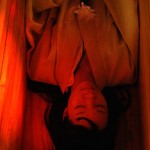
In front of an altar covered with flowers and his funeral portrait, Mr Ko instructs his trainees to choose a coffin, put on a traditional hemp death robe and then read out their wills one-by-one.

Next, it is time to be buried. Participants lie down in their coffins, while a man wearing the outfit of a traditional Korean death messenger places a flower on each person’s chest. Funeral attendants place lids on the coffins, banging each corner several times with a mallet. Dirt is thrown down on the lid, as loud as stones on a tile roof. The attendants leave the hall for five minutes – but it seemed like 30 minutes to those taking part.

Once the lids are lifted, Mr Ko asks the trainees how they felt. “When they were nailing the coffin and sprinkling the dirt, it felt like I was really dead,” Ms Baek says. “I thought death was far away but now that I have experienced it, I feel like I have to live a better life.”

Yoon Soo-yung, a manager at the Cheonnam Educational Training Institute, who was considering sending her staff on the course, said the experience was terrifying. “I felt like I was suffocating. I cried a lot inside my coffin,” she told the Financial Times. “I regretted so many things that I had done in my life and mistakes that I had made.”

Some medical experts are less convinced of the value of such programmes as a suicide prevention measure. “I think treating the fundamental causes like depression and impulsive behaviour is more important and should come before such programmes,” says Chung Hong-jin, professor of neuropsychiatry at the Samsung Medical Centre in Seoul.

Mr Ko, however, says those who have completed his course become more considerate, and attach greater value to their lives. “Life is a gift from your parents, but the way you live depends on the choices that you make,” he says. “People realise the beauty of life by experiencing death.”

—————————

Fake funerals operator sees an opening for mock incarceration

Fake funerals have become so popular in South Korea that Ko Min-su, the founder of Korea Life Consulting, now has competition in the death experience business.

“We’re like Nike – we have lots of imitators,” Mr Ko says in the sprawling complex he has just bought to house his expanding company.

But with patents to run the course in Korea and 17 other countries – including Japan, the US, Germany and India – Mr Ko is confident that he can retain his niche. “Since everyone will die at some point, I have registered international patents and would like to expand the programme abroad,” Mr Ko says, adding that Japan and China will be the first target markets.

In Korea, the company now has offices in Seoul and in Naju, in the south of the country, and employs eight full-time staff, as well as contract workers who help facilitate the courses. Each participant pays between $50 and $300 to attend.

With the fake funerals now well-established, Mr Ko is toying with the idea of expanding his business model to include other preventative courses.

Mr Ko is now thinking about expanding his business to include other courses with a death theme such as fake cremations, but is also considering ventures with other preventative lessons.

“I am thinking of developing other ideas such as a course involving living in a prison cell, to stop would-be criminals from breaking the law,” he says. “If they see what it’s like to lose their freedom, they might think twice.”

Architects bid to restore ‘soul of Seoul’

By Anna Fifield in Seoul
Published: July 14 2008

Yongsan development

Vision of the future: an artist’s impression of the Yongsan development, which will be sited close to the Han river and two big train stations

Hardly one of Asia’s most aesthetically pleasing cities, Seoul is undergoing a spectacular face-lift, with a range of multi-billion-dollar construction projects.

In the latest development, five internationally renowned architects are bidding to design the Yongsan international business district in the South Korean capital, a $28bn five-year project due to start in 2011.

“We’ve been invited to put the soul back in Seoul,” says Hani Rashid of the New York firm Asymptote, which designed Malaysia’s Penang Global City and is vying for the Seoul contract.

As South Korea rebuilt its razed capital after the Korean war and embarked on four dizzying decades of industrialisation, the emphasis was on function rather than form. The result is a mish-mash of concrete blocks. But in the past decade this has begun to change, with the construction of parks and plazas, and the emergence of more inspired buildings.

Now five architectural firms have been asked to design a “cutting-edge, future-oriented complex” on 566,000 square metres of land, currently home to railway warehouses, in the centre of Seoul.

The master plan is to include commercial, residential, cultural and leisure spaces, and must feature a landmark tower. The winner will be announced in December.

Close to the Han river and two important train stations, the Yongsan development borders the US military base, which will be turned into the “Central Park of Seoul” when the army relocates south of the capital in four years, and is in the middle of the three current business districts.

“Seoul is undistinguished in terms of its architecture and is not seen as an international player, and that is precisely what this project is about, what we have to answer,” says Nina Libeskind of Studio Daniel Libeskind, which is rebuilding the World Trade Center in New York. “It’s a very exciting, very optimistic moment in the city’s history.”

Local residents have mixed feelings.

Park Jin-ho, an interior designer who lives in an apartment near the railway station, says the area is “already good to live in because it is quite central, and I think it will be much better, with more benefits, once it is developed”.

However, others think the city government is not paying enough compensation to residents who will have to move.

“I don’t oppose the city’s plan to make Yongsan an upper-class town to raise Seoul’s competitiveness, but I really don’t like the way the city is pushing for the development project without consulting residents [or] guaranteeing our property rights,” says Chung Geun-soo, another resident.

The Yongsan area is nine times the size of the World Trade Center complex and each of the architectural firms has been given $1m to come up with a plan – compared with $40,000 for those offering to redesign Ground Zero.

Andy Bow of Foster and Partners, architects of the Swiss Re “Gherkin” building in the City of London, says the project has the potential to redefine Seoul. “It’s like Canary Wharf [in London] or La Défense [in Paris] in terms of the scale and the quantum of development,” says Mr Bow. “Canary Wharf moved the centre of gravity in London.”

The other architects bidding are Jerde Partnership, famous for Tokyo’s Roppongi Hills, and Skidmore Owings and Merrill, which is building the Burj Dubai, set to be the world’s tallest tower.

The project comes amid a dearth of office space and a flurry of construction. The vacancy rate among commercial buildings in Seoul is about 1 per cent, one of the lowest in Asia, and Jones Lang LaSalle, the property firm, estimates the lack of supply pushed up Korean office prices by about 25 per cent last year.

But Yongsan will be unique because of its central location and access to both parks and the river, the developers say. “I think it’s very important in a city of 10m or 20m people to have a place where people can come together into the centre,” says John Simones, design director of Jerde.

……………………………………………….

Billion-dollar developments lend touch of class

The Yongsan development is being built by a 26-member consortium, led by the state-run Korea Railroad Corporation, Samsung Corp and the National Pension Service. Total project finance could rise to $50bn (€31bn, £25bn), the developers estimate.

By common consent, Seoul is short of top class architecture. But two large-scale developments are under way in Youido, the island in the Han River and Korea’s financial centre.

The 486,000 sq metre Seoul International Finance Centre, being developed by the city government and a unit of AIG, the American insurer, will contain three office towers, a five-star hotel and a shopping mall.

Across the road, Skylan, a pan-Asian real estate development company, is running a similar $2bn project. New York-based Gale International is behind the $20bn construction of New Songdo City, near Incheon international airport It will feature residential and commercial buildings, a Jack Nicklaus-designed golf course, hospitals and schools. A 14km bridge linking the city to the Incheon international airport is almost complete.

Additional reporting by Song Jung-a

Park Kyung Ni: South Korean novelist

Park Kyung-Ni (photo: Oh Jong-chan / Chosun Ilbo)Author whose epic novel, Toji, is regarded as one of the greatest contributions to Korean literature

Park Kyung Ni was one of the leading South Korean novelists of her generation. In her own country and abroad, she was best known for the epic Toji (The Land), widely regarded as the greatest achievement of modern Korean literature.

Born in the city of Tongyeong in South Gyeongsang province at the southernmost tip of the Korean peninsula, Park graduated from Jinju Girls High School in 1946. During the Korean War, which broke out in 1950, she suffered a personal tragedy; her husband Kim Haeng Do, whom she had married shortly after leaving school, went missing in action. This sorrow, and the larger traumas of the war became the subject of much of Park’s early fiction, the author herself observing that she would not have written novels if she had been happy.

Her first published stories appeared in the magazine Contemporary Literature in 1956, and during the late Fifties she wrote a sequence of novels concentrating on the melancholy experiences of female protagonists who, like their creator, had been widowed by war. Among these were The Age of Distrust (1957), The Road Without a Guidepost (1958) and Drifting Island (1959). A later treatment of the Korean War was The Marketplace and the Battlefield (1964), concentrating on the relationship between a politically uncommitted student and his ideologically engaged teacher.

Among other important works from the early years of Park’s career were Saint and Witch (1960), a romantic melodrama, and The Daughters of Pharmacist Kim (1962), a tragic account of the lives of a pharmacist’s four daughters, said to have marked a change in subject matter and style for its author. Both these books were later adapted into notable films.

Park’s acknowledged masterpiece, The Land, was serialised in Contemporary Literature for a quarter of a century between 1969 and 1994. Chronicling the lives of five generations of a rural landowning family in Park’s native province, this epic used their personalities and experiences as a microcosm of the history of the nation from the end of the 19th century, through decades of Japanese colonial rule, to the division of the Korean peninsula in 1945. The finished work stretched to 16 volumes comprising a total of five episodes; to date, only the first two episodes have been translated into English. The book quickly achieved fame in South Korea, and a film adaptation of the early chapters was released in 1974; three television serials, a cartoon and an opera have also been based on the story.

In 1996 Park established the Toji Culture Foundation in order to encourage creativity and literary achievement among a younger generation of South Koreans. She served as chairman of its board of trustees, and later opened the Toji Cultural Centre on the site of her own home in the city of Wonju, east of Seoul.

Parkwon various prizes and honours, including the Inchon Award and, in 1992, the Bogwan Order of Cultural Merit, the third-highest cultural honour in South Korea; the highest honour, the Geumgwan Order, was conferred posthumously. In her later years, Park also became known for her concern with environmental issues.

When cancer was diagnosed in 2007 she refused treatment. A late poem, The Old House, expressed her equanimity in the face of death: “I am content with my old days; I have no desire / The burden I carry will be left when I say goodbye.”

Park’s marriage produced two children. Her son died in infancy, but she is survived by her daughter Kim Young Ju, head of the Toji Cultural Centre, and her son-in-law, the distinguished poet Kim Ji Ha.

Park Kyung Ni, author, was born on October 28, 1926. She died on May 5, 2008, aged 81

http://www.timesonline.co.uk/tol/comment/obituaries/article4091217.ece

You’ve Come a Long Way, Baby!

Hyon O\'BrienBy Hyon O’Brien
Korea Times
May 16, 2008

When the feminist movement (also known as Women’s Liberation or Women’s Movement) storm was gathering in the United States in the 1960s, many companies began to target women as a distinct group of consumers for their products.

One of the most successful was Philip Morris, which introduced a new extra-thin cigarette called Virginia Slims in 1968 and saturated the nation with the slogan “You’ve Come a Long Way, Baby.” Some media watch groups regard this highly effective Virginia Slims marketing campaign to be responsible for a rapid increase in smoking among teenage girls.

I have never smoked. So this slogan didn’t achieve its hidden agenda of persuading me to equate smoking with liberation or as a declaration of women’s equality to men. Fortunately I don’t have to smoke to know that. However, the catchy phrase has stuck in my vocabulary and I think of it often. I use it frequently t to compliment people’s progress and achievement in a light joking way.

Korea gets this every day from me: “Hey, Korea, you’ve come a long way, baby.”

In 2005 when I visited Brasilia to see a friend in the Korean diplomatic service, I learned of an intriguing method of arranging the location of the embassies. In 1960, when the Brazilian government moved its capital officially from Rio de Janeiro to Brasilia some 1,148 km (713 miles) inland, many embassies took their time relocating to the new and not very exciting site.

To give them an incentive to move, the government (so I am told) allocated a piece of land to each country to build an embassy and ambassador’s residence. The order in which embassies were lined up was according to the per capita GDP at that time.

The layout of the city was in the shape of an airplane (architect Oscar Niemeyer’s concept). The pilot seat was occupied by the three branches of the Brazilian government and the wings were for foreign missions. The right side of the wing was for the developed countries and the left side for the developing or underdeveloped countries.

So the Korean embassy and ambassador’s residence was located on the left side far behind those of many other countries, reflecting its meager economic status of 45 years ago. For instance, I noticed that the embassy of the Philippines was much closer to the center than Korea, reflecting its higher GDP at the time. Yes, Korea, you’ve come a long way, baby!

I’d like to give Korea a pat on the back (if Korea has a back) for many brilliant improvements and advances. At the top of the list is the wonderful transformation from the primitive public toilets of my youth to the world-class toilets that one finds (almost) everywhere in Korea today.

We even have a city, Suwon, that promotes its wonderful public toilets for people to visit as tourist attractions. One of them is a house in the shape of a toilet. I know I will miss these clean, well-designed, readily available public facilities when I return to the amenity-challenged United States.

The second is the amazing extent of cultural programs available for the public. I am constantly impressed by the festivals Korea puts on each year, celebrating everything from red pepper and garlic to bamboo and mud! Numerous world-class performing artists appearing in Korea attest to the arrival of Korea on the global stage.

The other month it was awesome to sit in the audience to listen to the New York Philharmonic Orchestra playing Beethoven the day after its historic appearance in Pyongyang. The other day we had an occasion to marvel at the superb a capella singing of the Norwegian chorus Schola Cantorum, visiting from Oslo.

Another cultural offering that has become abundant in Korea is museums. Our biannual fund-raising house tour for Friends of Love (www.friends.co.kr) last month included a stop at an owl museum in Samcheong-dong, where 2,000 or more owls were on display. Last fall, we paid a visit to a museum entirely devoted to locks.

One of our acquaintances owns a museum exclusively devoted to world jewelry. These boutique museums are small and focused on one theme. Other major museums, the National Museum of Korea (currently its special exhibition is “The Glory of Persia”), the Leeum Samsung Museum of Art, Ho Am Art Museum, Seoul Museum of Art, History Museum, War Memorial Museum (its exhibit on the Dead Sea Scrolls will be on until June 7, 2008) and many others are all delightful places to visit to widen our minds.

According to an American psychologist, Abraham Maslow (1908-1970)’s theory of hierarchy of needs presented in 1943 in his paper, “A Theory of Human Motivation,” cultural needs are the last needs people feel, coming into play only after the basic needs (physiological needs, safety needs, love / belonging needs, and esteem) have been met. If that is the case, Koreans have way passed the point of lower level of needs some time ago and arrived at the area of highest needs. Bravo, Korea. You’ve come a long way, baby!

However, I caution against complacency. I think Korea has miles to go before it can truly be qualified to be a world-class country in every sense. The top of my list for Koreans to improve is obeying all traffic rules. Some of my Western friends joke that a red light in Korea is a mere suggestion.

The shock of cars moving even with red light is beyond cultural shock. It is a matter of safety. Pedestrians have to be always alert for a possible car zooming by ignoring the light. Ubiquitous riders of motorcycles and bicycles for deliveries on sidewalks are also extremely hazardous and backward.

Another annoying thing is how people enter subway trains, buses and elevators before others have time to get off. And I have to mention people loudly using their hand phones (cellular phones / mobiles) everywhere.

Once we had to suffer through one hour of listening to a young man calling everyone under the sun during our ride from the Incheon International Airport to downtown Seoul oblivious of others riding the airport bus with him (now that they are talking about allowing cell phones to be used on airplanes, I shudder to think of the noise we will have to endure on the long haul to the United States).

Yes, Korea, you’ve come a long way, baby. Let’s also remember that you have miles to go to get the prize.

Hyon O’ Brien, a former reference librarian in the United States, has returned to Korea after 32 years of living abroad. She can be reached at hyonobrien@gmail.com.

Tesco buys 36 stores in South Korea for £1bn

http://www.ft.com/cms/s/0/13c3d76c-2216-11dd-a50a-000077b07658.html
By Elizabeth Rigby in London and Song Jung-a in Seoul

Published: May 15 2008 03:00 | Last updated: May 15 2008 03:00

Tesco is breaking its decade-long pursuit of overseas organic growth, with a record cash purchase of a chain of hypermarkets in South Korea.

Britain’s biggest chain is acquiring 36 stores owned by E-Land Group in and round Seoul, where 11m potential Tesco customers live, for just under £1bn, including the assumption of existing debt.

This deal is the first time Tesco has spent anywhere near this kind of money on an international acquisition. Until now, it has preferred to grow from the ground up, through joint ventures with local partners and store-by-store growth.

But Phil Clarke, international director of Tesco, stressed that this did not herald a more radical era of expansion for the grocer.

He said: “We prefer organic growth, that is always our priority and will remain so, but these 36 stores give us two and a bit years of growth in one hit. In four and a half years in this job I have done two deals [the other one being an asset swap with Carrefour]. I don’t see an acceleration of deals at all”.

It does show that Tesco is determined to gain pole position in chosen markets. Korea is the retailer’s biggest market outside the UK, with £2.7bn of sales coming from 66 hypermarkets and 72 convenience stores. That turnover will be closer to £4bn once the deal goes through.

Tesco said the Korean deal would have a neutral impact on earnings in the second year of ownership and boost earnings beyond that. About half the price was the assumption of debt. Tesco will fund the deal from existing facilities.

Mr Clarke tried to buy the stores back in 2006, when Carrefour, the then-owners, decided to exit Korea, eventually selling the stores to E-Land for €1.5bn( $2.3bn).

JPMorgan said the acquistion gave Tesco a chance to close the gap on Shinsegae’s E-mart, which has sales of Won9,000bn (£??bn), against Tesco’s Won5,900bn. “Korea is a very interesting market long-term as the sector has become a two-horse race,” it said.

Elsewhere, Mr Clarke is still working on India, and hinted that Tesco could be warming to Russia, a hotspot for rivals Wal-Mart and Carrefour. “Russia is not never. You know how long we looked at America. But we have more than enough to keep us busy in the markets we are in,” he said. The shares closed 1.7 per cent down.

Jon Lusk on Korean traditional music

OK, world music buffs … how many Korean traditional musicians can you name? Without sneaking a look at The Rough Guide to World Music, you’ll probably have a tough time coming up with even one artist from Korea. Even so, this little known far eastern peninsula has a distinctive musical culture with a long, well documented history.

If you’ve been lucky enough to have attended any of the sporadic DANO ‘Korean Breeze’ concerts staged in London, Oxford and Sheffield over the last couple of years, you’ll know that Koreans have a unique suite of instruments, music and dance genres – as well as exquisite traditional clothing with a striking and instantly recognizable pastel-toned palette.

The spectacular Korean group Dulsori were an eye-catching highlight of last year’s WOMAD festival in Reading, with their thunderous drumming, swirling ‘ribbon dance’ and the dramatic, almost a cappella ‘pansori’ song story, which was accompanied by frenzied onstage calligraphy. Yet, without the benefit of a translation or contextualising visual clues to add meaning, this last genre can be a trying – even harrowing – experience on CD. Dinner guests at my flat will often make faces and head for the door at the mere suggestion of a ‘Korean opera’ session. Even much instrumental Korean music rubs many western ears up the wrong way, with its slithering microtones, exaggerated vibratos, asymmetrical rhythms, disregard for harmony, sparse arrangements and often extremely slow tempos, which can create an illusion of almost metreless music.

As Nigel Williamson observed in his recent Songlines feature on the BBC Radio 3 Awards for World Music (sorry, ‘The Planets’), Asian music is a chronically under-represented area. Given that many world music fans take Africa as their point of reference – ¬and of course the ubiquity of African American popular music – this is hardly surprising. But why exactly is it that so much Asian music (and specifically, Korean) is outside our comfort zones? Are we searching for things that aren’t there, and missing out on what is, by listening in the ‘wrong way’?

Travelling to South Korea’s capital city of Seoul to meet some of the next wave of Korean artists who will be visiting London between May and December for the ‘Korean Encounters’ season, my first port of call is the home of Byungki Hwang, who actually played a rare London gig in February 2006. As Korea’s leading master of the kayagum (a plucked zither related to the Japanese koto and Chinese zheng), he seems like a good person to shed light on such questions.

I’m not disappointed when we meet at his elegant and substantial home on a hill in west-central Seoul. Below us, the central business district looms through blue-grey pollution haze, and the walls of his lounge are lined with books and dozens of kayagum, ranging from the old fashioned 12-stringed model to the huge 25-stringed version popular in North Korea since the early ’90s.

Mr. Hwang has a delightfully curious manner, and a youthful sparkle in his eyes, which defies his seventy years. He speaks heavily accented but remarkably poetic English. Referred to as ‘a green bud on a firmly rooted tree’ for his fresh and broadminded approach, his slim but eclectic back catalogue dates back to 1965 and ranges from a 70-minute sanjo (a folk genre pioneered in the 19th century) to the jarringly avant garde The Labyrinth, which is not for the faint-hearted.

He explains that Korean traditional styles can be broken down into ‘court’ and ‘folk’ music, both of which he has trained in. Court music is easily recognisable for its very slow tempos, whereas folk music is livelier and often has more immediate appeal. But both generally have a pervading sense of space, a result of the high value placed on individual tones, which is why there is no real place for harmony.

“Traditionally, Korean musicians especially dislike harmony. Comparing with Chinese or Japanese music, Korean music especially emphasises the beauty of sound, like a calligraphy line. So usually the calligraphy must be done on white paper. Otherwise it has no meaning. So like that, one tone is perfect. One tone has its own musical value …so important Korean melody instruments can change in pitch microtonally.”

This means that instruments with fixed tones like the yanggum (hammered dulcimer) or even piano are considered minor instruments, not worthy of solo parts. And chords are naturally an anathema, as they combine tones. Just as important as the tone is the concept of yeo eum, roughly translated as ‘after-tone’:

“If you see a beautiful calm or quiet lake, sometimes we put a stone to the lake. Then there make a ripple. And a ripple was created by myself. But it exists in its own way, by itself. You cannot change it. You can only appreciate the beauty. Like that in kayagum, if you pluck one string, the remaining tone is like a ripple. And Korean people like that after-tone very much. [It’s] like with Korean tea, they usually have as much interest in the aftertaste. So, for example, sugary tea is very tasty but the aftertaste is very bad. Usually the bitter one has better aftertaste.”

And because yeo eum is best achieved with plucked instruments, they are considered more important than bowed ones. With harmony, counterpoint and chords absent, a large Korean court ensemble with ten, twenty or more melodic instruments makes music fundamentally odd to western ears.

“In that case, they use heterophony. All the melody instruments follow the same melodic line, but not in unison.”

What results is a loosely swaying matrix of overlapping microtones, with startling vibrato and other effects differentiating each element. Mr. Hwang acknowledges it’s an acquired taste.

As for his own music, the ‘less is more’ philosophy rules. Not only is his sound incredibly sparse, but his output too. He gives no more than a handful of concerts each year in Korea and his fifth album came out in 1994; he is now preparing ‘number six’. He agrees with my suggestion that his work is something of an antidote to the high speed world modern Koreans find themselves in.

“Just the opposite! My hope is to create some music like a fountain of water from the mountainside. Even though I know modern people like Coca-Cola, cider or Fanta, I like no taste! Just pure water! But the interesting thing is, in peoples’ minds, they have some unconscious hope to drink pure water,” he chuckles.

The following day, my translator and cultural chaperone (also the organiser of DANO ‘Korean Breeze’) Justina Jang accompanies me to The National Center for Korean Traditional Performing Arts, (NCKTPA) housed in a rather monolithic late ’80’s building on the other side of town. Founded more than 1400 years ago, it employed up to 1750 people at its peak during the early years of Korea’s illustrious Josun dynasty (1392 –1910). The current staff of 500 represents a huge recovery from the chaos of the early 20th century, when Japanese occupation (1910-1945) was followed by the Korean War. Funded entirely by the Korean Ministry of Culture & Tourism, the present site houses an excellent museum and a 24-hour radio station (Gugak FM 99.1) dedicated to Korean traditional music. There’s also a dance troupe and a school for training music teachers. The centre holds regular public concerts at their 1200-seat theatre and they have produced more than 100 CDs, ranging from ancient ceremonial court music to east-west fusion and new experimental material as radical as anything by Byungki Hwang.

With no little ceremony, director Chul-Ho Kim presents us with copies of their wonderful 4CD sampler A Selection of Korean Traditional Music (SBCD-4380- 1–4). He explains that Koreans treat sounds ‘like living souls’, the importance of ‘harmonising with nature’ in the ancient court music, and how a full understanding of Korean music really requires knowledge of Confucianism and Taoism. He acknowledges that much of what they do is a recreation of now-extinct traditions, so I ask Justina about this as we walk among the fabulously decorated chingo drums and pyeongyeong stone chimes of the museum.

“Because of Confucian philosophy we have to learn the tradition that we had in order to develop into a new culture,” she explains.

A good place to hear a wide cross-section of court and folk music is the Chongdong Theatre near City Hall station. ‘It’s your turn to feel it’ promises the brochure somewhat ominously as I take my seat for the fragmented but entertaining 70-minute show.

It begins with sinawi folk music and dance of Southern Korea, which is associated with shamanist rituals. The first ensemble includes a kayagum, a seven-stringed bowed zither called an ajaeng, a taegum (tranverse flute) and the ubiquitous changgu (hour-glass drum). The dancers use their long sleeves to graceful effect; based as it is on the breath rather than the heart beat, most Korean traditional court and folk dance is slow, so there’s no jumping about. Next, there’s a little taste of pansori. A commanding female singer gestures with fan and hands while singing a short story from Korean folklore, acccompanied by a seated puk drummer, whose non-verbal exhortations (‘chu im se’) and beats are analogous to the jaleo of flamenco. The tempo heats up with a samgomu drumming group – seven immaculately dressed women who literally bend over backwards to beat out synchronised triple-time rhythms on 14 drums mounted in beautifully decorated stands. A short ‘chamber music’ duet between a two-stringed haegum fiddle and a piano follows, and the climax is a thrilling and thoroughly acrobatic farmers’ ribbon dance. Each performer beats a gong or drum while dancing, using small head movements to create mesmerising cyclical patterns with ribbons attached to their hats, accompanied by the raucous wailing of the shenai-like taepyeongso.

It’s an instrument I hear a lot more of the following day when we visit a shamanic ceremony at the temple run by Kim Gum Wha. Designated as a ‘National Living Treasure’ by the Korean government, she is probably the country’s most renowned shaman, in demand for her blessing ceremonies said to bring good fortune. Her ‘performances’ abroad have included a blessing for New York City, and at home she conducts both public and private events. January is her busiest month, when fishermen and farmers hopeful of a good harvest beat a path to her quiet retreat at Incheon, near Seoul’s airport.

Today, she’s doing a private ceremony for an old woman and her family. It’s a colourful and sometimes tearful affair conducted with the help of relays of apprentices, who spin and mutter incantations in archaic Korean before an altar decked with edible offerings. They don and shed layer after layer of clothes, wielding knives, bells and gongs, and even puffing the occasional cigarette –¬ if the spirit that posseses them happens to be a smoker – accompanied by four seated musicians. There’s a changgu drum, two gongs (the medium-sized ching and a smaller kwaenggari) and the gnarled shrieks of taepyeongso and the oboe-like piri. Afterwards, Ms. Gum Wha explains in her calm manner the central place of shamanism in Korean culture.

“This shamanic music is the roots of Korean music in general. It all comes from there. We didn’t have Christianity or Buddhism before. Shamanism was like the main religion.”

Though there was a time when shamans were revered advisors to the royal court, organised religion, and later repression during the Japanese occupation have meant that they now have low social status. “But there are also lots of people who realise the importance of our own culture,” Ms. Gum Wha adds.

My next stop is the Korean National University of the Arts, another important centre for music students. The music department was only established in 1998, but its professors have recorded a wide range of Korean styles, perhaps with more emphasis on fusions with western classical traditions than at the NCKTPA. I meet three who have all performed in the UK and will do so again in late May– taegum and tanso (Korean recorder) player Park Yong Ho, and kayagum maestros Min Eui Sik and Kim Hae Sook. The latter has a fervent pedagogical manner, but also a ready laugh. On one of the CDs she has recorded with her colleagues, it says: ‘If we see the history of harmony in western music, we see the history of rhythm in Korean traditional music’. She elaborates thus:

“Because western music is based on chords, the rhythms are more restricted. In Korean music we play with one tone, so we have more freedom to use different types of rhythms. Western music is typically binary, but Korean music typically uses triple time.”

When we adjourn to a rehearsal later that day, I’m amazed to see a succession of large ensembles of young players. Among others, there’s a 12-piece kayagum group, one with 15 haegum, a six-piece ajeang ensemble and even one with 15 komungo (a 6- stringed zither plucked with a short stick). There’s plenty of counterpoint, western scales and even harp-like caressing of the kayagum, which flies in the face of everything Byungki Hwang told me. Afterwards Min Eui Sik reassures me that these new compositions imitating western styles are experimental works in progress, largely aimed at improving the students’ technique and artistic scope – as well as broadening their employment prospects. One of the albums he gives me (Masterpiece of Korean Music Vol. 18) has an excruciating arrangement of Bizet’s Carmen Suite and Tchaikovsky’s Nutcracker Suite, but I’m reassured they won’t be playing any such things in the UK. It should also be said that his own Yeongsan Hoesang CD (AKCD-0022) is wonderfully minimal and old school, as is Park Yong Ho’s Pyeongjo Hoesang (TOPCD-024).

On my last full day in Seoul, I visit Chungmu Arts Centre to meet Kim Duk Soo, whose story encapsulates the last half-century of rapid transition in Korean society. As the founder of the percussion ensemble SamulNori, he is now a household name in Korea, and has collaborated with a wide array of jazz, classical and popular musicians on over 20 CDs. SamulNori have taken his adaptation of Korean farmers’ music around the world since 1978, generating a folk revival at home epitomised by the iconic ribbon dancers I saw at the Chongdong theatre.

This short, chain-smoking man with a piercing gaze is a formidable and charismatic presence, like a loaded spring. Born in 1952, he started performing in his father’s group of ‘wayfaring male entertainers’ called Namsadang at the age of five. It was a gruelling lifestyle, going from village to village performing traditional puppetry, tightrope walking, acrobatics, juggling, mask dancing and nongak or pungmul (farmers’ music) from dawn to dusk with as many as 45 artists and as few as four.

“You have to remember that this was just after the Korean War. It was a very harsh situation for Koreans to survive in, and as artists it was even harder”

They were in fact the last representatives of an art form heading for extinction by the end of the 1950s as the traditional town squares (madang) they used disappeared.

“Namsadang always performed in such places. However, once we became more industrialised, all these madang became occupied with other buildings. So obviously we lost our performance space! But also you had things like television coming along and also the western religions which immediately disregarded Korean culture … so things like shamanism and Korean traditional culture had to take second place.”

By the time the Korean government had woken up to the plight of their vanishing culture and designated Namsadang a ‘Living Human Treasure’ in 1964, the group had done its last performances. However, Kim Duk Soo soon applied his skills to a new career, first with the Korean Folk Singing and Dance Arts Troupe, with whom he made his international debut at the Tokyo Olympics. Then, from 1966 –1976 he was a member of the Little Angels Art Company. Such experiences abroad gave him plenty of perspective on what was happening at home.

“Obviously, I had lots of questions about what I was supposed to do as a traditional artist. I had the experience of looking at all these different cultures, so I had to think about what another way might be to express myself. I felt that we had actually thrown away our traditional culture.”

In response, he created SamulNori, whose impact on Korean culture has been described as ‘shocking and irresistible as the force of a sudden gust of wind’. They took the basic ensemble of four percussion instruments from the pungmul/nongak farmer’s music (changgu, puk, ching and kwaenggari) and other elements of traditional theatre and shamanist rituals and adapted them to the modern stage, sparking a folk revival in the process. As a result of their influence, there are now SamulNori–style groups in virtually every school, village and city throughout Korea. When I ask if he knows the group Dulsori, his eyes light up in recognition.

“Ah! That’s one of our student groups – from the south west!”

True to his word, when I venture down to the southern province of Yeongam the next day to witness the first few hours of a four-day folk festival, I’m greeted by the gaudy spectacle of 300 hefty farming women in paramilitary outfits with psychedelic tradi-modern mega-pom poms. They represent the eleven towns of the province, each with its own wildly distinctive colour scheme. Tang-ul-lim (‘rumbling of the earth’) is what they call the ritualised racket they make by thumping ching and kwaenggari gongs as well as puk, changgu and sogo drums as they parade around ‘pressing the misfortune into the ground’. It’s the tenth year of this festival, which commemorates the life of Wang In, a local hero revered for taking Chinese script and the teachings of Confucius to Japan in the 4th century AD.

Retreating from the sound and fury with my travelling translator Park Joo Chan, I visit the nearby Wolchusan National Park. It’s cherry blossom time in the countryside below, but up here in the serenity of the mountains, wild camellias and azaleas are beginning to splash the bare woods in crimson and mauve. We pause for a moments’ reflection at the marvellous Dogapsa, a Zen Buddhist temple where a monk is chanting prayers, beating out naturalistic rhythms on a hand-held wooden moktak bell. Eventually he gets up and sounds an intricately wrought metre-high cast iron bell. In the still morning air, the aftertone lasts for well over a minute.

Gamsa hamnida to: Justina Jang (KCPA), Park Joo Chan, Korean Air, the Korea National Tourism Organisation and all the people at NCKTPA and KNUA. For more Korean traditional music than you can shake a stick at, check out www.gugakfm.co.kr and the Korean Cultural Promotion Agency (KCPA) www.kcpauk.org

‘The point was to be part of nature’

By Mark Ellwood
Published: May 10 2008 01:50 | Last updated: May 10 2008 01:50
http://www.ft.com/cms/s/0/6d0193fa-1ca3-11dd-8bfc-000077b07658.html

Businessman Kim Chang-il accrued a billion dollar fortune in restaurants, real estate and retail in Cheonan, Korea, then used his wealth to build one of the world’s top private contemporary art collections. He also opened his own gallery, Arario, which has three sites across Korea and China; its fourth outpost, a 20,000 sq ft space designed by architect David Adjaye, recently opened in Manhattan, New York.

How many homes do you own?

Two – one in Cheonan and the other in Jeju Island, at the southern end of Korea. It’s still very rural down there. Migrating birds often pass by in front of my house and iIt’s located in front of a small pond and right after that is the ocean, so you can see both from the house. As my business is getting bigger, and as I need more time away to look atthink about the future, I go to Jeju Island. It’s also where I make my artwork.

You are as much a creator as a collector of art.

Yes. I have a studio in Cheonan, but it’s on the top floor of the [Arario] gallery, so I can only work there from 9am to 5pmbecause the building is closed after hours. But in Jeju Island I can work at 2am in the morning if I want to. But I didn’t want to have a work place in my home, so I have a separate studio that is connected to the main house.

Tell me about that house.

I built it two years ago. The main point was to be a part of nature. From the outside you can’t see in but from the inside you can really see out.

You grew up in Seoul. What was your childhood home like?

It was in a traditional wooden house. I was always scared because the winds would go through the house and when I walked, the floors would creak. I kept asking my mother to let us move.

But she never agreed?

Well, I moved to Cheonan from Seoul in 1978 after I graduated from college. And I lived in the same apartment for 30 years; I moved for the first time to a new home in Ssang Yong-Dong [Two Dragons] last July.

That suggests you’re a creature of habit.

I don’t like change: my work takes up so much of me. Home is just somewhere I’m comfortable and I don’t want to waste energy on that.

It must have been the perfect apartment to stay that long.

I’ve always dreamt of having a home near a school; when I first purchased my home I was going to have children and wanted them to be able to walk to school; it was safe and convenient. But I feel like being close to a school is very healthy too; in Korea, schools open up their courtyards to the public, so I go there in the morning to exercise then play basketball with my son. I’ve never needed to join a gym.

Can you describe your dream home?

If I were to build another home, I would pay a lot of attention to the kitchen. I want to start inviting a lot of people round and I was thinking about building [another] home in Jeju Island. I want an all-glass kitchen with an island in the center where you can cook, and a table round it where I can serve people, like in a restaurant.

Is the kitchen your favourite place at home?

Actually, in Cheonan, it’s my library; everything I want to read or think about is very accessible. But in Jeju Island my favourite place is a duplex in the art studio, on the second floor, where I can sit overlooking the pondand everything. I have two dogs, Chinese chow chows, and I’m happy when they are there next to me.

How do you choose what art to put on show at home?

Well, there are places you need to accentuate with a work of art but I don’t do it to excess. One of the walls in my bedroom is designated just for my own work; my photography. I have a studio in Jeju; I built a residence for artists with seven studios and nine apartments. People can’t come and just rent out the place – the artists have to be invited – but I wanted them to experience what I’ve experienced. A lot of artists enjoy the chance to be with nature and they choose to stay for up to six months. I’ve been to many artists’ studios and I realise how important the space is. And I feel like I’m providing something that takes them away from their regular studios. Being in nature and seeing the pond is a really good environment. I have lunch, which my chef prepares, with the artists at the cafeteria – though for dinner I usually cook at home myself.

No wonder you want that chef’s kitchen. Are you a cordon bleu cook?

Not really. Just egg fried rice, kimchi, broth and fish barbecue.

Leading executives quit in Samsung upheaval

By Song Jung-a in Seoul
http://www.ft.com/cms/s/0/0572e31c-10d0-11dd-b8d6-0000779fd2ac.html
Published: April 23 2008 03:00 | Last updated: April 23 2008 03:00

Samsung, South Korea’s largest conglomerate, suffered the biggest upheaval in its corporate history yesterday when four of its top executives, including the chairman, suddenly resigned after a year of allegations of financial wrongdoing.

Lee Kun-hee, group chairman, said he would take “full responsibility” for his indictment last week for tax evasion and breach of trust by resigning immediately.

“I will step down from the Samsung chairmanship today,” Mr Lee, 66, said in a televised speech. “I am saddened as there is still much to do and a long way to go, but I am leaving with all the faults of the past.”

The decision is unprecedented in corporate Korea, where tycoons usually continue to run business groups even after being convicted of serious white-collar crimes. It comes as Samsung faces rising competition from emerging Chinese rivals.

With no replacement named, there is a power vacuum at the top of Korea’s biggest chaebol, a $150bn family-run conglomerate with business units involved in everything from shipbuilding and electronics to credit cards and hotels.

Mr Lee had been trying to pass group control to his son, Lee Jae-yong, who yesterday resigned as chief customer officer of flagship Samsung Electronics, although he will continue working for the company. The chairman’s top lieutenant, vice-chairman Lee Hak-soo, and the group’s president, Kim In-joo, will step down within two months.

The chairman’s wife, Hong Ra-hee, accused of buying expensive artworks with Samsung’s secret funds, quit as head of Samsung’s Leeum art gallery yesterday.

Samsung will be run by “professional managers”, the group said. Lee Soo-bin, the chairman of Samsung Life Insurance, will represent Samsung for external relations. The group said there would be no replacement for chairman Lee on the business side.

The upheaval comes after Samsung’s former chief lawyer made allegations of widespread financial improprieties at the group, becoming Korea’s first whistleblower.

After months of investigating, a special prosecutor last week concluded that Mr Lee, the chairman, had breached his financial duty by letting his children buy bonds of Samsung’s affiliates through irregular financial transactions, incurring losses at the companies.

He found Samsung managed about Won4,500bn ($4.5bn) in borrowed-name accounts, and that Mr Lee had evaded Won112.8bn of income taxes.

Nine other Samsung executives were indicted on various charges. Mr Lee was cleared of more serious allegations that he was involved in Samsung Group’s efforts to bribe the country’s powerful figures including politicians, government officials and prosecutors.

The affair coincides with the global market turmoil threatening Korea’s export-dependent economy and is likely to alarm the new government of President Lee Myung-bak, who took office two months ago. He pledged to boost growth to 7 per cent, partly by encouraging chaebol such as Samsung to invest and expand.

Samsung Electronics shares yesterday rose 0.2 per cent to Won675,000. Shares in most other companies in the group fell.

Lee’s resignation rocks Samsung

By Song Jung-a
http://www.ft.com/cms/s/0/2d89f85c-108c-11dd-b8d6-0000779fd2ac.html
Published: April 22 2008 18:07 | Last updated: April 22 2008 18:07

The emperor bows out - Lee Kun-hee leaves Samsung, which is responsible for a fifth of Koreas exports, facing its biggest challenge

The emperor bows out - Lee Kun-hee leaves Samsung, which is responsible for a fifth of Koreas exports, facing its biggest challenge

It has long been an unwritten rule in South Korea that a few criminal convictions need not stand in the way of running the country’s biggest companies.

In recent years, Koreans have grown used to seeing the chairmen of leading conglomerates on trial for fraud or bribery one day, and back in the office the next.

So Tuesday’s surprise announcement that Lee Kun-hee, Korea’s most powerful tycoon, would immediately resign as chairman of Samsung, sent shockwaves through corporate Korea.

The reclusive Mr Lee was last week indicted on charges of tax evasion and breach of trust after a special prosecutor found that he managed billions of dollars in borrowed-name accounts and incurred losses at Samsung units by allowing his children to buy bonds in Samsung’s divisions at below-market prices.

But, as has so often been the case in Korea, many analysts, cynical about the prospects for real corporate change, expected Mr Lee to be given a slap on the wrist and then sent back to work.

Instead, Mr Lee resigned, saying he would take all responsibility for the scandal.

Even Samsung insiders were taken aback. “His resignation is shocking, totally unexpected,” said James Chung, a spokesman for Samsung Electronics. “We have some fear about whether we can do as well without him.”

Samsung is now facing the biggest challenge in its history.

Mr Lee has run the Samsung empire since 1987, taking over the reins after the death of his father, who founded the group as a small trading firm more than 70 years ago.

Mr Lee transformed the group from a copy-cat manufacturer into the global brand it is today.

Koreans have taken to calling their country the “Republic of Samsung” and referring to Mr Lee as its “emperor” – neither of them meant as compliments.

But, as he entered his late 60s, the chairman started preparing to pass the company to his only son, Lee Jae-yong – moves that landed him in hot water.

Although their ownership is tiny, the Lees have been able to control the group through a complex web of cross-shareholdings.

Lee Jae-yong is the biggest shareholder, with 25 per cent of Samsung Everland, the group’s de facto holding company, which in turn controls Samsung Life Insurance, which in turn controls Samsung Electronics.

Lee Jae-yong yesterday resigned from his specially created role as chief customer officer at Samsung Electronics – a position viewed as preparation for the chairmanship.

But Samsung said he would continue to work for the company.

Samsung also said it would dismantle the strategic planning office that advised the chairman and pledged to sell credit card group Samsung Card’s 24 per cent stake in Everland within five years, as part of efforts to reduce cross-shareholdings.

The changes failed to impress investors yesterday. Shares of most Samsung group units fell yesterday, as analysts expect that process of clearing up cross-shareholdings would take a long time.

But some analysts said the changes would allow Samsung to embark on real reform.

Mr Lee’s resignation could mark an “epoch-making” moment for corporate Korea, said Young Soo-gil, an influential economist who heads the National Strategy Institute.

“With his departure, Samsung can accelerate internal renovation and enhance its corporate competitiveness to become a truly global company,” Mr Young said.

“Now that every problem is exposed, social pressure has become unbearable for Samsung. It is bound to change, given potential negative repercussions it would face if did not accommodate the changing needs.”

Others, however, doubted that there would be fundamental improvements.

The fact that Samsung did not appoint a new chairman – instead saying Lee Soo-bin, the head of an affiliate, would represent Samsung externally – led to suggestions that Samsung would still try to install the younger Mr Lee as chairman in a few years.

“I don’t see any big change,” said a market strategist who did not want to be named.

“Mr Lee can exert his influence behind the scenes as long as he remains the major shareholder.”

Heir apparent

http://www.ft.com/cms/s/0/2d89f85c-108c-11dd-b8d6-0000779fd2ac.html

As Lee Kun-hee’s only son, Lee Jae-yong has long been considered the heir apparent at Samsung, a view solidified last year when he was appointed to the specially created role of chief customer officer of Samsung Electronics, writes Anna Fifield.

Mr Lee, 40, is easy-going and candid. All his life he has been groomed to inherit the company, completing an MBA at Keio University in Japan before entering Harvard Business School.

His father instructed him to play golf with Samsung executives and study their personal styles.

In one of his first tasks at chief customer officer last year, Mr Lee Jr showed News Corp’s Rupert Murdoch around the Samsung showroom at the Las Vegas consumer electronics show.