A city dedicated to books and print

By Edwin Heathcote
Published: August 21 2009 22:38 | Last updated: August 21 2009 22:38
http://www.ft.com/cms/s/2/26852872-8de2-11de-93df-00144feabdc0.html
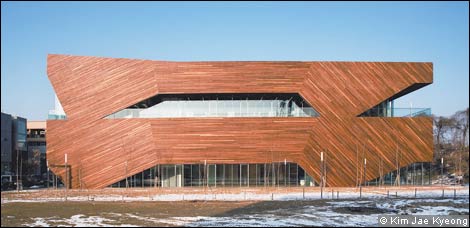
Publishing company Dulnyouk by Foreign Office Architects in Paju Book City, South Korea

Publishing company Dulnyouk by Foreign Office Architects in Paju Book City, South Korea

The idea of a city of books evokes a fantastical vision: towers of tottering volumes, narrow alleys formed by canyons and stacks of dusty hardbacks, formal avenues between loaded shelves. Like something imagined by Calvino or Borges, it conjures up a city of wisdom and surprise, of endless narratives, meaning, knowledge and languages. What it does not evoke is an industrial estate bounded by a motorway and the heavily guarded edge of a demilitarised zone. Yet somehow, South Korea’s Paju Book City begins to reconcile these two extremes into one of the most unexpected and remarkable architectural endeavours.

Built on marshland, former flood plains and paddyfields 30km north-west of Seoul, Paju Book City is an attempt to create an ambitious new town based exclusively around publishing. We may be reading obituaries of the book and the printed word almost daily, but the news has not reached Paju. Plans for the Book City were first proposed in 1989, as the country was emerging from a period of political repression. Publishing had gathered momentum and status after years of underground activity and censorship, and it re-emerged after the liberalisation of the regime in 1987 in an explosion of small, often family-run publishers. Their beautifully crafted books attempted to re-engage the nation with the history and culture that had been distorted, manipulated and lost over a period which included colonial rule from Japan, brutal civil war and military dictatorship. The project was also, at least in part, a reaction to the rapacious redevelopment of Seoul, the loss of the city’s historic fabric and its rapid embrace of the culture of bigness and congestion. That it was christened a “City to Recover Lost Humanity” tells us much about its creators’ intentions.
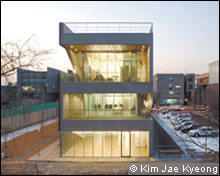
Publishing company Dulnyouk by Foreign Office Architects in Paju Book City, South Korea

Publishing company Dulnyouk by Foreign Office Architects in Paju Book City, South Korea

The project was initiated by publisher Yi Ki-Ung, whose ambition extended to creating a city of books that would also become a kind of museum of architecture: Paju features buildings by some of the finest architects working in the world today. The 1.5m sq m masterplan and the most sophisticated buildings on the site were carried out by the remarkable London-based Architectural Research Unit, run by Florian Beigel and Philip Christou. They wanted to create what they called, delightfully, an “urban wetland” – a paradoxical idea that allows them to root the new city in the landscape, to create something tied to its context rather than a suburban non-place. That context is beautiful, even epic, in its own way – the Han River, the mountain backdrop – but all that is cut off by the elevated motorway which also acts as a dyke. So the city is constructed on two levels: a dense street level, which accommodates the activity of the city itself, and a sparser upper level Beigel poetically refers to as “the strata belonging to the horizon”. Here a series of rooftop pavilions, elevated public spaces and buildings crowning bigger buildings below look over the road and out to the landscape beyond.

The city plan follows the contours and lines of the landscape, one main road snaking through it like a river and a series of tighter roads creating a denser network of small publishing houses, printers, distributers and so on. There are some extraordinarily ambitious buildings here. Just finishing construction is the Mimesis Museum, one of the Portuguese architect Alvaro Siza’s most arresting recent structures – its sheer concrete walls curve like the pages of a book in the wind, wrapping around a sculptural courtyard at its heart. SANAA, the Japanese architects of this year’s Serpentine Pavilion in London, have designed a stripped-down box, a publisher’s building of stark, striking elegance. London-based Foreign Office Architects have built a wonderfully theatrical publishing house which appears on the street as a modernist sliver, a delicately folded façade of glass which reveals sides with an almost nautical quality, clad in timber where they face a garden. There are exotically ambitious buildings under construction by Yung Ho Chang, Xaveer de Geyter, Stan Allen and some structures by Korean architects which would astound in any capital, let alone on a suburban Seoul industrial complex – notably those of Moogyu Choi and a bravado piece of concrete expressionism from Kim Jun-sung and Hallim Suh.
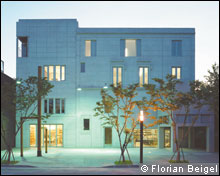
Youl Hwa Dang

Youl Hwa Dang

At the centre of the city stands a huge cultural complex, designed by Kim Byung-yoon, a combination of hotel (in which, it was pointed out to me, there are no TVs), restaurants, auditoriums and, on the roof, an urbane, elevated realm of seating, shops, libraries and galleries overlooking the sparkling waters of the river and the Simhak Mountain.

The finest buildings on the site, though, are by the ARU themselves (together with local partner Choi Jong Hoon). The first was for Yi Ki-Ung’s own Youl Hwa Dang publishing house, an enigmatic U-shaped building around a small courtyard. It looks like a bold pictogram, with a dark street façade, but to the courtyard there are “walls of light”, translucent membranes that recall the paper walls of traditional houses. An extension which contains a bookshop and café presents an intriguing contrast to the original buildings, retaining the subtlest memories of classical European urban architecture in moulding details, a portico and so on. This conservatism was conceived as a gentle provocation to the radical modernism all around and it works, with a startling clarity.

The ARU’s other structure, equally compelling, is for the Positive Thinking Publishing House. Designed as offices on a domestic scale and split into two units that create an intimate public plaza between them, they are built of traditional dark grey Korean brick set into a steel frame. The result is a hybrid of deeply embedded oriental and European archetypes. There is something here of Wittgenstein’s house, something of Beijing’s courtyard houses, a kind of Eurasian architectonic language which also, amazingly, manages to be conservative and deeply in thrall to the radical modernism of Mies van der Rohe. Inside, the surprises continue. The ceilings become an inverted urban landscape as a series of blocky paper lanterns break up the space from above. The domestic scale is wonderful: these feel like publishing offices, no plate glass, no open plan, rather a series of humane rooms, terraces and natural light.

If there is a problem at Paju it is that, as in all new cities, there is a kind of stillness, a lack of real density. This is compounded by zoning issues: as this is designated an industrial zone, the building of dwellings is difficult, and without places for people actually to live an area can never become a real city. Nevertheless, housing is slowly being built, and there are stirrings of the urban and commercial activity that constitute the beginnings of a real place.

It is not hyperbole to claim that this is one of the most extraordinary and most unsung cultural and architectural developments in the world. The idea that a city, right now, be dedicated solely to print and that an industrial estate could be a place of architectural pilgrimage could not be more heartening, more encouraging to anyone who delights in those very old information technologies – books and buildings.

Finally, laid to rest in Pyongyang

By Michael Rank
http://atimes.com/atimes/Korea/KH14Dg01.html

LONDON – There can be no lonelier grave anywhere on Earth. Amid fields close to the North Korean capital, Pyongyang, lie the remains of Flight Lieutenant Desmond Hinton, a British fighter pilot who flew for the United States Air Force as a member of United Nations forces in the Korean War.

Hinton is officially listed as missing in action (MIA), but his brother David, himself a retired Royal Air Force pilot, traced records of how and where Desmond died and managed to visit his grave in highly secretive North Korea.

“I was very close to my brother who was very much my role model and a father figure to me. I have never stopped missing him every single one of the 57 years since he died,” said David Hinton of Desmond, who was just 29 when he was shot down, leaving a widow and two small children.

David, now 77, is 12 years younger than Desmond, who had been awarded the Distinguished Flying Cross in World War II for shooting down two Japanese Zero fighter aircraft over Burma (now Myanmar). Having survived that ordeal, Desmond Hinton was one of 41 RAF officers seconded to the USAF during the Korean War.

“A tour lasted about three months. They were short of replacements, so Desmond offered to do a second tour and it was on his second tour that he was shot down and killed,” said David. “There’s an old maxim in the armed forces, ‘Never volunteer,'” he added with a wry smile.

David discovered in RAF archives a graphic report of how his brother died on January 2, 1952.

F/Lt [Flight Lieutenant] DFW Hinton had been ordered to undertake an interdiction and reconnaissance mission in the area of Sunan-Pyongyang with three other aircraft from his unit … After making a bomb run on railroad tracks just north of Sunan, he called the other members of his flight saying he was hit and on fire.

The aircraft was then seen to crash into the ground and explode on impact. The remaining three aircraft flew over the wreckage of F/Lt Hinton’s aircraft for 15 minutes, but returned to their home base after seeing no evidence that F/Lt Hinton was alive. Sadly, F/Lt Hinton is still reported as missing.

From this account, David had a good idea of where his brother had gone down in his F84e Thunderjet, over the Sunan area of Pyongyang which is now the location of the city’s airport.

He managed to buy a US military map of North Korea, and contacted the Foreign Office in London in the hope that the recently opened British Embassy in Pyongyang would be willing to ask the North Koreans if they could provide any further evidence concerning his brother’s fate. The British ambassador David Slinn and his colleague Jim Warren were only too happy to help, and found the North Koreans surprisingly cooperative.

It turned out that despite the North Korean government’s reputation of being deeply xenophobic, the remains of Desmond Hinton, who was fighting for the hated “Yankee imperialists”, had been given a decent burial close to where his body fell to ground.

David was therefore determined to pay his respects to his brother at his grave and in 2004 embarked on a remarkable journey to North Korea, taking the train from Beijing to Pyongyang.

Despite bitterness still evident in North Korea over the Korean War, he was treated as an honored guest and enjoyed the rare distinction of being accompanied during his visit by a senior Korean People’s Army officer, Colonel Kwak Chol-hui, who is director of Negotiations for Remains at the armistice site at Panmunjom.

The grave consists simply of a mound of earth surrounded by a white picket fence, without any inscription. It lies close to a narrow footpath on a hillside 200 meters from the road, near the village of Kuso-ri and 2.5 kilometers east of Pyongyang airport.

David was told that not long before his visit, his brother’s remains had been moved about 50 meters to a more accessible location.

He was introduced at the grave to two witnesses to Desmond’s crash, a Mr Ri and Mr Han, local villagers who were only 13-years old at the time but appeared to have perfect recollections of the event. “They told how the aircraft passed directly over their houses at very low level and they were at the crashed aircraft within minutes,” David said.

He asked his hosts if they could dig up a piece of Desmond’s clothing, and was deeply moved when he was presented with part of his flying suit.

He would have loved to have been given Desmond’s identity disc too, but was told this had been taken by Chinese troops who were fighting with the North Koreans against the US and other forces.

David gave a short speech at the grave, thanking Colonel Kwak and the ambassador for making his visit possible, while the head of the village promised to tend the grave and paint the fence regularly.

As a former RAF officer, David was also anxious to fix the position of the grave. “I went to the memorial to the Great Leader Kim Il-sung near the village in sight of the grave and took a compass bearing. The grave bears 160 degrees, 500 meters from the obelisk,” he noted in his diary.

He was also taken to the demilitarized zone at Panmunjom, where Colonel Kwak hosted a formal lunch and told him that Dear Leader Kim Jong-il had been made aware of and had approved his visit.

Reflecting the importance that North Korea attached to his visit, it was even reported by the official news agency KCNA, but for personal reasons David has not spoken about it until now.

The current British ambassador to North Korea, Peter Hughes, is aware of this lonely grave and said in an e-mailed statement: “Staff from this embassy visit the grave regularly to ensure it is kept in good order, and we carry out a small service there on Remembrance Day each year. I presided over the last such ceremony on November 9, 2008.”

Desmond Hinton’s grave is the only known one of its kind, but there has been one much larger-scale, much more official attempt to trace servicemen missing in action in North Korea.

In the 1990s, during a mild thaw in the frigid history of US-North Korean relations, the countries reached agreement on permitting American experts to search for the remains of US troops missing in North Korea.

More than 8,000 American troops are listed as MIA in the Korean War – far more than in the Vietnam War – but results from this unprecedented US-North Korean joint project were modest.

It “resulted in the recovery of 225 probable US remains; 27 have been identified to date and returned to their families for burial in US soil”, according to the US Department of Defense.

David Hinton is content for his brother’s remains to stay in North Korea, and he is now planning to visit Desmond’s grave again later this year.

There is every indication that the North Koreans are looking forward to welcoming him again, suggesting that despite its recent missile launches and atomic bomb test, Pyongyang has a human face after all.

Michael Rank is a former Reuters correspondent in China, now working in London.

The Traditional Art of Beauty and Perfume in Ancient Korea

http://www.mimifroufrou.com/scentedsalamander/2008/04/beauty_perfume_in_traditional.html

Fig. 1 - Beauty set: hair pins, combs, tweezer © Coreana Cosmetics Museum

Fig. 1 - Beauty set: hair pins, combs, tweezer © Coreana Cosmetics Museum

In keeping with my enthusiasm for cosmetics that make use of bio or natural ingredients, I thought that it would be interesting to explore the traditional Korean art of beauty and cosmetic culture in ancient times, more particularly as it was experienced from the medieval period until the turn of the 20th century.

If this topic may appear a bit geeky at first blush, I can point out that nowadays mainstream contemporary beauty brands do not hesitate to use ancient medieval recipes, like for example Lush with its “Angels on Bare Skin” facial scrub and Caudalie with its “Eau de Beauté” based on the legendary rejuvenating medieval rosemary lotion called “Eau de la Reine de Hongrie”.

I love Asian art, often travel in the region and I was delighted to discover this tradition, which as it turns out emphasized the use of gentle natural ingredients (flowers, fruit kernels, beans) rather than chemical concoctions like the infamous Blanc de Céruse composed of white lead which ailed and disfigured many a beauty junkie in modern Europe. This is not to say that chemicals are not beneficial or that natural ingredients are always the best alternatives!

An exhibition organized by the Coreana Cosmetics Museum entitled Parures, fards et onguents dans la Corée ancienne (Adornments, Make-up, and Oinments in Ancient Korea) was held last year in Paris on this virtually unknown topic in Europe and even the West at large…

Fig. 2 - An 18th century Korean beauty. Attributed to Kim Hong-Do (A.D. 1745- ?) © Seoul National University Museum

Fig. 2 - An 18th century Korean beauty. Attributed to Kim Hong-Do (A.D. 1745- ?) © Seoul National University Museum

Fig 3. - Celadon cosmetics containers, Koryo period (A.D. 918-1392) © Coreana Cosmetics Museum

Fig 3. - Celadon cosmetics containers, Koryo period (A.D. 918-1392) © Coreana Cosmetics Museum


Fig. 4 - Rouge container in white and blue porcelain, Choson period (A.D. 1392-1910) © Coreana Cosmetics Museum

Fig. 4 - Rouge container in white and blue porcelain, Choson period (A.D. 1392-1910) © Coreana Cosmetics Museum

Fig. 5 - Powder dish, Choson period © Coreana Cosmetics Museum

Fig. 5 - Powder dish, Choson period © Coreana Cosmetics Museum

Fig. 6 - Water-dropper for preparing make-up, Choson period © Coreana Cosmetics Museum

Fig. 6 - Water-dropper for preparing make-up, Choson period © Coreana Cosmetics Museum

The selection of cosmetics containers (fig. 3, and figs. 4-6), make-up tools, hair accessories and jewels which were exhibited (reproduced here with kind permission) come from the Coreana Cosmetics Museum, an affiliate of the Coreana Cosmetics Company which is currently one of the largest cosmetics companies in South Korea. The private museum was established in Seoul in 2001 by Yu Sang-ok, the founder and owner of the company. It currently holds the largest collection of artefacts related to traditional Korean cosmetic and beauty culture and includes 5,300 objects, ranging from the Three Kingdoms period (57 B.C. -A.D. 668) to the early 20th century. These objects were assembled with great care and passion by Mr. Yu.

Feminine Beauty Criteria and Ideals

Thick glossy hair, a fair skin, thin eyebrows and small lips (Korean beauties of the time would probably shudder in horror at the thought of getting silicone injections today!) constituted the classical canon of beauty in medieval Korea (see fig. 2).The woman depicted on this 18th century painting by Kim Hong-Do actually wears a wig made of coiled braids which was the most common hairdo at that time. The frenzy for this accessory was such that King Chongjo prohibited by royal decree in 1788 the use of such extravagant wigs that were deemed contrary to Confucian values of reserve and restraint. It is interesting to note that comparable high-built hairdos, which were equally status-affirming, were also popular at the French court at Versailles in the 18th century.

The twelfth century source the Illustrated Record of the Chinese Embassy to the Koryo Court (A.D. 1123) by the Chinese envoy from the Northern Song court, Xu Jing (A.D. 1091-1153), informs us about the make-up style of Korean women from the upper classes during the Koryo period (A.D. 918-1392). It is recorded that they favored light make-up, using powder but without rouge or blush, and drew eyebrows in the shape of a “willow leaf”.

The Kyuhapch’ongso dated from 1809, which was an instructional guide for everyday life for women of the upper classes during the late Choson period, which covered more than five centuries (A.D.1392-1910), records various techniques of manufacturing cosmetic products and fragrances, such as rouge for cheeks and lips, fragrances to perfume the body, oils to maintain long, black and glossy hair, as well as the descriptions of shapes of eyebrows, up to ten different ones!

Fig.7 - Celadon cosmetics oil bottle, Koryo period © Coreana Cosmetics Museum

Fig.7 - Celadon cosmetics oil bottle, Koryo period © Coreana Cosmetics Museum

The Making of Cosmetics and Perfume

Facial scrubs were made with ginseng root, red bean, green mung bean or sponge gourd, while facial lotions were made of cucumber or watermelon and perfumed with scented plants. Sunflower seeds, cabbage seeds and castor-oil plant were often used to produce cosmetic oils. Peony flower oil was particularly favored by Korean noblewomen of the 19th century to make their hair sleek, an ideal of beauty.

Owing to the lack of preservatives in ancient times, make-up was made in small quantities corresponding to daily needs and kept in tiny containers with a narrow aperture to prevent alteration, such as the Celadon cosmetics oil bottle shown here (fig. 7). The blue and white cosmetic set presented above (figs. 4-6) consists of a small pot which used to contain rouge, an octagonal dish for preparing make-up and a mini-water dropper used to dilute cosmetics. I marveled to see that these containers are only between one to one and half inches high!

Small pouches filled with fragrant herbs or scented with lightly diluted natural musk were carried both by men and women. In fact, court officials at the king’s service were required to carry such perfumed pouches during the Koryo period (A.D. 918-1392).

Historical records mention the existence at the royal court of artisan-perfumers called “Hyangjang” who bred musk deers in the palace precincts to produce perfume and incense. Clove, star anise and “nut grass” were the main ingredients used in producing perfumes.

Kisaeng women, by Yu Un-hong (1797-1859)

Kisaeng women, by Yu Un-hong (1797-1859)

Styles of Makeup

A simple yet elegant appearance, associated with a dignified demeanour and humble manners, were considered the epitome of beauty and elegance following Confucian ideals of the Choson period. While women from the upper classes could afford to use a higher-quality mixture of flower ashes, indigo plants and real gold powder to produce the dye for the eyebrow or the rouge make-up made of saffron flowers and cinnabar, less affluent people would use a piece of charcoal to highlight their eyebrows, as well as dried red pepper as a substitute for rouge.

A white-powdered face was to be avoided at all cost since it was the makeup style of the lowly lives, the female entertainer or Kisaeng (the Korean equivalent of the Japanese Geisha). They were women trained in the art of music, dance and poetry (fig. 8).

Respectable women were expected to wear light-peach-colored make-up when going out or receiving guests.

A postcard used by a French missionary in 1910

A postcard used by a French missionary in 1910. The caption reads: A Corean Singer & Maid -- The first was identified as a Kisaeng, from Chosun

New make-up styles and cosmetics were introduced in Korea in the late 19th century following the Treaty of Kanghwa in 1876 when Korean ports opened to foreign trade. European cosmetics, in particular French ones, were imported starting in the early 20th century and they were so popular that it prompted the creation in 1916 of the first face powder ever manufactured in Korea, Pak’s powder.

The famous kisaeng Hwang Jin-I played by South Korean actress Ha Ji-Won in a TV drama, from Chosun

The famous kisaeng Hwang Jin-I played by South Korean actress Ha Ji-Won in a TV drama, from Chosun

Acknowledgment: I wish to thank the Coreana Cosmetics Museum for providing information included in this article as well as the pictures illustrating this post.

Pictures © All rights reserved by the Coreana Cosmetics Museum, except where mentioned otherwise.

A Korean composer talks about crossing genres

http://www.ft.com/cms/s/2/d91c082a-7d61-11de-b8ee-00144feabdc0.html
By Laura Battle

Published: July 31 2009 23:17 | Last updated: July 31 2009 23:17

Unsuk Chin

Were Unsuk Chin in any other arts profession, her name would be familiar – already a brand, perhaps – but as a composer, even as one of the foremost composers in the world, she remains an elusive figure.

Within this rarefied field – that of contemporary classical music – Chin is admired and celebrated, but this was not always the case. In her early life in South Korea, and for much of her later development in Berlin, where she has lived since 1988, her search for recognition proved arduous and protracted. Each piece of music has required a significant investment of time and labour – not that you’d guess: many are characterised by glassy, delicate and often lyrical sequences that unravel in a stream-of-consciousness style – and premieres of Chin’s music are few and far between. This year, however, three new works have come to fruition.

When I arrive at her elegant Charlottenburg apartment Chin admits that life has been “a bit hyper” recently. Today is no exception: not so much because of work, more to do with the fact that it’s her 48th birthday. I’ve caught her between family lunch with her husband, the Finnish pianist Maris Gothoni, and their young son, and a soirée she is throwing later that evening. We seat ourselves rather awkwardly at the dining table and Chin prepares herself as if for interrogation: her career has largely developed without media interference, and one senses she prefers it that way. But this season the glare of the public eye will be hard to avoid.

A recording of her Violin Concerto, which scooped the prestigious Grawemeyer Award in 2004, has just been released, and this month sees the premiere of her new Cello Concerto at the Proms in London. That Chin is one of five female composers to have new work presented during the festival is happy coincidence: the piece was originally scheduled for 2007, although it was hatched, like so many of the best ideas, at a party a number of years earlier. The cellist Alban Gerhardt and violinist Lisa Batiashvili “came round to this flat with Brahms’s Double Concerto, I think. It was the first time I’d heard [Gerhardt] play and I promised immediately, ‘I will write a cello concerto for you!’ But then he had to wait another seven years!” Chin adds, with a nervous volley of laughter.

Unlike her two previous concertos, where the solo part floats and flirts with its accompaniment, she describes the cello here as being “in conflict” with the orchestra: “I’ve put much more personal energy into this work, the cello has to hold the whole piece the whole time, and the soloist has a very strong psychological role,” Chin explains. It is clearly a highly developed work and, judging from Gerhardt’s rehearsal blog, fiendishly difficult to play: “Many passages are incredibly fast,” he wrote on July 10. “If I get lost in them, I will be lost. Arghhhh!”

This emphasis on speed and complexity seems to reflect Chin’s interest in musical virtuosity. As a young girl in South Korea she dreamt of becoming a concert pianist, learning western-style harmony by accompanying services at Presbyterian churches where her father ministered. But the family was poor and tuition funds were not available to the second daughter. “It was also very difficult to get records at that time but we had a small transistor radio and I listened to music every day, I was crazy for it.” This was the 1970s, under Park Chung-hee’s repressive regime, and Chin’s perception of western culture was shaped by her obsession with the Beethoven and Tchaikovsky symphonies.

Once at Seoul National University, and now determined to compose, Chin was in thrall to the new wave of European composers: Stockhausen, Boulez, Nono et al. “It was quite strange, a Korean composer learning this Darmstadt avant-garde style in Korea, and I always felt that this was not my music.” Still, it was this interest that inspired her self-exile to Hamburg, where she sought the tutelage of Hungarian composer György Ligeti. It was her first trip abroad, and a “culture shock” initially, but the hard work had only just begun. “I think everyone knows, [Ligeti] was extremely difficult,” Chin begins, before detailing how he dismissed her work as derivative and “destroyed” her self-esteem – to the extent that she felt unable to compose for three years.

In spite of Ligeti’s disciplinarian approach, his influence would, in the end, prove valuable and long-lasting. Alice in Wonderland, Chin’s first full-blown opera, explored a theme that Ligeti suggested before his death. But although the great master haunts the piece, Chin’s soundscape is very much her own. There were boos from the first-night audience in Munich in 2007 – “They came in evening dresses and diamonds and I think they were expecting Aida or something” – but her score received favourable reviews, even if Achim Freyer’s po-faced, expressionist production did not. In any case, she was undeterred by the experience and plans to start work on Alice Through the Looking Glass.

Chin seems to have an omnivorous taste for styles and genres, and I notice that the room is dominated by two massive floor-mounted speakers, some sophisticated hi-fi equipment and piles of CDs. “There are so many composers who are almost autistic and have no communication with the outside world, and I think that’s problematic,” she explains, “I seldom have time to go to concerts but I have a very good connection with publishers and I always have recordings sent of new works.” Gérard Grisey, George Benjamin and Jukka Tiensuu are cited as composers she admires but they sit alongside a range of other artists.

“I like pop music from the 1980s very much. I was always impressed by Michael Jackson, for example, that he could compose a melody for just two bars, with two harmonies, and could win millions of people through this small act. It’s fantastic and we can’t do that,” she says, speaking for classical composers. However, although there are chord sequences and melodic hooks in her own music that speak directly to the layman, Chin denies that popular music has influenced her work. Her next work, the Sheng Concerto, pays its respects to a tradition of Asian folk music.

“This is my first piece for a non-western instrument but I use the sheng very carefully; I’ve limited the sheng’s role and I wrap the orchestra around it.”

Chin first heard the sheng, a wind instrument capable of organ-like clarity and sustain, as a young girl, but had overlooked its potential until a chance encounter with the specialist Wu Wei. As with Gerhardt, Chin was so bowled over that she promised a concerto on the spot, and Wu is to perform the work at premieres in Tokyo and Los Angeles in the autumn.

This season will conclude with a new piece for the Ensemble Modern and further engagements with the Seoul Philharmonic Orchestra, where Chin is composer in residence. Since her appointment in 2006, she has quietly achieved great things there, not least the performance of more than 50 Korean premieres, including Boulez’s Notations and Ligeti’s Violin Concerto. I wonder aloud if the role has explored her own connection to both eastern and western cultures but her reply is evasive, and even a little disapproving: “For me, there is no border between western or Asian or Korean music. For me, music is music.”

Cello Concerto premieres at Prom 38, Royal Albert Hall, London, on August 13; www.bbc.co.uk/proms

Roh Moo-hyun

Obituary commissioned by The Guardian. Completed 24 May 2009. Edited version published on
25 May 2009 at http://www.guardian.co.uk/world/2009/may/24/roh-moo-hyun-obituary

Combative South Korean president who challenged the old elite

Aidan Foster-Carter

Roh Moo-hyun, who ended his life on Saturday aged 62, was a South Korean president who broke the mould – though in the end the mould broke him. Born in poverty, his tenure in the Blue House (2003-08) antagonized the Seoul elite and Washington while disappointing his fans. Dismay grew as a corruption scandal enveloped him, finally driving him to jump from a clifftop near his home early in the morning after leaving a suicide note on his computer.

Roh never lost his roots in Korea’s rural southeast. The youngest child of a poor farmer, his nickname was ‘stone bean’: small but tough. His first-grade teacher said he had many talents – above all in presenting his opinions. Unable to afford college, he worked on building sites while studying at night for South Korea’s formidable bar examination. Passing this in 1975 – a remarkable feat for a non-graduate – he was briefly a judge before practising as a lawyer. In 1971 he had married his childhood sweetheart Kwon Yang-sook, from the same area and background; her father was once jailed as pro-communist. They have a son and a daughter.

At first more upwardly mobile than political – with a comfortable tax practice, he joined the local yacht club – in 1980 Roh defended students tortured on trumped-up charges by Seoul’s then military dictators. By his own account, the sight of torn-out toenails radicalized him. Now specializing in human rights cases, he was briefly jailed in 1987: the year democracy was restored. Elected to the national assembly for the port city of Pusan, he gained national fame for sharply grilling generals and tycoons, in sessions broadcast live on television. Such irreverence struck a fresh note in a country still in fear of the military and in awe of elites.

A spell in the wilderness followed. When his mentor Kim Young-sam allied with generals to win the presidency in 1993, a disgusted Roh threw in his lot with YS’s rival, the long-time dissident Kim Dae-jung. Regional antagonism between the southeast and DJ’s southwest made the latter a losing ticket in Pusan, but Roh doggedly ran and lost three times. His down to earth image as a principled if quixotic loser inspired his supporters to form Nosamo (We Love Roh), South Korea’s first ever political fan club, which blossomed as the Internet grew.

Kim Dae-jung won the presidency in 1997, and Roh served briefly as fisheries minister. Yet he was still a political outsider when the ruling party decided to choose its next candidate – South Korean presidents serve a single five-year term – via the country’s first ever primaries. To elite consternation, a bandwagon began to roll, delivering Roh the nomination. Insiders tried to deselect him; at one point he trailed third in the polls. But on the day in December 2002 he narrowly defeated a stiff conservative former judge. Koreans wanted a change.

In office Roh proved divisive. The establishment hated him, and he them. Shunning and at one point suing the conservative print dailies, Roh favoured left-leaning online news sites like Ohmynews. He promoted the radical 386 generation: in their 30s, at college in the 1980s and born in the 1960s. Populist and anti-American, the 386ers sounded a new assertive note. Roh himself, who unusually had never visited the US before (though he wrote a book about Abraham Lincoln), riposted by saying he did not see why he should go just to kowtow.

But the left were soon disappointed. Roh sent troops to Iraq, and in 2007 signed a free trade accord (still unratified) with the US, in the teeth of fierce street protests: a Korean speciality. If Iraq was a sop to Bush so that Roh could continue a ‘sunshine’ policy of engaging North Korea, the FTA seemed a real change of heart, rejecting the old ‘fortress Korea’ mentality.

Policies apart, Roh’s style grated. His mouth tended to run away with him. This spontaneity, refreshing at first, was often combative, could be crude and lacked gravitas. He admitted that on official trips – including the first ever Korean state visit to the UK, in 2004 – he packed ramyon (instant noodles); all that foreign nosh was uncongenial. Having no English small-talk was a problem too: by the time you beckoned the interpreter, the moment had passed.

At home Roh was forever upsetting applecarts, not least his own. Within weeks of becoming president, he wondered aloud if he was up to the job and suggested a referendum on his rule. In March 2004 he got one – as the first South Korean president ever to be impeached, which a simple apology could have prevented. A popular backlash in his favour then gave his party a majority in elections in April. In May the Constitutional Court threw out his impeachment. Roh, and Korea, bounced back from an unnerving roller-coaster largely of his own making.

Thus it continued. In 2007 as his term drew to a close, after years of antagonizing the Right on issues ranging from collaboration with past dictatorships to restricting elite schools, Roh startled friend and foe alike by proposing an alliance with the conservative opposition. The latter rejected this. Their candidate Lee Myung-bak, a formaer Hyundai CEO and mayor of Seoul, won a landslide in December 2007’s presidential election – over a centre-left which by then was desperate to distance itself from Roh, seen as a bungling, mercurial liability.

Still, at least he was clean. Scorning Seoul, Roh retired to a new house in his native village, where he grew organic rice, drank with the locals and blogged. In recent months this idyll darkened. A bribery scandal involving a Pusan shoemaker (a local supplier to Nike), Park Yeon-cha, was said to implicate Roh’s family. On April 7 Roh admitted his wife took money from Park to settle a debt. On April 30 he was driven to Seoul for a grilling that lasted till the small hours. Amid rumours from a suspiciously leaky prosecutor’s office – political bias is alleged – that Roh solicited $6 million from Park, he feared indictment, humiliation and jail. His death has halted this, sparing his family; but the full truth may now never be known.

“Discard me”, Roh wrote in his blog. For all his flaws, future history will judge him less harshly than that. His very weakness helped democracy. No emperor, he delegated and did not abuse power markedly. The economy grew at a fair clip, even if he had no clear vision for it – except a failed bid to move the capital from Seoul so as to promote regional equality.

His finest hour came in October 2007. Solemnly walking across the Demilitarized Zone, he drove on Pyongyang for a summit with Kim Jong-il whose results belied low expectations, launching wide-ranging business deals with the North. For a few months the two Koreas met daily and cooperated concretely. Roh’s successor Lee junked all this, just as in 2003 George W Bush brusquely ditched Bill Clinton’s outreach to North Korea. Si monumentum requiris, circumspice. Perhaps sunshine was appeasement, but does anyone have a better idea?

An odd mix of Candide-like innocence and often misplaced guile, Roh Moo-hyun could be a fool – and a hypocrite if he was not after all squeaky-clean. Yet he was a breath of fresh air, and his street-smart instincts did not lack vision. His end is a tragedy, for him and for Korea.

Roh Moo-hyun, politician; born August 6 1946, died May 23 2009.

Obituary: Roh Moo-hyun

By Christian Oliver in Seoul
http://www.ft.com/cms/s/0/571c01b4-4859-11de-8870-00144feabdc0.html
Published: May 24 2009 17:07 | Last updated: May 24 2009 17:07

Roh Moo-hyun, who committed suicide on Saturday, was devastated by an enquiry into his probity and had written on his blog of his shame at losing his reputation as South Korea’s only clean president. He was 62.

Prosecutors had been investigating payments of nearly $6m from a shoemaking tycoon to members of the family of Mr Roh, a leftist who left office last year. Even though prosecutors had not charged Mr Roh with corruption or tax evasion, by the time he threw himself from a mountainside, he was distraught about the damage to his reputation.

“I have lost the right to say anything about democracy, progress and justice. I fell into an abyss which I cannot escape,” he wrote earlier this month.

Within South Korea, Mr Roh’s supporters are portraying the case as a politically motivated assault by right-wingers. Although the sums involved are large, they are small by the standards of previous Korean presidents and the money is less clearly linked to direct political influence than in earlier scandals.

Mr Roh is popular mainly among Korea’s young people, who are sick of the traditional political caste. After his presidency, his home village became a pilgrimage site for day-trippers.

Of Mr Roh’s four predecessors, two were jailed for graft and the sons of two others were imprisoned on similar counts. Mr Roh was widely viewed as a highly principled man in a corrupt system. Many Koreans are viewing his suicide as an attempt to free his family from a painful investigation. If that was his motive, it worked.

Mr Roh was born to a poor farming family in Gimhae, south-east Korea in 1946. In a country where political success has normally been the preserve of graduates from Seoul’s top three universities, Mr Roh was an unusual autodidact who had spent nine years getting himself through the national bar exam.

He forged his reputation defending unionists and democracy activists during the turbulent democracy struggle of 1980s when the country was riven by bloody protests. In 1987, he spent three weeks in prison for supporting an illegal strike.

He entered parliament a year later and, ironically enough, gained stardom in a parliamentary hearing on the corruption of a former president, Chun Doo-hwan.

He became the protégé of Kim Dae-jung, president from 1998 to 2003, serving as his fisheries’ minister.

Although not expected to win the 2002 presidential election, he rode to victory on a wave of anti-Americanism, partly fired by the death of two Korean schoolgirls killed in an accident with a US military vehicle. He had campaigned on a platform of fighting corruption and reforming the mighty conglomerates that dominate the economy.

On becoming president, Mr Roh became well-known on the international stage for continuing Mr Kim’s “Sunshine Policy” of engagement with North Korea. Most famously he visited Pyongyang for a summit in 2007 and signed a raft of co-operation deals.

Mr Roh’s strategy was marred by the test of a North Korean nuclear weapon in 2006. However his diplomacy appeared to be paying dividends by the end of 2007 when international inspectors agreed North Korea was disabling its atomic facilities.

At heart a proud Korean nationalist, he was criticised for being too curt in some of his dealings with the US and Japan, the old imperial overlord.

On the domestic front, his presidency was marked by feuding, owing to his lack of a deep political support base. He was impeached in 2004 after publicly supporting his own party, contravening the constitutional neutrality of the president. He was reinstated after two months.

His government forged a trade deal with Washington, that has run into trouble under his successor, Lee Myung-bak.

He retired to the village of Bongha to work in an organisation dedicated to traditional farming methods. But the bribery scandal shattered his pursuit of rural tranquillity.

“Because of the state I am in, I cannot do anything. I cannot even write or read a book,” he wrote in his suicide note.

In the note, he also hankered after a return to nature.

“Do not be sad. Are not life and death all part of nature? … Please cremate me and leave a small tombstone near my home. I have thought about this for a long time.”

Additional reporting by Kang Buseong

Thousands in Korea mourn Roh’s death

By Song Jung-a and Christian Oliver in Seoul
http://www.ft.com/cms/s/0/f848bf9c-485d-11de-8870-00144feabdc0.html
Published: May 24 2009 13:46 | Last updated: May 24 2009 17:15

Tens of thousands of mourners gathered across South Korea to pay their final respects to Roh Moo-hyun, a former president who committed suicide at the weekend as he faced a growing corruption scandal.

Shortly after dawn on Saturday, Mr Roh, 62, went hiking on a mountain behind his home in Bongha, a village in the south-east of the peninsula. Police said he jumped from a cliff-face near the summit and suffered severe head injuries. He left a brief suicide note to his family.

South Koreans were stunned by the sudden death of Mr Roh, famed abroad for his attempts to build a rapprochement with communist North Korea. “This is hard to believe,” said Lee Myung-bak, the president. “It’s very sad and lamentable.”

Mr Roh, who left office in February 2008, had complained he was suffering from intense stress because of a scandal involving alleged corruption during his presidency. Prosecutors summoned him last month for an investigation into allegations that his family received $6m from a businessman while he was in office. His family has also been grilled.

Mr Roh’s supporters claimed the investigation was politically motivated to undermine the opposition and that the prosecutors’ probe into his family drove him to take his own life. The government on Sunday said the case against Mr Roh was closed but analysts speculate his suicide still threatens to catalyse the country’s political tensions.

Thousands of people queued up to burn incense and bow before a make-shift altar erected to Mr Roh in downtown Seoul. As Mr Roh was fond of smoking, many mourners left a cigarette rather than an incense stick. State radio reported 10,000 mourners had visited Bongha by Sunday morning.

“I am lost for words. His death is a great loss for the country,” said Kim Jae-suk, a 52-year-old housewife waiting for her turn in the tearful crowd gathered at the altar.

Mr Roh’s death came as prosecutors were due to decide whether to charge him. Mr Roh admitted his wife had taken money from a businessman to pay family debts. He had issued a public apology, but the scandal dealt a blow to his image as a clean politician in a rotten system.

Mr Roh, a former human rights lawyer, was elected in 2002 on a promise to reform powerful conglomerates, fight corruption, improve relations with Pyongyang and make Seoul more independent from the US, its long-standing military ally.

However, his five-year term proved turbulent, marked by political infighting and scandals. Mr Roh was impeached by lawmakers in early 2004 over a breach of election rules but was two months later reinstated after the Constitutional Court overturned the move.

His death may rekindle tensions between predominantly young liberals and older conservatives in South Korea, where President Lee, a conservative former businessman, came to power last year after a decade of liberal rule.

“A controversy is flaring up over whether the prosecutors were responsible for his death. If the government fails to handle this well, then the probe could be seen as a political revenge against Mr Roh. In that case, it will be a huge political burden for Mr Lee,” said Ham Sung-deuk, a politics professor at Korea University.

Obituary: Roh Moo-hyun (BBC)

Former South Korean President Roh Moo-hyun, who has died after falling into a ravine, was a controversial figure whose administration ended last year dogged by scandal and infighting.

At the time of his death, which police are treating as a possible suicide, 62-year-old Mr Roh was under investigation for receiving millions of dollars in bribes from a businessman while in office.

With his relative youth, lowly beginnings and promises to root out endemic political corruption, he seemed when he took power in 2003 to be the new start the country needed.

But his term in office was a rollercoaster ride. His Uri party was hit by scandal and in-fighting, and there was fierce public opposition to several of his policies.

He was even suspended early in 2004, after parliament voted to impeach him over a breach of election rules, but the Constitutional Court later overturned the move and he was reinstated.

Campaigning lawyer

A human rights lawyer by trade, President Roh first made headlines soon after he entered politics in 1988, when he grilled top officials from the previous administration during a special parliamentary hearing on graft.

He had been one of the leaders of the “June Struggle” in 1987, against the dictatorship of Chun Doo-hwan. He served a three-week jail sentence that year for abetting striking workers.

Born to poor peasant parents in the south-eastern region of Kimhae, Mr Roh initially studied law as a means of escaping poverty.

But in 1981 his work brought him in contact with a case of human rights abuse which he says changed his aspirations forever.

Mr Roh was asked to defend one of two dozen students arrested for possessing banned literature, for which they were detained and tortured for almost two months.

“When I saw their horrified eyes and their missing toenails, my comfortable life as a lawyer came to an end,” Mr Roh is quoted as saying.

Following nationwide protests which pushed Mr Chun out of office, Mr Roh entered politics by winning election to the National Assembly as a member of a pro-democracy party led by the activist Kim Young-sam, who later became president.

Mr Roh was helped to leadership by a public disillusioned with scandal and South Korea’s close relationship with the US.

Ironically, it was scandal and political infighting that also blighted Mr Roh’s time in office.

Mass defections

Within a year of taking office, Mr Roh and his supporters formed the Uri Party ( which means Our Party).

But in March 2004, parliament voted to impeach Mr Roh for breaching a minor election law, and he was forced into two months of political limbo.

The impeachment came about because the conservative opposition – which at the time dominated South Korea’s parliament – said the president had contravened the country’s voting rules by openly supporting the Uri party in the run-up to assembly elections.

The move humiliated Mr Roh, worried markets and drove thousands of people onto the streets in protest.

In May the Constitutional Court overturned the verdict, saying Mr Roh had violated the law, but not gravely enough to warrant his removal from office.

The Uri Party made a strong showing in assembly elections that April, and the president emerged in a much stronger position to push his reformist agenda in parliament.

But a series of unpopular decisions, including sending Korean troops to Iraq, a failed attempt to move the capital from Seoul and the continuation of a policy of engagement with North Korea saw Mr Roh’s popularity ratings plummet again.

His government was also accused of incompetency over its handling of the economy and in foreign affairs.

Last month, Mr Roh was questioned over allegations that he had taken millions of dollars in bribes from a wealthy businessman. He later apologised for the scandal.

In a statement posted on his website, he admitted his wife received a substantial sum of money from the businessman, but suggested it was not a bribe but a payment to help her settle a debt.

Mr Roh leaves his wife and childhood sweetheart Kwon Yang-sook, a son and a daughter.

He said he enjoyed mountain climbing and bowling. He spent his two months of impeachment reading and hiking around the hills behind his official residence.

Seoul food aims for top table

By Christian Oliver
http://www.ft.com/cms/s/0/b56f1ae0-417d-11de-bdb7-00144feabdc0.html
Published: May 15 2009 19:28 | Last updated: May 15 2009 19:28

Across the world, every octopus should be quaking in his rock-pool; Korean chefs are going global.

By 2017, we will not just be dialling out for pizza Margherita and chicken korma, we will be hankering after tongue twisters such as samgyeopsal and doenjang-jjigae – sizzling pork-belly and spicy bean-paste stew. Those of a hardier constitution may even have tried dog soup and wriggling tentacles.

As part of an ambitious national branding scheme intended to awaken the world to the joys of an undiscovered hermit kingdom, South Korea’s government says it is planning to make its cuisine one of the world’s top five over the next eight years.

It is a very Korean goal. Koreans love league tables and outstripping performance targets. It is why they do so well. But the desire to produce one of the world’s top five cuisines also illustrates Korea’s peculiar tendency of seeking to quantify the unquantifiable.

The culture ministry does have a more quantifiable target of increasing Korean restaurants worldwide about sevenfold. The fluid strategy involves a sort of Korean Michelin star scheme, Korean cooking classes at Cordon Bleu schools and tweaking recipes to suit international palates.

Even if that works, is Korea then in the world’s top five? Who will measure such a subjective notion? If one starts counting restaurants, should you include the thousands of restaurants that serve dishes from all over the world, including the odd Korean dish?

Then there is the prickly issue of food from a region, not a country. Korea might claim victory over Morocco, Tunisia or Algeria on restaurant count but, in the real food wars, has fermented cabbage really defeated tajine and couscous?

None of this matters. It is an output target and not to be questioned. Much of this Korean love of pecking orders hails back to the educational system. Fear of nepotism means Koreans prefer that exams be reduced to “right” and “wrong” questions, partly explaining why the humanities are so weak. You may flunk exams but at least the mark did not depend on the whim of an arbitrary or corrupt examiner. Ranking people or things has become overly acceptable because it was seen as fair at school.

Korean officials now maintain the illusion that league tables can nail subjective issues. Their graphs can reflect their own opinions about certain themes, rather than objective data collection. The culture of statistics is pervasive and the otherwise truculent domestic press whimpers before them. An international survey ranking Korea only 50th in mothers’ welfare received wide but bizarrely uncritical coverage.

Korea’s culture ministry concedes there is no real ranking system for foods but wants random people surveyed in 2017 to say Korean food is in their top five. As with many things presented as statistics in Korea, it is ultimately a question of raw emotion.

Dedicated to a poetic Korea

Kevin O'Rourkehttp://www.irishtimes.com/newspaper/features/2009/0506/1224245988613.html
6 May 2009

Koreans have been described as ‘the Irish of Asia’, and after translating 2,000 of their poems, Fr Kevin O’Rourke is in a position to judge, writes DAVID McNEILL

IN HIS COURTING days, Kevin O’Rourke once walked the 17-mile journey from Cavan town to Clones, in nearby Co Monaghan, in pursuit of a girl. Adventures like that, in the countryside that inspired W Percy French, Patrick Kavanagh, Patrick McCabe and other writers may unwittingly have prepared him for his unusual path: becoming the world’s greatest translator of Korean poetry.

O’Rourke (70) gave up girls, Ireland and much else besides to achieve his task. “I set out to put out the entire Korean poetry tradition in English,” he says from his home in the Korean capital, Seoul. Nearly 45 years later, the job is almost done. Now a semi-retired Columban priest, O’Rourke is part of a tiny but renowned Irish group of Asian scholars, including Dublin-raised Lafcadio Hearn (1850-1904) and Co Mayo-born Eileen Kato, who died last year.

Fr O’Rourke’s journey from Cavan to professor of English literature in Kyung Hee University, Seoul, began after he was ordained in 1964. He plunged into his adopted culture, becoming the first foreigner to be awarded a doctorate in Korean literature at a local college in 1982. Early missionary work in a region that was recovering from the Korean war of 1950-53 was a delight, he recalls. “Every day was a new adventure, getting to these remote places in the countryside. Modernisation took a lot of fun out of it, to be honest.”

Like many translators, he was struck by similarities between his new language and the one he left behind. Ten years ago, he began working on the poems of the vagabond satirist, Kim Sak-kat (1807-1863), a deposed aristocrat who took to the road, recalling the wandering Gaelic poets of 16th-century Ireland.

“He earned his food, lodging and booze off his pen,” says Fr O’Rourke. “So when he went to your house and asked you for a bed and something to eat, he’d be very nice to you. But if you refused, he’d let you have both barrels and hang the result on your front gate, like the poets who went to the big houses in Ireland.”

The Koreans, with their history of colonialism, have been described as “the Irish of Asia” – not entirely complimentarily, he points out. “It means we’re rowdy, drink too much, a bit dirty in our habits, cry at the drop of a hat, and so on. But we do get along with them.”

Bringing Kim to the English-speaking world is part of an enormous labour of love that has made Fr O’Rourke a local celebrity. Over the years, he has translated about 2,000 poems, as well as stories and other literature, a task requiring a working knowledge of thousands of Chinese characters. Much of it has been published, but he is still grappling with his idea for an anthology of the collected poems, divided into two volumes, classical and post-1910.

“Korean poetry doesn’t sell, for some reason,” he says. “East Asian literature is occupied by Japanese and Chinese.”

He is also trying to finish a book that is a miscellany of his story, his own poems and lessons on “how to survive in an alien culture like Korea for 45 years”.

Every year, he makes the journey from the Missionary Society of St Columban in Seongbuk, northern Seoul, to Cavan, for the visitation of the local graves, and Rosslare, where he stays in his brother’s holiday home. The dictionaries stay on his desk in Seoul. “It’s difficult in Rosslare. The golf club is five minutes up the road and the sea is close by.”